


3DS Liability Shift Explained: How 3D Secure Protects Merchants From Fraud Chargebacks

August 7, 2026
- Liability shift is a scheme rule that moves fraud loss from merchant to issuer after successful authentication—not a blanket chargeback shield.
- The 3ds liability shift and 3d secure liability shift depend on correct 3DS2 flows, cryptogram pass-through, and issuer confirmation—not merely turning 3DS on.
- SCA exemptions can preserve issuer-side liability when approved; skipping authentication without an exemption path leaves card-not-present exposure on the merchant.
- Operational disputes (delivery, quality, billing) stay merchant-owned even after successful authentication.
- Treat liability as an integration and observability problem: reconcile chargebacks against authentication logs by corridor and BIN.
Every card-not-present transaction carries a question nobody wants to answer after the fact: if this turns out to be fraud, who pays? That question has a name in the payments industry — liability shift — and for online merchants, the answer increasingly comes down to one protocol: 3D Secure.
Understanding the 3ds liability shift is not a compliance checkbox. When authentication outcomes never reach authorization, exposure to fraud chargebacks returns overnight. It directly affects exposure to fraud chargebacks, checkout conversion, and the cost of doing business online. This guide explains what the 3d secure liability shift actually means, how it works technically, when it applies, where it fails, and what merchants and issuers should operationalize in production.
What is a liability shift?
Direct answer: a liability shift is a card-network rule that decides whether the merchant, acquirer, or card issuer absorbs the loss when a transaction is later disputed as fraudulent.
Historically, liability for fraudulent transactions defaulted to the merchant in card-not-present (CNP) channels. A stolen card used online, a friendly-fraud claim on a digital good, a credential-stuffing cart — the merchant often ate the chargeback, the lost inventory, and the scheme penalty fee.
The payment liability shift changes that default. When a merchant properly authenticates a transaction using an approved method — most commonly 3D Secure — responsibility for certain fraudulent transactions moves from the merchant to the card issuer. That is the core mechanic behind the fraud liability shift, and it is why merchants adopted 3DS despite the friction it can add at checkout.
| Party | Typical CNP default (no 3DS) | After successful 3DS2 authentication |
|---|---|---|
| Merchant | Bears fraud chargeback + goods loss | Fraud category shifts toward issuer |
| Acquirer | Processes dispute per merchant agreement | Relies on authentication evidence in authorization |
| Card issuer | May still dispute on service grounds | Holds fraud liability for authenticated CNP per scheme rules |
| Cardholder | Can dispute unauthorized use | Can still dispute delivery, quality, billing |
In short: liability shift is who writes the check when the dispute reason code says fraud — not who handles customer service when the dispute reason code says the sweater was blue, not green.
How the 3D Secure liability shift works
Direct answer: authenticate the cardholder through 3DS2, pass the result correctly into authorization, and fraud liability for eligible dispute types moves off the merchant’s books.
Before EMV chip cards and 3D Secure became standard, both card-present magstripe transactions and unauthenticated card-not-present transactions left the merchant holding the risk. Once EMV chip reads and 3d secure 3ds authentication became the norm, that risk moved toward the issuing bank — provided the transaction was properly authenticated.
Three conditions matter as much as the marketing slide:
- The authentication channel matches scheme expectations (3DS2 for modern CNP).
- The issuer returns a successful authentication outcome the acquirer can read.
- Your stack passes authentication values into the authorization message — a missing or malformed authentication value quietly forfeits the 3ds liability shift you thought you bought.
It is worth being precise: successful authentication shifts fraud liability; it does not eliminate disputes altogether. Cardholders can still raise disagreements over service, delivery, or billing errors. The 3d secure liability shift is narrower — it reassigns who pays for fraud, not who enters a dispute workflow.
“Liability shift is not immunity. It is a documented transfer of fraud loss — and only when your integration proves authentication happened.”
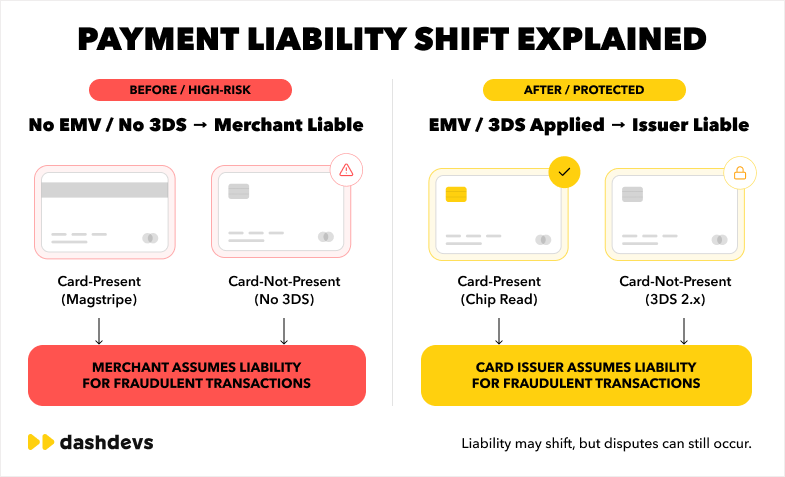
Before and after EMV and 3DS
| Channel | Legacy exposure | After standard authentication |
|---|---|---|
| Card-present magstripe | Merchant liable for counterfeit/chip-capable cards | EMV dip shifts counterfeit liability to issuer |
| Card-not-present e-commerce | Merchant liable for unauthorized use | 3DS2 successful authentication shifts fraud liability to issuer |
| Card-not-present without step-up | Merchant remains default liable party | No secure liability shift without authentication or approved exemption |
The diagram above maps the same idea visually: without EMV or 3DS, the merchant assumes fraud liability; with chip reads and 3DS 2.x, the card issuer assumes liability for fraudulent transactions — while disputes can still occur.
The 3DS2 authentication flow, step by step
Direct answer: checkout → gateway → 3DS server → ACS at issuer → authenticated authorization → completion.
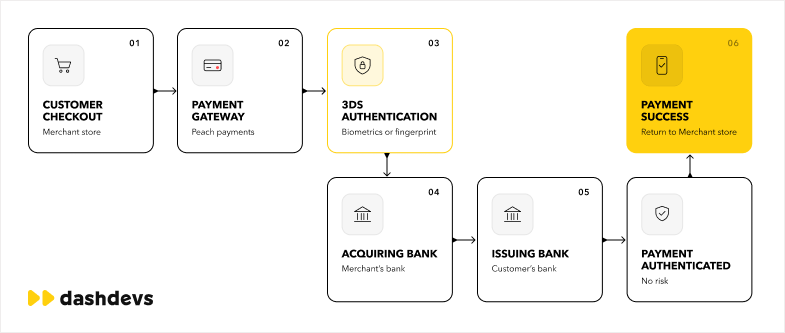
A typical 3D Secure 2.x flow through a payment gateway looks like this:
- Customer checkout — the shopper initiates payment at the merchant store.
- Payment gateway — the attempt routes to the payment service provider for processing.
- 3DS authentication — the customer may authenticate via biometrics, app push, or OTP — not the old redirect-only static password pattern.
- Acquiring bank → issuing bank — the authentication request passes from the merchant’s bank to the customer’s bank for verification.
- Payment authenticated — the issuer confirms low enough risk for frictionless, or the cardholder completes a challenge.
- Payment success — the shopper returns to the merchant with an authorized order.
Frictionless vs challenge
Risk-based 3ds2 liability shift eligibility depends on which path the access control server chooses:
| Path | Cardholder experience | Liability implication |
|---|---|---|
| Frictionless | No visible step-up | Successful authentication outcome still required for shift |
| Challenge | OTP, biometric, or app approval | Abandonment = no shift; completion = shift if cryptogram passes through |
| Failed / unavailable ACS | Decline or fallback rules | Merchant may revert to standard CNP liability |
Schemes such as Mastercard Identity Check and Visa’s Secure Remote Commerce equivalents are built on this flow. Frictionless, risk-based routing is a major reason 3DS2 improved the checkout experience versus 3DS1 — when merchants send rich device and transaction data, issuers challenge fewer legitimate buyers.
For protocol versions, challenge UX, and vendor selection criteria, see our dedicated guide to 3D secure authentication.
Why liability shift rates are climbing
Direct answer: more volume runs through 3DS2, issuers tune frictionless models, and SCA regulation pushes authentication into the default path.
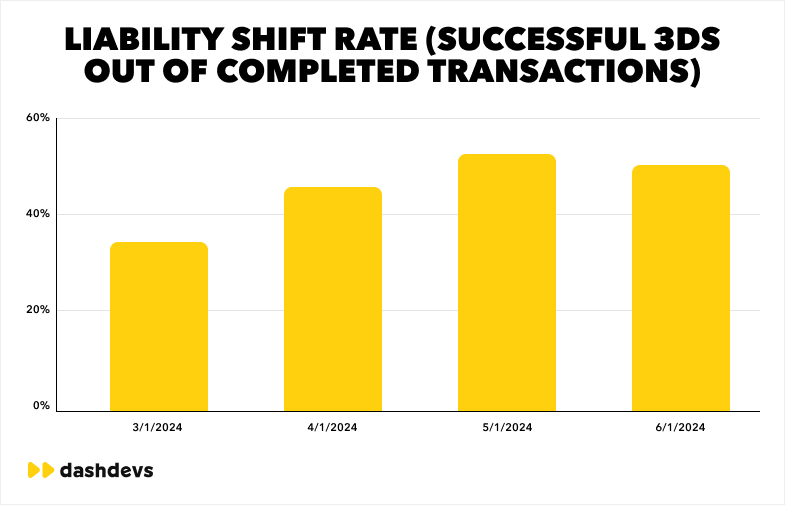
Industry data shows authentication succeeding on a growing share of attempts — not because fraud disappeared, but because integration maturity and issuer risk engines improved. Ravelin’s authentication benchmarks report global 3DS success near 82% with frictionless share around 58% in recent cohorts — meaning more completed checkouts carry authentication outcomes eligible for shift.
The chart above tracks the liability shift rate (successful 3DS out of completed transactions) climbing from roughly a third in March 2024 to about half by May–June. This kind of movement typically reflects three things happening at once:
- Issuers tuning ACS models to challenge fewer legitimate transactions when merchant data quality improves.
- Merchants completing 3ds2 liability shift-eligible integrations instead of partial 3DS1 redirects.
- Regulatory pressure pushing more of the transaction base through sca requirements in the EU/EEA and mirrored regimes elsewhere.
A plateau below roughly half of eligible CNP volume often signals integration gaps: exemption indicators not passed, soft declines after step-up, or issuers declining frictionless for a BIN segment your gateway treats as “authenticated enough.”
What to measure weekly
| Metric | Why it matters for liability |
|---|---|
| Attempt rate into 3DS | Baseline for shift-eligible volume |
| Frictionless share | Conversion without forfeiting authentication outcomes |
| Challenge completion | Abandoned challenges = merchant liability exposure |
| Post-3DS authorization approval | Soft declines can masquerade as issuer “no” |
| Chargebacks coded fraud vs service | Validates whether shift is working in finance, not only in the gateway UI |
Teams that publish corridor-level targets for authentication success treat the 3ds2 liability shift as operational infrastructure — not a launch-week checkbox.
SCA requirements and when the liability shift applies
Direct answer: the liability shift applies when Strong Customer Authentication completes successfully and the issuer confirms it — not when you “intended” to authenticate.
Strong Customer Authentication (SCA), mandated under PSD2 in the EU/EEA and echoed in other frameworks, expects at least two of three independent factors: something the customer knows, something they have, and something they are. That regulatory backbone is why 3D Secure became the default expectation rather than an optional add-on for card-not-present commerce.
The secure liability shift applies specifically when:
- Authentication completes with a result the scheme recognizes as successful.
- The merchant did not bypass 3DS without an approved exemption path.
- Authentication data reaches the acquirer intact in the authorization request.
If a merchant skips authentication, runs an outdated flow, or the customer abandons the challenge, the transaction reverts to standard card-not-present liability rules — merchant exposure returns.
The joint EBA–ECB payment fraud reporting continues to show materially higher card fraud rates where SCA is not applied — a reminder that cross-border and exemption-heavy corridors need explicit policy, not hope.
When liability shift 3ds does not trigger
| Situation | Typical liability holder |
|---|---|
| No 3DS attempt on CNP | Merchant |
| Challenge abandoned by cardholder | Merchant |
| Authentication success but cryptogram not in auth message | Merchant (integration failure) |
| Service or delivery dispute after successful 3DS | Merchant for non-fraud reason codes |
| Approved issuer exemption | Issuer if exemption valid; merchant if mis-tagged |
In short: the liability shift applies on fraud grounds after successful authentication — not on every dispute label in the portal.
SCA exemptions and liability shift
Direct answer: approved exemptions can preserve issuer-side liability; unilateral opt-out does not.
Not every transaction needs a visible challenge. SCA exemptions — low-value payments, recurring subscriptions, trusted beneficiary lists, and transaction risk analysis (TRA) — let merchants or issuers skip active step-up for lower-risk purchases. That matters for liability and for checkout experience.
| Exemption type | Operational note | Liability nuance |
|---|---|---|
| Low-value | Monitor cumulative velocity | Issuer must accept exemption indicator |
| TRA | Requires calibrated fraud performance | Acquirer/issuer threshold must be met |
| MIT / recurring | Only after correctly authenticated CIT | Wrong MIT flags forfeit shift on renewals |
| Trusted beneficiary | Maintenance-heavy | Scheme and issuer support varies |
When a merchant requests an exemption and the issuer grants it, liability typically stays with the issuer only if the issuer approved that exemption path. When a merchant unilaterally decides not to route a transaction through 3DS at all, liability stays on the merchant side. The distinction between an approved exemption and simply opting out is one of the most common sources of confusion in payment liability shift discussions.
Merchants optimizing renewals should read exemption tagging alongside payment processor vs payment gateway architecture — the party that owns MIT indicators is not always the party that owns the checkout UI.
3D Secure chargebacks: what still goes wrong
Direct answer: fraud chargebacks can still arrive — but unauthorized disputes should shift when authentication succeeded and evidence was transmitted.
The liability shift covers fraud-related disputes — specifically unauthorized transaction claims — but it does not cover:
- Non-receipt of goods or services
- Product-not-as-described disputes
- Duplicate billing or processing errors
- Subscription cancellation disagreements
Merchants sometimes assume 3DS makes them immune to chargeback liability altogether. It does not. It shifts the fraud category to the card issuer; operational and service-related disputes remain the merchant’s responsibility to manage and represent with evidence.
Integration failure mode
If authentication data is not passed correctly to the acquirer — missing authentication value, wrong ECI, truncated cryptogram — the transaction can process as unauthenticated while the product team believes 3DS ran. That is a common integration bug, not a policy exception. Solid payment gateway integration design treats cryptogram pass-through as a release gate, not a post-launch surprise.
| Dispute type | After successful 3DS | Merchant action |
|---|---|---|
| Unauthorized / fraud | Issuer liable per scheme rules | Still monitor for mis-coded chargebacks |
| Non-delivery | Merchant liable | Proof of shipment / digital delivery |
| Not as described | Merchant liable | Product evidence, policies |
| Duplicate charge | Merchant liable | Receipt and ledger reconciliation |
“The costliest 3DS program is the one that challenges customers beautifully — and forgets to attach the authentication result to authorization.”
Reconcile chargebacks against authentication logs monthly. If a 3d secure chargeback arrives on a transaction that should have shifted liability, that is a signal to check with the acquirer — not a line item to absorb silently.
Card-present vs card-not-present: two liability stories
Direct answer: EMV solved chip-present fraud shift; 3DS solves CNP fraud shift — do not conflate the two playbooks.
| Dimension | Card-present | Card-not-present |
|---|---|---|
| Primary authentication | EMV chip (contact or contactless) | 3DS2 (or approved exemption) |
| Legacy risk pocket | Magstripe on chip-capable cards | Any checkout without step-up |
| Dispute mix | Skimming, counterfeit (pre-EMV) | Unauthorized use, friendly fraud |
| Merchant control | Terminal type, fallback rules | Gateway data, challenge UX, exemption tags |
For teams building or extending card programs, this split is foundational. Issuer-side access control servers and BIN-level challenge rates shape the experience for cards you issue — not only for cards you accept. Card issuing integration services and merchant acceptance should share one authentication event model so finance and fraud see the same story.

Best practices for merchants and issuers
Direct answer: implement 3DS2 completely, pass rich data, monitor by corridor, reconcile chargebacks to auth logs, and pick partners who treat exemptions as production logic.
Merchant checklist
- Implement 3DS2, not legacy 3DS1 — frictionless flows, richer risk data, broader device coverage.
- Pass complete device and transaction data so issuers grant more frictionless outcomes and valid TRA exemptions.
- Monitor authentication success rates by issuer and region, not only in aggregate.
- Reconcile chargebacks against authentication logs; escalate mis-coded fraud disputes.
- Choose infrastructure partners who handle exemption logic, fallback handling, and issuer routing correctly.
Issuer checklist
- Publish ACS timeout and challenge-rate SLAs your program managers can track.
- Align frictionless models with the data fields merchants actually send — not a specification PDF alone.
- Train dispute ops to honor authentication outcomes on fraud reason codes.
- Review exemption performance quarterly — fraud migrates toward the weakest exemption door.
When evaluating providers, comparative write-ups of the best payment processing companies help — then re-score on 3DS field completeness, exemption support, and chargeback reporting samples.
Platform teams comparing build vs buy should also read Stripe alternatives and white label payment gateway provider options with the same liability lens: who owns cryptogram pass-through when you change acquirer?
How DashDevs helps you build liability-shift-ready payment flows
Getting the 3ds liability shift to work in production is an integration problem that touches gateway, issuer relationships, and fraud tooling at once. Merchants who treat the 3d secure liability shift as a launch-week toggle usually discover gaps at first chargeback reconciliation. DashDevs works with fintechs and merchants across that stack:
- Payment gateway integration flows with full 3DS2 authentication and frictionless routing.
- Card issuing integration services for teams managing issuer-side authentication logic on their own BINs.
- Fintech integration services so payments, KYC, and core banking share consistent risk and authentication data.
- Vendor reliance calibration — how much authentication and liability posture should sit with a third-party processor versus in-house infrastructure — aligned with our vendor reliance framework.
- Architecture on Fintech Core where authentication and liability logic can be customized rather than bolted on.
If you are comparing off-the-shelf stacks, our guide on how to start a payment processing company clarifies which modules you rent versus own. For the underlying plumbing 3DS plugs into, see the transaction processing system overview — authorization, ledgering, and dispute evidence should read from the same event bus.
Final take
The 3d secure liability shift is the industry’s answer to a simple fraud question in card-not-present commerce: who pays when the cardholder says they did not buy this? Successful authentication moves that answer toward the card issuer for eligible fraud disputes — while service, delivery, and billing disagreements stay with the merchant. Operationalizing the 3ds liability shift means measuring authentication outcomes, not only displaying a 3DS badge at checkout.
Treat 3ds2 liability shift as measurable infrastructure: frictionless share, challenge completion, cryptogram pass-through, exemption hygiene, and chargeback reconciliation by corridor. Merchants who instrument those controls protect margin without pretending checkout friction disappeared.
Teams that need both conversion and defensible fraud posture should pair this liability map with the conversion and vendor-selection depth in our 3D secure authentication guide — one article on who pays, the other on how to tune the funnel that produces the authentication outcomes.
Share article
