


Banking App Development Cost in 2026: Full Breakdown, Timelines, and Hidden Costs

March 17, 2026
Summary
Banking App Development Cost in 60 Seconds
- In 2026, serious banking app projects usually start around $150,000 and can exceed $1M once licensing, integrations, and multi-market rollout are included.
- The main cost drivers are compliance scope, third-party integrations, backend and core banking architecture, and the operating model you choose.
- A focused MVP can launch in 3-6 months when teams use modular infrastructure and keep the first release narrow.
- White-label cores and Banking-as-a-Service can reduce launch time and upfront cost by 50-70%, but they also create trade-offs in control, flexibility, and long-term margin.
- The most expensive mistake is not spending too much in month one. It is designing the wrong architecture and paying for it again later.
Banking app development in 2026 is no longer a straightforward software budgeting exercise. It is a strategic decision about infrastructure ownership, regulatory exposure, time-to-market, and long-term margin. Two products can look almost identical in the App Store and still have completely different cost structures underneath. One may be a relatively thin user interface sitting on top of a Banking-as-a-Service provider. The other may be a deeply integrated product with its own orchestration layer, custom ledger behavior, multiple payment rails, and an internal compliance stack. The screens may look similar. The economics never do.
This is exactly why so many cost estimates for banking apps are misleading. Teams often ask for a price before they have decided what kind of financial product they are really building. They ask for an app quote while the real question is about regulated infrastructure, risk ownership, and product strategy. That is how companies end up with estimates that look reasonable in month one and feel unrealistic by month six.
This guide is designed to fix that. It explains where banking app budgets actually go, what changes cost the most, which trade-offs matter at board level, and how to reduce waste without compromising the quality of the product. It also adds practical tables, executive guidance, internal resources, podcast insights, and a few extra sections that help leaders make clearer decisions before budget is approved.
TL;DR for Decision Makers
- Serious banking app projects usually start around $150,000 and can exceed $1M when multi-market rollout, custom backend logic, and licensing complexity are included.
- The biggest cost drivers are compliance, integrations, backend and core banking architecture, and ongoing operational overhead.
- A focused MVP can often launch in 3-6 months if scope is tight and the infrastructure strategy is realistic.
- White-label cores and BaaS can reduce cost and launch time by 50-70%, but the trade-offs in control, margin, and vendor dependence need to be understood early.
- The most expensive mistake is not overspending at launch. It is building the wrong structure and paying for refactoring later.
Why Banking App Costs Are Still So Easy to Misread
The phrase “banking app” sounds smaller than the work it usually implies. Many stakeholders hear it and think about the visible part of the product: mobile screens, onboarding forms, payment buttons, and balance widgets. That is the easiest part to imagine, which is why it tends to dominate budget conversations. The expensive part is everything behind those screens: the logic that decides whether a payment should move, the provider relationships that make a card work, the compliance controls that keep the business legal, and the operational tooling that keeps incidents from turning into customer or regulatory problems.
This is the first reason cost estimates go wrong. Teams price the interface but underestimate the infrastructure. The second reason is that banking apps are not all built for the same strategic purpose. One company may need a narrow app for one region and one customer segment. Another may be building a platform that needs to support multiple schemes, regions, and monetization models. Those are not variations of the same project. They are entirely different cost profiles.
From a CEO point of view, a more useful framing is this: a banking app is not just a digital product. It is an operating model. It defines how much you outsource, how much risk you keep, how quickly you can launch new products, and how much operational weight your team carries after launch.
What this guide helps you do
- Estimate realistic budget bands for different product ambitions.
- Understand where cost comes from beyond the UI layer.
- Compare build, white-label, and BaaS strategies more clearly.
- Spot hidden costs before they show up in monthly burn.
- Make a more defensible go/no-go decision at leadership level.
Why Banking Apps Keep Growing in 2026
The market is still growing because banking is no longer confined to banks. Digital banking has spread into neobanks, wallets, B2B finance tools, embedded finance products, super apps, and niche vertical platforms. In other words, customer demand for financial functionality is still rising, but it is no longer captured only by traditional institutions.
The Shift from Banks to Financial Platforms
Over the last decade, the center of gravity has shifted from branch and browser to mobile-first financial experiences. Neobanks proved that a strong onboarding flow, transparent pricing, and an intuitive interface could compete effectively with incumbent banks. Embedded finance then pushed the industry further by putting accounts, cards, and lending inside existing software platforms and marketplaces. In many regions, wallet ecosystems and super apps are now the default financial interface for large segments of the population.
For product teams, this means that the banking app is often no longer a supporting channel. It is the main product, or at least the financial layer that makes the broader product commercially stronger.
What matters in 2026
- Mobile is the default interface for large parts of the market, especially younger users.
- Real-time payments are changing expectations around speed and transparency.
- Open banking and open finance continue to influence product architecture.
- Customers compare banking apps to the best digital products they use, not just to banks.
- Expansion into new regions increasingly depends on how flexible the underlying architecture is.
What this means for product teams
The practical result is that speed-to-market matters more than it did five years ago, but so does infrastructure quality. A fast launch can create value only if the product does not collapse under the weight of growth, fraud, partner limitations, or compliance change requests. That is why teams that succeed in this space tend to treat architecture and operations as product issues, not back-office issues.
If you want a broader strategic view of the direction the market is moving in, this overview of banking trends to follow helps frame where new demand is coming from.
What “Banking App Development” Actually Includes
One of the most useful mental shifts for non-technical stakeholders is to stop thinking of a banking app as a mobile project and start thinking of it as a stack of business-critical layers.
The Product Stack
| Layer | What it covers | Why it matters |
|---|---|---|
| Frontend | iOS, Android, web portals, customer-facing UI | This shapes user perception, onboarding, and day-to-day usability |
| Backend | APIs, business logic, orchestration | This connects user actions to actual financial flows |
| Banking core | Ledger, balances, accounts, transactions | This determines data integrity and financial correctness |
| Integrations | BaaS, PSPs, cards, KYC, open banking, fraud tools | This expands capability but also introduces dependence and operational complexity |
| Compliance layer | KYC/KYB, AML, reporting, auditability | This keeps the product legal, supportable, and scalable |
The most important insight here is simple: most of the cost is not in the mobile app. The customer sees the frontend, but the majority of long-term complexity usually sits in the backend, integrations, and compliance layer. If a company underestimates those layers, it tends to end up with polished UX on top of fragile infrastructure.
Pro tip
- If your budget conversation is still centered on screens, you are probably too early to ask for a reliable number.
- The most accurate cost discussions start with product scope, licensing model, and infrastructure choices, not with design references.
Types of Banking Apps and Why Their Costs Differ
The phrase “banking app” covers several product categories, and each one behaves differently from a cost perspective.
Neobank apps
Neobank apps aim to replicate most of the services customers expect from a retail or SME bank. They usually include accounts, cards, transfers, budgeting, notifications, and often lending or investment layers. Because they operate closest to a real bank, they usually require deeper integration with banking infrastructure, tighter risk controls, and more formal licensing or strong licensed partners. These are generally the most expensive products to build and maintain.
Mobile wallets
Wallets focus more tightly on value storage, P2P movement, QR or merchant payments, and cards. They often have less licensing burden than full neobank products, depending on structure and geography, but they still need strong payment orchestration, fraud controls, and support operations. Wallets are often a more practical entry point for teams that want to validate usage and operating models before layering in broader banking functionality.
Aggregator apps
Aggregator apps are often built on top of open banking and data access rather than on top of account issuance. They pull together account information from multiple institutions, help users understand cash flow, and may provide insights or financial planning tools. These products are usually less capital-intensive than full neobank apps, but they are often highly integration-heavy and sensitive to partner quality and API maturity.
Embedded finance apps
Embedded finance products place financial capabilities inside a larger software or marketplace experience. A vertical SaaS product may offer accounts and cards to its users. A marketplace may embed payouts, wallets, or credit. These products often move quickly when built on top of BaaS or white-label infrastructure, but their cost depends heavily on how deeply they need to integrate into the host platform and how much customization the business model requires.
Corporate and SME banking apps
Corporate and SME products are often underestimated because they can look functionally “smaller” than retail apps. In reality, they carry heavy workflow complexity. Multi-user roles, approvals, spending policies, limits, and reconciliation are not just extra features. They are often core product requirements. That pushes cost upward through access-control logic, auditability, support tooling, and integration with ERP or accounting systems.
The Cost Drivers That Matter Most
Once the product type is clear, the next question is what actually drives budget. In banking apps, a small number of cost drivers usually account for most of the difference between a lean project and a very expensive one.
Feature complexity
Feature depth does not scale linearly. Adding cards, scheduled payments, lending, or FX is not just adding screens. It adds more rules, more failure cases, more compliance obligations, more partner interactions, and more support work.
| Level | Typical feature set | Budget effect |
|---|---|---|
| Basic | Login, KYC, balance view, simple transfers | Lowest technical and operational burden |
| Standard | Cards, bill payments, scheduled transfers, notifications | Moderate increase in integration and support complexity |
| Advanced | Analytics, savings tools, FX, lending | Significant increase in orchestration, compliance, and risk complexity |
| Enterprise | Multi-country routing, multi-entity support, workflow engines | Highest burden across architecture, regulation, and operations |
A useful rule of thumb is that moving from one level to the next is often a 2-3x increase in total effort rather than a small add-on. That is why roadmap discipline matters so much.
Compliance and regulation
Compliance is not a separate track that starts after product design. It shapes the product. KYC and KYB determine what data you must collect. AML and transaction monitoring affect the way payments flow. Reporting and retention rules affect how data is stored and retrieved.
In Europe, frameworks such as PSD2/PSD3 and, where relevant, MiCA influence authentication, access, and reporting. In GCC markets, frameworks shaped by SAMA and other regulators create their own expectations around data, consent, and infrastructure. In the US, licensing often becomes fragmented across federal and state levels.
That means compliance has three cost effects:
- It increases the upfront cost of product and architecture design.
- It increases ongoing operating cost through monitoring and audits.
- It slows change if governance is weak.
For broader context, this guide to fintech regulations across major markets is useful when you are mapping expansion plans.
Security infrastructure
Security affects everything from trust to regulator confidence to incident cost. The visible parts are familiar: encryption, biometrics, 2FA. The less visible parts are often more important: key management, auditability, fraud detection, and the ability to investigate issues quickly when something goes wrong.
One way to think about security is not as a feature, but as a recurring operating commitment. Fraud changes. Attack surfaces evolve. Regulators and partners ask new questions. If security is treated as a one-time implementation, it becomes a future liability.
Integrations
Integrations are often the biggest hidden cost. Each provider adds:
- Another SLA to monitor.
- Another update cycle to track.
- Another source of operational inconsistency between sandbox and production.
- Another reconciliation path when real-world events do not match internal assumptions.
| Integration type | Example providers | Cost pressure comes from |
|---|---|---|
| Payments | Stripe, Adyen | Edge cases, settlement handling, fraud flows |
| Banking / BaaS | Solaris, Mambu, Unit, Modulr | Product constraints, margin pressure, roadmap dependence |
| Cards | Visa / Mastercard processors | Card states, tokenization, scheme rules, disputes |
| KYC / KYB | Sumsub, Onfido, Trulioo | Completion rates, false positives, compliance fit |
| Open Banking | TrueLayer, Tink, Salt Edge | Coverage gaps, consent flows, API consistency |
This is why integration-heavy products often consume more budget in testing, monitoring, and production support than stakeholders expect.
Architecture
Architecture is where short-term convenience often turns into long-term cost. A monolith can be perfectly acceptable for a narrow MVP. It can also become difficult to evolve when the product starts adding providers, schemes, countries, and business lines. Microservices can scale better, but they also add deployment and monitoring complexity if the team is not ready.
An event-driven architecture often works well for payments and ledgers because it improves traceability and recovery logic. But it requires strong discipline around events, retries, and state transitions.
The main warning is straightforward: bad architecture can create 3-5x cost later through refactoring, outages, and change resistance.
“As fintechs evolved, their once-simple models became multi-layered ecosystems.” - Fintech Garden episode 122
That quote captures why architecture matters so much. Growth does not just add scale. It adds layers. If the structure cannot support those layers, the product gets more expensive every quarter.
UX and trust design
UX in banking is not just about looking polished. It affects completion rates, support burden, and user confidence. Weak onboarding design reduces KYC completion. Vague payment states create panic. Poorly structured card controls drive support tickets and distrust.
What matters most:
- Clear onboarding steps.
- Transparent transaction status.
- Error messages that explain what happened and what happens next.
- Trust signals around balances, confirmations, and limits.
In banking, trust design is a commercial lever, not just a design concern.
Team structure and location
Team cost depends on geography, but total delivery cost depends on more than hourly rate.
| Region | Typical hourly rate |
|---|---|
| US / UK | $120-200 |
| Western EU | $70-120 |
| Eastern Europe | $40-100 |
Many effective teams use a blended model: product leadership and architecture close to the business, broader delivery in cost-efficient regions. The goal is not cheapest hourly cost. It is the best combination of speed, governance, and delivery quality.
“Vendor relationships can make or break a product’s success.” - Fintech Garden episode 110
That is especially true in banking, where your vendors can affect risk, timelines, and unit economics just as much as your internal team.
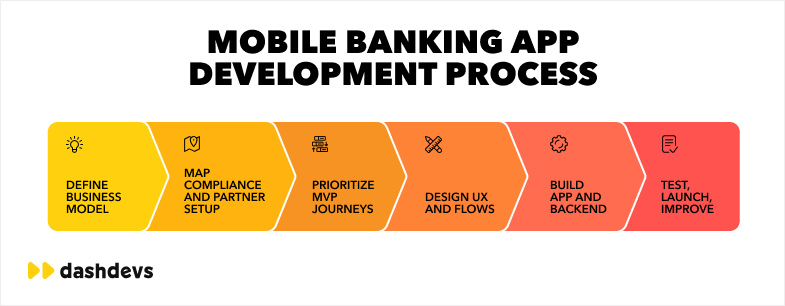
A Realistic Development Timeline
Many teams ask for a budget before they ask how long the work realistically takes. The two questions should be asked together.
Full lifecycle view
| Stage | Typical duration | What happens here |
|---|---|---|
| Discovery | 2-6 weeks | Scope definition, architecture choices, compliance mapping |
| Design | 4-12 weeks | UX, flows, UI system, onboarding and transaction states |
| Development | 3-12 months | Backend, mobile, integrations, compliance tooling |
| Testing | 1-3 months | Functional testing, partner testing, security, regression |
| Launch | 2-4 weeks | Final checks, production readiness, rollout, support setup |
Shorter timelines are possible when the product is narrow and the infrastructure strategy is pragmatic. Longer timelines are typical when teams try to launch several business models, geographies, or providers in parallel.
What slows projects down
The same problems appear repeatedly:
- Requirements that are still changing after design starts.
- Compliance and legal feedback arriving too late.
- Integrations behaving differently in production than they did in sandbox.
- Weak ownership across product, compliance, and engineering.
CEO advice
- Ask for a written MVP definition before approving budget.
- Ask which integrations are genuinely required for launch and which are optional.
- Ask whether compliance has signed off on the design assumptions, not just the business idea.
Feature-Level Cost Breakdown
It helps to understand how common modules accumulate effort.
Core features
| Feature | Time | Cost | Notes |
|---|---|---|---|
| Authentication | 150-200h | $5K-8K | Sessions, recovery flows, 2FA, device handling |
| Transactions | 300h | $8K-12K | Payment logic, states, validation, error handling |
| Cards | 200h | $6K-10K | Card states, controls, tokenization, display logic |
| Notifications | 80h | $2K-3K | Push, in-app alerts, critical event communication |
These are not meant to act as final estimates. They are a reminder that seemingly standard modules still absorb real engineering and QA time.
Advanced features
| Feature | Main value | Why teams add it |
|---|---|---|
| Spending analytics | Retention | Helps users understand behavior and stay engaged |
| AI insights | Differentiation | Makes the product feel smarter and more proactive |
| Lending | Monetization | Can add significant revenue if risk model is strong |
| FX | Global expansion | Important for multi-country and travel-heavy user bases |
Pro tip: add advanced features only when you can explain which business metric they improve. Otherwise, they become an expensive decoration.
Budget Bands by Product Type
The most useful planning view for leadership teams is not cost by feature alone, but cost by overall product ambition.
| Product type | Cost range | Timeline | Typical use case |
|---|---|---|---|
| Prototype | $20K-50K | 1-2 months | Investor narrative, testing UX, validating demand |
| MVP | $80K-200K | 3-6 months | One region, one core flow, narrow user segment |
| Production app | $250K-600K | 6-12 months | Strong feature set, more mature operations, real scale |
| Multi-market platform | $700K-1M+ | 12-24 months | Several geographies, deeper compliance, many partners |
These bands assume a sane sequence and a reasonable willingness to say “not now” to non-essential features.
Licensing and Regulatory Cost Reality
Licensing is often discussed as a separate legal workstream, but in real projects, it is a core cost and design driver.
License types
- EMI for e-money and wallet-style services.
- PI for certain payment services without full banking permissions.
- Banking license for deposit-taking and full bank behavior.
- MSB and state-level registrations in the US for money transmission activities.
Cost comparison
| License | Approximate setup cost | Important note |
|---|---|---|
| EMI | EUR 20K-150K | Does not include the internal work needed to prepare and maintain it |
| PI | EUR 5K-50K | Often cheaper up front, but narrower in capability |
| Banking | $1M+ | Capital and governance requirements materially raise the true cost |
Why BaaS remains attractive
Banking-as-a-Service exists because licensing is slow and expensive. By building on top of a licensed provider, teams can test the market faster and with lower upfront cost.
“Instead of building a bank from scratch, companies can partner with BaaS providers to access pre-built banking infrastructure.” - Fintech Garden episode 108
That is the clearest summary of the early-stage value of BaaS. The trade-off is that the provider’s pricing, risk tolerance, and roadmap will influence your product. This is why many teams begin with BaaS and later move toward more ownership where the economics justify it.
Build, Buy, or Partner
This is one of the highest-value sections in the article because it reframes the cost conversation from “what does it cost?” to “what should we own?”
Build from scratch
Best for teams that need high control, strong differentiation, and a long-term platform strategy. More expensive and slower at first, but easier to optimize for your own economics later.
White-label or fintech core
Best when time-to-market matters and much of the product is standard. It helps reduce time, reuse battle-tested modules, and simplify early delivery. The downside is lower flexibility and stronger vendor influence.
BaaS
Best when you need to test or launch quickly without taking on full licensing burden. Very attractive for early expansion or embedded finance products. The long-term trade-off is dependence on a provider’s rails and margin structure.
Board questions to ask before signing
- Which parts of the stack genuinely differentiate us?
- Which components are commodity and should be outsourced?
- How hard will it be to replace this provider in 18 months?
- What happens to our unit margin if provider pricing changes?
- Who owns operational recovery when incidents happen?
Decision framework
| Goal | Best fit |
|---|---|
| Fast launch | White-label / BaaS |
| Full control | Build |
| Validate demand | BaaS or narrow white-label |
For a broader decision lens, this article on how to build a neobank using vendors, platforms, or APIs is worth reviewing alongside your internal business case.
Hidden Costs That Catch Teams Later
The most painful costs are often the ones that were absent from the initial spreadsheet.
Common hidden costs
- Compliance audits and remediation.
- Fraud tooling updates and model tuning.
- Cloud infrastructure growth and observability.
- 24/7 support and incident operations.
- Regulatory updates that require code and process changes.
Hidden cost dashboard
| Cost area | Why teams miss it | Business effect |
|---|---|---|
| Compliance audits | Feels like periodic admin work | Can force engineering rework and divert leadership attention |
| Fraud tuning | Assumed to be solved at launch | False positives or fraud loss hurt margin and trust |
| Support operations | Underestimated in self-service products | Rising cost-to-serve and slower issue resolution |
| Platform monitoring | Seen as technical overhead | Poor observability drives slower incident response |
The right leadership mindset is to treat these as part of your steady-state economics, not as surprises.
Maintenance and Scaling Costs
Launch is where the budget story changes from project mode to operating mode.
Ongoing monthly cost bands
| Category | Monthly range | Notes |
|---|---|---|
| Infrastructure | $5K-50K | Depends on traffic, redundancy, regions, and data volumes |
| Support | $10K-30K | Depends on user base, complexity, and automation |
| Compliance | Continuous | Internal and external effort, monitoring, audits, reporting |
Scaling challenges to expect
- Performance under load and transaction spikes.
- Multi-currency and multi-time-zone complexity.
- Different local rules and settlement behaviors across regions.
- Partner expansion and scheme changes.
CEO tip: The cost of scaling is usually lower when the team anticipated it architecturally, even if they did not build every future feature on day one.
How to Reduce Cost Without Cutting Quality
The right way to reduce costs in banking products is to reduce waste, not discipline.
Smart strategies
- Start with a narrow MVP and one defensible value loop.
- Reuse infrastructure where it is not your differentiator.
- Keep the first release focused on onboarding, funding, and money movement.
Product strategy tips
- Delay lending, FX, or advanced analytics until the first core flows prove value.
- Use pilots and smaller cohorts to learn before you scale.
- Optimize completion and trust before adding more features.
Technical optimization
- Use modular architecture with clear domain boundaries.
- Prefer provider APIs for commodity functions.
- Avoid building a core banking stack from scratch unless it directly supports your business edge.
Real-World Example: Launching a Digital Wallet
Imagine a team launching a wallet for freelancers in one European market. Their initial scope is reasonable: onboarding, top-ups, P2P transfers, basic cards, and notifications. What looks like a small product quickly reveals a heavier reality.
They need at least one KYC provider, a PSP for top-ups, a card processor, fraud controls, and some form of account or wallet infrastructure. They also need reconciliation, support tooling, and a ledger they can trust.
On one path, they wire providers directly into a fast monolith and get to market quickly. Within a year, changes become painful, new payout partners are hard to add, and the team is forced into an expensive refactor. On another path, they build a cleaner orchestration layer, isolate integrations, and maintain a proper ledger domain. They still launch fast, but they can extend the product at much lower incremental cost later.
That is the real difference between a product that scales and a product that accumulates technical debt.
Tech Stack That Commonly Powers Banking Apps
The exact stack should match team strength and product need, but several patterns show up repeatedly in successful products.
Backend
Java, Kotlin, and Go are strong choices for high-throughput and strongly typed services. Node.js remains useful for orchestration and lighter API services when teams know how to use it responsibly.
Infrastructure
AWS, GCP, and Azure dominate for good reason. They support scaling, managed services, and automated deployment. Event-driven systems such as Kafka often help with payments, audit trails, and integration flows.
Security stack
At a minimum, teams should expect:
- Strong encryption and key management.
- Centralized logging and monitoring.
- Fraud tooling and anomaly detection.
- Secure secrets handling and access management.
For a wider architectural view, this guide to fintech architecture connects these decisions at system level.
What Will Push Costs Higher After 2026
Budget estimates that look solid today may feel tight in 2027 or 2028. The reason is not inflation alone. Several structural shifts in regulation, technology, and customer expectation are already in motion. They will push up both upfront build cost and the ongoing operating cost for banking products. Understanding them now helps leadership set realistic multi-year budgets and avoid the trap of underfunding a product that will need to evolve quickly.
AI-driven risk and personalization
AI is moving from a nice-to-have to a baseline expectation. On the risk side, regulators and partners increasingly expect more sophisticated fraud detection, anomaly scoring, and explainability. Simple rule-based systems will not be enough. On the product side, users expect smarter insights, proactive alerts, and personalized recommendations. Each of these adds data pipelines, model governance, and operational overhead. The cost is not just the AI itself. It is the data quality, consent management, and auditability that make AI safe and compliant. Teams that treat AI as a bolt-on will pay more later when they have to retrofit governance and retrain models at scale.
Real-time payments as the default
Instant payments are becoming the norm in many markets. SEPA Instant, FedNow, UPI, and similar schemes change what users expect. They also change settlement behavior, reconciliation logic, and incident response. Products built around batch or next-day settlement will need refactoring. Real-time flows require stronger idempotency, better error handling, and more granular monitoring. The infrastructure and integration cost for real-time rails is typically higher than for legacy batch systems. Teams that delay this transition will face both technical debt and competitive pressure.
Open finance beyond basic account data
Open banking started with account aggregation and payment initiation. Open finance expands into investments, insurance, pensions, and credit data. That means more data sources, more consent flows, more schema variations, and more partner dependencies. Each new data domain adds integration work, compliance checks, and support complexity. Products that want to offer a full financial view will need to integrate with a growing number of providers and keep up with evolving API standards. The cost of staying current in open finance will rise as the ecosystem matures.
Embedded finance as standard
Embedded finance is no longer an edge case. Vertical SaaS, marketplaces, and platforms increasingly expect accounts, cards, and payouts as built-in capabilities. That creates demand for deeper integration, white-label experiences, and flexible orchestration. The cost pressure comes from two directions: the host platform expects a seamless, branded experience, and the underlying banking infrastructure must support multiple use cases and business models. Teams that build embedded finance products will need stronger API design, more configurable workflows, and better multi-tenant isolation. All of that adds to both build and run costs.
Tokenized assets and new regulated asset types
Tokenization of real-world assets, stablecoins, and new regulated digital asset classes are gaining traction. Each new asset type brings its own regulatory framework, custody requirements, and technical complexity. MiCA in Europe, evolving SEC guidance in the US, and regional frameworks elsewhere will shape how these products are built and operated. Teams that add tokenized or crypto-adjacent features will face higher compliance, security, and infrastructure cost. The upside can be significant, but the bar for doing it correctly is rising.
Cost pressure summary
| Trend | Where cost rises | Leadership question to ask |
|---|---|---|
| AI and personalization | Data, governance, model ops, explainability | Do we have the data and consent foundation to support AI safely? |
| Real-time payments | Integration, reconciliation, monitoring, incident ops | Are we designing for real-time flows or assuming batch forever? |
| Open finance expansion | More providers, schemas, consent flows, support | How many data domains do we need to support in the next 24 months? |
| Embedded finance | API design, multi-tenant logic, white-label UX | Are we building for one product or for many embedded use cases? |
| Tokenized assets | Compliance, custody, security, new partner types | Is our roadmap touching regulated digital assets? If so, when? |
The practical takeaway: the cost of banking products will not stay flat. Teams that invest early in flexible architecture, strong observability, and clear governance will absorb these shifts more cheaply than teams that treat each trend as a one-off project. For a forward-looking view of where the industry is heading, this overview of banking trends to follow helps frame which of these pressures matter most for your market.
Final Advice for CEOs and Product Leaders
The most useful conclusion is not that banking apps are expensive. It is that the wrong banking app strategy is expensive.
The teams that navigate this well usually do a few things consistently:
- They define a very clear first version.
- They decide early what they will own versus outsource.
- They treat compliance and architecture as growth enablers, not cost centers.
- They review vendor strategy as often as they review product roadmap.
If you are planning a banking app, the next step should not be another vague quote. It should be a tighter definition of product scope, licensing model, partner strategy, and architecture boundaries. Once those are clear, the budget becomes much easier to defend and much harder to waste.
Share article

