


Banking CRM Systems: When Generic CRM Platforms Are Not Enough

July 31, 2026
- Generic CRM fails in banks when product, risk, and compliance data stay outside the relationship record—and relationship managers work from incomplete truth.
- Choose banking CRM systems by operating model: extend a horizontal platform, buy a banking-specific suite, or build orchestration when your journeys are the product.
- Score vendors on core and KYC integration depth, consent and audit trails, segment-specific workflows, and exit terms—not on feature checklists alone.
- Treat CRM as a control plane for customer interactions across retail, SME, and wealth—not as a sales pipeline tool bolted onto a core.
- Implementation success depends on data ownership, event quality from the core, and change management for branch and digital teams—not only license selection.
Banks do not fail CRM projects because teams misunderstand what a CRM is. They fail when a horizontal sales tool is asked to run regulated customer journeys without product, risk, and consent data—and relationship managers stop trusting the screen.
This article is a decision guide for CTOs, CIOs, heads of retail or SME banking, and product leaders evaluating banking CRM systems: when generic platforms are enough, when bank CRM systems must be banking-native or heavily extended, and how to choose between buy, extend, and custom banking crm system development without locking your roadmap to a vendor UI. Leaders comparing bank CRM systems should treat the choice as architecture and operating-model work—not a license refresh.
The decision in one sentence
Choose banking CRM systems when customer interactions must reflect live product holdings, KYC status, risk appetite, and channel history—and a generic CRM cannot prove that truth in the workbench your teams use daily. If that bar is not met, pause the RFP and fix data contracts before you add another bank CRM system.
Why banks outgrow generic CRM platforms
A horizontal CRM software stack is designed around leads, opportunities, and tickets. A bank’s operating reality is accounts, cards, loans, mandates, complaints with regulatory clocks, and multi-party relationships (household, company, beneficial owners).
Generic platforms break down in four recurring scenarios:
| Scenario | What the generic CRM shows | What the bank needs |
|---|---|---|
| Cross-sell after onboarding | A marketing list and a campaign status | Product eligibility, risk grade, and next-best action tied to live holdings |
| Branch + digital handoff | Separate notes and cases | One timeline of customer interactions across app, call center, and branch |
| SME relationship management | Company as a “account” object | Hierarchy of entities, signatories, limits, and group exposure |
| Complaint or vulnerable-customer path | A service ticket SLA | Audit trail, consent, policy steps, and evidence for regulators |
When those gaps stay unresolved, teams invent shadow spreadsheets. That is how a bank loses the operational value of CRM software even after a successful license purchase—and why patterns of bank losing customers often trace back to fragmented servicing, not only pricing. Mature bank CRM systems close that gap by making the relationship record operationally complete.
Bain’s retail banking research has long shown that digital friction and failed first-time journeys destroy loyalty: in its global survey work, the NPS gap between customers who opened an account digitally on the first attempt and those who failed and switched banks reached 103 points. CRM that cannot orchestrate those journeys with core and KYC data will not close that gap.
What “good” looks like in a bank CRM system
A bank CRM system is the control plane for relationship work: it manages customers, household and company graphs, opportunities, service cases, and marketing campaigns—while reading (and writing carefully) product and status data from systems of record.
Minimum capabilities that separate banking CRM solutions from a sales CRM with a finance skin:
- Golden customer and party model with roles (owner, guarantor, director), not only contacts
- Product and balance awareness suitable for next-best action—without treating CRM as a second ledger
- Consent, marketing preference, and complaint timelines that survive audits
- Workflow automation for onboarding handoffs, renewal reviews, collections cues, and RM tasks
- Analytics and reporting that connect effort (calls, visits) to wallet share and attrition risk
- User friendly RM and contact-center UX that works under branch time pressure
Direct answer: if your CRM cannot show why a customer is eligible (or blocked) for an offer in under a minute, it is not yet a banking workbench.
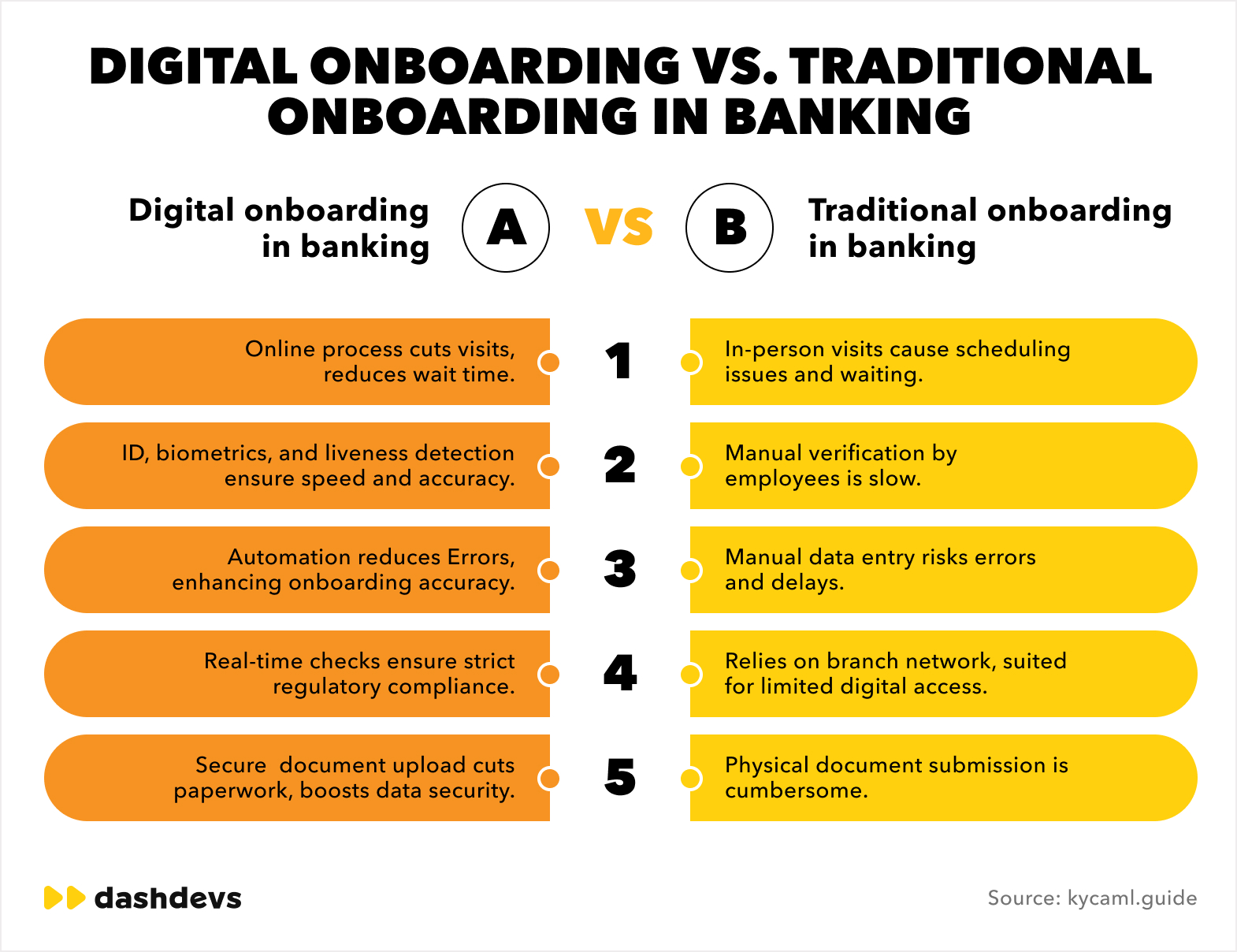
Onboarding is the first stress test. Teams investing in digital onboarding solutions for banks need CRM cases and tasks that open from KYC outcomes automatically—otherwise the “CRM go-live” is just another inbox.
CRM in banking industry vs sales CRM: operating model differences
CRM in banking industry is measured by retention, product depth, and cost-to-serve—not only by pipeline velocity. Sales stages still matter for wealth and commercial coverage, but the sales pipeline is one module inside a broader relationship system.
| Dimension | Typical sales CRM | CRM in the banking industry |
|---|---|---|
| Primary object | Opportunity | Customer / party + product relationship |
| Success metric | Won revenue | Wallet share, NPS/effort, attrition, compliant service |
| Data freshness | CRM-owned | Core-, KYC-, and channel-sourced |
| Compliance | Optional fields | Consent, audit, retention, access controls by role |
| Change cadence | Marketing and sales process | Product, risk policy, and regulatory calendar |
The importance of CRM in banking shows up when customers engaging across channels expect personalized experiences without repeating KYC or product facts. Horizontal CRM software banking teams buy “as is” rarely delivers that without a deliberate integration program. In practice, CRM in banking industry programs succeed when product eligibility and consent travel with every assisted interaction.
Market context: Research and Markets estimates the banking CRM software market at about $18.07B in 2025, growing to $21.22B in 2026 (17.5% CAGR in that step)—growth driven by digitization and retention pressure, not by novelty of CRM as a category.
Architecture: CRM, core, CDP, and who owns the truth
Bank CRM systems should not become a shadow core. The same rule applies whether you brand the program as banking CRM systems or a “financial services cloud” rollout. The durable pattern:
- Core (or BaaS) owns balances, products, and posting.
- Identity / KYC owns verification state and evidence pointers.
- CRM owns relationship plans, tasks, cases, campaigns, and conversation context.
- Optional CDP or warehouse owns advanced analytics and model features for data driven decisions.
When you compare core banking solutions, ask how customer and product events leave the core—batch files, CDC, or APIs. That answer predicts CRM freshness more than any CRM demo.
For open-data and partner channels, plan bank api integration so CRM can subscribe to account and payment events without nightly reconciliation drama. Many programs also need specialist fintech integration services for contact-center, KYC, and marketing tools that sit beside the CRM.
Summary: CRM is the relationship system of engagement; the core remains the system of record for money. Confuse the two and you get both wrong balances and wrong conversations. That boundary is the heart of any serious crm system banking industry design review.
Buy, extend, or build: a practical decision framework
There is no universal winner among platform CRM, vertical banking suites, and custom builds. Choose by where differentiation lives. Teams that skip this step often buy two bank CRM systems over five years—the second to undo the first.
| Path | Choose when | Watch-outs |
|---|---|---|
| Extend horizontal platform (e.g. Microsoft Dynamics 365, Salesforce FSC) | You need ecosystem apps, familiar admin skills, and speed to a first RM workbench | Banking objects and compliance workflows become a multi-year customization tax |
| Buy banking-vertical CRM | Out-of-the-box retail/SME journeys beat your ability to configure a horizontal tool | Weaker fit if your operating model is unusual; exit can be hard |
| Custom / modular banking crm system development | Journeys, multi-brand ops, or data residency rules are product-critical | Higher delivery ownership; requires strong product and platform discipline |
Microsoft Dynamics 365 is often shortlisted because banks already live in Microsoft identity, Teams, and Power BI. That ecosystem fit is real—and still not a substitute for core event quality. Treat Dynamics (or any platform) as the shell; treat your domain services as the durable layer if you must avoid vendor lock-in.
Custom work is justified when orchestration—not the CRM UI—is the asset. DashDevs’ Tico platform work is a useful pattern reference: a purpose-built CRM with workflow automation, branch/network filters, and reporting shaped around how operators actually work—not around generic opportunity stages. Banking programs that need the same depth of fit usually land in fintech software development with a thin CRM UI and hard boundaries to the core.
For diligence discipline, reuse the evidence mindset from core banking vendor evaluation: architecture proof, security artifacts, TCO, and exit—not slides.
Where AI-powered CRM helps—and where it creates risk
AI powered features in a crm solution should reduce RM prep time and improve offer timing—not invent facts the core does not support.
High-value uses:
- Prep briefs that summarize holdings, recent disputes, and open cases before a call
- Next-best-action ranked by eligibility rules and capacity, not only propensity scores
- Case routing and summarization for contact-center volume
- Churn and dormancy alerts fed by product and login signals
Pair CRM AI with the broader set of AI use cases in banking so fraud, credit, and servicing models do not diverge from what relationship managers see.
Risks to control: hallucinated product advice, biased targeting, and unclear model lineage for audit. Keep human approval on regulated recommendations; log prompts and outputs when they influence customer outcomes.
Selection checklist for bank CRM systems
Use this scorecard in RFPs for banking CRM systems. Weight integration and data higher than feature count. A second pass should test whether your crm system banking industry requirements still hold after a policy change (pricing, vulnerability, or collections).
| Criterion | What “good” looks like | Red flags |
|---|---|---|
| Party & product model | Household/company graphs; product awareness without ledger duplication | Contacts-only model; balances typed by hand |
| Seamless integrations | Event APIs, webhooks, idempotent writes back for tasks/cases | Nightly CSV only; undocumented fields |
| Compliance | Consent, retention, role-based access, audit export | “Configure it yourself” with no reference architecture |
| Workflow automation | Configurable journeys for onboarding, renewals, complaints | Rigid stages that break at first policy change |
| Analytics and reporting | RM productivity + attrition + campaign lift with data lineage | Vanity dashboards disconnected from finance metrics |
| UX | User friendly mobile/branch modes; offline or low-bandwidth realities | Desktop-only demos that ignore teller/RM floors |
| Commercial & exit | Data export, transition assistance, clear IP for customizations | Perpetual lock on custom objects and history |
Shortlist reality check for crm systems for banks:
- Can an RM explain a declined cross-sell using data on screen—not tribal knowledge?
- Can compliance export a full interaction and consent trail for a sample customer in hours?
- Can you switch marketing or contact-center vendors without rewriting the CRM core?
- Do sandbox scripts include your actual core event shapes—not vendor sample JSON?
Run the same four questions for every crm systems for banks shortlist finalist—including the incumbent you already own.
If you need a delivery partner comparison beyond CRM vendors, review banking software development companies with the same evidence bar.
Implementation realities that decide ROI
Licenses are the cheap part. These operational factors decide whether crm software for banks becomes a daily tool or shelfware:
- Data ownership: name the team that owns customer information quality SLAs between core and CRM.
- Cutover strategy: dual-run high-value segments (wealth, commercial) before mass retail rollout.
- Change management: RMs adopt tools that save prep time in week one; training decks do not.
- Scope control: postpone exotic AI until the timeline of customer interactions is complete and trusted.
- Security: encrypt PII, segment environments, and test break-glass access for fraud ops.
For digital challengers and program banks, CRM sequencing sits beside license and core choices. A neobank app development company path still needs a relationship layer for ops and partners; white label digital banking accelerates client shells only when CRM and core event contracts are designed together.
Scenario playbooks: three common bank CRM paths
Retail bank modernizing contact center and RM tools
Start with service cases and a unified customer timeline; add sales and marketing campaigns after case hygiene is real. Prefer extend-platform if Microsoft or Salesforce is already enterprise-standard. Measure first-contact resolution and repeat contacts—not CRM login counts.
Commercial / SME coverage model
Prioritize company hierarchies, call plans, and credit-review tasks linked to exposure. Generic opportunity stages without group structure will fail. Here, crm system banking industry requirements look closer to account planning than retail ticket handling. Banking CRM systems that cannot model group exposure usually force RMs back to credit-committee packs outside the tool.
Challenger launching with thin ops team
Buy or extend fast for tickets and CRM software for banking industry marketing basics; invest custom effort in the orchestration that connects onboarding, risk, and product events. Do not build a full CRM from zero unless the CRM itself is your product.
How to phrase the business case
Executives fund crm software banking programs when the case ties to measurable leakage: abandoned digital applications, failed handoffs, low product-per-customer, and high cost-to-serve in assisted channels. Frame the investment as reducing those leaks—not as “upgrading CRM.”
A concise executive sentence: bank CRM systems pay for themselves when relationship teams act on the same customer truth the core and channels already know—faster than competitors who still reconcile screens by phone. That is also the clearest way to justify CRM in banking industry spend to a CFO who has seen CRM projects fail before.
Closing decision checklist
Before you sign:
- Map must-have journeys (onboarding, complaint, renewal, cross-sell) to systems and events
- Decide buy / extend / build with an explicit lock-in and exit stance
- Fund integration and data quality as first-class workstreams
- Pilot with one segment and one channel before enterprise rollout
- Require analytics that prove customers engaging more deeply—not only more emails sent
When generic platforms cannot carry those journeys with audit-grade customer information, banking CRM systems—or a custom control plane around a platform shell—are the rational path. DashDevs approaches these programs as fintech infrastructure work: cores, APIs, consent, and ops UX wired so a crm banking software choice survives production, not only a vendor demo. If you still need a single bank CRM system decision rule: pick the option that keeps core truth authoritative and still makes RM work faster in week one.
Share article
