


Best Chargeback Management Software: Top 10 Picks for 2026

September 7, 2026
- Global chargeback volume is projected to reach 324 million transactions by 2028, a 24% increase in three years.
- Every $1 in chargeback losses costs merchants $5.13 all-in when accounting for fees, fulfillment, and operational time, according to the 2026 LexisNexis True Cost of Fraud study.
- Friendly fraud now accounts for 43.8% of total chargebacks in 2026. 86% of all disputes handled by Chargebacks911 trace back to first-party misuse.
- The chargeback management software market is valued at $2.6 billion in 2025 and is projected to reach $9.3 billion by 2035 at a 13.5% CAGR.
- Most payment businesses wake up to chargebacks when a ratio alert fires or a card network letter arrives. By that point, the problem is already structural.
Chargeback management is the set of tools, workflows, and processes that payment businesses use to prevent disputes from forming, respond to them when they do, and recover revenue lost to illegitimate claims. Done well, it protects card network standing, reduces operational overhead, and turns dispute data into a signal for product and risk improvements. Done poorly, it costs more than the chargebacks themselves.
This guide is written for product, risk, and payments leads at PSPs, PayFacs, card issuers, and high-volume merchants evaluating chargeback or dispute management software. You will get a vendor-neutral comparison of the 10 best chargeback management software options available in 2026, a clear explanation of the layer each one occupies, a build-vs-buy framework for payment businesses with engineering capacity, and the questions that matter when shortlisting.
For payment businesses that also need guidance on the underlying payment infrastructure this tooling sits on, DashDevs has covered the payment gateway vs. payment processor distinction and the full picture of how electronic payment services work in detail elsewhere.
The True Cost of Chargebacks: More Than the Disputed Amount
Global chargebacks are projected to climb to $41.69 billion by 2028, with U.S. merchants absorbing roughly 10% of global volume.
Chargebacks are on track to reach 324 million transactions in 2028, while 44% of consumers say they struggle to recognize their own purchases. Nearly half have disputed a transaction they later realized was legitimate.
Merchants incur an average of $82 in internal costs per chargeback. Add the chargeback fee from your processor (typically $20 to $100 per dispute), the cost of merchandise or service already delivered, and staff time spent on evidence collection, and the effective cost per chargeback can exceed the transaction value several times over.
In 2025, every dollar lost to fraud cost US merchants $5.13, a 52.7% increase compared to five years earlier, per LexisNexis Risk Solutions.
Beyond direct losses, there are second-order costs that most teams underestimate:
| Cost layer | What it looks like in practice |
|---|---|
| Card network monitoring | Exceeding Visa VAMP or Mastercard ECM thresholds triggers formal monitoring, additional fees, and potentially merchant account termination |
| Acquirer relationship risk | High chargeback ratios create friction with acquiring banks, sometimes resulting in reserve requirements or processor offboarding |
| Revenue recovery opportunity cost | Uncontested illegitimate disputes are pure loss; many merchants have win rates well below 50% because responses miss deadlines or lack compelling evidence |
Chargebacks are not a back-office nuisance. They are a strategic risk and a barometer of your business’s health.
Chargebacks vs. Friendly Fraud: Why the Distinction Determines Your Tooling
Before evaluating any chargeback prevention software, you need to know which dispute category is driving your losses. The right chargeback prevention software for true fraud looks different from what you need for a friendly-fraud problem. The tooling requirements are not the same.
True fraud chargebacks occur when a cardholder disputes a transaction they did not authorize. Prevention relies on fraud scoring at authorization, 3DS authentication, and velocity rules. For a deeper view of how liability shifts under 3DS, see our guide on 3DS liability shift.
Friendly fraud occurs when a legitimate cardholder disputes a transaction they did authorize. According to Chargeflow’s 2026 research, friendly fraud now drives approximately 75% of eCommerce disputes. Addressing it requires evidence: transaction records, delivery confirmation, IP logs, and browser fingerprinting data. That evidence must be assembled into a representment package and submitted within strict network-mandated deadlines.
What Chargeback Management Software Actually Does
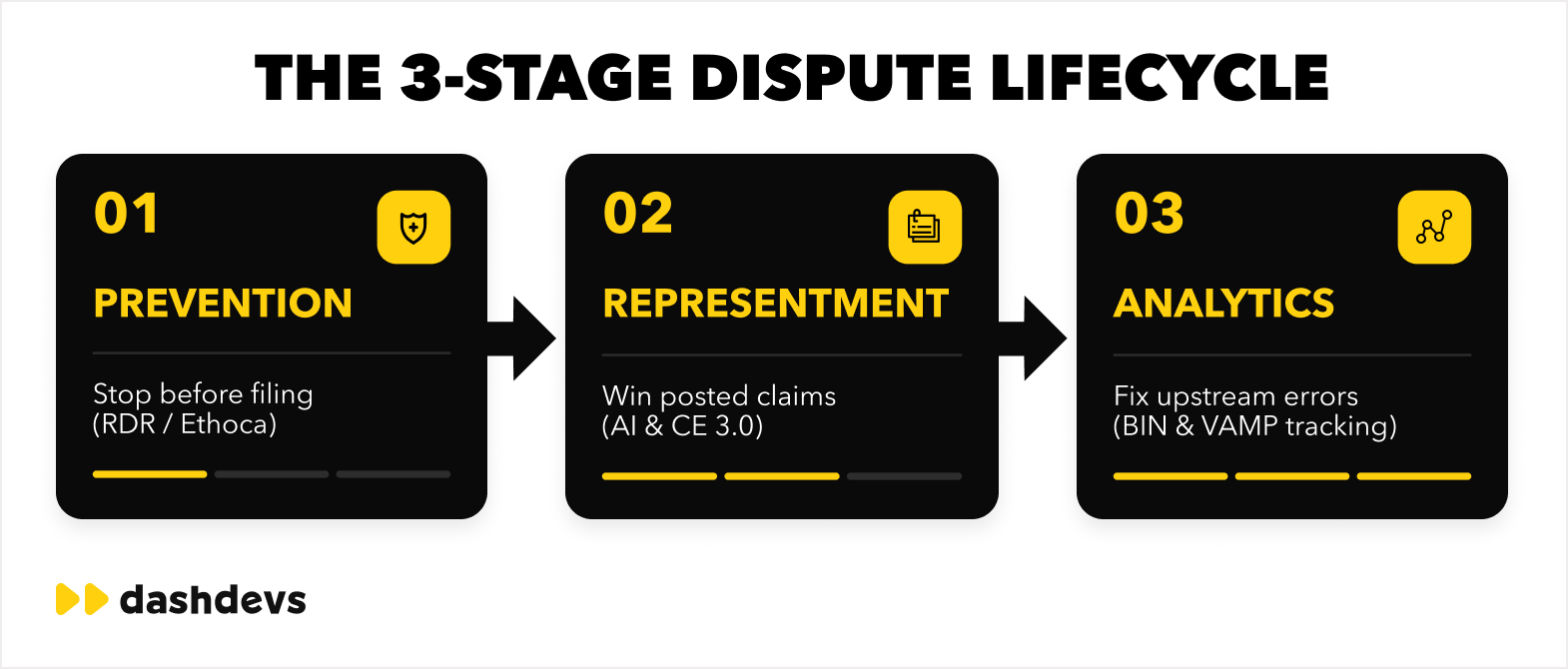
The right tooling handles one or more of three distinct jobs in the dispute lifecycle. Not all chargeback solutions cover the full dispute lifecycle. That is why understanding which layer each tool operates in is the first step. Chargeback prevention tools operate before the chargeback posts; representment tools engage after.
Prevention: Stop Disputes Before They Form
Prevention tools operate before a chargeback is filed. The two primary mechanisms are the following:
Network alert programs. Visa’s Rapid Dispute Resolution (RDR) and Cardholder Dispute Resolution Network (CDRN), plus Mastercard’s Ethoca alerts, notify merchants when a cardholder initiates a dispute. This gives the merchant a window (24 to 72 hours) to resolve the issue before it becomes a formal chargeback. Resolving at this stage avoids the chargeback fee and the ratio impact. Post-VAMP, your chargeback management system needs to track TC40 fraud reports alongside TC15 disputes. A chargeback management system that reports only traditional chargebacks is operating with incomplete data.
Order Insight and enhanced data. Visa’s Order Insight program pushes real-time transaction details to issuers. When a cardholder calls their bank to dispute a charge, the agent can immediately see the merchant name, item purchased, and delivery status. Many disputes resolve at that point without becoming chargebacks.
Representment: Win Chargebacks Already Filed
Representment is the process of contesting a chargeback. The merchant submits evidence to the issuer through their acquirer, arguing the transaction was legitimate and the chargeback should be reversed. Evidence typically includes order confirmation, delivery proof, terms acceptance, IP and device data, and customer communications.
AI-driven representment platforms automate evidence collection and submission, format it for specific card-network requirements, and optimize arguments based on dispute reason codes and historical win-rate data. Support for Visa’s Compelling Evidence 3.0 framework is a key differentiator at this layer.
Analytics: Understand What’s Causing Your Chargebacks
Root-cause analytics identify whether chargebacks stem from merchant error, fulfillment issues, billing descriptor confusion, or systematic friendly fraud. Win rate reporting is table stakes. Root-cause analytics enable preventive changes.
This layer turns chargeback data into operational improvements: fixing the descriptor, improving cancellation flows, or tightening authorization rules at specific BINs. The best chargeback management tools expose this analytics layer as a first-class feature.
Top 10 Best Chargeback Management Software in 2026
Here is how the leading chargeback management software options and chargeback prevention companies compare across the criteria that matter most for payment businesses in 2026.
| Tool | Core focus | Network compliance (TC40+TC15) | Evidence automation | Integration type | Pricing model |
|---|---|---|---|---|---|
| Chargebacks911 | Prevention + managed representment | Ethoca + CDRN | Yes, with ISD routing | API + managed service | Quote-based |
| Justt | AI representment | Multi-processor | Yes, per-dispute AI arguments | API-first | Performance-based |
| Chargeflow | eCommerce automation | Ethoca + Verifi | Yes, automated evidence pull | Platform connectors | Success-based |
| Verifi (Visa) | Pre-dispute interception (Visa) | RDR + Order Insight | Prevention only | Network-native | Per-alert |
| Ethoca (Mastercard) | Pre-dispute interception (MC) | Ethoca Alerts + Consumer Clarity | Prevention only | Network-native | Per-alert |
| Kount / Midigator | Analytics + prevention | Ethoca + Verifi integrations | Analytics-first | API + processor connectors | Custom |
| Chargeback Gurus | Managed representment + analytics | Network alert integrations | Expert-managed | API + managed service | Performance-based |
| Signifyd | Fraud guarantee on approved orders | Fraud only | Not applicable (guarantee) | Platform connectors | % of GMV |
| Riskified | Fraud guarantee + cross-border | Fraud only | Not applicable (guarantee) | API-first | % of GMV |
| Chargebackhit | Full lifecycle (PSP/PayFac focus) | Ethoca + Verifi + RDR | Yes, AI-powered | API-first | Custom |
1. Chargebacks911
Core focus: End-to-end chargeback lifecycle management (prevention alerts, managed representment, and analytics) as a hybrid technology and managed-service model.
Best fit for: High-volume merchants and ISOs across retail, travel, digital goods, and subscriptions who want a vendor to manage dispute operations, not just provide tooling.
2. Justt
Core focus: AI-native dispute representment, individualized evidence arguments per dispute.
Best fit for: Enterprise merchants with large datasets, multiple processors, and significant monthly dispute volume who want fully automated representment with no manual case preparation.
3. Chargeflow
Core focus: Chargeback automation for eCommerce (prevention alerts, evidence assembly, and representment) with success-based pricing and native Shopify/Stripe integration.
Best fit for: eCommerce merchants who want zero-touch dispute automation without dedicated dispute operations staff.
4. Verifi (Visa)
Core focus: Card-network-native pre-dispute resolution — intercepting disputes before they post as formal chargebacks through Rapid Dispute Resolution (RDR) and Order Insight.
Best fit for: Any merchant or PSP processing significant Visa volume who needs to reduce formal chargeback counts and protect VAMP ratio directly.
5. Ethoca (Mastercard)
Core focus: Pre-dispute alert network for Mastercard transactions, enabling merchants to resolve disputes before they post as formal chargebacks. Ethoca is among the most widely used chargeback prevention services at the card-network level.
Best fit for: Merchants with a high Mastercard transaction mix who want to reduce formal chargeback counts on MC rails.
6. Kount (Equifax) / Midigator
Core focus: Analytics-first chargeback prevention, identifying root causes across 40+ data points before deciding on the response workflow.
Best fit for: Merchants who need to understand why their ratio is high before choosing how to address it. Especially those running multiple payment processors without unified dispute visibility.
7. Chargeback Gurus
Core focus: Full-service chargeback management with vertical expertise: prevention, evidence preparation, and representment handled by specialists familiar with vertical-specific dispute patterns.
Best fit for: Merchants in high-risk or niche verticals (nutraceuticals, subscriptions, travel, and online education) where generic representment templates produce lower win rates.
8. Signifyd
Core focus: Chargeback protection through financial guarantee. Signifyd underwrites fraud risk on approved orders rather than fighting disputes after they occur.
Best fit for: eCommerce merchants who want to remove fraud-driven chargeback risk from approved orders and are willing to pay a percentage of protected GMV for the guarantee. Not a substitute for active chargeback management services on the representment side.
9. Riskified
Core focus: AI-driven fraud prevention with chargeback guarantee on approved orders, same model as Signifyd, with stronger international and cross-border coverage.
Best fit for: Enterprise merchants with significant cross-border volume who want fraud guarantee coverage across EMEA and APAC markets.
10. Chargebackhit
Core focus: Full dispute lifecycle coverage (pre-dispute deflection, prevention alerts, and AI-powered representment) in one integration designed for PSPs and payment operations teams.
Best fit for: Payment businesses managing disputes across a portfolio of sub-merchants, where single-merchant tooling creates reconciliation gaps.
Whether you are evaluating standalone chargeback prevention companies or full-lifecycle platforms, the right chargeback software depends on which layer you need most — and whether you are managing disputes as a direct merchant, PSP, or card issuer.
Integration Architecture: Three Models That Shape Your Operational Flexibility
The integration model you choose for your chargeback management tools shapes operational flexibility for years. This decision matters most for PSPs, PayFacs, and high-volume merchants building payment infrastructure for scale.
API-first integration connects the chargeback tool to your transaction data through REST APIs. You control what flows where, enabling multi-processor dispute visibility and clean data separation. Justt, ChargebackHit, and Riskified operate this way. The trade-off is engineering investment at implementation, and data normalization across processors takes time to do correctly. This architecture is the right choice for PSPs and PayFacs building dispute management into a broader payment risk layer.
For context on how API connectivity fits the broader payment stack, see our overviews of transaction processing systems and ClearBank API integration.
Gateway-embedded integration relies on your payment gateway’s native dispute handling — Stripe Radar, Adyen Disputes API, and Braintree Dispute Management. Low implementation overhead, but limited to disputes processed through that gateway. Chargeflow and Signifyd work this way for most eCommerce deployments. Not viable for multi-gateway environments.
Processor-level integration gives the deepest data access. Verifi and Ethoca operate at the card-network layer, intercepting dispute signals before they reach your processor. The data advantage is significant for VAMP ratio management. The switching cost is also the highest of the three models. For payment businesses managing KYC and fraud detection alongside transaction monitoring, integrating dispute signals into the same risk architecture produces better prevention outcomes. Running them in separate silos creates blind spots.
The integration architecture question comes down to one decision: does your payment risk layer own the dispute workflow, or does the dispute tool own your payment data?
Build vs. Buy: When Custom Dispute Infrastructure Makes Sense
For most high-volume merchants, combining a prevention alert layer (Verifi + Ethoca) with a representment engine (Justt or Chargeflow) is adequate. The build case emerges in three specific scenarios.
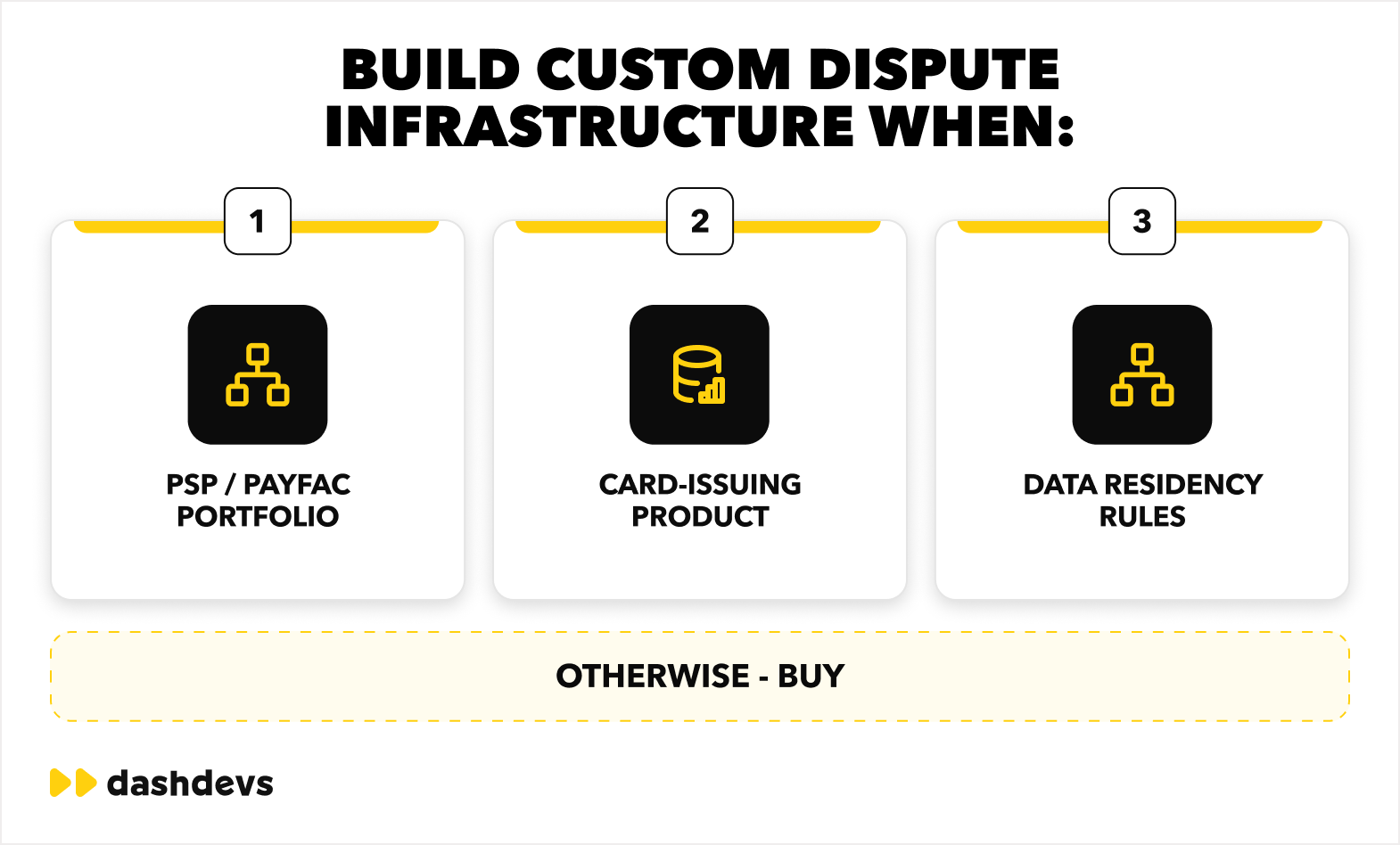
PSP or PayFac managing disputes at the portfolio level. An off-the-shelf chargeback management solution is designed for direct merchants. PSPs and PayFacs need dispute aggregation across sub-merchant accounts, liability allocation between acquirer and sub-merchant, and compliance reporting at the portfolio level. That requires custom integration or a platform designed for intermediaries.
See our guide on how ISV payments work for how dispute liability flows across different payment intermediary structures. Teams building a payment operation from the ground up will also find the broader context in our guide to starting a payment processing company.
Card-issuing product. The dispute workflow for issuers is structurally different — issuers adjudicate and respond to representment packages rather than submit them. Issuer-side dispute management often requires custom tooling built into the core banking or card management platform.
Data residency requirements. Regulated financial institutions in certain jurisdictions can’t route transaction and dispute data to SaaS vendors with infrastructure in other regions. Custom dispute infrastructure, hosted in the required jurisdiction, becomes the only compliant path. Our compliance-first digital banking platform in Saudi Arabia is a direct example: fraud-screening and compliance workflows built from scratch delivered full AML coverage under both card-network and SAMA regulatory standards.
Our teams have worked through this evaluation with payment businesses across Europe, MENA, and North America.
How DashDevs Has Built Fraud and Dispute Infrastructure in Production
DashDevs has built fraud and dispute infrastructure across regulated markets. From a compliance-first digital banking platform in Saudi Arabia with full AML coverage and 24/7 transaction monitoring to Centarrow’s automated risk-assessment platform that reduced manual risk-analysis workload by 50% while maintaining audit transparency at production scale.
For alternative asset managers, we built an AI-powered fraud monitoring platform where fraud screening, KYC verification, and transaction monitoring share a single data architecture, eliminating the blind spots that appear when dispute and fraud tools run in silos.
Where the root cause is a governance or policy gap rather than a tooling gap, our overview of bank fraud and high-risk customer controls covers the security controls layer that sits above the dispute stack.
For a broader view of what regulators and investors expect from a payment business’s dispute and fraud controls at each stage of growth, see our guide to fintech risk management.
After 17+ years around payment and risk infrastructure, the pattern is familiar: teams buy a representment tool after the first VAMP letter, then discover the real gap was never evidence formatting — it was missing TC40 visibility and a portfolio-level liability model.
The Right Chargeback Stack Depends on Your Operating Model
The best chargeback management software for a high-volume merchant is not the same tool that fits a PSP. Neither addresses the architecture requirements of a card issuer managing dispute adjudication. For teams building closed-loop payment systems, that architectural coherence is where the real operational value is.
Teams that have reached a build decision can find out more about our custom fintech software development services.
Share article
