


Best Crypto On-Ramp and Off-Ramp Providers in 2026

August 28, 2026
- For a compliance-first white-label on-ramp, Transak and Banxa lead. For fast wallet integration, Ramp Network. For a trusted US off-ramp, Coinbase and Kraken.
- A crypto on-ramp moves fiat into crypto. A crypto off-ramp moves crypto back into bankable fiat. Most products need both directions.
- Pick providers by licensing, corridors, all-in fees, payment rails, custody model, and integration depth — not by logo recognition.
- Fintechs building branded flows should evaluate a crypto on-ramp API or embedded crypto on-ramp, not only a hosted widget.
- Run fee math at current, 5x, and 20x volume before you lock a vendor. Switching mid-flight costs more than choosing well upfront.
If your product needs to move users between fiat and crypto, you already know the pain. One provider drops your region, another buries you in KYC friction, a third quietly raises fees after you have shipped. Here is a clear-eyed comparison of the best crypto on-ramp and off-ramp providers 2026 has on offer, built for people who actually have to choose one.
Quick answer: for a compliance-first white-label on-ramp, Transak and Banxa lead the pack. For fast wallet integration, Ramp Network. For a US-based consumer-trusted off-ramp, Coinbase and Kraken. For fintechs building embedded rails, look at a crypto on-ramp API rather than a hosted widget. The full breakdown, including a side-by-side table, is below.
| If you need… | Start with… | Why |
|---|---|---|
| White-label buy flow without a rival consumer app | Transak or Banxa | Partner-first model and stronger licensing depth |
| Fast wallet / Web3 embed | Ramp Network | Hosted widget + SDKs with light integration |
| Trusted US cash-out | Coinbase or Kraken | Regulated brand and familiar USD/EUR path |
| Branded in-app conversion | White-label API or embedded flow | Keeps UX and funnel under your brand |
What are crypto on-ramps and off-ramps?
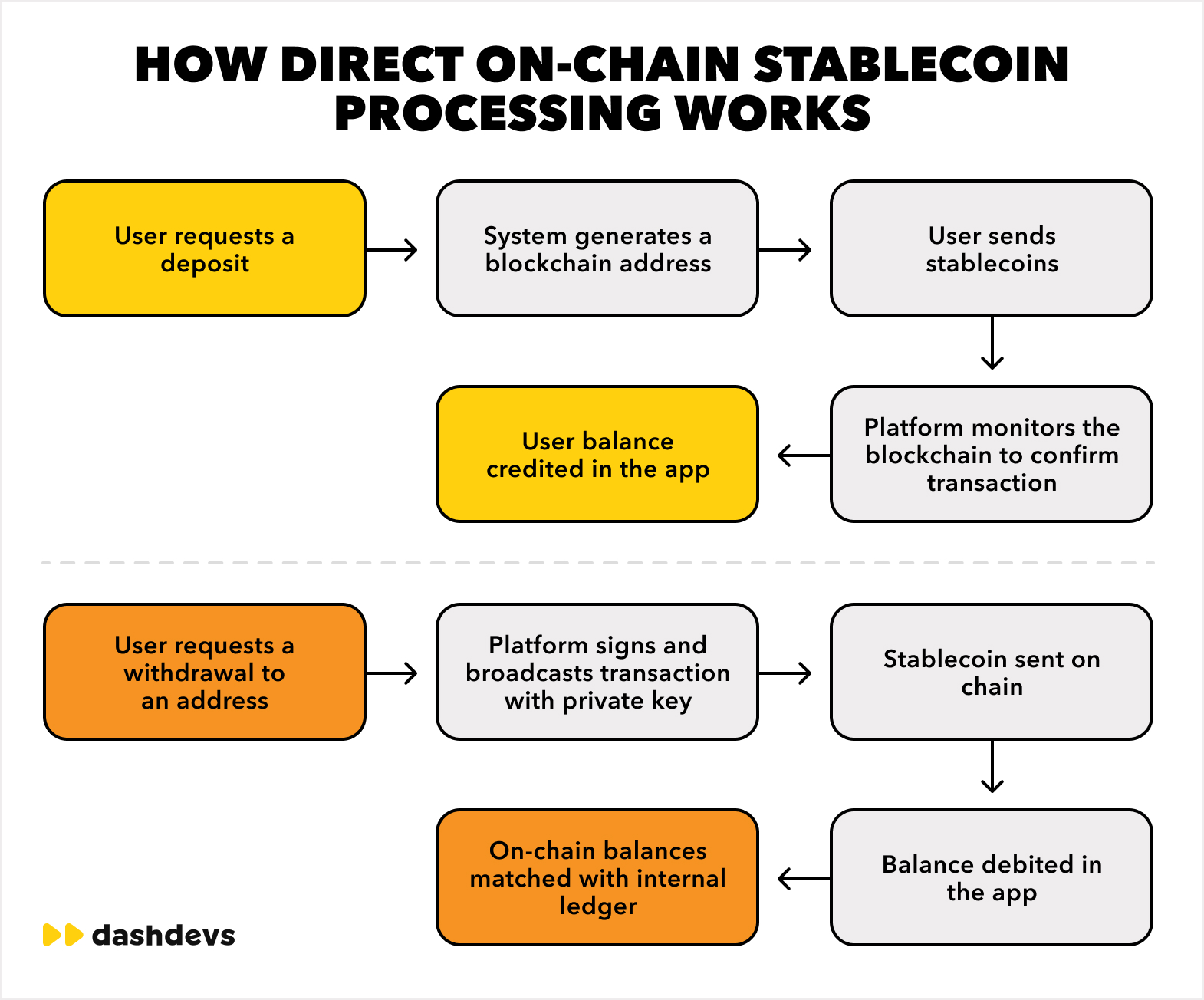
A crypto on-ramp lets a user buy crypto with fiat currency, through a card, bank transfer, or digital wallet. A crypto off-ramp does the reverse, converting crypto back into fiat and sending it to a bank account or card.
Both sound simple from the outside. Neither is simple to build.
The last 10% of a fiat on-ramp is where most engineering budgets quietly die. It is never the happy path that breaks a launch. It is the failed payment and the flagged KYC case that nobody built a runbook for.
An on-ramp has to handle payment processing and fraud monitoring before a single dollar touches a blockchain. It also needs identity verification running in the background. An off-ramp has to handle liquidity and settlement before that same dollar leaves the system again, with AML checks running alongside every withdrawal. After 17+ years building fintech infrastructure, fiat-to-crypto conversion is still one of the areas where the last 10% of the work eats 60% of the budget.
Most companies do not build a fiat to crypto onramp in-house anymore. They pick a crypto onramp provider, or several, and plug in.
| Direction | What the user does | What your system must survive |
|---|---|---|
| On-ramp | Pays fiat, receives crypto | Payment success, fraud checks, KYC tiers, asset delivery |
| Off-ramp | Sends crypto, receives fiat | Liquidity, AML, bank settlement, payout disputes |
| Both | Buys and cashes out | One ledger story across two failure modes |
How to choose the best crypto on-ramp and off-ramp providers in 2026
Picking from the best crypto on-ramp and off-ramp providers 2026 offers comes down to six factors: licensing and compliance, geographic and currency coverage, fee structure, supported payment rails, custody model, and integration effort.
| Factor | What “good” looks like | Common trap |
|---|---|---|
| Licensing and compliance | Registered entities in your live corridors; MiCA passport if you scale the EU | “Global compliance” with no named licences |
| Coverage | Your top countries, fiat currencies, and assets in writing | Country-count marketing that misses three real corridors |
| Fees | Full chain: fee + spread + network + payout | Comparing headline card % only |
| Payment rails | ACH, SEPA, PIX, or local rails users already trust | Assuming card covers every market |
| Custody model | Matches your risk and product policy | Letting the vendor dictate custody by default |
| Integration effort | Widget for speed, API for brand control | Shipping a redirect and calling it “embedded” |
Start with corridors and licences, not feature grids. A provider that cannot legally serve your users is not a pricing problem. It is a non-starter.
Here is how the main providers stack up against those criteria.
| Provider | Coverage | Licensing highlight | Best for |
|---|---|---|---|
| Transak | 63+ countries, 26 fiat currencies, 136+ cryptocurrencies | US, UK, Canada, Australia, Hong Kong; ISO 27001, SOC 2 Type II | White-label integration without a competing consumer app |
| MoonPay | Cards, Apple Pay, Google Pay, PayPal, local bank transfers | Enterprise stablecoin virtual accounts (New York, 2026) | Teams comfortable sharing users with MoonPay’s own app |
| Ramp Network | 150+ countries, 50+ fiat currencies | Hosted widget, web and mobile SDKs | Fast integration for wallets and Web3 apps |
| Banxa | 200+ countries, 100+ cryptocurrencies, 150+ fiat currencies | ~45 licences, including a MiCA licence passporting across the EEA | Compliance-heavy exchanges, wallets, and PSPs |
| Coinbase Onramp | US-focused, ACH-based | Established regulated US brand | Products that want a trusted, recognizable US flow |
| Stripe | US and EU, embedded in existing Stripe stack | Runs on Stripe’s existing payment infrastructure | Companies already using Stripe for payments |
Best crypto on-ramp providers in 2026
Transak
Transak is a regulated fiat-to-crypto infrastructure provider that embeds inside wallets, apps, and exchanges without running a competing consumer product of its own. It supports 136 or more cryptocurrencies across 45 or more blockchains, spanning 63 countries and 26 fiat currencies.
Transak holds registrations in the US, UK, Canada, Australia, and Hong Kong. It also carries ISO 27001 and SOC 2 Type II certifications, which matters if your own compliance team needs to justify the vendor choice upward.
The absence of a consumer app is a deliberate design choice. It means Transak never becomes a rival to the partner using its rails, which matters if you are building your own branded wallet or exchange.
MoonPay
MoonPay runs both a partner-facing on-ramp and its own consumer app and wallet. That dual model is worth noting: unlike Transak, MoonPay can end up competing for the same end user it supplies through partners. MoonPay supports cards, Apple Pay, Google Pay, PayPal, and local bank transfers, and expanded its enterprise stablecoin footprint with virtual accounts launched in New York in 2026.
Ramp Network
Ramp Network focuses on wallets and Web3 applications, with reported coverage across more than 150 countries and 50 fiat currencies, among the widest published ranges in the retail category. It ships as a hosted widget with web and mobile SDKs, which keeps integration light for teams that do not need a fully white-label flow.
Banxa
Banxa is a compliance-heavy fiat-to-crypto platform, now operating inside OSL Group, serving exchanges, wallets, and PSPs. It reports coverage across more than 200 countries, 100 or more cryptocurrencies, and 150 or more fiat currencies, backed by around 45 licences, including a Netherlands MiCA licence that passports across the EEA. Third-party reviews consistently flag stricter verification requirements and higher fees as the trade-off for that compliance depth.
Coinbase Onramp and Stripe
Coinbase Onramp is a strong pick for teams that want a regulated, ACH-based US flow with an established brand behind it. Stripe’s embedded crypto onramp suits companies already running Stripe payments and looking to add fiat-to-crypto without a second vendor relationship. Neither is a full white-label solution out of the box, so factor that into your evaluation.
Do not compare a single headline fee across providers. Record the full path: fiat paid, crypto received, provider fee, network fee, spread, and rail cost. Two identical advertised fees can still differ by 2–3% once the chain is complete.
| Fee line item | Ask for | Why it matters |
|---|---|---|
| Provider fee | % + minimums by method | Base cost of conversion |
| Spread / FX | Mid-market vs quoted rate | Often larger than the “fee” |
| Network fee | Who pays gas / chain cost | Users notice surprise deductions |
| Card / bank rail cost | ACH, SEPA, PIX, card MDR | Method mix changes unit economics |
| Failed / refund cost | Who eats chargebacks and retries | Quiet killer of margin |
Best crypto off-ramp providers in 2026
A crypto off-ramp gets less attention than a buy flow, but the same standards apply, sometimes with sharper compliance scrutiny because withdrawals sit closer to AML rules.
Among the best fiat off-ramps for crypto, four names come up again and again. Treat the crypto off-ramp with the same diligence you give the on-ramp.
| Provider | Strength | Watch out for |
|---|---|---|
| Coinbase | Compliant, well-known path to USD and EUR | Fees can run higher than pure infrastructure providers |
| Kraken | Strong security posture and regulatory adherence | Slower onboarding for new accounts in some regions |
| Binance | Deep liquidity for high-volume conversions | Regulatory standing varies sharply by jurisdiction |
| Ramp Network | Direct wallet and dApp off-ramp, no exchange detour | Coverage still corridor-led in emerging markets |
Coinbase remains a strong default for US and EU users who want a compliant, well-known path back to dollars or euros. Kraken is often the pick for users who prioritize security and regulatory adherence above raw speed. Binance offers deep liquidity for high-volume conversions, which matters when you are moving large positions and slippage becomes a real cost. Ramp Network stands out again here as a best crypto off-ramp option built specifically for direct wallet and dApp conversions, bypassing a full exchange flow.
If your product needs both directions from one vendor, check whether the provider actually supports off-ramp natively. Some white-label APIs still cover on-ramp only, with off-ramp routed through a separate widget or SDK, so confirm this before you build your architecture around a single assumption.
Users forgive a slow buy once. They do not forgive a sell that never lands in their bank account. Off-ramp quality is a trust product, not a checklist row.
API and embedded on-ramp options for fintechs
A crypto on-ramp API lets a fintech embed fiat-to-crypto conversion directly inside its own product, under its own brand, without becoming a licensed crypto business itself. The provider handles KYC and AML screening behind the scenes. Sanctions checks and settlement happen there too, invisible to your users.
This is where the build versus buy conversation gets real. A hosted on-ramp integrates in a day or two but redirects users to someone else’s interface. An embedded crypto on-ramp keeps the entire flow inside your app, which takes longer to integrate but protects your brand and your conversion funnel.
| Integration model | Time to ship | Brand / UX control | Best when |
|---|---|---|---|
| Hosted widget / redirect | Days | Low | Validating demand fast |
| Embedded crypto on-ramp | Weeks | High | Conversion and brand matter |
| Full API integration | Weeks+ | Highest | Ledger, webhooks, and multi-provider routing |
| Red flag in the pitch | What it usually means |
|---|---|
| “Off-ramp coming soon” | Likely 12+ months away |
| “Global compliance” with no licence list | Corridor risk you will own later |
| Settlement quoted as “1–5 business days” | No operable SLA |
| Pricing only after a sales call | Hard to model unit economics |
Losing a user to an external tab for 90 seconds is enough for some of them to abandon the flow. That is why white-label infrastructure keeps gaining ground over hosted widgets.
The same discipline applies when you compare white-label payment gateway providers for fiat acceptance: control of UX and merchant ownership usually beats a fast redirect.
Regulatory obligations do not disappear just because a provider handles the technical work. In the US, providers still need Customer Identification Program checks and FinCEN registration as a Money Services Business.
In the EU, MiCA adds e-money institution authorization requirements above certain conversion thresholds. FATF Travel Rule compliance kicks in above 1,000 EUR too. A reputable API-first integration absorbs this complexity so your engineering team does not have to rebuild it from scratch.
If you are architecting this yourself, our guide on bank API integration walks through how open banking rails and provider APIs fit together at the infrastructure level.
Build vs buy: when to use a ramp aggregator vs custom infrastructure
A ramp aggregator routes users across several providers from one interface, surfacing whichever quote and payment method fits best. That is a reasonable starting point if you are testing demand and do not yet know which corridors matter to your users.
Once volume grows, the calculus changes. Enterprise pricing on most white-label providers runs 1 to 3 percent per transaction.
At meaningful monthly volume, that fee adds up fast enough that some fintechs start asking whether owning more of the stack, or negotiating direct rails, makes better economic sense.
This is the same decision curve I have watched teams walk through when they consider how to start a crypto exchange business instead of staying a pure on-ramp integrator. There is no universal right answer here. It depends entirely on your volume, your licensing appetite, and how much of the user experience you actually need to control.
| Stage | Sensible default | When to revisit |
|---|---|---|
| Testing demand | Ramp aggregator or single hosted widget | First real corridor concentration appears |
| Early growth | 1–2 white-label providers | Fee line exceeds budget tolerance |
| Scale | Direct rails + modular ledger | Provider fee becomes a top opex line |
| Volume scenario | What to model | Decision tip |
|---|---|---|
| Current volume | All-in cost per successful conversion | Confirm the provider is profitable for you today |
| 5x growth | Same fee stack at higher throughput | Check volume tiers and support SLAs |
| 20x growth | Fee as % of revenue + switching cost | Prefer portable architecture before you hit this tier |
A provider fee that looks negligible today can become your largest infrastructure line item at scale. Switching mid-flight costs more than choosing well upfront.
A modular core banking platform can shorten this path considerably, since it lets you plug in ramp providers, custody, and card issuing without rebuilding the ledger layer every time you add a capability.
Compliance, KYC/AML, and licensing considerations
Compliance is not a checkbox you tick once. It is an ongoing operating cost, and it should shape your provider choice from day one.
| Compliance signal | Pass | Fail |
|---|---|---|
| Entity registration | Named licences in every live corridor | Head-office claim only |
| EU readiness | Named MiCA licence / passport path | “We cover Europe” with no entity |
| Security posture | SOC 2 Type II or ISO 27001 | No audit evidence |
| Travel Rule | Built into standard flow above thresholds | Sold as a paid add-on later |
| Sanctions / PEP | Included in base KYC/AML | Manual exception process only |
Compliance is not a checkbox you tick once. It is an operating cost that should shape provider choice on day one — before UX polish and fee decks.
Here is how the main thresholds break down by region:
| Region | Trigger | Requirement |
|---|---|---|
| United States | Any customer onboarding | Customer Identification Program (CIP) checks, FinCEN MSB registration |
| United States | Suspicious activity | SAR filing under BSA rules |
| European Union | Fiat-to-stablecoin above threshold | E-money institution authorization under MiCA |
| United States | Transactions above $3,000 | FATF Travel Rule compliance |
| European Union | Transactions above 1,000 EUR | FATF Travel Rule compliance |
Security does not stop at the provider boundary either. Your own systems still need to protect the data flowing through them. Our breakdown of banking cybersecurity frameworks covers the controls that matter once fiat and crypto rails sit inside the same product.
Practical tips: how to evaluate a provider before you integrate
Before you sign with any crypto onramp provider, run through this checklist:
| # | Check | Pass signal |
|---|---|---|
| 1 | Full fee breakdown in writing | Fee + spread + payout costs, not headline % only |
| 2 | Native off-ramp support | Same vendor path, not “separate SDK later” |
| 3 | Active licences by jurisdiction | Named list you can verify |
| 4 | Real payment methods | Your users’ rails work in sandbox and live |
| 5 | Settlement under real conditions | Measured time, not best-case deck copy |
| 6 | Failed tx / dispute handling | Clear ownership, statuses, and support path |
That’s it. Six checks, and you will avoid most of the surprises that show up three months after launch.
Tip: run one live buy and one live sell in each priority corridor before you sign. Marketing coverage dies in the first failed payout.
How DashDevs helps companies build fiat on/off-ramp infrastructure
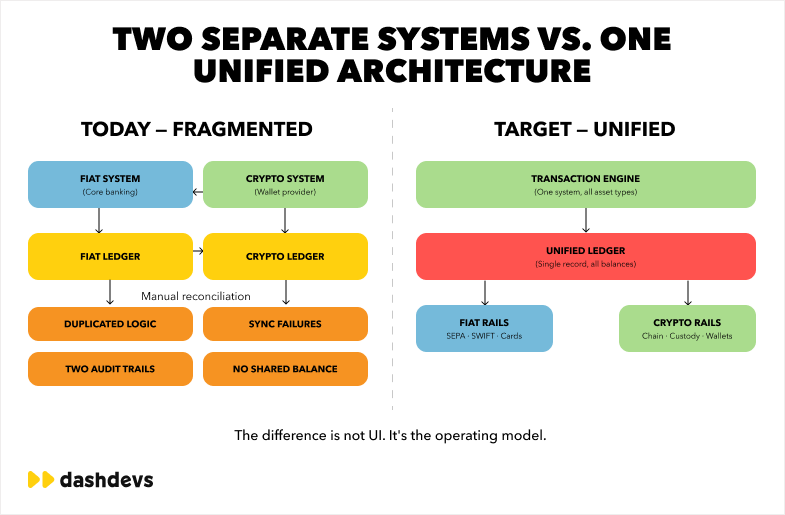
Choosing a provider solves half the problem. The other half is wiring it into a system that can actually hold and move funds across fiat and crypto without falling apart under real volume. Reconciliation is where most homegrown builds start to crack.
We have built this for companies that needed more than a plug-in widget. Our work on stablecoin banking and crypto banking infrastructure covers exactly this kind of fiat on and off ramp architecture for companies that need it to scale.
For teams that need institutional-grade custody rather than a consumer wallet, we also cover crypto custody infrastructure built through direct integration instead of a from-scratch build.
If your product needs a unified balance across fiat and crypto rather than two disconnected ledgers, our piece on building a fiat-crypto platform with a unified balance system walks through the architecture decisions that make or break that experience.
If the end goal is a full wallet product rather than a single ramp feature, our overview of digital wallet innovations covers where the category is heading next. Teams shipping mobile wallets often pair that path with ewallet app development so funding, holding, and cash-out stay one product story.
Final thoughts
The best crypto on-ramp and off-ramp providers in 2026 are not the ones with the longest feature list. They are the ones whose licensing, coverage, and fee structure actually match what your users need, in the corridors they actually use.
Start with your compliance requirements, not your feature wishlist. Everything else — fees, UX, integration speed — gets easier to evaluate once you know which providers are even legally allowed to serve your users.
Want help mapping your specific corridors and volume against the right on-ramp and off-ramp stack? Talk to our fintech infrastructure team and we will walk through the architecture with you.
Share article
