


Best Crypto Wallet Development Companies: A 2026 Buyer Guide

November 20, 2026
- Start with the custody model. Custodial, non-custodial, MPC and embedded wallets need different skills and different licences.
- Judge vendors on four things: custody model, key security, compliance and fiat rails. A slick UI is the easy part.
- Look for public case studies with named features and numbers. Claims without evidence score zero in our scorecard.
- Most teams build on wallet infrastructure (Fireblocks, BitGo, Dfns, MetaMask Embedded Wallets) instead of writing key management from scratch.
- If your wallet needs IBANs, cards or on/off-ramps, pick a partner with fintech delivery experience on top of blockchain skills.
Every crypto wallet looks the same in a Dribbble shot. Balance on top, a nice gradient.
The differences hide underneath. Who holds the private keys? And what happens when a user loses their phone?
That’s what this guide is about. You get a transparent scorecard for choosing a crypto wallet development company in 2026, plus the evidence behind every score.
What does a crypto wallet development company do?
A crypto wallet development company designs and builds the apps, key management and integrations that let users store and move digital assets.
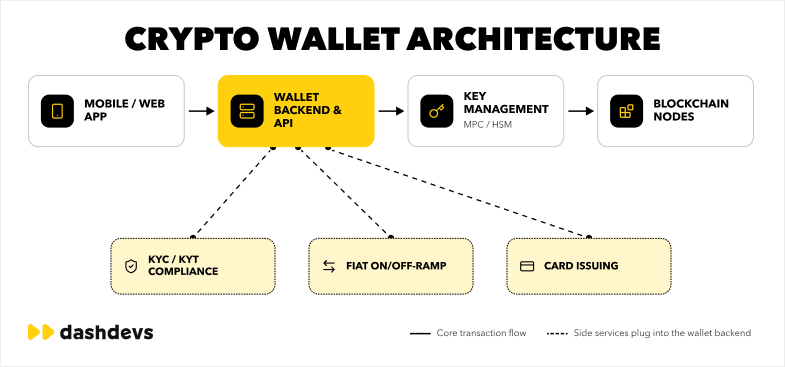
Crypto wallet development covers much more than the mobile app. A full build usually includes:
- Key management: how private keys are created, stored, split and recovered
- Blockchain connectivity: nodes or APIs for each network you support
- Transaction logic: fees, signing, history, notifications
- Compliance: KYC, AML screening and transaction monitoring
- Fiat features: on-ramps, off-ramps, IBANs, cards, Apple Pay and tap to pay
- Back office: support tools, limits, risk controls and reporting
If you are still choosing between wallet types, our guide to types of digital wallets is a good primer. Building a fiat e-wallet as well? See our digital wallet app development guide.
Which custody model do you need?
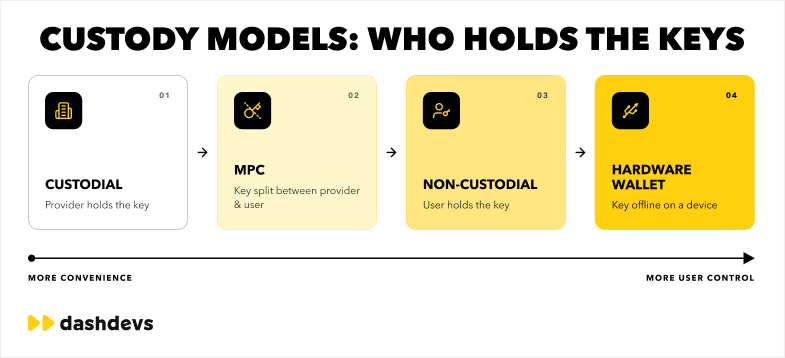
Pick the custody model first. It decides your security architecture and your regulatory obligations.
| Custody model | Who controls the keys | Best for | Main trade-off |
|---|---|---|---|
| Custodial | Your company (or a qualified custodian) | Exchanges, neobanks, regulated crypto services | You carry the security and licensing burden |
| Non-custodial (seed phrase) | The user | Crypto-native users, DeFi access | Lost seed phrase means lost funds |
| MPC wallet | Key shares split between user, server and sometimes a third party | Fintech apps that want self-custody with easier recovery | More complex to build and audit |
| Embedded wallet | User, via social login or passkey, backed by MPC or secure hardware | Mainstream apps where users never see a seed phrase | You depend on the embedded wallet provider |
MPC (multi-party computation) deserves a plain-language explanation. The private key is never stored in one place. Instead, it is split into shares, and a transaction needs several shares to sign. Steal one device and you still cannot move the funds. Our guide to how to create a digital wallet goes deeper on architecture.
Decide your recovery flow before you pick a vendor. “What happens when a user loses their phone?” tells you more about a wallet team than any portfolio page.
For a deeper look at self-custody inside fintech apps, read about non-custodial wallets in mobile apps.
How we scored crypto wallet development companies
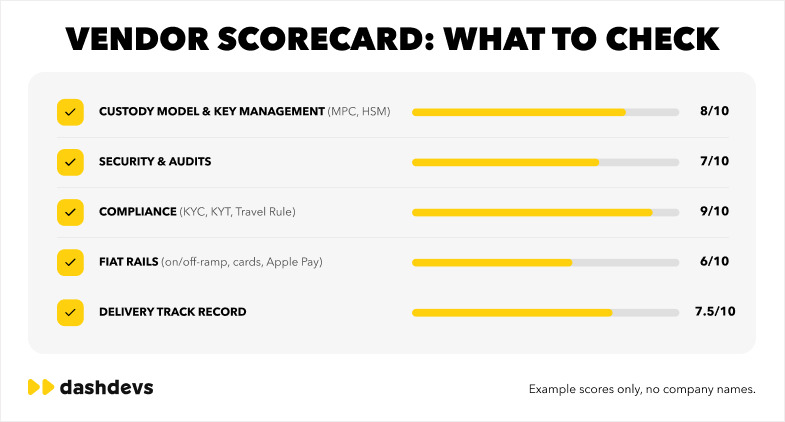
We scored each company on five criteria using only public evidence: their own case studies and press coverage.
| Criterion | What we looked for | Why it matters |
|---|---|---|
| Custody model | Shipped custodial, non-custodial or MPC wallets, with clear key management | Wrong custody design is the hardest thing to fix later |
| Key security | MPC, HSM, secure enclave, multisig or audited libraries named in case studies | This is what stands between users and theft |
| Compliance | KYC, AML or KYT screening integrated into real projects | Required as soon as you touch fiat or regulated users |
| Fiat rails | IBANs, cards, on/off-ramps or bank integrations delivered | Users expect to top up and cash out easily |
| Proof | Public case studies with features, timelines or numbers | Separates real delivery from marketing copy |
Scores use three levels:
- Shown: a public case study clearly describes it
- Partial: mentioned, but without detail
- Not shown: we could not find public evidence (which does not mean they cannot do it)
We are a crypto wallet development company ourselves, so we put DashDevs in the table with the same rules. Judge our evidence as strictly as everyone else’s.
Best crypto wallet development companies compared
Listed alphabetically. Evidence comes from each company’s public case studies as of November 2026. For a wider list, see our top blockchain development companies.
| Company | Custody model | Key security | Compliance | Fiat rails | Proof |
|---|---|---|---|---|---|
| Acropolium | Shown: flexible custody for retail and institutional users | Shown: KMS/HSM, multisig key encryption | Shown: GDPR, AML, KYC | Shown: fiat-to-crypto via bank and payment integrations | Shown: 35% less downtime, 25% more user acquisition |
| DashDevs | Shown: custodial and non-custodial, including Web3Auth-based wallets | Shown: in-house key management and signing; BitGo-based wallet operations in Fintech Core | Shown: KYC, KYB, KYT, AML, Travel Rule | Shown: EUR IBANs, SEPA/SWIFT, Visa cards, USDC | Shown: Kleos, Eleven, digital assets trading platform |
| Devexperts | Shown: non-custodial HD wallet | Partial: seed-phrase key derivation, MPC not mentioned | Shown: Elliptic AML screening | Shown: PayPal and Transak on-ramps | Shown: Chrome extension MVP, then Flutter mobile app |
| Idealogic | Shown: non-custodial wallet (Swissy) | Shown: secure-enclave key storage, social recovery | Not shown in wallet case | Not shown in wallet case | Shown: 4.6-star rating, 89% onboarding completion |
| Purrweb | Shown: multichain seed-phrase wallets | Not shown: client team built the backend | Shown: third-party KYC with ID and selfie | Shown: IBAN, virtual and physical cards | Partial: features listed, no performance metrics |
Acropolium
Acropolium built a custom crypto wallet for a German fintech with 55 employees. The case describes KMS/HSM security, multi-signature key encryption and fiat-to-crypto conversion through banking integrations. The client also asked for seedless social recovery.
Good fit if: you need a multi-region custodial wallet with compliance reporting.
DashDevs
DashDevs is a fintech product development company that designs, builds, and scales regulated financial products, and also works as a blockchain development company for crypto products. Our crypto wallet work sits next to banking and payments, which shapes how we build wallets.
Three projects show the range:
- Kleos. In our work with Kleos, we moved customers off a legacy app onto Fintech Core. Kleos users now see EUR IBAN accounts, Web3Auth-based wallets, USDC and Visa cards in one app. The MVP took 10 weeks.
- Eleven. The Eleven crypto wallet project put a BTC wallet inside a secure messenger, with direct blockchain access via SPV and wallet transfer between devices through a QR security check.
- Digital assets trading platform. For a digital assets trading platform we built, each user can hold 20 different tokens alongside multi-currency bank accounts.
DashDevs provided us with top-notch consulting as well as execution assistance.
— Albert Becker, customer representative, Eleven
Honest note: Eleven started when crypto transactions in consumer apps were still a barely tested technology. That was hard. The QR-based device transfer we added there came straight out of that struggle.
Good fit if: your wallet needs fiat rails and regulated compliance.
Devexperts
Devexperts built a non-custodial HD wallet for a US investment firm. It supports Bitcoin, Ethereum, Polygon, Base and Solana, with Elliptic AML screening and on-ramps through PayPal and Transak. The MVP launched as a Chrome extension before a Flutter mobile app.
Good fit if: you are a broker or investment platform adding a self-custody wallet.
Idealogic
Idealogic, based in Tallinn, built Swissy, a non-custodial wallet that keeps private keys in the device secure enclave and replaces the seed phrase with social recovery. They report a 4.6-star store rating and 89% onboarding completion.
Good fit if: consumer UX and seedless onboarding are your top priorities.
Purrweb
Purrweb designed and built the mobile app for ZoidPay, a crypto banking app with multichain wallets, an IBAN account and cards. The client’s own team built the backend, while Purrweb handled discovery, UI/UX, the mobile app and the admin panel.
Good fit if: you have a backend team and need a strong mobile and design partner.
Wallet infrastructure you can build on
Most teams build on a wallet infrastructure provider and let a development company handle the product around it.
| Provider | What it gives you | Notable 2025 to 2026 facts |
|---|---|---|
| Fireblocks | MPC wallets, policy engine, tokenization, network of institutions | Network connects more than 2,400 institutions |
| BitGo | Qualified custody plus self-custody wallets, multisig and MPC | Subsidiary converted to a federally chartered bank, BitGo Bank & Trust |
| Dfns | MPC and HSM wallet infrastructure via API | Reported over 15 million wallets for 250 clients in October 2025; powers IBM Digital Asset Haven |
| MetaMask Embedded Wallets (formerly Web3Auth) | Embedded wallets with social login and MPC key management | Web3Auth is now part of Consensys |
We use this approach ourselves. Fintech Core by DashDevs, DashDevs’ composable fintech infrastructure and orchestration platform, runs crypto wallet and transfer operations through BitGo. Read more about institutional custody through BitGo and our comparison of digital asset custody options.
What to look for in a crypto wallet development company
Ask for proof on custody, security, compliance and fiat rails, and test how the team thinks about recovery and failure.
Use this checklist in your first call:
- Can they show a shipped wallet with the same custody model you need?
- Which key management approach do they recommend, and why?
- How does account recovery work if a user loses their device?
- Which KYC, AML and KYT providers have they integrated?
- Have they delivered fiat features: IBANs, physical cards, Apple Pay, tap to pay?
- Which networks do they support, and how do they add new ones?
- Who audits the code, and can you see past audit reports?
- What happens after launch: who handles monitoring and incident response?
For a broader vendor framework, see our guide to evaluating fintech vendors.
If fiat matters for your product, compare how teams approach compliant crypto on/off-ramps and stablecoin payment rails.
Red flags to watch for
- A portfolio full of wallet designs with no technical case studies
- “We build any wallet in 4 weeks” with no questions about your custody model
- No answer to “how do users recover their funds?”
- Key management built from scratch when proven infrastructure exists
- No experience with compliance, even though your product touches fiat
Should you build, buy or partner?
Buy a white-label wallet when your needs are standard. Build on infrastructure when the wallet is a core product and you need both speed and control.
| Approach | Speed | Control | Best for |
|---|---|---|---|
| White-label wallet | Fastest | Low | Pilots, standard features, tight timelines |
| Custom build on wallet infrastructure | Medium | High | Fintechs where the wallet is a key product |
| Build on a fintech infrastructure platform | Fast | High | Crypto-fiat products with IBANs, cards and compliance |
Fintech Core by DashDevs is composable fintech infrastructure and orchestration for launching, expanding, or modernizing regulated financial products. It gives teams a faster starting point than custom build, with more flexibility and control than traditional white-label or SaaS platforms. It is typically 12 weeks into production, and it connects to the licensed banking, custody and card providers your product needs.
If your wallet needs fiat, see how Fintech Core delivers compliant crypto-fiat infrastructure.
Conclusion
The best crypto wallet development companies show their work. Look for public evidence on custody, key security, compliance and fiat rails, then test how the team handles recovery and failure.
Start with the custody model and the infrastructure under it. Then choose the crypto wallet app development company that has shipped something close to what you need.
DashDevs has 15+ years in regulated fintech and 100+ financial products delivered. Ready to build? Explore our crypto wallet development services.
Share article
