


7 Best Digital Banking Solutions and Providers in 2026

August 24, 2026
- Digital banking solutions cover engagement layers, cloud cores, white-label stacks, and modular platforms — not one interchangeable product category.
- Shortlist by operating model first: incumbent modernization, neobank launch, embedded finance, or white-label distribution.
- Score vendors on ledger honesty, API depth, onboarding conversion, CRM and payments fit, cybersecurity controls, and exit terms — not demo UI alone.
- Enterprise suites (Temenos, Finastra, FIS-class peers) optimize scale and compliance templates; composable and modular stacks optimize product velocity.
- DashDevs Fintech Core fits teams that need configurable white-label banking with provider-agnostic integrations rather than a fixed SaaS workflow.
Banks and fintech product teams do not shortlist digital banking solutions the way they shortlist a single checkout widget. They are choosing how account holders open products, move money, talk to the institution, and stay compliant — across online banking and mobile channels — while the ledger and partner rails stay coherent behind the scenes. Production-grade digital banking solutions also have to serve relationship managers and ops teams, not only the customer app.
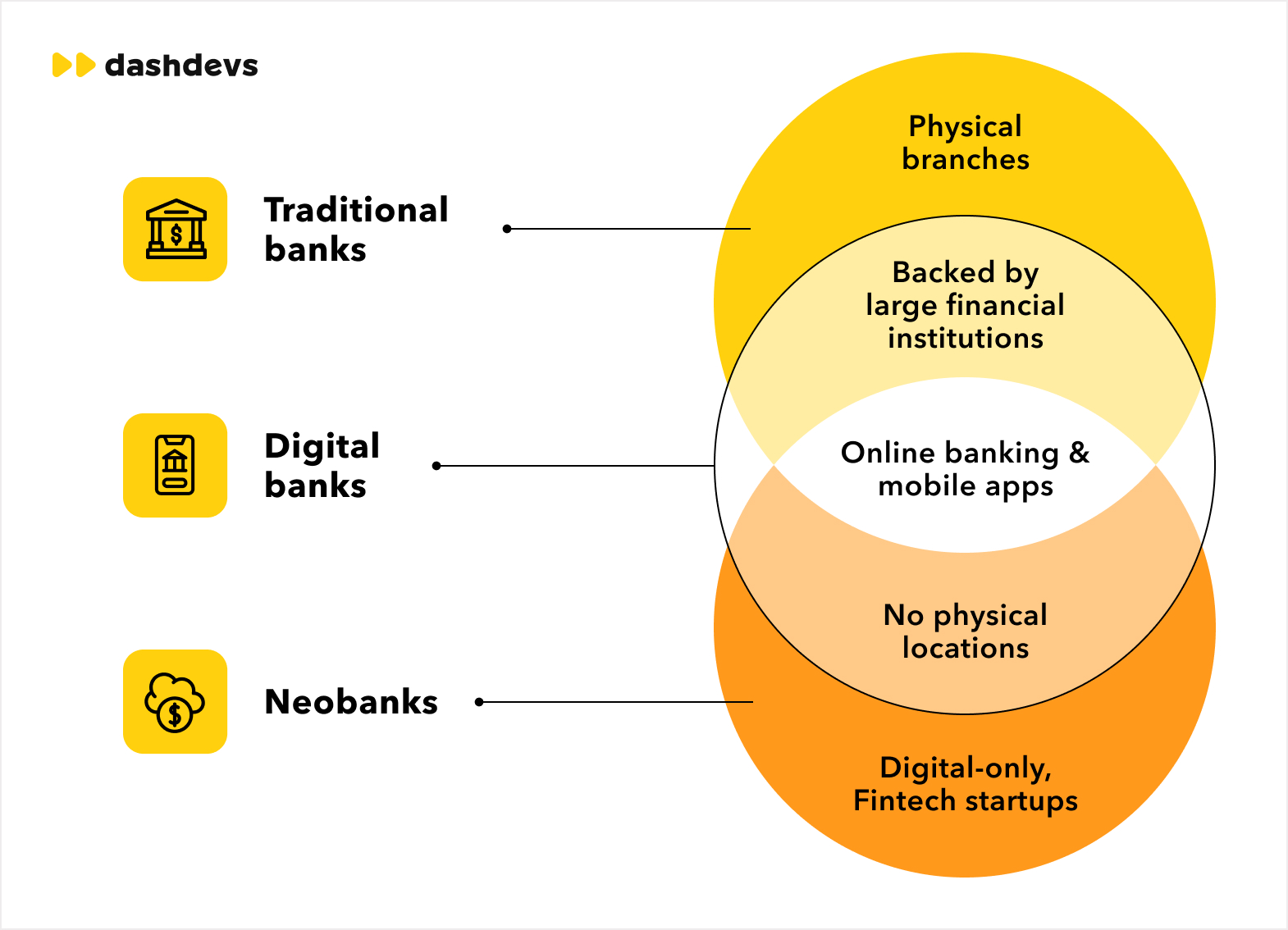
This guide compares seven digital banking platform providers and related stacks teams evaluate in 2026 RFPs. It is a decision frame for financial institutions, challenger banks, and digital banking companies building consumer and business offerings — not a logo popularity contest. For definitions and model types before you compare vendors, start with our primer on digital banking.
What counts as a digital banking solution in 2026
A banking solution in this category is more than a branded app shell. Production digital banking solutions typically combine:
- Customer channels (web, mobile, service desks) and a consistent banking experience
- Account management, payments, and product catalogs for retail and business banking
- Onboarding, KYC/AML hooks, and case workflows that protect conversion
- Integration to cores, card processors, CRM, and open-banking partners so teams can seamlessly integrate new rails
- Controls for fraud, access, and audit that satisfy cybersecurity and regulatory expectations
Some vendors sell a full digital banking platform. Others sell digital banking platform solutions that sit on top of an existing banking system. Still others sell modular white-label building blocks you assemble with licensed partners. Confusing those packaging models is how RFPs pick a demo winner that fails in operations.
How to shortlist digital banking platform providers
Use the same scorecard on every vendor before you read marketing pages:
| Criterion | Why it matters |
|---|---|
| Operating model fit | Incumbent modernization ≠ neobank MVP ≠ embedded finance |
| Ledger and product depth | Who owns balances, holds, fees, and multi-entity books |
| Channel and UX ownership | How much of the digital experience you can brand and change |
| Integration surface | Cores, cards, payments, CRM, and bank API integration cost |
| Compliance evidence | Regional licenses, audit artifacts, and control ownership |
| Economics and exit | License shape, professional services load, data portability |
Teams launching a challenger brand often need neobank app development services alongside platform selection. Teams modernizing an incumbent usually need a clearer cut between engagement layer and core banking solutions. Choosing a digital banking platform without that cut is how budgets migrate into endless integration change requests.
7 best digital banking solutions and providers compared
The profiles below represent digital banking software solutions and platforms that appear repeatedly in 2026 shortlists. Re-validate packaging, regions, and licenses in diligence — vendor catalogs change faster than blog posts.
1. DashDevs Fintech Core — modular white-label banking stack
DashDevs delivers Fintech Core as a configurable white-label fintech platform for teams that need accounts, payments, cards, compliance integrations, and provider abstraction without a rigid SaaS ceiling. It is closest to innovative digital banking solutions when product scope will change across regions and partners.
- Best fit: PSPs, EMIs, wallets, and brands assembling white label banking under their roadmap
- Strength: Modular architecture and engineering delivery through a white label fintech solutions provider model
- Watch-out: Requires deliberate implementation strategy — not a one-click theme swap
- Pair with: ewallet app development when balances and cards sit beside banking UX
2. Backbase — engagement-led channel suite
Backbase is widely used by incumbent financial services groups that want a modern omnichannel experience on top of existing cores. Its value is customer journeys, personalization, and time-to-digital for retail and business banking portals.
- Best fit: Established banks refreshing the digital experience without an immediate core rip-and-replace
- Strength: Channel and engagement depth across consumer and business segments
- Watch-out: Success still depends on core, payments, and data quality underneath the UX layer
3. Temenos — enterprise digital banking and core breadth
Temenos remains a default shortlist name when large institutions want proven scale across products and markets. Buyers treat it as one of the top digital banking platforms when they need enterprise templates, multi-country programs, and long-running transformation partners.
- Best fit: Multi-entity banks and complex product catalogs
- Strength: Breadth across core and digital banking capabilities
- Watch-out: Implementation weight and change programs are rarely “lightweight SaaS”
4. Mambu — cloud-native composable core for digital products
Mambu is frequently evaluated among best digital banking platforms for challengers and digital-first lenders that want a composable core with strong API orientation. It suits teams shipping products quickly while keeping the banking system cloud-operable.
- Best fit: Neobanks, digital lenders, and fintechs composing products via APIs
- Strength: Configurability and cloud delivery speed
- Watch-out: Channel UX, CRM, and some market connectors may still be assembled around the core
5. Thought Machine — cloud-native ledger-centric banking system
Thought Machine’s Vault-centric approach attracts banks that want a modern ledger foundation and product flexibility. It shows up on lists of top rated digital banking platforms when architecture quality and cloud operations are board-level priorities.
- Best fit: Institutions rebuilding core logic for real-time products
- Strength: Smart contracts / product definition model and cloud-native posture
- Watch-out: Program complexity and partner ecosystem maturity vary by market
6. Finastra — banking IT solutions across wholesale and retail
Finastra provides banking IT solutions spanning payments, lending, and digital channels for financial institutions that already run broad Finastra estates — or want suite continuity. It is often grouped with digital banking solution providers that sell depth inside an enterprise relationship, not only a front-end app.
- Best fit: Banks standardizing on a wide vendor suite
- Strength: Cross-domain coverage inside financial services portfolios
- Watch-out: Confirm which modules are truly digital-channel ready versus back-office heavy
7. FIS — scale digital banking for large consumer franchises
FIS-class platforms remain relevant when the buyer is a large retail bank optimizing deposit servicing, cards adjacency, and high-volume digital channels. Among vendors with deep North American footprints, FIS is still a pragmatic shortlist entry for scale and operational process coverage.
- Best fit: Large retail banks and processors aligned to FIS ecosystems
- Strength: Operational scale and established servicing patterns
- Watch-out: Less ideal as a greenfield modular stack for a 10-person fintech squad

Comparison snapshot: provider fit at a glance
| Provider / stack | Primary model | Strongest fit | Main limitation |
|---|---|---|---|
| DashDevs Fintech Core | Modular white-label | Configurable launch with swappable providers | Needs implementation ownership |
| Backbase | Engagement platform | Incumbent digital experience programs | Depends on underlying core quality |
| Temenos | Enterprise suite | Multi-market bank transformations | Heavy delivery programs |
| Mambu | Composable cloud core | API-first digital products | Channels and CRM often separate |
| Thought Machine | Cloud-native core | Ledger-led modernization | Complex implementation |
| Finastra | Enterprise banking IT | Suite buyers across domains | Module-by-module diligence required |
| FIS | Scale retail digital | High-volume consumer banking | Not a lightweight startup default |
These are among the best digital banking solutions on many 2026 shortlists — but “best” still means best for a stated operating model. Teams hunting best digital solutions for banking should write that model on one page before vendor demos begin.
Capabilities that separate demos from production
Onboarding and account opening
Conversion dies in KYC friction. Evaluate digital account opening software depth: document capture, risk scoring hooks, drop-off analytics, and how cases escalate to humans. Small businesses and retail flows rarely share the same form logic — ask for both if you sell business banking.
Payments and gateway adjacency
A stack that cannot explain settlement and disputes will create finance fire drills. When acceptance sits beside accounts, re-score candidates against white-label payment gateway providers criteria: PCI scope, method coverage, and funding reports.
CRM and customer relationship workflows
Service quality is part of the banking experience. Generic CRM tools often fail regulated case types — use a banking-specific lens from our guide to banking CRM systems when the RFP includes servicing, collections, or relationship management.
APIs and open banking
Digital banking solutions that cannot expose or consume APIs cleanly stall partnerships. Pressure-test bank API integration patterns: auth, consent, idempotency, and sandbox parity for third-party and internal consumers.
Security and resilience
Treat cybersecurity in banking as a selection gate: identity, fraud signals, segregation of duties, logging, and incident playbooks. The best digital banking software still fails if access control and monitoring are afterthoughts.
Mobile delivery
Channel strategy shapes vendor choice. If mobile is the primary bank, align platform capabilities with a realistic mobile banking app development plan — SDK quality, offline edge cases, and release cadence matter as much as Figma screens.

Where AI belongs on the scorecard
Vendors increasingly market best AI-powered digital banking solutions for servicing copilots, next-best-action, and fraud scoring. Treat AI as an accelerator on clean data and controlled workflows — not a substitute for ledger design, reconciliation, or KYC policy. Ask where models run, what PII they see, how decisions are audited, and whether human override is first-class.
Build, buy, or assemble
| Approach | When it fits | Typical trade-off |
|---|---|---|
| Buy suite platform | Incumbent needs speed on channels with known vendor estate | Less uniqueness; roadmap dependency |
| Buy composable core | Digital-native products with API-first teams | You still own channels and ops tooling |
| Assemble modular white-label | Differentiated products and provider flexibility | Higher implementation discipline |
| Build heavily custom | Rare IP-heavy cases with strong engineering capacity | Longest path to regulated production |
Many programs assemble: an engagement layer for channels, a modern core or ledger, and modular pieces for cards or wallets. That is also where creating a white-label bank with Fintech Core becomes a practical pattern rather than a slogan.
Practical shortlist process
- Write the one-pager: brand owner, license perimeter, retail vs business banking, corridors, go-live date.
- Pick the model: engagement platform, composable core, enterprise suite, or modular white-label — then name the digital banking platform role in that model.
- Run three vendors maximum through the same scorecard.
- Prove sandbox → production parity on onboarding, payments, and servicing cases.
- Negotiate exit, data export, and provider-swap terms before volume commitments.
Top digital banking solutions earn their place by surviving month-end reconciliation and peak-hour servicing — not by winning a slide deck. Prefer vendors and delivery partners that show production references in your use case and treat infrastructure as a system.
Final take
The best digital banking solutions for 2026 are the ones that match your operating model, compliance perimeter, and engineering reality. Use this list of seven digital banking platform solutions as a structured shortlist, then validate ledger honesty, integration cost, and customer relationship tooling in diligence.
Whether you need top digital banking platforms for an incumbent refresh or modular software for a new brand, insist on clear ownership of accounts, APIs, and security before the contract closes. DashDevs helps teams evaluate stacks, integrate partners, and ship branded banking products without locking the roadmap into a single rigid vendor path.
Share article
