


Best Software for Investment Portfolio Management: A Guide for Fintechs and RIAs

September 23, 2026
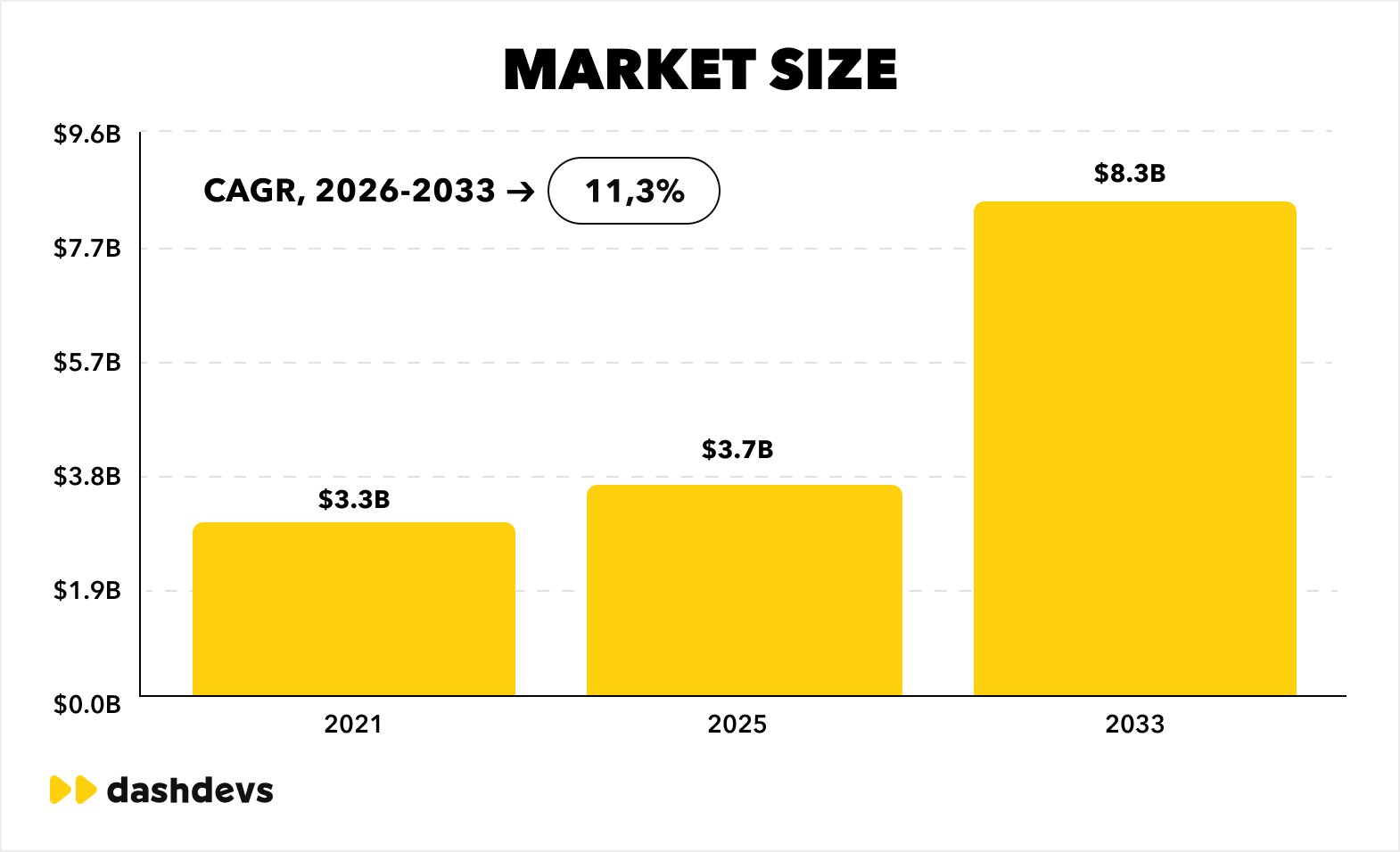
- The investment portfolio management software market reached $3.73 billion in 2025 and is projected to reach $8.32 billion by 2033 at an 11.3% CAGR.
- The RIA industry set records in 2025: 16,544 SEC-registered firms managing $176.8 trillion for 73.7 million clients, with AUM up 22.3% year-on-year.
- Most off-the-shelf portfolio tools were built for individual investors or tier-one institutions. Fintechs and growing RIAs sit between both.
- The build-vs-buy decision is not binary. Compliance environment, client complexity, and product control requirements each shift the answer.
- Compliance is the most consistently underestimated build cost. SEC, FCA, and MiFID II requirements shape architecture decisions that cannot be retrofitted cheaply once the platform is in production.
Most fintech product teams and RIA operations leaders arrive at this the same way: they have outgrown spreadsheets, evaluated three or four off-the-shelf platforms, and found that none quite fits — too rigid for their client experience, too expensive to integrate, or too limited for the asset classes they actually manage.
This is not a technology procurement problem. It is a product architecture problem dressed up as one. The right software for investment portfolio management depends on what you are building, who you are serving, and where compliance risk lives in your stack.
This guide is for those evaluating whether to integrate, white-label, or build portfolio management capability, and for RIA and wealth management decision-makers who need software for investment portfolio management that handles real-world complexity without requiring a mid-sized dev team to maintain it.
Why Portfolio Management Software Matters Now More Than Ever
SEC-registered advisory firms reached 16,544 in 2025, managing $176.8 trillion for 73.7 million clients, a 22.3% AUM increase year-on-year.
At the same time, the global market for portfolio management software reached $3.73 billion in 2025 and is projected to reach $8.32 billion by 2033 at a CAGR of 11.3%, driven by AUM complexity, regulatory mandates, and the accelerating shift to cloud deployment. A firm managing 500 client portfolios across multiple asset classes while maintaining SEC or FCA compliance cannot do this at scale without purpose-built portfolio management tools. The software for investment portfolio management question is really a capacity and risk question.
What Investment Portfolio Management Platforms Actually Do
Any serious platform must cover portfolio construction and rebalancing across accounts and asset classes, performance measurement (TWR, MWR, attribution), risk analytics (concentration, drawdown, stress testing), investor-facing dashboards and regulatory reporting, custody and market data integration, and a tamper-evident compliance audit trail aligned to SEC, FCA, or MiFID II requirements.
Where platforms diverge is in multi-asset complexity, multi-custodian environments, white-label depth, and API accessibility for fintech teams that need to embed rather than operate a standalone tool. A platform built for a single-custodian RIA managing domestic equities will not support a fintech building a multi-asset, multi-jurisdiction investment product.

Leading Investment Portfolio Management Software for Advisors and Fintechs
The platforms below cover the most commonly evaluated investment portfolio management software for advisors and fintech product teams in the mid-market. For teams focused specifically on investment portfolio management software for advisors (covering micro-investing, robo-advisory, or embedded wealth products), the comparison table that follows maps all options against criteria that matter in a real evaluation.
Orion Investment Portfolio Management Software
Orion is one of the most established portfolio management software for advisors in the RIA channel, covering portfolio accounting, performance reporting, rebalancing, billing, and client-facing reporting in a unified environment, with strong custodial integration across Schwab, Fidelity, and Pershing. It works best for established RIAs with portfolios of domestic equities and mutual funds. It shows its limits in multi-asset complexity, white-label flexibility, and API access for custom product builds.
Addepar
Addepar is purpose-built for demanding portfolio analytics requirements, alternative assets, private equity, and complex multi-custodian portfolios. As portfolio management software for institutional investors and family offices, it excels at data aggregation and performance analysis for wealth managers holding non-standard assets that generic platforms cannot model accurately. The trade-off is implementation depth and cost: over-specified for retail or mass-affluent fintech products, often the most defensible choice for platforms managing alternatives at real scale.
SS&C Black Diamond
SS&C Black Diamond Wealth Solutions, rebranded under SS&C Technologies in 2025, serves over 800,000 active users across more than 3,000 firms managing more than $3.6 trillion in assets, with data aggregated from hundreds of custodial and market data sources daily. Named best-in-class in the 2025 Datos Matrix for Portfolio Management and Client Reporting Providers for RIAs, it is the benchmark for advisor-centric reporting and billing workflows. API exposure has improved but remains limited for fintech embedding.
Tamarac (by Envestnet)
Tamarac combines portfolio management, rebalancing, reporting, CRM, and client portal in an integrated advisor environment. Envestnet continued active Tamarac development in 2026, including quarterly releases with expanded trading oversight and mobile client experience. It works well for RIAs wanting managed account infrastructure without building trading workflows from scratch. For independent fintechs building differentiated products, the Envestnet ecosystem dependency is typically a disqualifier.
Morningstar Direct
Morningstar Direct is best understood as a research and analytics tool that extends into portfolio construction and reporting. It is a genuine differentiator for advisors whose value proposition is grounded in fund selection and model construction. For fintechs needing real-time transactional infrastructure or a client-facing investment experience, it is not the right architectural layer.
Charles River Development (a State Street company)
Charles River Development, acquired by State Street Corporation in 2018 and now forming the front-office layer of State Street Alpha, is institutional investment management software at enterprise scale. Investment and wealth managers in approximately 30 countries rely on Charles River IMS to manage USD $59 trillion in assets. The December 2025 T. Rowe Price migration to Charles River IMS is the most recent public proof point of its positioning. This is the competitive benchmark for front-to-back investment operations, not a platform most RIAs or growth-stage fintechs will evaluate.
FactSet
FactSet is an analytics and data layer rather than an operational portfolio management platform, strong for performance attribution, risk modelling, and investment research, and weaker as a standalone system for client portfolio management at an advisory scale.
Portfolio Management Solutions for Advisors and Fintechs
No single platform earns the title of top portfolio management software across all use cases. Whether you are choosing investment portfolio manager software for a growing advisory firm or evaluating software at enterprise scale, use this comparison as a starting point.
| Platform | Best For | Multi-Asset | API / Embed | Custodial Integration | Compliance Depth | Implementation |
|---|---|---|---|---|---|---|
| Orion | RIAs (domestic, mid-market) | Moderate | Limited | Strong (Schwab, Fidelity, Pershing) | SEC-aligned | Low–Mid |
| Addepar | Institutional / alternatives-heavy | High | Moderate | Strong (multi-custodian) | High | High |
| SS&C Black Diamond | Mid–large advisory firms | Moderate | Improving | Hundreds of sources, 3,000+ firms | High | Mid |
| Tamarac (Envestnet) | RIA advisor desktops | Moderate | Limited | Envestnet ecosystem | Moderate | Mid |
| Morningstar Direct | Research-led advisors | Low–Moderate | Limited | Moderate | Moderate | Low |
| Charles River (State Street) | Institutional / front-to-back | Very High | High | ~30 countries, $59T AUM | Very High | Very High |
| FactSet | Analytics / institutional | High | High | Data-focused | High | High |
The platform that scores highest on every dimension doesn’t exist. The correct choice matches your client complexity, compliance environment, and product architecture.
The Build-vs-Buy Framework for Investment Portfolio Management
The build-vs-buy decision for software for investment portfolio management is answered by five variables. Before running any investment portfolio management software comparison, work through each of these: they determine whether the right answer is buying off-the-shelf software, white-labeling a platform, or building custom. Our build vs buy vs partner framework applies the same decision logic across fintech infrastructure choices.
Client complexity
Domestic equities and mutual funds are well-served by off-the-shelf platforms. Alternative assets, cross-border portfolios, structured products, or tokenized assets are either poorly supported or require significant customization. If your client complexity exceeds what standard platforms support cleanly, you are already in custom territory.
Regulatory jurisdiction
A platform serving SEC-registered advisors in the US has different reporting, suitability, and recordkeeping obligations than one under FCA supervision in the UK or MiFID II in the EU. Engaging fintech consulting before committing to a platform architecture surfaces these regulatory gaps before they become delivery blockers.
Product control and white-label requirements
Off-the-shelf platforms vary significantly in white-label depth. If your product differentiation depends on the investment experience you deliver to clients, constraining that experience is a strategic trade-off. Teams navigating this typically weigh white-label vs. custom software development options before finalizing their approach.
Integration architecture
Investment portfolio management tools connect to custody platforms, market data providers, accounting systems, and compliance infrastructure. A platform that requires proprietary connectors or exposes a minimal API surface will generate ongoing engineering debt. Leveraging fintech integrations early in the evaluation consistently reduces delivery risk. It is worth reviewing wealth management platform integration options early.
Time-to-market vs. long-term control
Buying accelerates launch but constrains future product decisions. Building gives control but delays time-to-market. White-labeling and composable infrastructure sit between these poles. Decision rule: if portfolio management is your core differentiator, build. If it is infrastructure enabling a different differentiator, buy or white-label.
What Makes Investment Portfolio Management Software Hard to Build
The complexity lives in the data layer and the compliance layer. When teams first evaluate software for investment portfolio management, they focus on the dashboard and reporting UI. The real differentiators are invisible until something breaks in production.
Data integrity. Portfolio accounting accuracy depends on corporate action handling (splits, dividends, and spin-offs), multi-currency conversion, and cost basis calculation across accounts. Teams that underestimate this rebuild their accounting engine six to twelve months after launch. The portfolio management tools used for rebalancing and reporting are only as reliable as the data layer underneath them. Our analysis of real-time trading platform development covers the architectural decisions this involves.
If stock trading app development is part of your roadmap, note that the data model decisions made at the portfolio layer directly constrain what is possible at the trading layer.
Performance calculation and audit trail. Institutional and regulatory standards (GIPS, TWR, MWR) require specific methodologies. Getting these wrong creates regulatory and liability exposure, not just inaccurate reports. Every transaction and portfolio change requires a tamper-evident audit trail embedded in the data architecture from day one. This is not a feature you add later. Software for investment portfolio management built on a reactive compliance approach almost always requires a costly rebuild within two to three years.
The teams that rebuild their portfolio management infrastructure most often aren’t the ones who built badly. They are the ones who built without compliance-first architecture from the start.
We also recommend reading our guide on how to create a trading platform. The compliance architecture decisions overlap significantly.

Cloud Investment Portfolio Management Software: What Actually Matters
Cloud deployment held the largest share of the investment platform market in 2025, according to Grand View Research. But “cloud-based” is a marketing term that obscures meaningful architectural differences. The questions that actually matter when evaluating investment manager software:
Is the data layer multi-tenant or dedicated?
How is custodial data synchronization handled: streaming or batch?
Where does the calculation engine run, and what are the contractual consequences of downtime for a regulated financial product?
Compliance Considerations That Shape Platform Choice
SEC-registered RIAs face recordkeeping requirements under the books and records rules, performance advertising standards under the Marketing Rule (adopted December 2020, effective November 2022), and suitability documentation obligations. A platform that cannot produce compliant performance reports or maintain the required audit trail creates regulatory exposure regardless of its feature set.
FCA-regulated investment managers operate under client suitability assessments, MiFID II-derived best execution obligations, and COBS-aligned reporting requirements, frameworks that US-centric platforms often require meaningful customization to meet. Fintechs building embedded investment products frequently underestimate that the embedded capability carries the same regulatory obligations as a standalone advisory platform. A core banking vendor due diligence checklist approach applied to investment software procurement surfaces compliance gaps before they become delivery blockers.
Watch-Outs: Where Investment Platform Builds Go Wrong
Watch-out 1: Scoping to current asset classes only
A platform built for domestic equities that cannot support alternatives, fixed income, or digital assets will require replacement as the product grows. Build or buy for the asset class roadmap.
Watch-out 2: Treating custodial integration as a vendor-solved problem
Each custodian has its own data format, reconciliation timing, and error handling. Multi-custodian environments multiply this complexity. Custodial integration is a data engineering problem.
Watch-out 3: Choosing a platform for its UI rather than its data model
The interface can be replaced. The data model (how positions are stored, how cost basis is calculated) can’t be refactored without effectively rebuilding the system.
Watch-out 4: Missing the integration cost in TCO
Platform licensing is rarely the highest cost. Integration with custodians, accounting systems, and compliance infrastructure often represents two to three times the license cost. Evaluating custom software development options alongside platform procurement produces more accurate cost models. And underestimating risk management in fintech at scale (exposure monitoring, stress testing, and scenario analysis) is a separate failure mode that consistently compounds integration cost.
Watch-out 5: Overlooking operational automation as a cost lever
Firms that have reduced manual portfolio operations through RPA in fintech workflows report meaningfully lower ongoing integration overhead. That saving belongs in any realistic TCO model before a build-vs-buy decision is finalized.
What DashDevs Has Built in Investment Portfolio Management
For Downing, a UK-based sustainable investment management platform operating across renewable energy, infrastructure, property, and healthcare with over 25,000 investors, DashDevs delivered a complete architecture modernization: a new web application, portfolio analytics infrastructure, and investor onboarding workflows aligned to FCA requirements. The result was 2× annual revenue growth (from £1.8M to £3.6M) and growth to 25,000+ users.
For a separate London-based investment analytics platform (NDA), DashDevs built a secure, scalable product with portfolio analysis, model comparisons, and personalized investor dashboards, integrating proprietary Python-based investment scoring, Amazon Cognito, and Stripe, in 7 months on a $100K+ budget, delivering 95%+ faster portfolio insights.
Both builds share the same pattern: compliance-first data architecture from day one, modular models that support asset class expansion, and reporting infrastructure designed for regulatory audit trails.
The difference between a portfolio platform that survives a compliance review and one that doesn’t is rarely the front end. It is whether the data model was designed around regulatory requirements or adapted to meet them after the fact. After 17+ years shipping regulated financial products, that distinction shows up earlier than most teams expect — usually in discovery, not in a post-launch audit.

How Fintechs Should Think About Embedding Portfolio Management
For fintechs embedding investment capability into an existing product (a neobank, a savings platform, or a micro-investing feature), the question is not which investment portfolio manager software to deploy. It is which layer of the investment stack to own, which to buy, and how to ensure the embedded experience does not compromise the core product’s regulatory standing.
Composable financial infrastructure (portfolio management capability accessed through APIs alongside payments, KYC, and ledger infrastructure) is the increasingly common architectural pattern. This is the model behind Fintech Core, DashDevs’ composable banking platform. The launch-ready fintech infrastructure approach is usually more capital-efficient than a full custom build and more controllable than a constrained white-label product.
Check out our article on how to build a micro-investing platform to scope the investment management component without overbuilding.
How to Select the Right Portfolio Management Solution
Step 1. Define client complexity first
Asset classes, account structures, custodian relationships, and multi-currency requirements should be documented before any platform is evaluated. Whether you are evaluating investment manager software for a single-custodian RIA or a multi-asset fintech product, any platform that cannot support your current complexity is off the shortlist before the demo.
Step 2. Map compliance to architecture
SEC, FCA, and MiFID II obligations translate into specific technical requirements: audit trail depth, reporting formats, and data retention rules. These belong in your evaluation criteria.
Step 3. Model total cost of ownership over three years
Include licensing, implementation, integrations, support, and internal engineering time. For most mid-market RIAs and fintechs, this number is significantly higher than the platform license alone, which often changes the build-vs-buy answer. Test with real data before committing: a proof-of-concept using a portfolio manager software deployment against your actual client data is the only reliable test of fit.
Our guide on how to select the right fintech vendor provides a reusable evaluation framework for this process.
The Decision That Has to Be Made
The honest answer to “Which best investment portfolio management software fits our needs?” depends on five things:
- client complexity
- regulatory jurisdiction
- product control requirement
- integration architecture
- time-to-market priority
Optimizing for one without the others produces the wrong answer.
For straightforward advisory environments, the best investment management software is often the platform already widely deployed in your segment. The custom build case is strongest when compliance is unusual, the asset class mix is non-standard, or the embedded experience is itself the product. Everything else sits in the composable middle. What defines the best software for investment portfolio management in your context is not the most feature-rich, but the one that serves your clients, satisfies your compliance obligations, and does not constrain your product roadmap. Software for investment portfolio management that scores well on vendor demos but fails on integration depth or compliance audit trail will cost more to fix than it saved at procurement.
Share article
