


9 Best Stablecoin API Providers for Fintechs in 2026

September 30, 2026
- There is no single best stablecoin API. Issuance, payouts, custody, and cross-chain transfers are four different jobs, and most fintechs end up with two or three providers.
- Licensing decides your shortlist before features do. MiCA's transitional period closed on 1 July 2026, and the GENIUS Act takes effect no later than 18 January 2027.
- Consolidation is real. Stripe owns Bridge and Mastercard completed its BVNK acquisition on 3 August 2026, so check whose roadmap you are signing up for.
- Lock-in risk sits in your ledger. If provider IDs and balances live only on the vendor side, switching later means a migration project.
- An orchestration layer lets you run two providers for the same job and fail over when one stalls.
Open any list of the best stablecoin API providers and check who wrote it. The author is almost always ranked #1. Funny how that works.
We build stablecoin products for licensed fintechs and don’t sell an API of our own. So this ranking groups providers by the job you need done and shows what each one costs you in integration work and lock-in.
What is a stablecoin API?
A stablecoin API is a set of HTTP endpoints that lets your product mint, hold, move or convert digital dollars without running blockchain nodes or a crypto compliance program yourself.
The volume behind these calls is no longer experimental. Stablecoin transfers hit a record $4.5 trillion in Q1 2026, according to Forbes. More of that flow runs through fintech integrations every quarter.
Here’s the catch. The label stablecoin API covers very different products. Comparing them on one list is like comparing a bank with a vault.
What jobs can stablecoin infrastructure do for a fintech?
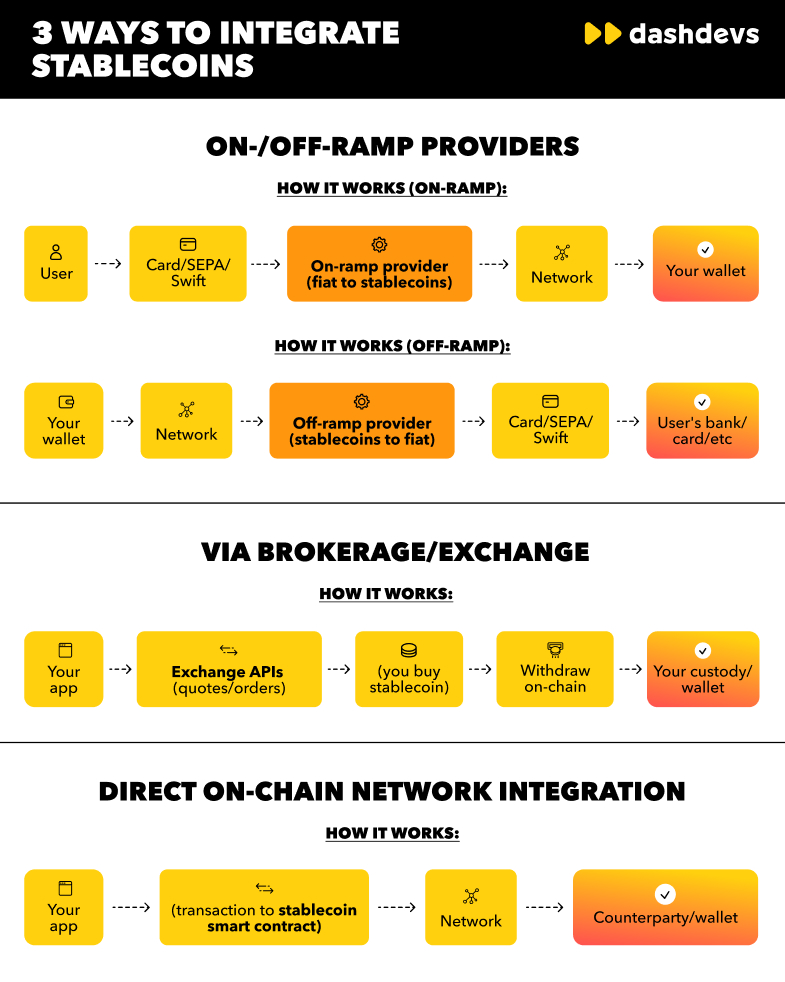
When we scope stablecoin infrastructure with clients, it almost always splits into four jobs:
- Issuance and treasury. Minting and redeeming USDC or USDT against fiat, or launching a branded stablecoin.
- Payouts and on/off-ramps. Converting fiat and stablecoin in both directions and paying out in local currency over bank rails.
- Wallets and custody. Holding keys, signing transactions and enforcing policies on who can move what.
- Cross-chain routing. Moving value between networks when your user holds USDC on Base and the recipient wants it on Solana.
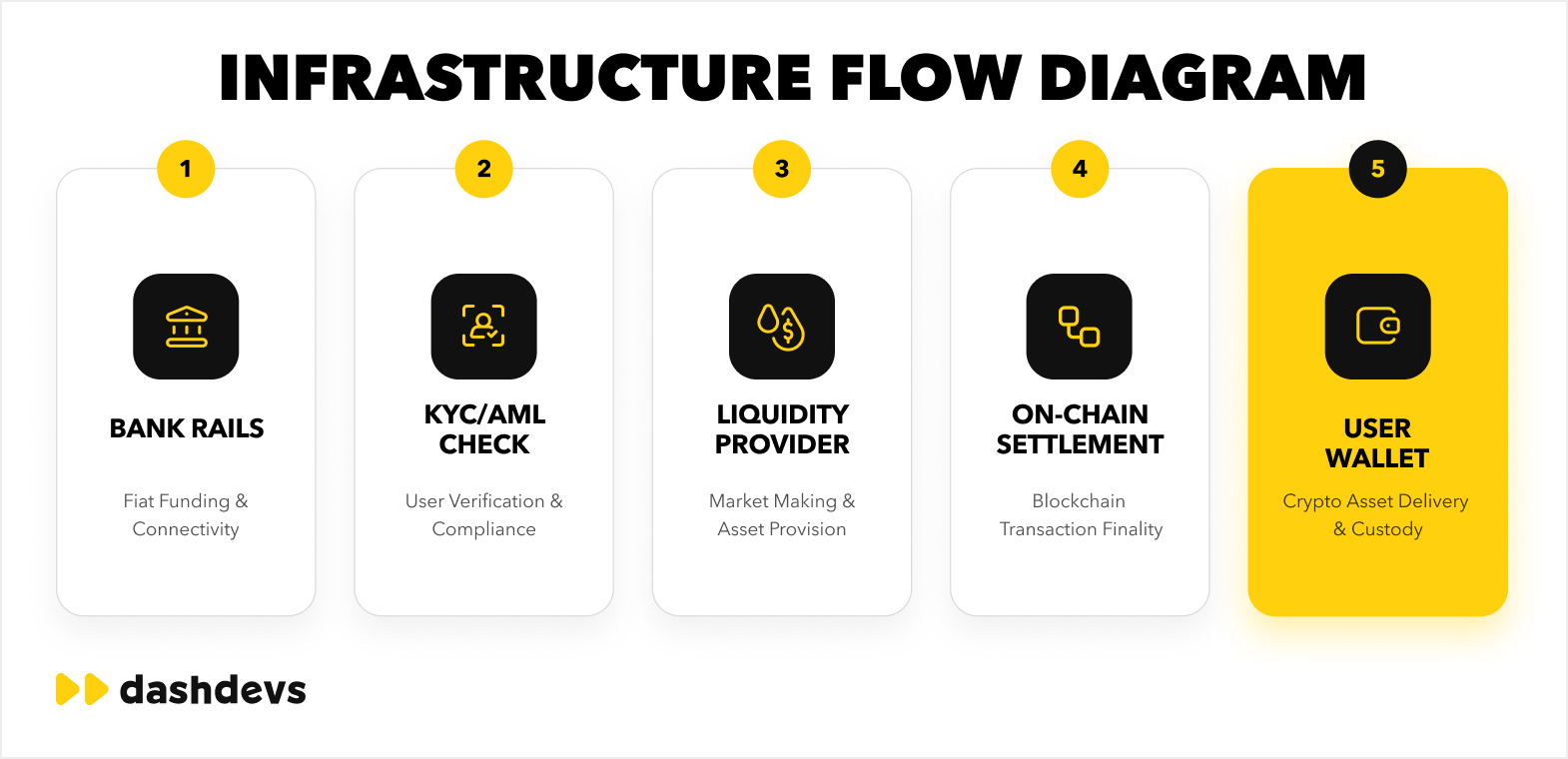
Kebbie Sebastian, CEO of Merge, described the pattern well on our Fintech Garden podcast, episode 140. Kebbie calls it the stablecoin sandwich: fiat goes in, stablecoins move in the middle, fiat comes out. The on-chain part is the easy bit. The hard problems sit at the edges, where compliance meets last-mile access to local payment rails.
That matches what we see in delivery. Most of the integration effort goes into the two slices of bread. If you want the business case first, our guide to stablecoins for cross-border payments covers it.
How did we rank these stablecoin API providers?
We ranked each provider inside its job category, judged from the integrator’s side of the contract. Licensing coverage and lock-in risk moved the ranking most.
Why those criteria? Because we learned them the expensive way. Kleos, a non-custodial finance platform we work with, started on a provider-dependent stack where wallet custody and banking ran in separate environments, each with its own provider. Every new feature meant coordinating changes across disconnected systems. Ouch.
We moved Kleos onto Fintech Core with Web3Auth MPC wallets and USDC on Ethereum. The MVP with IBAN accounts and SEPA/SWIFT transfers shipped in 10 weeks, and the yield vaults followed 6 weeks later. That project taught us to price the exit before we price the entry. The painful part is not the new API. It is mapping old provider IDs onto a ledger you should have owned from day one.
Here is what we scored:
- Job fit. Does the provider own this job end to end, or resell a partner for part of it?
- Licensing coverage. Which entity holds the license for your flow under the GENIUS Act in the US and MiCA in the EU?
- Integration effort. How many systems you have to touch: API, webhooks, KYB, ledger mapping and reconciliation.
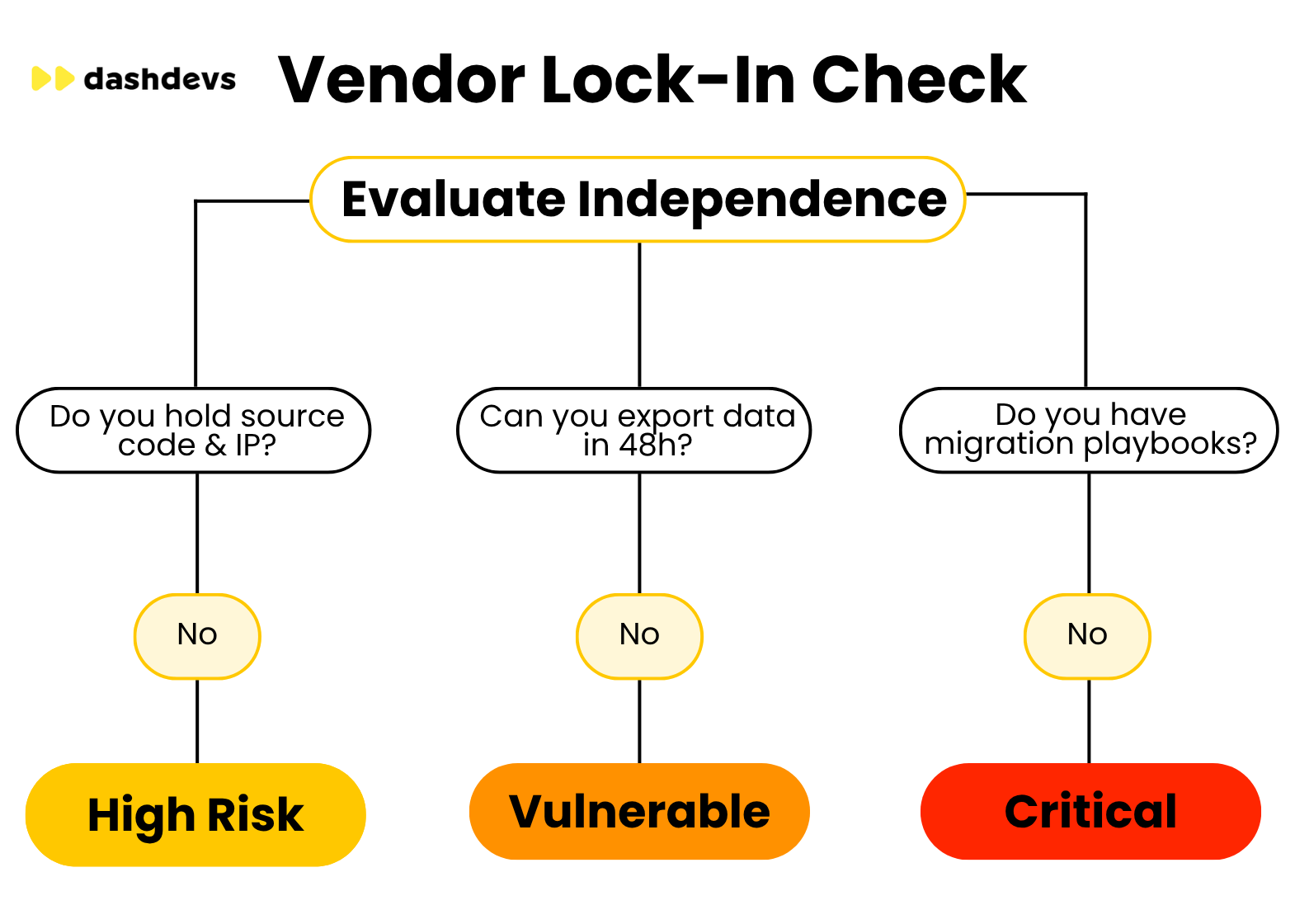
- Lock-in risk. Whether you can export balances and full transaction history, and whether the provider pushes one chain or one stablecoin.
- Chain and asset coverage. USDC or USDT, EURC, and the networks your users actually hold funds on.
We did not score price. Almost every provider on this list quotes enterprise pricing per deal, so any number we printed would be a guess.
Pro tip: Ask every vendor for their sandbox webhook catalogue before the first sales call. The number of event types tells you more about integration effort than the API reference does. After 17+ years shipping regulated rails, the integrations that blow up later are the ones that looked simple in the happy-path docs.
Best stablecoin API providers compared
The nine best stablecoin API providers for fintechs in 2026 are Circle, Paxos, Bridge, BVNK, zerohash, Fireblocks, Coinbase Developer Platform, LayerZero and LI.FI, grouped below by the job each one does best.
| # | Provider | Job | Main assets | US licensing | EU (MiCA) | Integration effort | Lock-in risk |
|---|---|---|---|---|---|---|---|
| 1 | Circle | Issuance, treasury, USDC routing | USDC, EURC | OCC national trust bank approved (July 2026) | EMT issuer for USDC and EURC | Medium | Medium: USDC only |
| 2 | Paxos | White-label issuance | USDG, PYUSD, USDP | OCC national trust charter since Dec 2025 | EMI in Finland | High | Low to medium |
| 3 | Bridge (Stripe) | Orchestration, ramps, issuance | USDC, USDT, USDB | Conditional OCC trust charter (Feb 2026) | Confirm per flow | Low to medium | High in the Stripe stack |
| 4 | BVNK (Mastercard) | B2B payouts and settlement | USDC, USDT, EURC | Confirm per flow | MiCA licence (Feb 2026) | Medium | Medium |
| 5 | zerohash | Embedded ramps for regulated firms | USDC, USDT, USDG and more | Multi-state money transmission | Confirm per flow | Medium | Medium |
| 6 | Fireblocks | Custody, wallets, settlement network | 1,000+ tokens | NYDFS trust company | Via network partners | High | Medium |
| 7 | Coinbase Developer Platform | Wallets and USDC payments | USDC on Base first | Coinbase entities | Confirm per flow | Low | High: Base and USDC |
| 8 | LayerZero | Cross-chain messaging (USDT0) | USDT0, OFT tokens | Open protocol, no license | Protocol | Medium | Low |
| 9 | LI.FI | Cross-chain routing aggregator | Any routed asset | Protocol, non-custodial | Protocol | Low | Low |
Integration effort and lock-in risk are our editorial assessment, based on public docs and the integration patterns we see in delivery. Where the table says Confirm per flow, the provider’s coverage depends on which entity serves your corridor, so ask for the license map in writing.
Issuance and treasury: who mints the dollars?
Issuance providers sit closest to the money. You go to them when you need to mint and redeem stablecoins against fiat at scale, or when you want a coin with your own brand on it.
1. Circle: best for USDC-native fintechs
Circle is the issuer of USDC and EURC that exposes minting, redemption, wallets and cross-chain transfers through its developer APIs.
If your product runs on USDC, Circle is the shortest path to the source. Its Cross-Chain Transfer Protocol (CCTP) burns USDC on one chain and mints it on another. CCTP V2 is live on 17 blockchains and its Fast Transfer mode settles in roughly 8 to 20 seconds, per Circle and Eco’s CCTP guide.
On licensing, Circle received final OCC approval in July 2026 for Circle National Trust. Read the fine print, though. At launch the trust bank only provides custody for Circle and its affiliates, and USDC issuance is set to move to a New York trust company.
- Integration effort: medium. Mint access needs KYB and a funded account; CCTP itself is a contract integration.
- Lock-in risk: medium. Everything is optimised for USDC, so a USDT corridor needs a second provider.
- Watch out: CCTP V1 entered manual phase-out on 31 July 2026. If an older integration still calls V1, migrate it now.
2. Paxos: best for launching a branded stablecoin
Paxos is a regulated issuer that runs white-label stablecoins for partners, including PayPal’s PYUSD and the Global Dollar (USDG).
The model is simple. You bring the brand and the distribution, Paxos brings the charter and runs the reserves behind the mint. Paxos converted its New York trust charter into an OCC national trust charter on 12 December 2025, which covers all 50 states. Its Finnish entity issues USDG under MiCA.
Paxos also says 80+ trading firms are onboarded for direct mint and burn, per its issuance page. That matters because a branded coin with no liquidity is a very expensive loyalty point. The mint itself is usually a smart contract plus a reserve process, not a widget.
- Integration effort: high. A branded launch is a legal and commercial project as much as an API project.
- Lock-in risk: low to medium. Reserves and the contract sit with Paxos, so moving issuers later means a token migration.
- Watch out: the GENIUS Act anti-circumvention rules proposed by the OCC target yield passed through white-label partners. Model your economics without it.
Payouts and on/off-ramps: who connects stablecoins to bank rails?
Payout and ramp providers handle the fiat edges of the sandwich. This is the category most fintechs mean when they search for a stablecoin payment API, and it is where consolidation hit hardest in 2026.
For a deeper ramp-only comparison, see our breakdown of crypto on-ramp and off-ramp providers.
3. Bridge: best for teams already on Stripe
Bridge is Stripe’s stablecoin orchestration platform for issuance, conversion, virtual accounts and payouts behind a single API.
Stripe closed its $1.1 billion acquisition of Bridge in February 2025. On 12 February 2026 the OCC gave Bridge conditional approval for a national trust bank that could issue stablecoins and custody the reserves behind them. It is still conditional, so treat it as a direction of travel.
Bridge is also the rails behind other platforms. Payoneer announced stablecoin features on Bridge’s infrastructure in February 2026, per American Banker.
- Integration effort: low to medium. If you already run Stripe, a lot of the KYB and payout plumbing is familiar.
- Lock-in risk: high inside the Stripe ecosystem. New chains and corridors arrive when Stripe’s roadmap says so.
- Watch out: confirm which entity serves your EU users before you assume MiCA coverage.
4. BVNK: best for B2B settlement and PSPs
BVNK is a stablecoin payments company that lets enterprises move and convert stablecoins and fiat across more than 130 countries.
Mastercard signed a definitive agreement in March 2026 to acquire BVNK for up to $1.8 billion. Mastercard completed the acquisition on 3 August 2026. BVNK also picked up a MiCA licence in February 2026.
So here’s the founder question. Do you want your stablecoin rail owned by a card network? For many PSPs that is a plus. For a fintech that competes with card economics, it deserves a board conversation.
- Integration effort: medium. Strong B2B tooling, with corridor-by-corridor onboarding.
- Lock-in risk: medium. Watch for product changes as Mastercard integrates the platform.
- Watch out: customer contracts stayed in place at close, but product roadmaps now sit inside Mastercard.
5. zerohash: best for regulated firms embedding ramps
zerohash is a B2B infrastructure provider that lets banks and fintechs embed stablecoin conversion and settlement under its licenses.
Its customer list reads like a who’s who of regulated finance: Morgan Stanley, Interactive Brokers, Kalshi, Worldpay and Gusto, per its August 2026 release. Stablecoin transaction volume on the platform grew 690% year over year in 2025.
zerohash walked away from acquisition talks with Mastercard and told Payment Expert it intends to stay independent. That makes it one of the few large ramp providers not owned by a network today.
- Integration effort: medium. Built for firms that already have compliance teams and want to stay the customer-facing brand.
- Lock-in risk: medium. You inherit its license perimeter, so map it against your markets.
- Watch out: its own release notes that services may not be available in every jurisdiction, including New York.
Wallets and custody: who holds the keys?
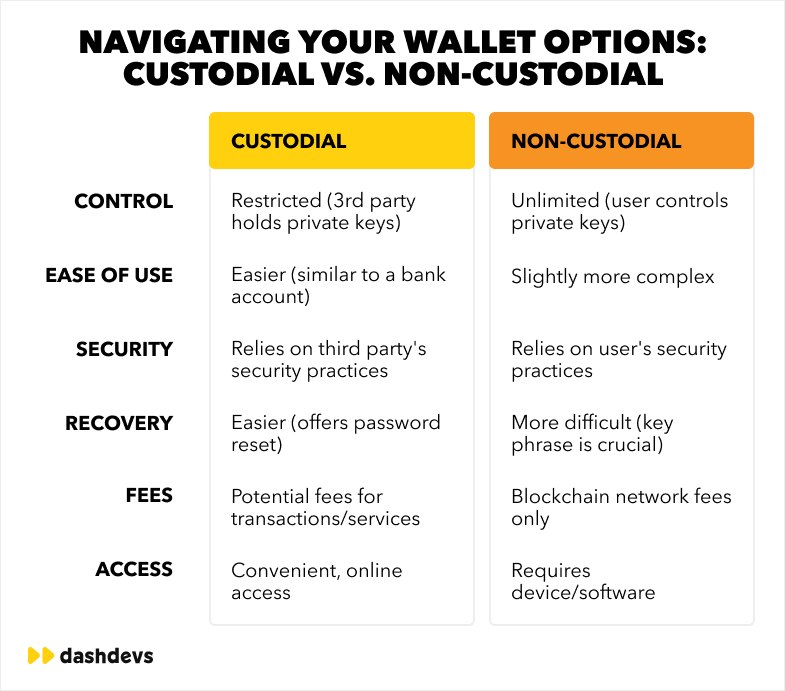
Custody providers decide who can sign a stablecoin transaction and under which policy. Pick this layer carefully, because migrating keys and addresses later is the most painful switch on this list.
6. Fireblocks: best for institutional custody plus a settlement network
Fireblocks is a digital asset infrastructure platform that combines MPC wallet custody with a network connecting banks and PSPs for stablecoin settlement.
The scale is hard to argue with. Fireblocks reports roughly $6 trillion in stablecoin transfers on its platform in 2025. A consortium of 12 European banks led by Qivalis also chose it for a MiCA-compliant euro stablecoin, per Cointelegraph.
We compared it with an in-house build in our guide to Fireblocks vs. building your own custody. Building your own typically takes 6 to 18 months and a dedicated security team.
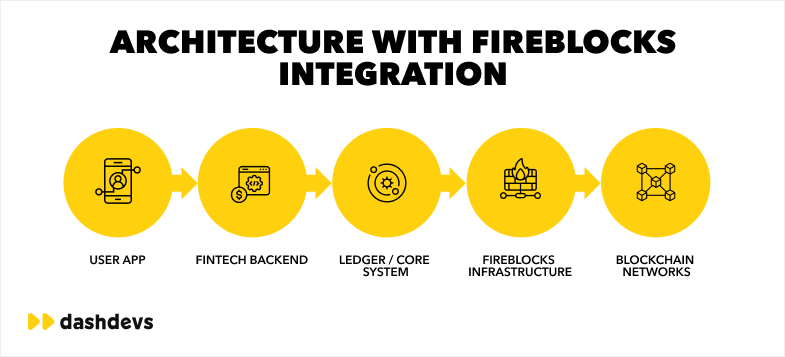
And sometimes building is the right call. For the digital assets trading platform we built for a licensed APAC fintech, the client needed key management to stay in-house. A team of 12 delivered it in 6 months, with KMS-secured signing and automated hot and cold wallet rebalancing that holds a 95:5 liquidity ratio.
- Integration effort: high. Vault structure and approval policies take real design time.
- Lock-in risk: medium. MPC key shares are tied to the platform, so plan your exit with their team up front.
- Watch out: pricing is not public, and smaller treasury teams often find onboarding heavy.
7. Coinbase Developer Platform: best for USDC payments on Base
Coinbase Developer Platform (CDP) is Coinbase’s suite of APIs and SDKs for embedded wallets, USDC payments, onramps and onchain tools.
CDP is the fastest start on this list. Coinbase says you can begin with a single API key. In Q4 2025 it launched payment APIs that let businesses accept stablecoins at checkout and settle in USDC on Base, per Payment Expert.
The trade-off is focus. CDP pulls you toward USDC on Base, which is great until a key corridor runs on USDT or Tron.
- Integration effort: low. Good docs and a fast sandbox. The brand also helps in compliance reviews.
- Lock-in risk: high if Base and USDC become your only rails.
- Watch out: Coinbase earns a share of USDC reserve income, so its incentives favour USDC over other assets.
If you are building the wallet experience itself, our team covers that in digital wallet app development.
Cross-chain routing: how do you move stablecoins between networks?
Cross-chain routing providers move value between blockchains when your sender and recipient use different networks. For USDC, Circle’s CCTP (covered above) is the native option. For everything else, you need one of these.
8. LayerZero: best for native USDT across chains
LayerZero is a cross-chain messaging protocol whose Omnichain Fungible Token (OFT) standard powers USDT0, the multichain version of Tether’s USDT.
If your users ask for USDC or USDT, many corridors will push you toward USDT. USDT0 crossed $100 billion in cross-chain volume on 25 June 2026 and is natively integrated on about two dozen chains, per The Block. Tether also made a strategic investment in LayerZero Labs in February 2026.
- Integration effort: medium. You integrate a protocol, so your team owns monitoring and retries.
- Lock-in risk: low. It is an open standard with many independent integrators.
- Watch out: USDT0 is backed 1:1 by USDT locked on Ethereum. Check whether your compliance team treats it as USDT or as a separate asset.
9. LI.FI: best single API for routing across bridges
LI.FI is a non-custodial routing API that aggregates bridges and intent solvers so you can move stablecoins between chains through one integration.
LI.FI picks the route for you and can switch paths when one bridge gets slow or expensive. TRON DAO integrated it in April 2026 to open access to TRON’s USDT liquidity. Its May 2026 changelog added API presets for optimised stablecoin routes, per LI.FI docs.
- Integration effort: low. The SDK and widget can go live without a backend.
- Lock-in risk: low. You can swap it for another aggregator if routes get worse.
- Watch out: an aggregator inherits the security of every bridge it routes through. Set allowlists for the bridges you trust.
Routing is where payment flows break most often in production. We cover the redundancy patterns in our guide to cross-chain fallback solutions.
How do the GENIUS Act and MiCA affect your choice of stablecoin API?
Your provider’s license only protects you if it covers your exact flow in your exact market. In 2026 both the US and the EU moved from transition to enforcement.
MiCA: the EU deadline has already passed
MiCA’s transitional period ended on 1 July 2026, and ESMA confirmed there would be no extension. Crypto-asset service providers without authorisation must wind down their EU services, per ESMA’s April 2026 statement.
Only about 210 of the 1,200+ firms with pre-MiCA national registrations converted to full CASP authorisation, per Relai. That’s roughly 17%. If a provider on your shortlist serves EU users, ask which authorised entity signs your contract.
GENIUS Act: the US clock runs to January 2027
The GENIUS Act takes effect no later than 18 January 2027. US regulators missed the 18 July 2026 deadline for final rules, and the OCC has been targeting November for its final rule.
The OCC’s proposal sets a $5 million minimum capital floor for new issuers. For you as an integrator, the practical point is simpler. Work with issuers and custodians that already hold or are converting to a federal charter, and keep yield features out of your launch plan until the rules are final.
We help licensed teams map these obligations onto their stack through Fintech Core for MiCA, CASP, VASP and MSB. Our guide on compliant on/off-ramps for regulated fintechs goes deeper on KYT and Travel Rule flows.
How do you run two stablecoin API providers behind one orchestration layer?
You put your own ledger and a thin adapter layer between your product and the providers, so each provider becomes a replaceable route.
This is the part most vendor-written rankings skip. Of course they do. A vendor has no reason to teach you how to switch away from it.
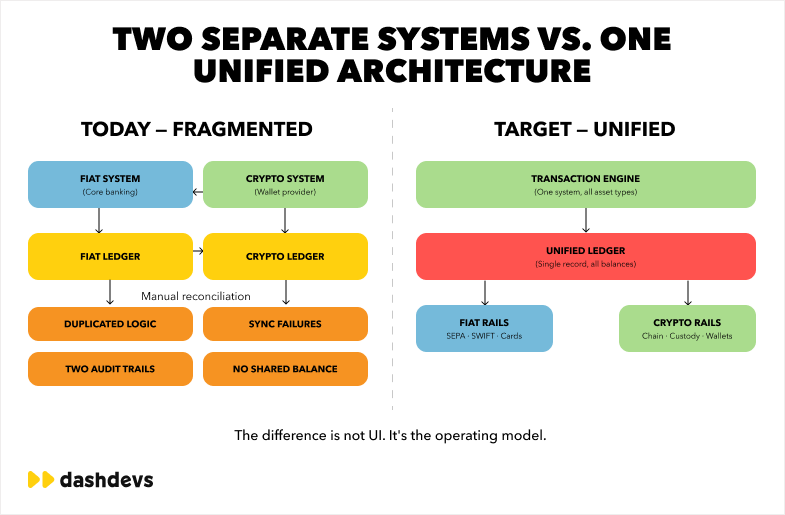
Here is the pattern we use on Fintech Core projects:
- Own the ledger. Every balance, fee and status lives in your system first. On the APAC trading platform we built one unified ledger for fiat and crypto, and that single decision made adding liquidity partners cheap later.
- Normalise provider events. Map each vendor’s webhooks to your own event types: quote created, funds received, payout sent, payout failed.
- Route by rules. Choose the provider per transaction based on corridor, asset, amount and provider health.
- Reconcile daily, then hourly. Match your ledger against each provider’s statements and on-chain data. Breaks show up here before customers notice them.
- Fail over deliberately. Define which errors trigger a retry with the same provider and which reroute to the second one.
Skip step 1 and keep balances only on the provider side, and your first migration turns into a data archaeology project. Kleos lived a version of this before the move to Fintech Core. Once the ledger and adapters exist, adding a second provider is a mapping exercise, not a platform rewrite.
Pro tip: Store the provider’s transaction ID and your internal ID side by side from day one. It costs you one database column now and saves weeks of reconciliation later.
If you are designing the balance model itself, our article on how to build a fiat-crypto platform with a unified balance walks through the ledger design. And for the bigger strategic call, see our build vs buy vs partner framework.
How to choose the best stablecoin API for your fintech
Start from your money flow, then shortlist one provider per job and a backup for the job that earns you revenue.
These steps hold for any stablecoin payment infrastructure, whether you are accepting stablecoins from customers or paying suppliers abroad:
- Draw the sandwich. Write down where fiat enters and where it exits in local currency. Your finance teams should sign off on this before engineering starts.
- Pick the stablecoin before the provider. USDC or USDT decides half of your shortlist. EUR flows add EURC and MiCA-authorised issuers.
- Ask for the license map. Which legal entity serves each corridor, and under which license? Get it in writing.
- Test the failure paths in sandbox. Trigger a failed payout and a stuck cross-chain transfer. Then reject a KYB case on purpose. See what the webhooks tell you.
- Price the exit. Ask how you would export balances and transaction history if you left in 12 months.
- Integrate one job at a time. Ship the payout or ramp corridor that earns revenue first, then add custody or routing.
If you integrate stablecoins into an existing cross border payment product, our team handles cross-border payment integration and the smart contract work through our blockchain software development services. You can also compare traditional rails in our list of cross-border payment providers.
Conclusion: pick providers per job, own the layer in between
The best stablecoin API providers in 2026 are strong at one job each. Circle and Paxos own issuance. The ramp providers own the fiat edges, Fireblocks and Coinbase own the keys, and LayerZero and LI.FI move value between chains.
Your advantage comes from the layer you control: the ledger and the routing rules on top of it. With vendors everywhere publishing their own rankings, that layer is also the one nobody will design for you.
If you want to see how stablecoin balances sit next to IBANs and cards in one product, read how stablecoin banking and fiat on/off-ramps work for companies. And when you are ready to map your own stack, talk to the DashDevs team. We’ll help you shortlist providers per job and design the orchestration layer before you sign the first contract.
Share article
