


BIN Sponsorship for Fintechs: How It Works, Costs and How to Choose a BIN Sponsor

October 14, 2026
- BIN sponsorship is a scheme-member arrangement that lets a non-member fintech issue or acquire cards.
- Score the bank on direct membership, scheme coverage, program type, processor fit, risk appetite, and exit terms.
- Budget setup, a monthly minimum, per card, per transaction, an interchange share, a reserve, and scheme fees. The agreement sets the amounts.
- Fintech Core is typically 12 weeks into production.
A licensed scheme member lends its BIN and licence so a non-member can issue or acquire cards. The member absorbs scheme liability. You keep the product and the customer relationship.
BIN sponsorship for fintech products covers both issuing cards and accepting them. A non-member needs a member to stand in front of the scheme.
Challenger banks, spend platforms, prepaid wallets, and BNPL issuers usually start here. The build side of that stack is card issuing integration.
How BIN Sponsorship Works: Parties and Responsibilities
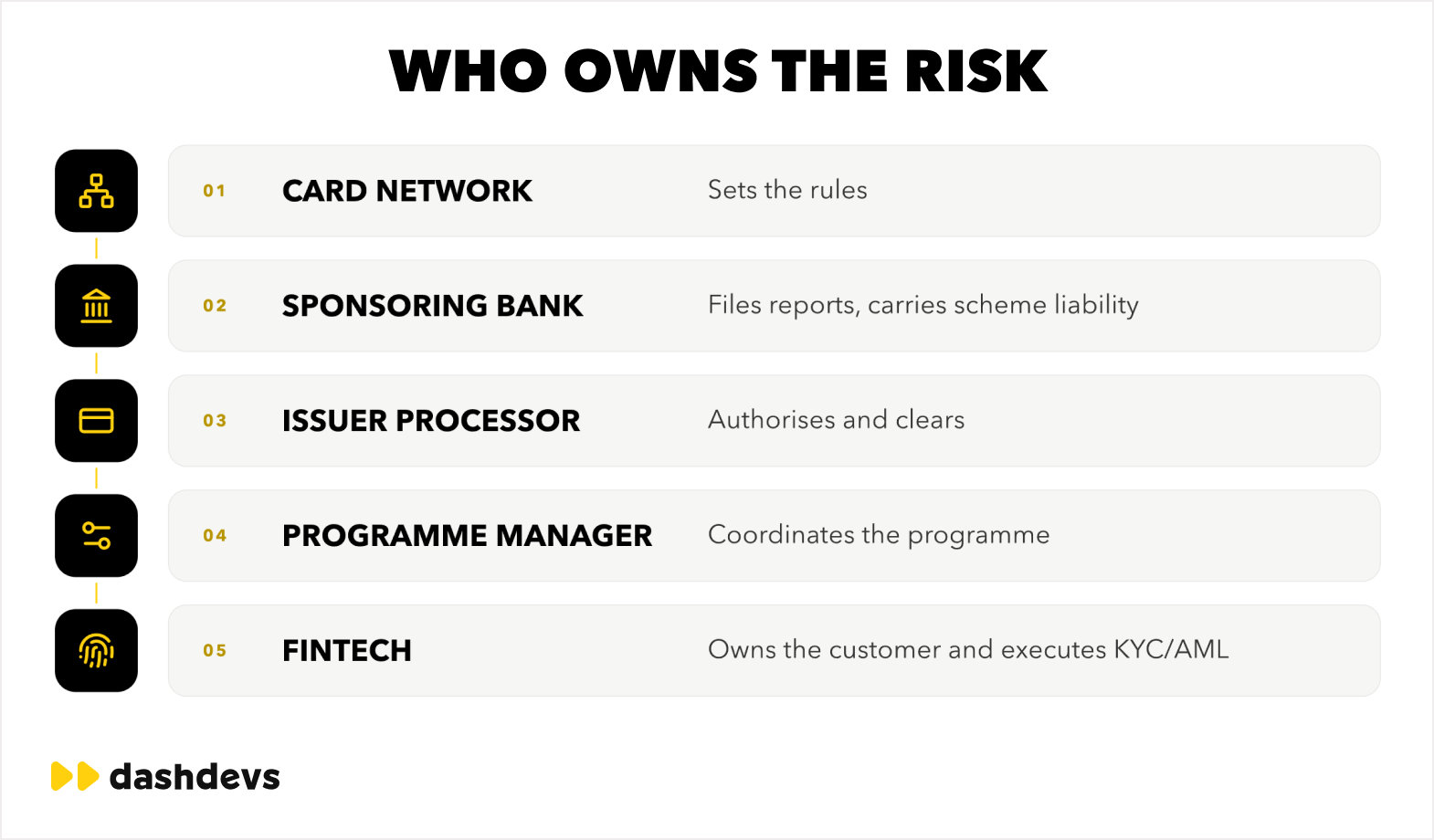
Five parties sit in the stack, and each one owns a different risk.
Card network, then sponsoring bank, then issuer processor, then program manager, then the fintech.
| Responsibility | Card network | Sponsoring bank | Issuer processor | Program manager | Fintech |
|---|---|---|---|---|---|
| Scheme rules | Owns | Enforces | Adheres | Adheres | Adheres |
| KYC and AML accountability | Requires | Owns | Supports | Supports | Executes |
| Settlement and reconciliation | Clears | Settles | Processes | Reports | Receives |
| Disputes and chargebacks | Sets the rules | Liable | Manages | Coordinates | Is notified |
| Scheme reporting | Requires | Files | Provides data | Provides data | Not applicable |
| Card production | Sets standards | Approves | Not applicable | Manages | Designs |
In 2024, worldwide payment card fraud losses were $33.41 billion, the Nilson Report found, on $51.920 trillion of card volume.
The sponsor bank files the scheme reports and carries the scheme liability. Your team still executes KYC and AML. The processor moves authorizations and clearing files. You own the customer experience.
On Fintech Garden, the fintech podcast by DashDevs, episode 148 takes up why banks accept that liability. Igor Tomych is a fintech entrepreneur and product strategist with 17+ years of experience building financial products. The episode is a DashDevs conversation, not an outside review.
Issuing BIN Sponsorship vs. Acquiring BIN Sponsorship
Issuing puts cards in cardholders’ hands. Acquiring lets a business accept card payments. They are separate contracts. One bank can hold both. Do not assume a single contract covers both jobs.
| Dimension | Issuing | Acquiring |
|---|---|---|
| What you do | Issue cards to cardholders | Accept card payments |
| Typical product | Wallets, prepaid, corporate cards, credit | Payment facilitation, marketplace payouts |
| Who takes scheme risk | The member bank | The member bank |
| Who you check | Cardholders | Merchants |
| Licence you still need | EMI or similar e-money permission | Acquiring licence or PayFac registration |
A PayFac model needs the acquiring contract. Read the payment facilitation guide before you scope merchant onboarding. Status as of October 2026: PSD2 remains in force in the EU.
How Much Does BIN Sponsorship Cost?
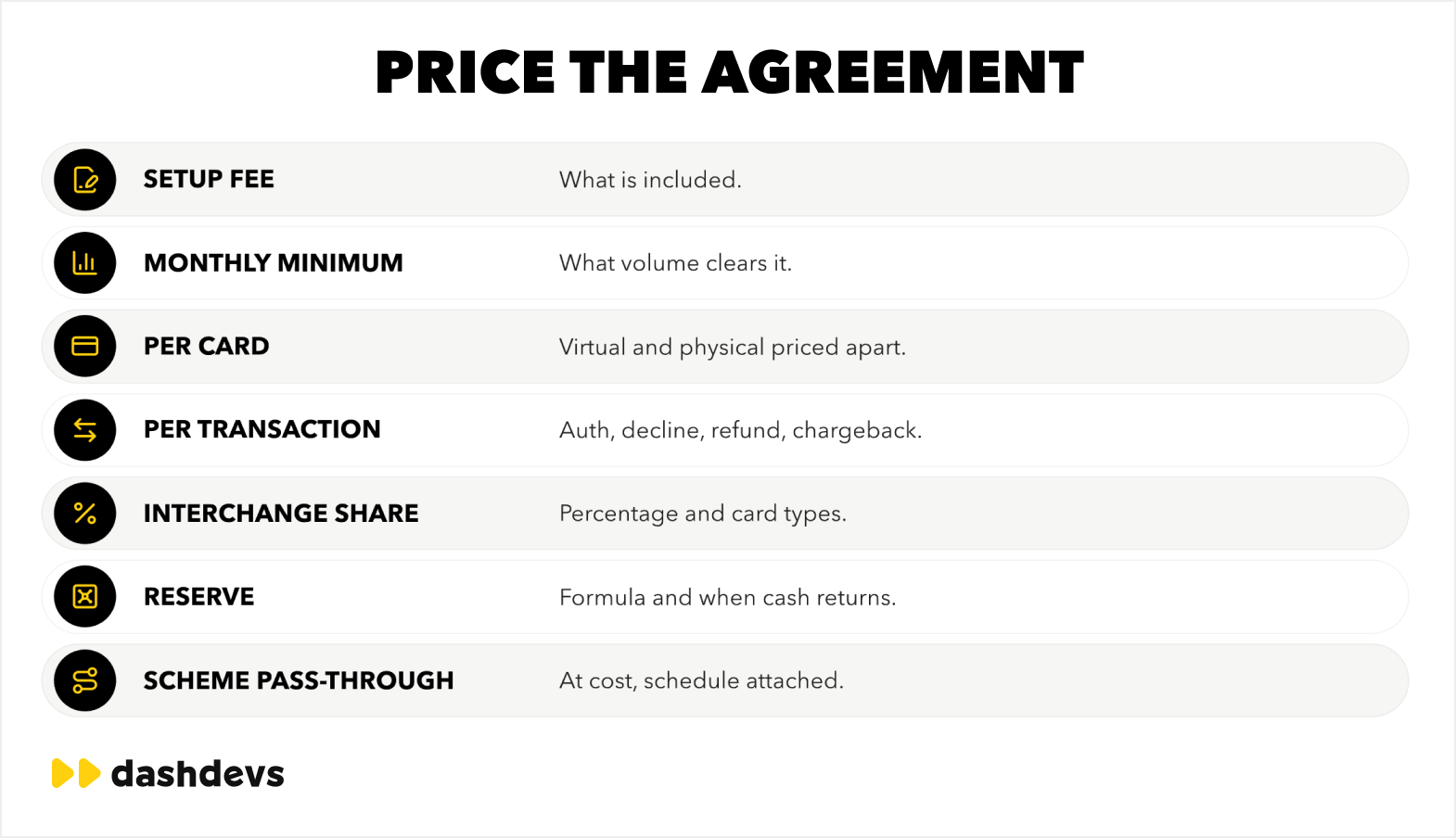
Budget setup, a monthly minimum, per card, per transaction, an interchange share, a reserve, and scheme pass-through fees. The signed agreement is the source of every amount.
| Cost item | What it is | What to get in writing |
|---|---|---|
| Setup fee | Due diligence, BIN setup, and the first integration | One-off amount, what it includes, and what triggers a change order |
| Monthly minimum | A floor you pay even when volume is low | The floor, the volume that clears it, and how long it lasts |
| Per card | A fee at issue or each year, virtual and physical priced apart | Price by card type, and whether reissue is a new fee |
| Per transaction | A fee on each authorisation through the member BIN | Authorisation, decline, refund, and chargeback priced separately |
| Interchange share | The member keeps part of the interchange you earn | The percentage, the card types it covers, and a 12-month model |
| Reserve | Cash held against settlement risk | The formula, the months of volume, and when cash comes back |
| Scheme pass-through | Network access, assessments, and cross-border fees | Pass-through at cost, with the network schedule attached |
Visa publishes its fee rules for acquirers and issuers on the Visa fee pages. That schedule is the network pass-through, not the member’s markup. The reserve ties up cash before the first transaction. Model it on expected monthly settlement. Put that cash in the raise.
In 2023, prepaid fraud losses hit 312.6 basis points of transaction value for covered US issuers, the Federal Reserve found. Interchange share grows with volume. Model both at month twelve, not at launch month.
In 2024, the exempt US dual-message debit interchange averaged $0.61, against $0.22 when the issuer was covered, the Federal Reserve reported. The term sheet often skips the reserve formula, the notice period, and prefix portability. Those three sit in the agreement.
Visa BIN sponsorship and Mastercard BIN sponsorship are priced apart when the license, market, and card type differ. Mastercard publishes interchange and assessment rules on the Mastercard interchange pages. Ask for two schedules if you need both networks.
Get the seven amounts in the agreement, then model reserve and interchange at month twelve. The member’s asset size decides whether the covered or the exempt debit schedule applies.
Get the reserve formula and the interchange share in the agreement before you compare monthly minimums.
Shared BIN vs. Dedicated BIN
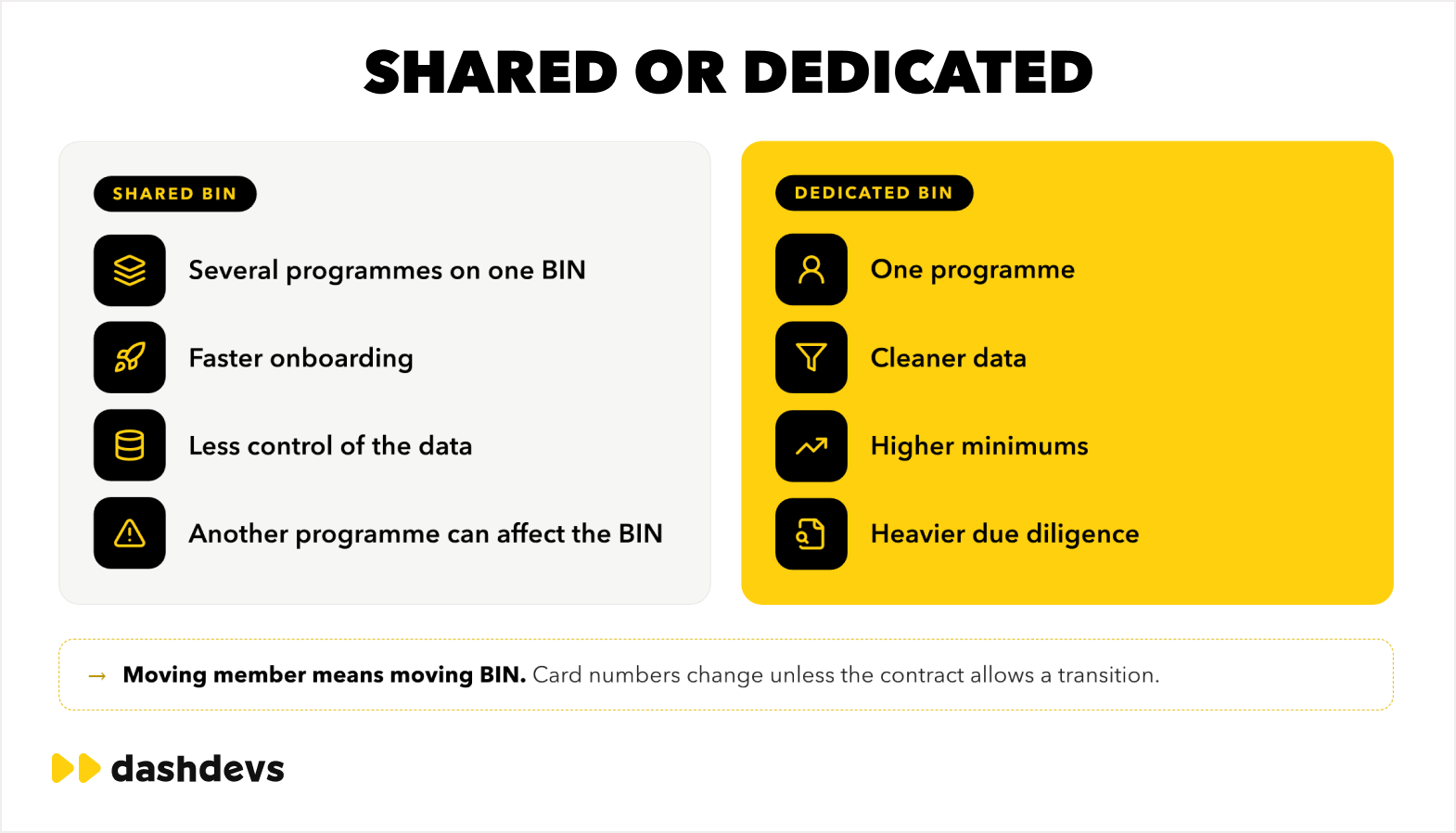
A shared BIN pools several programs on one prefix. A dedicated BIN belongs to one program. That split changes cost, data, and reputation risk. Compare best card issuing platforms only after you know which prefix you need.
A shared prefix helps the member reach scheme volume thresholds sooner. Onboarding is usually faster. You get less control of transaction data. Another program on that prefix can affect how schemes see the BIN.
A dedicated prefix gives you a distinct scheme identity and cleaner data. Minimums are higher. Due diligence is heavier.
Can you switch without reissuing cards?
Moving a member means moving BIN. Card numbers change unless the contract and the processor both allow a transition route. The prefix belongs to the member, not to your brand.
Some processor setups can route old numbers for a limited period. Both members must agree. The processor must support the token map. Put the portability clause in the first agreement.
On Kleos, extending the legacy platform had become the constraint. The new MVP on Fintech Core took 10 weeks. Visa virtual and physical cards then shipped in release v1.2.0 in 8 weeks, instead of stretching the old app.
How to Choose a BIN Sponsor: 6-Point Scorecard
Score every candidate on direct membership, scheme coverage, program type, processor fit, risk appetite, and exit terms. The wrong contract shows up later. It shows up when a new card product, a new market, or a better interchange talk is blocked.
| # | Criterion | What to ask | Red flag |
|---|---|---|---|
| 1 | Direct member or extra layer | Is this bank a Visa or Mastercard principal, or does another bank sit above it? | An extra layer adds fees and a dependency you do not control |
| 2 | Networks and markets | Which principal memberships, and in which countries? | One country blocks the next market |
| 3 | Program type | Prepaid, debit, credit, or commercial, specifically? | A strong prepaid bank may have no credit stack |
| 4 | Processor fit | Which processors are already live with this bank? | A forced processor change replaces a working integration |
| 5 | Risk appetite | Has this bank launched your vertical, and does it give templates or only oversight? | A first-time vertical stalls in due diligence |
| 6 | Exit and portability | What is the notice period, and what happens to numbers on exit? | A long notice and no portability clause must be modelled before signature |
Reject a candidate that fails processor fit or exit terms, even if the monthly minimum looks low. Those two failures are what force a reissue later.
If the bank forces a processor change, read the card issuing guide before you accept the delay.
A weak exit clause is the other hard fail. It decides whether a later direct licence is possible at all. Episode 144 covers when a non-bank licence becomes a ceiling. That conversation is on Fintech Garden, the fintech podcast by DashDevs. It is not an independent endorsement.
When to Move from BIN Sponsorship to Principal Membership
Move when interchange economics, product limits, or a direct-license rule make the current arrangement the constraint. The sponsored model is the right start for most teams. It is not the last structure.
Principal membership gives you direct scheme access and your own prefix. You keep the interchange economics. You also take the capital, the compliance operation, and the scheme approval process.
Start that process when one of these is true.
- The interchange share, not the feature list, is what dominates the margin.
- The member’s risk rules block a product you cannot design around.
- You plan to sponsor other fintechs yourself.
- A target market requires a direct licence.
The exit clause decides how hard that move is. Portability language keeps the option open. A fintech consulting review of the draft agreement is cheaper than a forced migration.
Fintech Core is DashDevs’ composable fintech infrastructure and orchestration platform for launching, expanding, or modernizing regulated financial products. It gives teams a faster starting point than a custom build, with more flexibility and control than traditional white-label or SaaS platforms.
Fintech Core has 20+ vendor integrations available in Fintech Core. It is typically 12 weeks into production.
Which Situation Fits Which Option
Match the member to the market and the product limit you will hit first.
| Your situation | What to weigh first | Likely fit |
|---|---|---|
| US spends on startup, early stage | Speed, a shared prefix, a low minimum | A programme manager with an embedded member relationship |
| EU EMI adding cards | SEPA, Mastercard Europe, an EMI-friendly control set | A European member or a provider with direct scheme membership |
| Neobank planning credit in later years | A path to a dedicated prefix, no prepaid-only lock-in | A principal member with credit programs on record |
| BNPL expanding across borders | Several markets, installment authorization, and a processor that knows that risk | A regional member that has shipped installment flows |
A neobank planning credit needs a path past a prepaid-only contract. Neobank app development comes only after the member can support credit.
An EU EMI already runs customer due diligence under its own licence. The member contract should say who files scheme reports, and it should not make you repeat that KYC.
On the multi-market BNPL platform, Poland’s installment cards had to keep the Czech limit model. Dashdevs’ 10+ person team reused that pattern for the Polish authorization flow.
Use the row that matches the constraint you will hit first: speed, an EMI control set, a credit path, or a second market.
Final take
Sign the member that can issue the products you will need in year two, on a prefix you can leave.
The arrangement is a liability contract with scheme reporting attached. Five parties share the stack, and the member still files the scheme reports. You keep the customer, the product, and the KYC execution. Issuing and acquiring are separate contracts, even when one bank offers both.
Price seven lines from the signed agreement. Those lines are set up as a monthly minimum per card per transaction, an interchange share, a reserve, and a scheme pass-through. Model the reserve and the interchange share at month twelve. The member’s asset size decides whether US debit interchange follows the covered schedule or the exempt one.
A shared prefix is the faster start. A dedicated prefix is the cleaner scheme identity, and it is harder to leave.
Score the bank on direct membership, scheme coverage, program type, processor fit, risk appetite, and exit terms. A low monthly minimum still fails if a processor change or a weak exit forces a reissue. Stay with the member while that contract is the fastest way to issue. Move toward principal membership when interchange economics, product limits, or a direct-licence rule make the contract the constraint.
Kleos shipped Visa cards in 8 weeks after a 10-week MVP, once the legacy platform was the constraint. On the BNPL platform, a 10+ person team reused the Czech limit model for Poland.
Share article
