


Build vs Buy Treasury Management Software: A Decision Framework for CFOs

July 9, 2026
- For most banks and corporate treasuries, buying a modern cloud-based treasury management system is the faster, lower-risk path — typically 3 to 6 months to core functionality at mid five to low six figures annually.
- Building a custom core treasury system makes financial sense mainly for institutions with unusual multi-entity structures, strict data-residency rules, or proprietary risk logic — usually $400K to $1M+ upfront over 6 to 12 months.
- The build vs buy treasury management system decision fails when teams compare year-one vendor quotes against build estimates without modeling five-year TCO, internal team time, and licensing growth.
- Vendor TMS platforms cover 80 to 90% of requirements for most treasuries; gaps cluster around multi-entity data models, sovereign data constraints, and proprietary liquidity or netting logic.
- A hybrid path — buy the vendor core for bank connectivity and cash visibility, build microservices for the differentiator — often delivers 90% of a custom build at a fraction of cost and risk.
For most banks and corporate treasuries, buying a modern cloud-based treasury management system is the faster, lower-risk path. Implementation typically runs 3 to 6 months, with annual costs in the mid five to low six figures. Building a custom treasury system makes financial sense mainly for banks and large multinationals with unusual multi-entity structures, strict data-residency rules, or proprietary risk logic. A build of meaningful complexity usually costs $400K to $1M or more upfront and takes 6 to 12 months — and typically pays off over a 3 to 5 year horizon once vendor licensing costs scale past that fixed investment.
Every treasury team has one: the spreadsheet nobody fully admits to trusting, quietly stitching together cash positions across a dozen bank accounts, three ERPs, and at least one acquired subsidiary nobody’s fully migrated yet. It works fine, right up until the morning it doesn’t — and the CFO is asking why nobody could give her the real cash position before a covenant call.
That’s the moment “we need a real treasury management system” stops being a someday conversation and becomes a live decision. And the decision that follows is rarely as simple as picking a name off a shortlist. It’s a genuine fork in the road: buy a treasury management system off the shelf, or build a core treasury system engineered around how your organization actually operates. Both paths are well-worn, and both have failure modes nobody puts in the vendor deck. In 2026, the math behind build vs buy for a corporate treasury system has shifted enough that it’s worth a fresh look — even if you settled this question two years ago.
This guide is written for the people who have to make that call and defend it afterward: bank treasurers, corporate CFOs, and the finance and technology leaders in the room once the vendor demos start.
What is a treasury management system?
A treasury management system is the software layer that centralizes cash visibility, liquidity forecasting, payments, bank connectivity, FX and interest rate risk, and treasury reporting. It replaces the patchwork of bank portals, spreadsheets, and manual reconciliation that most finance teams start out with. In practice, a modern corporate treasury system has become something closer to an operating system for how money moves through the business — where cash positioning happens every morning, where payment approvals live, and where the audit trail for regulators starts.
Three forces are converging in 2026 to push this decision back onto the agenda, even for organizations that thought they’d settled it years ago.
- The market is genuinely maturing, not just growing. Most 2026 analyses put the global treasury management system market somewhere between $6 billion and $7.5 billion, with double-digit compound annual growth projected into the early 2030s as more mid-market and multinational treasuries move off spreadsheets and legacy platforms.
- ISO 20022 is forcing a replacement cycle whether you asked for one or not. SWIFT’s migration to ISO 20022 messaging is reshaping bank connectivity requirements industry-wide. Treasury teams running older platforms are finding that “keep what we have” is no longer a passive, zero-cost option.
- AI has changed what “good” looks like. Roughly half of US corporate treasurers are now piloting or have deployed AI-assisted cash forecasting, according to AFP’s 2026 treasury technology research — nearly double the adoption rate from two years earlier. AI-assisted forecasting reaches the high 80s to low 90s percent accuracy at a 13-week horizon, against roughly 60% for manual, spreadsheet-driven forecasts over the same window.
Put together, that’s not a subtle nudge. It’s a market telling every treasury leader that the tooling question is live again — and why the build vs buy treasury management system decision deserves an honest, current look, not a five-year-old assumption.
The three paths, side by side
Most organizations frame this as a two-way choice, but there are three viable paths. Conflating them is where a lot of decision paralysis comes from.
| Path | Typical cost profile | Typical timeline | Best fit |
|---|---|---|---|
| Legacy enterprise TMS (large ERP-native or tier-1 platforms) | High five to low six figures annually; implementation fees often exceed year-one licensing | 12–24 months to full deployment | Large, complex enterprises with dedicated implementation budget |
| Modern cloud-based treasury management system | Mid five to low six figures annually; implementation typically bundled | 3–6 months for core functionality | Mid-market and enterprise treasuries that want fast time-to-value |
| Custom-built treasury system | Roughly $400K–$1M+ upfront for meaningful complexity, plus ongoing engineering | 6–12 months mid-complexity; 12+ months high-end multi-entity | Banks and large multinationals with unique operating models, proprietary risk logic, or regulatory constraints off-the-shelf platforms cannot satisfy |
Cost and timeline ranges are directional, based on public vendor and implementation-partner disclosures current as of 2026. Actual figures vary significantly by entity count, integration complexity, and region.
That middle row is worth pausing on, because most build vs buy content skips it. A modern, cloud-based treasury management system is not the same purchase it was a decade ago. Implementation windows that used to run over a year now routinely close in a single quarter for mid-market deployments — driven by API-first bank connectivity replacing the custom-mapped integrations that made legacy TMS rollouts so slow.
Where vendor TMS platforms actually run out of road
For the large majority of corporate treasuries, a good treasury management system — Kyriba, FIS Quantum, ION, or one of the newer cloud-native platforms — will cover 80 to 90% of what’s needed, and cover it well. The gap shows up in the last 10 to 20%, and it tends to cluster around a few recurring themes.
Multi-entity complexity that doesn’t fit the vendor’s data model. Vendor platforms are built around a general-purpose model of entities, accounts, and currencies. That works cleanly until an organization has nested subsidiaries with different reporting calendars, intercompany netting rules specific to one jurisdiction, or an in-house bank structure the vendor’s configuration screens were not designed around. Vendors will often say yes to a customization request — then quote a professional-services engagement that starts to look uncomfortably close to a custom build, billed at consulting rates instead of engineering ones.
Regulatory and data-residency requirements a multi-tenant SaaS model cannot satisfy. Banks in particular run into this. A treasury management system that is truly multi-tenant means your data sits in shared infrastructure alongside other clients’ data. That can be a non-starter for institutions with strict data localization rules or internal policies against certain categories of data leaving a specific jurisdiction. This is an architectural gap — no amount of configuration fixes it.
Proprietary logic that is, itself, the competitive advantage. Some large banks run liquidity optimization or collateral-management logic built from years of internal quantitative work. Asking a vendor to replicate that inside their platform is not customization — it is asking them to rebuild your intellectual property inside their product.
Vendor demos consistently show the 80% every prospect needs. They rarely surface the entity structure you actually have — the nested joint venture from an acquisition six years ago. That gap usually appears during implementation, when it is expensive to discover.
Before assuming your organization needs a custom build, run a quick gut-check. Ask whether the requirement is truly unique, or just unusually configured. Most “we’re different” requirements turn out to be solvable with a well-implemented modern platform and a properly scoped vendor selection process. Genuine uniqueness — proprietary risk models, sovereign data constraints, one-of-a-kind netting structures — is real, but rarer than the average RFP suggests.
The multi-entity and regulatory complexity problem, in numbers
The complexity gap shows up consistently in industry research on why treasury management software implementations stall or underdeliver.
| Reported barrier to TMS adoption or full utilization | Share of organizations citing it |
|---|---|
| High implementation complexity | ~46% |
| Integration challenges with legacy/ERP systems | ~41% |
| Internal skill gaps for full utilization | ~38% |
None of the top-cited barriers are about the vendor’s core functionality. They are about fit: how well a general-purpose platform maps onto one organization’s specific entity structure, legacy ERP landscape, and internal capability. That is exactly the gap where a well-scoped custom treasury system, or a hybrid build extending a vendor core, starts to make financial sense rather than just architectural sense.
Total cost of ownership: what actually belongs in the model
Most build vs buy comparisons fail at the modeling stage. Treasury leaders compare a vendor’s year-one quote against a developer’s build estimate — and the two numbers are not measuring the same thing. A defensible five-year TCO model needs the same line items on both sides:
- Licensing or build cost — for vendor paths, model how licensing scales as you add entities, users, or transaction volume; for a build, include full initial engineering cost, not a rough sprint estimate.
- Implementation and integration — bank connections, ERP mapping, and data migration cost real money on either path.
- Internal team time — someone on your side manages the vendor relationship or owns the build; that time has a cost even if it never appears on an invoice.
- Ongoing maintenance and upgrades — a vendor absorbs this for a fee; a custom build makes it your permanent responsibility.
- Security, compliance, and audit overhead — certifications, penetration testing, and disaster recovery testing are either bundled into a vendor subscription or become a line item your team owns.
Ask your finance team to build the five-year model before a single vendor demo happens. It is the only way to compare a subscription quote against a build estimate on equal terms — and it keeps the decision anchored to your numbers instead of a vendor’s slide deck.
When a custom build delivers a measurable advantage
Building a custom treasury system is not, in most cases, the right call. Any development partner telling you otherwise before understanding your entity structure and regulatory footprint is not being straight with you. But there is a definable set of conditions under which building wins outright.
- You are a bank or large multinational with a multi-entity structure a vendor’s data model cannot cleanly represent — and the customization quote from vendors already resembles a bespoke project in cost and duration.
- You operate under data residency, sovereignty, or supervisory requirements that rule out multi-tenant SaaS, making the vendor conversation moot regardless of functionality fit.
- Your treasury operation runs on proprietary risk, netting, or liquidity logic that constitutes real competitive advantage — logic that does not belong inside a shared vendor platform.
- You already have, or are willing to build, sustained engineering capacity to own the system for a decade, not a project. A custom-built treasury system is a permanent product commitment — security patching, bank-format changes, and regulatory reporting updates arrive indefinitely.
Where these conditions genuinely apply, the economics tend to invert over a multi-year horizon. A vendor treasury management system with per-entity or per-user licensing scales its cost as your organization grows. A custom platform’s cost is front-loaded but comparatively flat afterward. For a bank or large corporate with dozens of entities and multiple currencies, that crossover point often lands in year three to five — which is why this decision rewards a five-year TCO model rather than a first-year price comparison.
Organizations that build rarely do so because day-one cost is lower. They build when multi-entity netting logic reflects years of internal treasury work — and no vendor will prioritize replicating it for a single client.
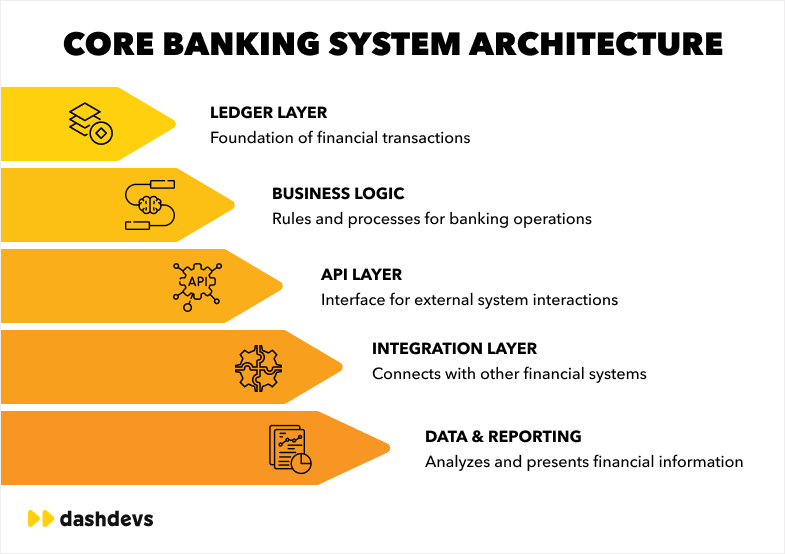
This is the space where DashDevs tends to get the call — not to replace buying a TMS for most companies, but to build the specific system for the subset of banks and treasuries where buying was never going to close the gap. DashDevs’ work in core banking solutions and white-label banking infrastructure sits in exactly this space: institutions that need treasury logic wired into a broader banking core, rather than bolted onto a generic SaaS layer.

Vendor lock-in and exit costs: the question most RFPs skip
Almost every vendor evaluation asks about implementation cost and go-live timeline. Very few ask what it costs to leave — and exit cost is where buying a treasury management system quietly turns expensive, years after the decision felt settled.
Questions worth asking every vendor before signing:
- Who owns the historical data, and in what format can you export it?
- What does the contract say about data portability if you terminate mid-term?
- How deeply is the vendor wired into your payment approval workflows and bank connections?
- Is your configuration documented anywhere your team controls, or does it live entirely inside the vendor’s support tickets?
None of this is a reason to avoid buying a treasury management system. It is a reason to negotiate exit terms with the same seriousness you bring to negotiating price — and to read how to avoid vendor lock-in traps before you treat any TMS contract as irreversible.
The hybrid path almost nobody talks about
You do not have to choose build or buy as an all-or-nothing decision. A growing number of treasury teams buy a vendor’s core treasury management system for what it does well — bank connectivity, base cash visibility, standard reporting — then extend it with custom microservices or APIs for the specific 10 to 20% that does not fit. That might be a proprietary forecasting model, a non-standard netting structure, or an internal reporting layer that talks to systems the vendor was never going to integrate with natively.
This is the same logic that has reshaped how banks build digital products elsewhere: buy the commodity layer, build the differentiator. It is the thinking behind assembling a neobank from vendor platforms and APIs rather than building every layer from scratch — and it applies just as cleanly to treasury.
If a vendor’s answer to a customization request is “yes, via our professional services team, for an additional fee,” ask what that customization would cost as a standalone API-connected microservice instead. Sometimes the vendor’s connectivity is good enough that the smarter move is a light custom layer — not a subscription add-on you renegotiate every renewal cycle.
A security and compliance checklist before you sign anything
Whichever path you are leaning toward, treat this list as a minimum bar — whether you are evaluating a vendor platform or scoping a custom build with a development partner.
- Independent security certifications — SOC 2 Type II and ISO 27001 are the baseline for any vendor handling treasury data; for a custom build, ask your partner how they get you to an equivalent standard.
- Bank connectivity certifications, including current SWIFT and ISO 20022 compliance — not a roadmap promise.
- Disaster recovery and business continuity testing with documented recovery time objectives.
- Role-based access controls and full audit trails covering every payment approval and configuration change.
- A named process for regulatory reporting updates as rules change — vendor release notes or your own maintenance backlog.
Effective fintech risk management applies fully here: the treasury rail changes, not the regulatory duty.
A practical framework for making the call
Work through these in order, and resist jumping to a conclusion before you have run the numbers on your own organization.
- Is the requirement genuinely unique, or just unusually configured? Most are not unique; some — proprietary logic or sovereign data rules — truly are.
- What does a real five-year total cost of ownership look like for each path — licensing growth, implementation, integration, and internal team time?
- Do we have, or are we willing to build, the engineering capacity to own a custom system indefinitely?
- How fast do we actually need this live? If the honest answer involves this fiscal year, a modern cloud-based TMS is almost always the realistic path.
- Could a hybrid model — buying the core and building the differentiator — get us 90% of the benefit of a custom build at a fraction of the cost and risk?
For most banks, treasurers, and CFOs, the honest answer at the end of that framework is still: buy a modern treasury management system, and buy well. For a smaller set of institutions — usually banks and large multinationals with genuine multi-entity, regulatory, or proprietary-logic constraints — the numbers point elsewhere. There, a custom-built core treasury system, or a hybrid build layered on a vendor platform, is where the risk profile lands.
In Summary
The build vs buy treasury management system decision is not about software preference. It is about which model lets your organization manage liquidity, risk, and regulatory obligations most effectively, at a cost and speed that make sense for where you actually are. Run the five-year numbers honestly. Be skeptical of both the vendor who says everything is customizable and the development partner who says everything should be custom-built. Let your actual entity structure and regulatory footprint — not a shortlist of logos — make the decision for you.
For most organizations, buying a modern cloud-based treasury management system remains the faster, lower-risk path. For the subset where vendor platforms cannot represent your entity model, satisfy data-residency rules, or host proprietary logic, a custom or hybrid core treasury system is the defensible choice — provided you have the engineering capacity to own it for the long term.
Share article
