


Build, Buy, or Partner: A Framework for Fintech Infrastructure Decisions

September 23, 2026
- Build, buy, and partner are three distinct paths — and most fintech stacks need a hybrid of all three, scored component by component.
- In most fintech projects, 70 to 80% of engineering time goes into infrastructure customers never see, not the features that differentiate the product.
- Score each component on differentiation, regulatory complexity, time-to-market pressure, talent availability, and vendor lock-in risk before you commit capital.
- Teams that combine BaaS for regulated infrastructure with a small team for the differentiated product layer cut time-to-market by 50 to 60% versus building the full stack.
- Revisit the framework annually and every time you enter a new market — the right answer for a core ledger can flip when a second licensing regime enters the picture.
Every fintech roadmap hits the same fork eventually: build it, buy it, or partner for it. Get the call wrong and you either burn eighteen months on a commodity ledger, or hand your product’s core logic to a platform you don’t control. This build vs buy decision framework turns that call into a score instead of a guess.
What Does Build vs Buy vs Partner Actually Mean in Fintech?
A build vs buy decision framework helps you decide, for each piece of your stack, whether to develop it internally, purchase it as a finished product, or license a configurable platform someone else maintains.
In fintech, the third option carries more weight than in most industries. So much of the stack — ledgers, KYC, card issuing, payment rails — is regulated and expensive to get wrong. Very little of it is what actually wins you customers.
Build means your engineering team owns the code, the infrastructure, and every future maintenance ticket that comes with it.
Buy means you purchase a vendor’s product and adapt your workflows around it.
Partner sits between the two. You license a configurable platform — a white-label banking core, for example — that gives you control over the product experience while someone else owns and runs the regulated plumbing underneath.
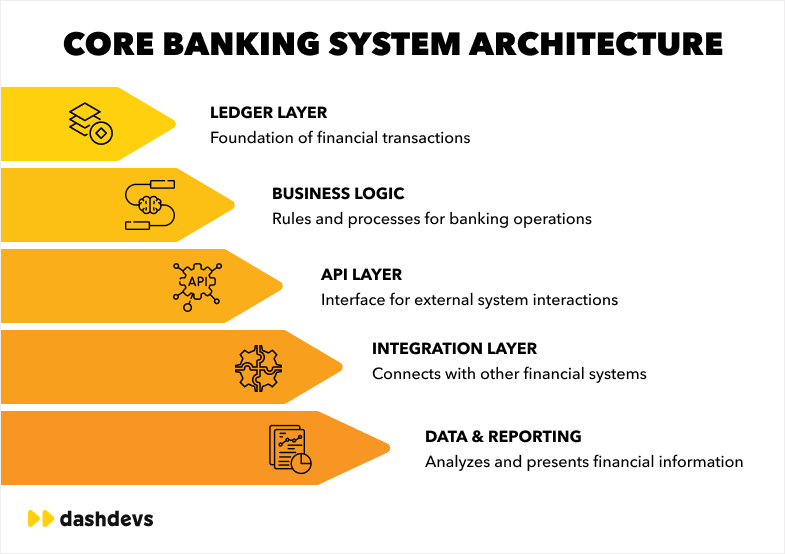
This isn’t a new question for fintech leadership. What’s changed is how mature the middle option has become. A few years ago, buying usually meant settling for a rigid, one-size-fits-all vendor product.
Today, licensed cores like Fintech Core let you configure ledgers and onboarding flows without writing them from the ground up, and add card programs the same way. That shift is exactly why the buy vs build decision framework conversation has moved from a two-way fork to a three-way one.
This theme keeps coming up in industry conversations right now. Infrastructure strategy is a recurring thread on conference agendas this season, including at Fintech Meetup Europe. The framework below isn’t tied to any single event. It’s the same logic we walk clients through on nearly every engagement.
Why This Decision Is Harder Than It Looks
Building sophisticated financial infrastructure is no longer the hard technical problem it used to be. Cloud platforms, open-source components, and mature analytics stacks have lowered the barrier to entry so far that most well-funded teams with decent engineers can stand up a working ledger or KYC flow.
That’s the uncomfortable part. A build vs buy software decision inside fintech carries more regulatory weight than the same decision in most other industries, and treating it like a generic build vs buy software choice undersells that difference.
As Earnix put it in a widely cited 2026 analysis of pricing infrastructure decisions:
The strategic question has shifted from “can we build this?” to “what are we not doing while we build it?”
— Build vs buy: why pricing strategy choices matter more in 2026, FinTech Global
The real question was never whether you can build it. It’s whether building it is the best use of your team’s time and capital, not to mention your leadership’s attention.
Here’s where the numbers get uncomfortable. Building custom fintech software typically costs between $120,000 and $500,000 for a production-grade application, with delivery taking four to nine months. That estimate assumes nothing goes sideways with a banking partner integration or a compliance review, and something usually does.
In most fintech projects, 70 to 80% of engineering time goes into infrastructure the customer never sees, not the features that actually differentiate the product. That’s the trap. Teams set out to build a lending product and end up maintaining a reconciliation engine instead.
Pro tip: Before you score anything, list every component in your stack and mark which ones are genuinely part of your value proposition. If a competitor could swap in a vendor for that component and your customers wouldn’t notice, it’s a buy or partner candidate by default. Don’t spend a build score on it.
The Three Paths, Explained
Build In House
You write and own everything: the ledger, the KYC logic, the card program rules, the full stack, end to end.
This works when the component is your actual differentiator, you have deep in-house fintech engineering experience, and you’re planning to run this system for years, not months. Building in house is not a shortcut around vendor negotiation. It’s a commitment to owning a problem permanently.
Ongoing maintenance never stops once you build in house. Enterprise core banking platforms built from scratch can exceed $750,000, and that’s before compliance certifications enter the picture.
| Certification | Typical added cost | Typical remediation time |
|---|---|---|
| SOC 2 Type II | $40,000–$150,000 | 2–4 months |
| PCI DSS Level 1 | $40,000–$150,000 | 2–4 months |
| ISO 27001 | $40,000–$150,000 | 2–4 months |
Building in house is rarely a one-time investment. It’s a standing team with a standing payroll, and that payroll doesn’t shrink once the system ships.
If you’re weighing this path for a full digital bank rather than a single component, our guide on how to build a neobank walks through the licensing and technology decisions in more depth.
Buy Off the Shelf
You purchase a vendor’s product as is and adapt your workflows to fit it.
This is where most of the fintech stack should live. If a capability is commodity infrastructure shared across the industry, like KYC verification, basic ACH processing, or standard compliance monitoring, buy it. The market has matured enough that buying no longer means settling for a rigid, closed product.
Take card issuing. Stripe Issuing prices virtual cards at roughly $0.10 each and physical cards around $3.50, with no monthly minimums, which makes it a realistic option for teams that don’t want to manage a BIN sponsor relationship directly.
We break down where that model fits, and where it doesn’t, in our full look at Stripe Issuing. For a wider comparison, our roundup of card issuing platforms covers the alternatives.
The same logic applies to identity verification. KYC and AML platforms cut compliance engineering burden through integrated APIs for identity checks, sanctions screening, and ongoing monitoring. Typical commodity-buy candidates include:
- Identity verification and liveness checks
- Sanctions and watchlist screening
- Basic ACH or SEPA processing
- Standard transaction monitoring
- Card issuing for non-differentiated programs

If you’re comparing vendors in this category, our guide to choosing the right KYC vendor lays out the criteria that actually matter.
The catch: you inherit the vendor’s roadmap, pricing changes, and outages. A pure buy strategy across your whole stack also leaves you with no real technical differentiation, which matters if infrastructure ownership is part of your story to investors.
Partner: License a Configurable Platform
You license a platform, often white-label, that gives you configuration control over the product layer while a partner owns and maintains the regulated core underneath.

Teams tend to underestimate this option. It isn’t buy with extra steps. A well-built launch-ready platform gives you room to customize integrations and swap processors, and add new markets without renegotiating your entire architecture every time a vendor changes terms.
Our deeper look at what that looks like in practice is in launch-ready fintech infrastructure for companies entering a new market.
For a broader view of what’s available in this category today, our comparison of top core banking solutions is worth a look before you shortlist anyone, and our piece on white label banking platform builds covers the customization angle specifically.
This path works when you need banking-grade infrastructure fast, you don’t want single-vendor lock-in, and you still want room to differentiate the parts customers actually touch.
How Do You Score a Build Buy Partner Decision?
Here’s the build buy partner framework we actually use with clients. Score each component of your stack from 1 to 5 on these five dimensions, then read the total against the guide below.
| Dimension | What it measures | Push toward build | Push toward buy or partner |
|---|---|---|---|
| Differentiation value | Does this shape why a customer picks you? | High score | Low score |
| Regulatory complexity | Licensing, audit, and ongoing compliance load | Low score | High score |
| Time-to-market pressure | Revenue or position lost per month of delay | Low urgency | High urgency |
| Talent availability | Can you hire or retain the right engineers | Strong bench | Thin bench |
| Vendor lock-in risk | Exposure if a vendor changes price or is acquired | Low tolerance | Higher tolerance |
How to read your total score:
| Score pattern | Path |
|---|---|
| High differentiation, low regulatory complexity, strong in-house talent | Build |
| Low differentiation, high regulatory complexity, tight timeline | Buy |
| High regulatory complexity, but you still need product-layer control and multi-market flexibility | Partner |
| Mixed signals across dimensions | Hybrid — build the differentiated layer; buy or partner for everything underneath |
Mixed signals are normal. Most fintech stacks end up as a hybrid approach.
This build vs buy decision framework isn’t meant to produce one answer for your whole company. It’s meant to run component by component. Your onboarding flow might score build, your sanctions screening might score buy, and your core ledger might score partner, all inside the same product.

TCO Comparison: What Each Path Costs Over Three Years
Sticker price is the least useful number here. What matters is total cost of ownership: the maintenance and compliance work, plus the opportunity cost, none of which show up on the first invoice.
| Factor | Build in house | Buy off the shelf | Partner (configurable platform) |
|---|---|---|---|
| Time to first launch | 3–18 months, depending on regulatory scope | Weeks to a few months | Typically 2–4 months |
| Upfront cost | $120,000–$500,000+ for production-grade infrastructure | Low to none, usage-based pricing | Licensing plus configuration effort |
| Ongoing cost | Full engineering team, 15–25% of build cost per year in maintenance | Vendor fees that scale with volume | Platform fee, lower internal maintenance load |
| Control over roadmap | Full | Minimal, vendor decides | Partial, configuration-level control |
| Vendor lock-in risk | None | High | Low to moderate |
| Best fit | Your genuine differentiator | Commodity, well-regulated components | Multi-market products needing speed and flexibility |
One number worth sitting with: teams that combine BaaS for regulated infrastructure with a small in-house or agency team for the differentiated product layer cut time-to-market by 50 to 60% versus building the full stack, according to a 2026 fintech development cost analysis, and that hybrid also removes most of the compliance lift in the process. See the full breakdown in Fintech App Development Cost In 2026, Appzoro’s cost report. That’s the hybrid approach in a single data point.

If you’re weighing this specifically for cross-border payment rails or third-party connections, our guide to fintech integration services covers integration cost separately from the build-or-buy call itself, since seamless integration effort tends to get underestimated on both the buy and partner sides.
What This Looks Like in Practice
Frameworks only earn their keep once they meet a real product. Here are two examples from our own work.
When Partner Beat Build Entirely
Kleos came to us running on a single fiat provider for its onboarding, accounts, and cards alike. Every time that provider changed terms, Kleos felt it directly.
Instead of building a banking core from scratch, or staying locked into one vendor, Kleos moved onto a configurable platform. Our work with Kleos on white-label fintech infrastructure covers how that shift gave them a personal EUR IBAN, virtual and physical cards, SEPA transfers, and crypto operations on one non-custodial layer, without depending on any single provider for the whole product.
When Build Made Sense, With Outside Engineering Depth
Twisto needed payment orchestration at a scale off-the-shelf tools weren’t built for. They kept decisioning logic as their own differentiator and brought in outside engineering depth to build the orchestration layer, rather than growing an entire in-house team from zero.
The resulting Twisto payment orchestration platform now handles up to 10,000 concurrent payment requests per second across multiple gateways. Transaction routing was a genuine differentiator for Twisto’s business model, so build scored high on our own framework.
Both cases score differently on the same five dimensions:
| Dimension | Kleos | Twisto |
|---|---|---|
| Differentiation of the component | Low (account infrastructure) | High (transaction routing) |
| Vendor lock-in risk | High, single provider | Low, multi-gateway from day one |
| Talent fit | Better served by a configurable platform | Strong in-house/partner engineering fit |
| Framework outcome | Partner | Build, with outside engineering support |
We’ve talked through this exact tension on our own podcast more than once. Episode 137 gets into build vs. buy decision-making in fintech from a founder’s perspective, and episode 160 revisits build-vs-buy for fintech infrastructure with a sharper focus on what’s shifted in the vendor landscape since.
How to Apply This Decision Making Framework to Your Own Roadmap
Inventory Your Stack
List every major component: ledger, KYC, card issuing, payments, compliance monitoring, the customer-facing app layer.
Score Each Component
Use the five dimensions above, with your engineering lead and someone from compliance in the room, not just product.
Group the Results
You’ll typically end up with a small build list, a larger buy list, and a handful of partner candidates where regulatory weight and product control both matter.
Model the TCO
Run each candidate over three years, not just the first year. Maintenance and compliance costs compound quietly.
Revisit the Framework Annually
Vendor pricing shifts, your team’s talent changes, and what scored buy last year might deserve a second look once you’ve hit scale.
This isn’t a decision you run once at launch and file away. The best fintech teams we work with revisit it every time they enter a new market or add a regulated product line, because the answer for “core ledger” in your home market might flip entirely once a second jurisdiction’s licensing regime enters the picture.
Our guide to fintech architecture goes deeper into structuring a stack that can absorb that kind of change without a full rebuild.
Common Mistakes in a Build vs Buy Software Decision
Scoring the Whole Company Instead of Each Component
“We’re a build company” or “we’re a buy company” isn’t a strategy. It’s a way to skip the analysis. Score components, not companies.
Ignoring Talent Availability
A component can score high on differentiation and still be a bad build candidate if you can’t hire or keep the specific engineers it requires. We’ve seen teams commit to building a core ledger, lose their two senior backend engineers eight months in, and end up buying anyway, just later and at a higher cost than if they’d scored it honestly from the start.
Treating Partner as Permanent Lock-In
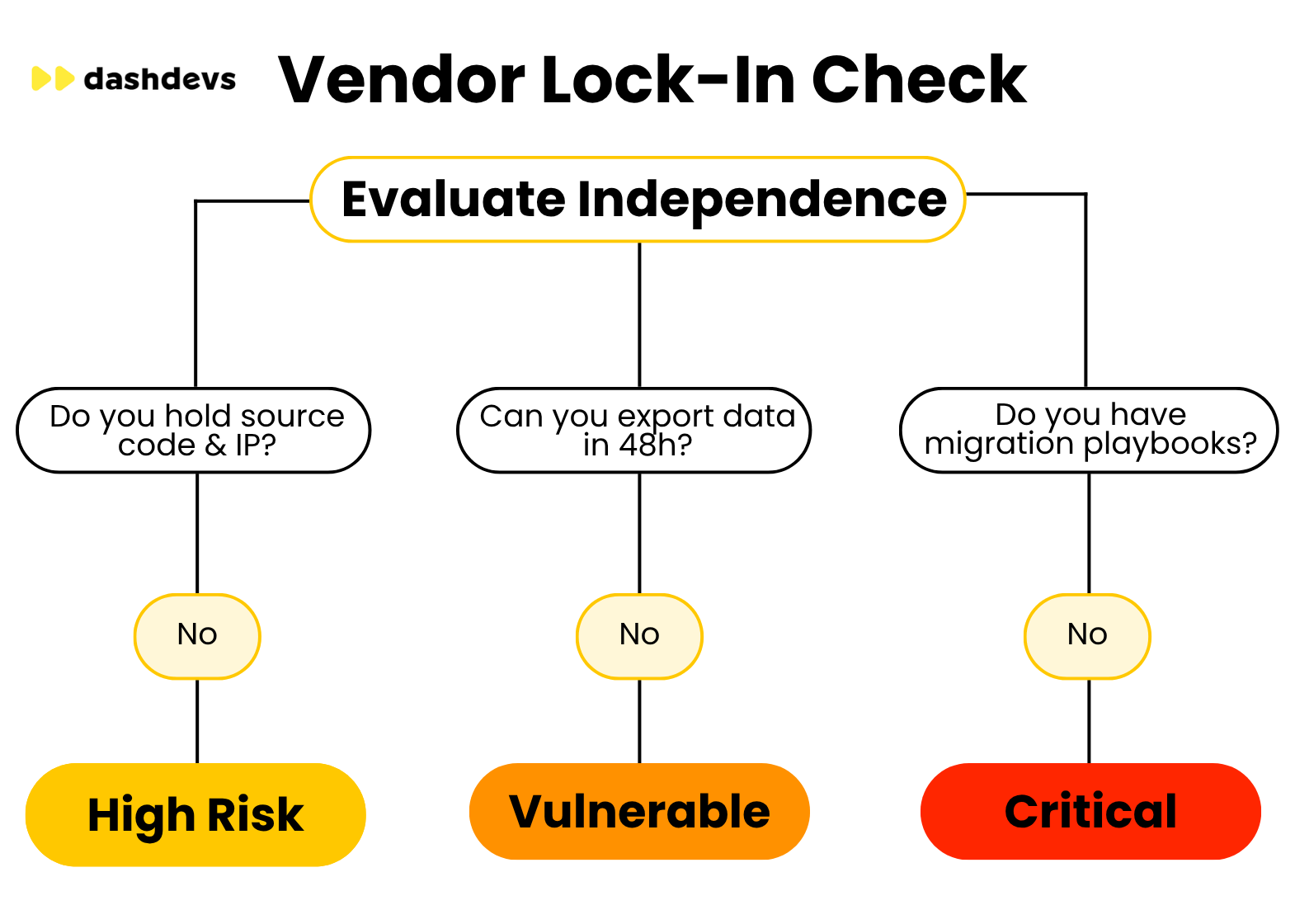
The whole point of good fintech development outsourcing or a platform partnership is that it shouldn’t trap you. If a partner platform won’t let you migrate your data out or swap underlying processors, that’s not really a partner relationship. It’s vendor lock-in with better marketing.
Underbudgeting Integration Work
Whether you buy or partner, connecting the pieces still takes real engineering time. Our fintech API integrations guide covers what that work actually involves, because “just call the API” undersells what integration takes inside a regulated environment.
Bringing It Together
There’s no universal right answer between building, buying, and partnering. There’s only the right answer for this specific component, at this specific stage of your product, given the team you actually have.
Run the build buy partner framework, weigh the pros and cons honestly instead of optimistically, and model the three-year cost instead of the first invoice.
After 17+ years helping teams choose what to own versus what to license, the expensive mistakes are almost always the same: scoring the company instead of the component, and treating the first invoice as the total cost.
Share article
