


Building Compliant Crypto On/Off-Ramps for Regulated Fintechs

September 6, 2026
- Building an in-house fiat-to-crypto on-ramp from scratch costs more, whereas buying from a ramp provider is cost-effective and absorbs part of your compliance burden. However, the EMI or PSP license still determines which checks you must own and prove independently.
- As of July 1, 2026, MiCA's transitional period is over. Any entity in the EU crypto transaction chain without CASP authorization is now in breach of EU law.
- The global cryptocurrency market is projected to reach $85.3 billion in revenue in 2026.
- The build-vs-partner decision is a compliance liability and pricing question. Speed to market comes second.
The real situation we often see: the crypto stack works well, users hold assets, the wallet is live, and on-chain transactions settle. At first, everything looks fine until the moment someone wants to fund with EUR or withdraw from a bank account.
At this moment, crypto-first fintechs discover that banking access, settlement rails, and compliance reporting work by different rules than anything in their existing stack. Building crypto on/off-ramps is a regulated layer of infrastructure with real legal obligations. The most common landmine here is signing a third-party provider contract where nobody clearly maps out who holds the legal bag when things go wrong.
In 2026, the global cryptocurrency market is expected to reach $85.3 billion. While the market shows growth, the main question for regulated fintechs is how to build it without accumulating compliance debt that surfaces in an audit two years later. When setting up an on-ramp, off-ramp crypto flow, understanding what happens under the hood during on-ramping and off-ramping is everything.
This guide covers the build-vs-partner framework, KYC/AML ownership, MiCA and US licensing, banking partner selection, and what implementation looks like after the contract is signed. If you’re a compliance lead, a product owner, or a technical decision-maker at neobanks, wallets, remittance platforms, or trading apps, this article will help you build crypto on/off-ramps the right way.
Build, Buy, or Partner: The Decision Framework
It’s important not to treat an on-ramp, off-ramp crypto strategy only as a question of speed or API fees. The real decision depends on who owns compliance liability for flagged transactions and on long-term liability costs.
Before picking a vendor, evaluating crypto on/off ramps starts with matching your regulatory license to the right setup.
| Model | Compliance liability | Time to market* | When it fits |
|---|---|---|---|
| Build in-house | Entirely yours: KYC, AML, banking, custody, and settlement stay under your direct operational control. | 9–18 months | Tier-1 banks and large licensed institutions with direct bank rails and crypto licenses. |
| White-label ramp | Split: You handle user-facing KYC; the provider manages liquidity execution and block settlement. | 4–8 weeks | Regulated fintechs with an established user base wanting to own compliance data. |
| Embedded ramp API | Provider-owned: Provider handles primary checks; you manage basic UI and raw user data entry. | 1–3 weeks | Early MVPs launching under a sponsor bank or Banking-as-a-Service (BaaS) setup. |
The embedded API route looks tempting for a fast fiat on-ramp. However, it is a highly risky assumption if you treat the provider’s KYC checks as automatically satisfying your own license obligations. First, determine which entity is legally providing each regulated service, which checks are performed by each party, and what evidence each party retains.
For most regulated platforms, a white-label setup gives you the safest baseline for managing crypto on/off ramps. It fits your existing verification tools instead of bypassing them, so you keep full ownership of the audit log. Teams using Fintech Core run ramp flows on a compliant ledger. This keeps reconciliation, audit trails, and KYC/AML under one roof so that the ramp provider sits behind a clean adapter interface. That is why it is easy to swap them later without breaking your compliance core.
* Time-to-market figures are indicative implementation estimates. Actual timelines depend on licensing, bank onboarding, vendor due diligence, integration scope, and jurisdiction.
The fastest ramp to market is not always the cheapest. A provider-side KYC model that saves six weeks of integration can cost six months of remediation when your regulator disagrees with the setup.
End-to-End Infrastructure Flow
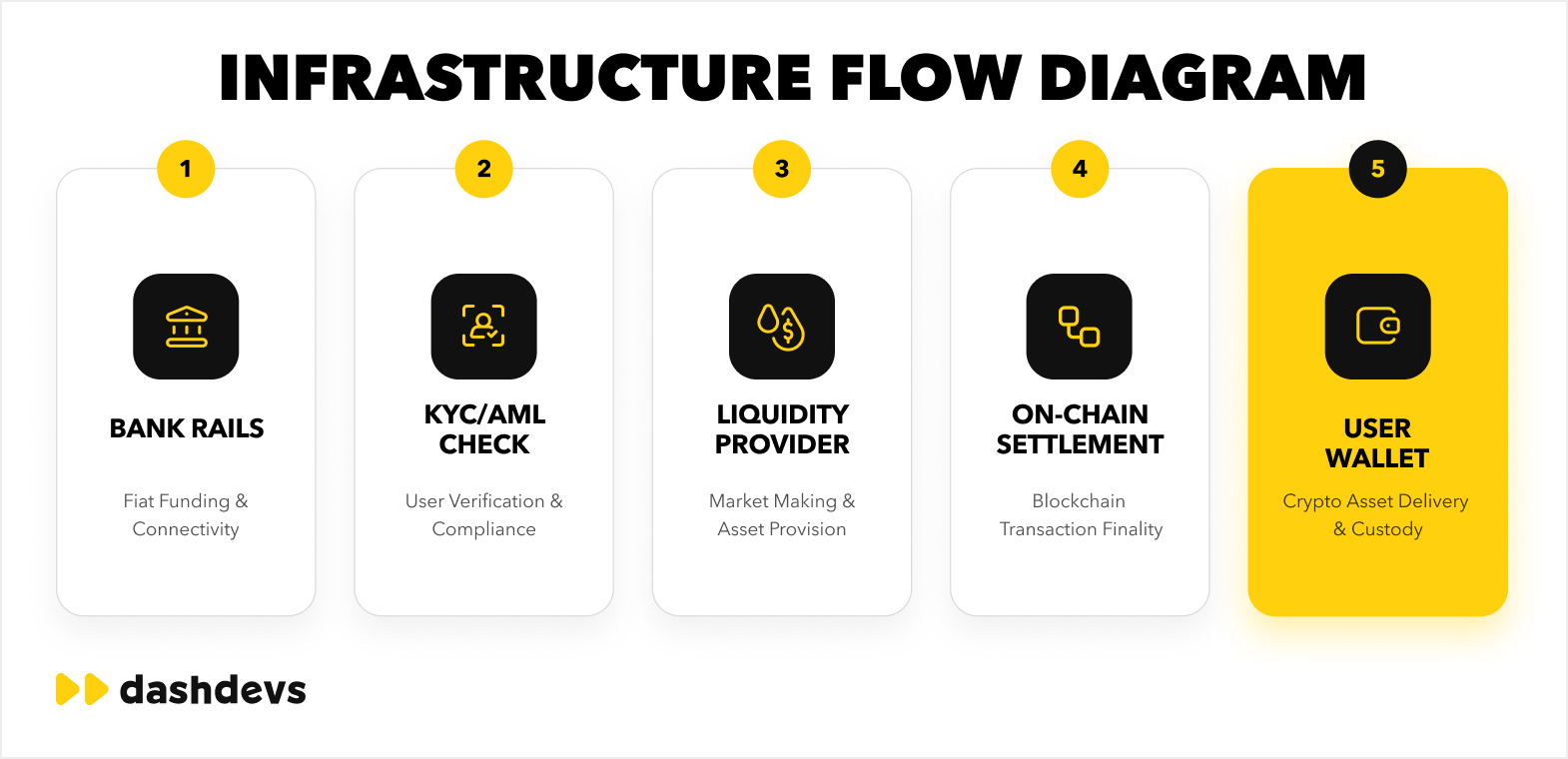
Money and data flow across bank rails, card networks, compliance checks, and block explorers. At its core, an on-ramp or off-ramp crypto infrastructure performs five fundamental jobs:
- Quote: Price the trade and hold that price for a defined window.
- Collect: Take the inbound leg via two main payment methods — bank transfers (SEPA Instant, FedNow, ACH, or virtual IBANs) or card acquiring (credit/debit cards). Before funds move into a liquidity pool, your transaction processing system logs the event, screens sanctions, attaches Travel Rule data, and proves the deposit actually cleared.
- Convert: Execute against liquidity partners and book the real fill rate, not just the initial quote.
- Settle: Deliver the outbound leg once and only once, landing directly in the user’s wallet or secure institutional custody.
- Account: Explain, to the cent, where the money and assets sit right now across your internal ledger. This is the critical step that teams most often skip.
This five-step sequence applies to every on-ramping deposit and off-ramping withdrawal your platform processes.
KYC & AML Responsibility Before Integration
Picture a neobank using a default ramp integration: provider-side KYC with a simple pass/fail flag sent back over an API. A year later, a regulator asks for the evidence supporting 40 transactions flagged during an AML review.
The neobank asks the provider for the underlying records, but the provider explains that identity documents and screening logs remain in its environment and can only be retrieved through a formal request. Now the fintech has a practical compliance problem. It may have an agreement in place, but it can’t independently retrieve the evidence it needs when the question arrives.
That’s not necessarily an automatic regulatory violation. It is, however, a serious architecture and vendor-management risk. When running on-ramping or off-ramping operations, the first question should be simple: which party performs each control, and can the other party access the evidence when it needs it? This applies equally to a crypto off-ramp withdrawal as it does to a deposit.
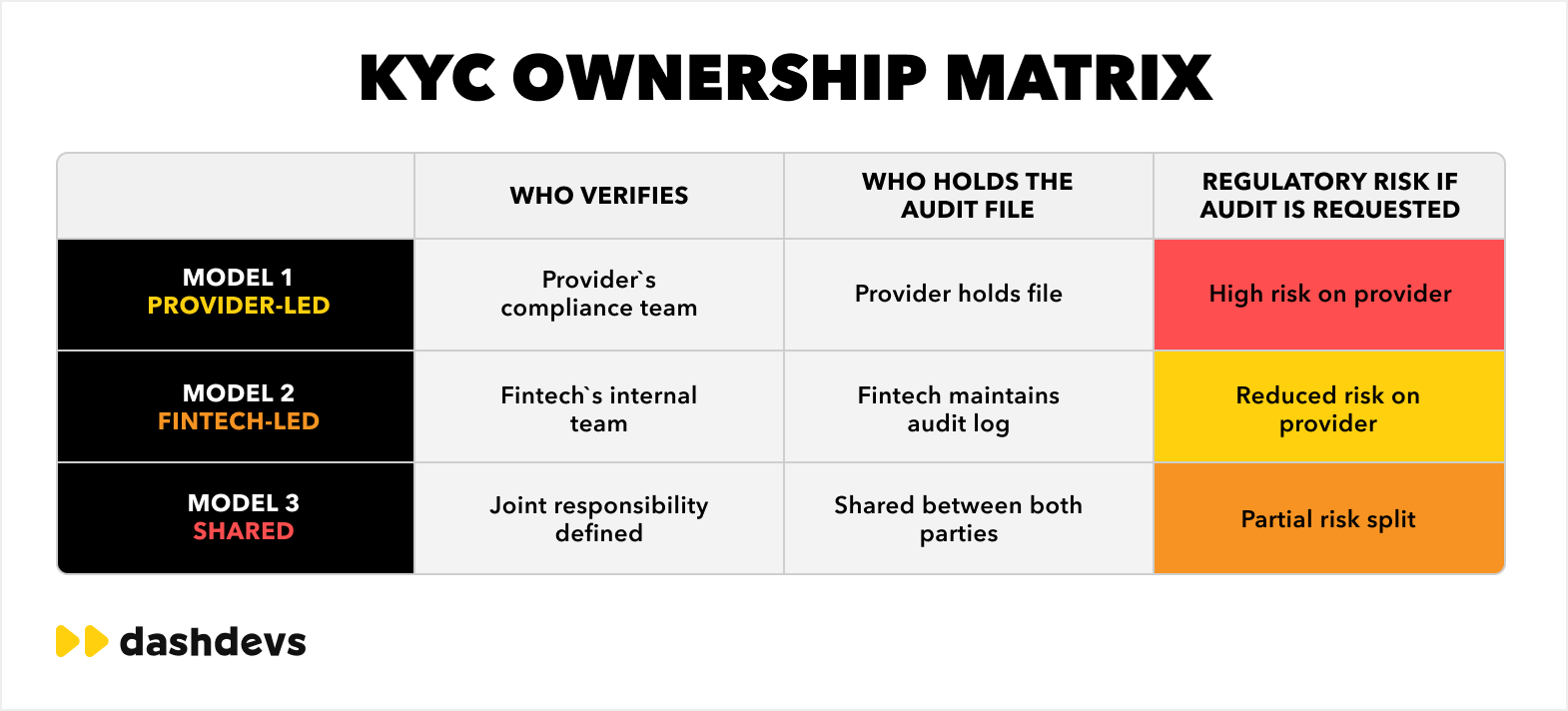
In practice, there are three options for KYC/AML ownership:
| Model | How it works | What to confirm before launch |
|---|---|---|
| Provider-led KYC | The provider performs customer verification and related screening. You receive the status and evidence defined in the integration and contract. | What records you can access, retrieval speed, retention, and who handles regulatory requests |
| Fintech-led KYC, provider-assisted | You onboard users on your platform and perform verification relevant to your regulatory role, then pass status or data to the ramp API. | You operate the corresponding compliance controls properly and retain evidence |
| Shared KYC | Both sides perform different parts of customer and transaction screening. | Who does what, what evidence is retained, how exceptions escalate, and how regulatory requests are handled |
For a licensed EMI or PSP, Model 2 can be a strong fit for an on-ramp, off-ramp crypto setup when the business already has a mature customer-verification framework. But it isn’t automatically the best model. The right choice depends on the services provided by each party and the regulatory framework that applies.
The real test for a ramp setup is simple. Can you retrieve the evidence behind a flagged transaction without opening a vendor support ticket?
MiCA and US Licensing: What Actually Applies to You
Getting clear on on-ramp vs. off-ramp crypto rules matters greatly. Your license dictates which technical models you can legally run. That is why you need to know about MiCA and US licensing before reading vendor docs.
| European Union (MiCA / TFR) | United States (FinCEN MSB / State MTL) |
|---|---|
| CASP authorization or applicable financial-entity route | Federal AML and state licensing may apply |
| €50K / €125K / €150K minimum capital by CASP class | Requirements vary by state and business model |
| MiCA transition ended July 1, 2026 | New York has a separate BitLicense regime |
| TFR requires information with in-scope crypto transfers | Additional rules may apply to custody, stablecoins, and money transmission |
EU: MiCA CASP Authorization
Since December 30, 2024, platforms facilitating EU crypto flows need CASP authorization. Alternatively, they must operate under a licensed partner. That includes white-label setups — if your app touches the transaction, MiCA applies to you. Minimum regulatory capital tiers range from €50,000 up to €150,000 depending on services.
Getting authorized takes anywhere from 40 to 90 business days. However, national regulators like BaFin can take six months sometimes. This happens if your application filings miss critical details. The transitional grandfathering period has now officially ended. Now, operating without proper authorization is an illegal financial service.
MiCA also aligns with strict Transfer of Funds Regulation (TFR) rules. Every entity in the payment chain must collect verified user information. TFR mandates data sharing on all CASP transfers with zero minimum threshold. The €1,000 limit applies specifically to transfers involving self-hosted wallets. If your app sits in the flow, you share these mandatory TFR duties. You can’t simply push them onto the underlying CASP.
If you settle payouts using stablecoins, MiCA’s E-Money Token guidelines add extra rules on reserves and redemptions. To see how that works in practice, check out our guide on stablecoin banking.
US: MSB and State Licensing
In the US, the main question is whether your company counts as a money transmitter. Does fiat flow through your accounts before hitting a ramp partner? If so, regulators treat you as a money transmitter. This applies even if you never touch a single Satoshi.
Right now, 49 states require their own Money Transmitter License (MTL). New York’s BitLicense is the toughest one to secure. Establishing an audit-ready on-ramp, off-ramp crypto architecture requires early legal consultation. If you serve users in both the EU and the US, you’re balancing two distinct rulebooks at once.
A vendor covering EU rules might lack the required US state MTLs. Furthermore, EU KYC workflows might fail US exams. You can’t simply reuse the same compliance setup. Get legal counsel to verify your setup before signing vendor contracts for your product.
Banking Partner Selection Checklist
Every on-ramp, off-ramp crypto build relies heavily on a solid banking partner. The bank handles fiat clearing, and the liquidity vendor handles on-chain assets. Picking the wrong bank leads to random freeze events, settlement delays, and compliance gaps that can later become your problem.
Anyone working in cross-border payments knows banks pull out of crypto verticals all the time. A bank might approve your business model today. Tomorrow, they could shut your accounts down because of internal policy shifts. A bad headline about another client could also trigger this.
Pro tip: Always build an abstraction layer so you can plug in a backup bank without rewriting your product code.
| Evaluation criteria | Requirement and standard | Strategic value |
|---|---|---|
| Contractual policy | Written crypto-friendly policy documented directly in the binding SLA | Prevents sudden account terminations following internal board policy shifts |
| Segregated client reserves | Complete structural isolation of customer funds from corporate balance sheets | Mandated under EU MiCA rules; non-negotiable for EMI and PSP license holders |
| Settlement rail SLAs | Real-time support for SEPA Instant, Faster Payments, or FedNow | Prevents user drop-off caused by multi-day settlement delays on a fiat on-ramp |
| Virtual IBAN provisioning | Automated generation of unique IBANs per user account | Eliminates manual matching errors and simplifies automated reconciliation |
| Transaction-level screening | Continuous, real-time sanctions and PEP screening on all fiat movements | Catches compliance flags before funds clear irrevocable clearing rails |
If you’re launching a fiat on-ramp, real-time bank rails are a must-have for a decent user experience. A fiat on-ramp that settles in seconds can’t be unwound if a sanctions flag fires after clearing. That is why you must catch sanctions or compliance flags before funds clear. Otherwise, you will face massive unrecoverable losses.
Ramp Provider Comparison: Compliance Coverage First
Operating under a real financial license changes your priorities entirely. First, understand how much compliance work the vendor absorbs. Second, ensure you can access raw audit logs whenever needed.
| Provider | Geographic coverage | KYC model | Travel Rule support | Ideal target fit |
|---|---|---|---|---|
| Ramp Network | EU (MiCA ready), UK, US select states | Configurable: provider or fintech-owned | Yes | EMI/PSP platforms with an existing user KYC base |
| MoonPay | EU, UK, US (47 states + BitLicense), APAC | Provider-side by default | Yes | Consumer-facing apps needing broad global coverage out of the box |
| Banxa | EU, Australia, Canada, US limited | Shared model available | Yes | Mid-market fintechs and exchanges needing flexible compliance options |
| Onramper | Aggregator across 40+ providers | Delegated to underlying provider | Varies by provider | Early MVPs needing multi-provider routing; less suitable as a primary crypto on-ramp for licensed entities |
Architecture matters as much as provider selection. When we integrated BitGo’s institutional custody into a digital assets trading platform, the core requirement was one ledger tracking both fiat and on-chain holdings simultaneously. The ramp provider connected to that ledger rather than running a parallel state. This eliminated the reconciliation gap that becomes a compliance event the first time two separate systems diverge.
That KYC ownership column is what keeps your license safe. Defaulting to provider-side verification leaves big audit gaps if your license says you have to verify customers yourself. Watch out for aggregator setups too. Routing transfers across multiple providers creates data silos, and you might not know which vendor verified a user. In this situation, finding existing proof becomes nearly impossible.
That’s a massive red flag during a regulatory audit of a crypto on-ramp. Get the KYC ownership split spelled out clearly in your vendor contract. Ask one exact question before going live: “If regulators request the full KYC file for a specific transaction, who generates it?” Also ask about the required format and delivery speed. If the answer involves waiting on a vendor’s support team, rethink your setup.
What the Implementation Actually Looks Like
A ramp integration is complete when it handles settlement failures and passes a reconciliation audit. Finally, it must pull up full KYC logs on demand.
Real-World Build: Digital Assets Trading Platform
An APAC fintech with EMI and VASP licenses needed to merge fiat and crypto liquidity into one compliant framework, with one core constraint. Every single on-ramping or off-ramping transaction required audit-ready KYC, KYB, and KYT records. Complete Travel Rule tracking was also strictly mandated. They also had to prove segregated custody and proof-of-reserves to keep their banking partner happy.
We built their platform using Fintech Core. We set up a unified balance system, which synced fiat and crypto states in real time. We isolated compliance logic into independent services, meaning they can update or swap vendors without touching core settlement code. On the fiat side, we added stablecoin routing for cross-account payments. Moreover, we included automated wallet rebalancing and KMS key security. As a result, they avoided relying on third-party key custodians.
The numbers:
| Outcome | Result |
|---|---|
| Onboarding speed | 60% faster user onboarding thanks to streamlined KYC/KYB/KYT flows |
| Liquidity posture | 95:5 liquidity ratio maintained automatically between cold and hot wallets |
| Throughput | 30,000 TPS engine capacity running inside a fully audited setup |
| Regulatory readiness | Cleared EMI and VASP regulatory checks on day one without structural reworks |
The 3-Phase Implementation Blueprint
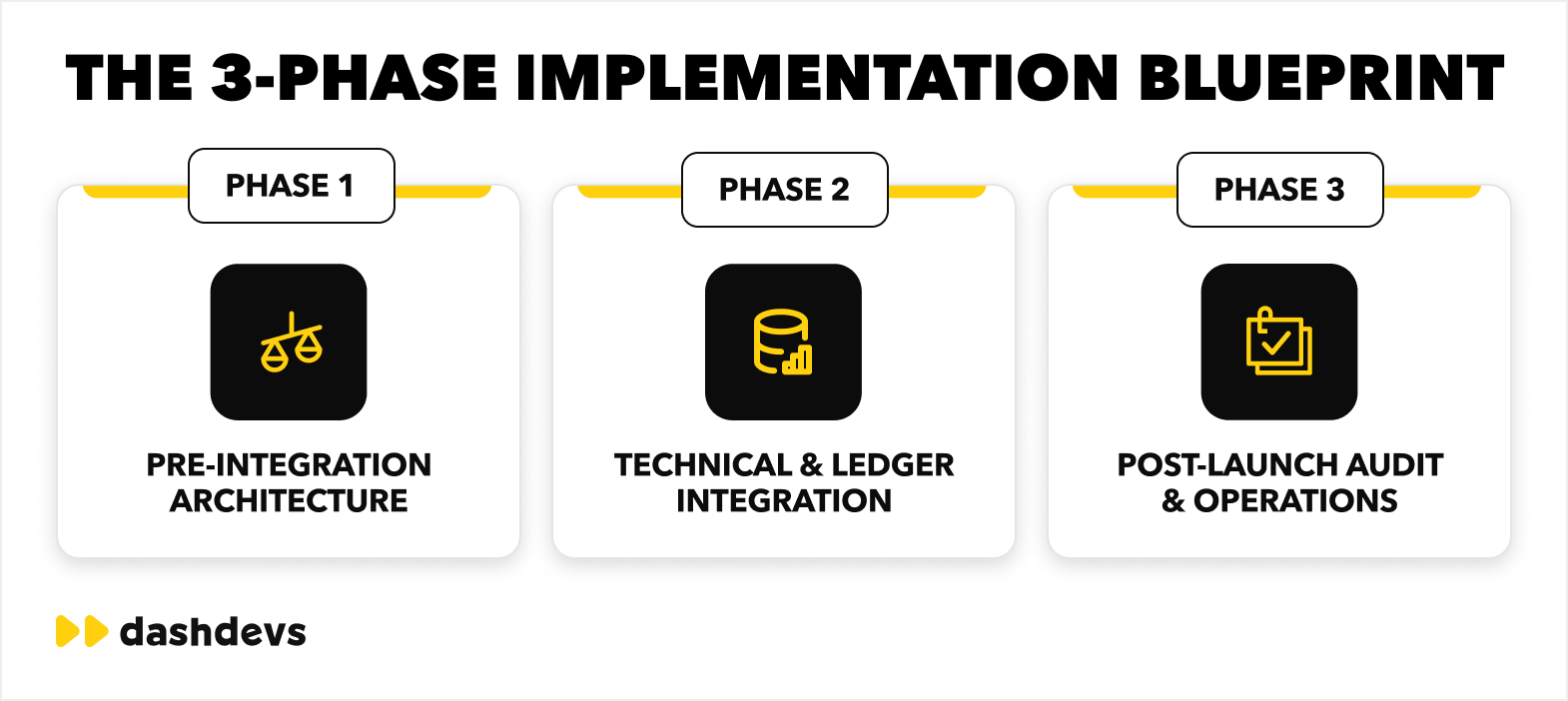
Phase 1: Pre-integration architecture
- Lock in your compliance ownership model with legal counsel before writing code.
- Verify exact licensing requirements across every target region.
- Get written, contractually binding crypto policies from your banking partners.
- Design an audit-ready on-ramp, off-ramp crypto setup with clear data retention rules.
- Work with experts in fintech mobile app development to harden client-side APIs and key handling.
Phase 2: Technical and ledger integration
- Build on a single, unified ledger for fiat and crypto states. Separate ledgers invite reconciliation nightmares.
- Log every KYC/AML check with timestamps, pass/fail status, and raw vendor payloads.
- Add strict API idempotency to stop double-crediting when network connections glitch.
- Update user account balances only when receiving verified settlement webhooks — never on initial API call responses.
- If you’re doing custom eWallet app development, make sure your wallet architecture handles pending ledger states cleanly.
Phase 3: Post-launch audit and operations
- Run monthly three-way reconciliations across internal ledgers, bank statements, and blockchain entries.
- Map your stack against common digital wallet types to support new asset types as you grow.
- Test your automated audit log exports internally before a regulator asks to see them. Any on-ramping transaction that passed verification under an older policy may no longer meet current standards. Test for this before a regulator does.
- For cross-border payment flows, check your ledger logic against international standards for business payment remittance.
Your tech choices today matter a lot. They dictate whether your app passes its first regulatory review smoothly. Poor ledger designs might force expensive overhauls under deadline pressure.
What Goes Wrong After Launch
These issues appear months after launch, when the original team has already moved on.
1. Vendor KYC Policy Drift
Ramp vendors update their internal KYC policies quietly over time. A user passed verification years ago. Today, they might fail current standards and might also violate local regulatory rules. Your legal duty to monitor transactions doesn’t stop at onboarding. Both MiCA and US rules mandate ongoing transaction monitoring. Set up regular checks to catch vendor policy shifts early.
2. Treating All Stablecoins the Same Across Borders
USDC and USDT fall under different rules under MiCA’s EMT provisions compared to US regulations. Setting up a European stablecoin fiat on-ramp involves specific legal steps. Running that same flow in the US differs entirely. Trying to serve both regions with a one-size-fits-all setup without local legal review will lead you into trouble.
3. Shipping Settlement Before Reconciliation Tools
A reconciliation mismatch in production is a potential compliance breach. Don’t push settlement features live before testing reconciliation scripts fully. Discrepancies between databases, bank records, and block explorers cause headaches and might even require filing a Suspicious Activity Report (SAR). Build settlement and reconciliation together in the same sprint.
4. Relying on a Single Banking Partner
Banks change their risk appetite fast. When a bank decides to exit crypto, they act quickly and most often rarely give you more than 60 days to move. Your product might rely on one bank connection without middleware. Consequently, an account closure notice can freeze your operations overnight. Building a banking abstraction layer takes minimal effort upfront and saves you from sudden product blackouts later.
Your initial compliance setup dictates your future. It will either support or constrain everything you build next. This includes wallet features, remittance rails, and embedded finance tools. Getting the basics right is critical when learning how to create a digital wallet. Staying sharp on digital wallet innovations helps you build systems that last.
Compliance Is the First Decision
Most failed ramp integrations don’t crash with error codes. The APIs work. Payments clear. Users move fiat to crypto without seeing a single glitch. Then, an auditor asks for verification records from months ago. Sadly, the team discovers a major problem. The audit trail lives on a vendor’s servers, completely out of reach.
That’s why getting this right matters. Plenty of surface-level articles explain basic transaction mechanics. Almost none explain who actually holds legal responsibility when those mechanics run inside a licensed fintech product.
The right setup depends on your license, location, vendor contracts, and ledger structure. None of those belong at the end of a sprint task. Lock them down before writing your first line of code. Your technical architecture permanently bakes those exact choices in. A database built without compliance verification checks resists easy patching. Usually, you must scrap it and rebuild from scratch.
Fintechs that succeed treat compliance as the foundational design rule. It tells you which vendors to pick and banks to use. It dictates how to layer your wallet software. Finally, it defines what your audit logs must prove. The tech simply follows the rules you set.
After 17+ years around regulated payment and crypto infrastructure, the pattern is consistent: teams that treat KYC ownership and ledger reconciliation as design constraints ship once. Teams that treat them as post-launch tickets rebuild.
Share article
