


Credit Card Processing: Costs, Key Players, and What Fintech Leaders Need to Know

July 25, 2026
- Credit card processing is a P&L and conversion system — cost is generated at interchange, network assessment, processor markup, and acquirer risk layers, not only on a quoted rate card.
- Map each flow step to who acts, what can fail, and which metric moves (auth rate, abandonment, support load, reserves).
- Roles blur in modern stacks (gateway + processor + PayFac); know what you actually control versus what you rent.
- Move up the maturity curve when volume, margin, international settlement, or embedded issuing make off-the-shelf economics and control insufficient.
- Choose partners on API quality, settlement/reserves, reconciliation and disputes, PCI scope, pricing transparency, and failover — not feature checklists alone.
Credit card processing is invisible when authorization rates stay high and funding lands on time. It becomes a board-level problem when declines spike at checkout, fee lines creep without a clear owner, chargebacks drain reserves, or a compliance gap puts cardholder data in the wrong place.
For payment product managers, fintech founders, and digital banking leaders, the useful question is not whether payment processing exists — it is where margin is created and lost across the flow, which vendor holds leverage at each step, and what changes when you move from an off-the-shelf stack to owning more of the rails. This article gives you a working mental model of credit card processing: the transaction path, the participants, the fee layers that drive your effective rate, and a decision framework for architecture and vendor choices as transaction volume grows.
How Credit Card Processing Works (Transaction Flow)
How credit card processing works in production is a chain of timed handoffs. Each handoff has an owner, a data payload, and a failure mode that hits conversion or ops cost.
- Authorization request — The merchant (or their checkout) initiates the sale. Card data (or a token), amount, currency, and merchant identifiers move toward the gateway. Failure here is usually UX, tokenization, or client-side validation — cart abandonment before the network ever sees the attempt.
- Authentication and fraud checks — Gateway and fraud tooling apply velocity rules, device signals, 3-D Secure / SCA where required, and AVS/CVV checks. Failure is a soft or hard decline that looks like “issuer said no” to the customer even when the issuer never fully adjudicated funds.
- Routing — The payment processor selects pathing across card networks and acquiring relationships. Poor routing shows up as higher declines, slower responses, or unnecessary cross-border fees.
- Acquiring — The acquiring bank (merchant bank) presents the authorization into the scheme. Underwriting posture and MCC configuration shape both approval odds and later interchange.
- Issuer approval or decline — The issuing bank checks funds/credit, risk rules, and card status, then returns a response code. This is where “insufficient funds,” stolen-card flags, and issuer risk models decide the sale.
- Settlement — Approved authorizations clear through the networks; scheme rules and cut-off times determine when obligations crystalize between acquirer and issuer.
- Funding — Net proceeds land in the merchant’s bank account after fees, holds, and reserves. Delays here are a cash-flow and reconciliation problem, not a checkout problem.
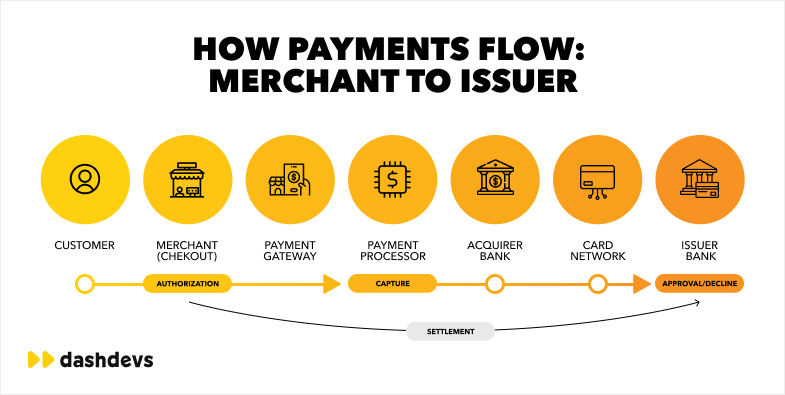
Credit card transactions that “fail mysteriously” are usually a mapped response code plus an unowned retry policy — not random network magic. Authorization-to-funding works only as well as the weakest timed link.
Who’s Involved — and What Each Party Actually Controls
Treat each participant as a control surface, not a glossary term.
Merchant
Initiates the transaction, owns the customer relationship and checkout experience, and bears chargeback risk and many reserve requirements. You control product UX, retry/dunning design, and which providers you integrate — not scheme interchange tables.
Payment gateway
Encrypts and transmits transaction data, often runs the first fraud screen, and is usually the primary API your engineers touch. Gateway quality shows up in docs, token vaulting, webhook reliability, and how cleanly you can accept credit card payments across web, mobile, and a physical card reader where needed.
Payment processor
Routes the authorization request and manages technical connectivity to card networks and acquirers. Commercially bundled with the gateway in many contracts, functionally distinct when you need multi-acquirer failover or orchestration.
Acquiring bank (merchant bank)
Holds the merchant account, assumes settlement risk, and underwrites you. Acquirer appetite drives reserves, delayed funding, and whether high-risk MCC traffic is even allowed.
Card networks
Visa, Mastercard, and peers set interchange frameworks, route between acquirer and issuer, and enforce scheme rules including payment card industry data expectations. Network rules are not optional product preferences.
Issuing bank
Owns the cardholder relationship, approves or declines, and ultimately moves funds from the issuing bank side of the obligation into the clearing cycle. If you build issuing products, card issuing integration and card issuing solutions sit on this side of the stack — adjacent to, but not the same as, merchant acquiring.
How roles blur
Modern stacks collapse titles: one provider may act as gateway, processor, and PayFac; a marketplace may underwrite sub-merchants; a fintech may sponsor banking while another firm runs processing. Your contract should name who holds the merchant account, who is PCI-responsible for which systems, and who you call when settlement breaks — regardless of the marketing label on the invoice.
Where the Money Goes — Fees Explained by Layer
Quoted “processing fees” are almost never a single number. Processing a credit card creates cost in stacked layers that compound into your effective rate.
Interchange fees
Set by card networks and paid primarily to the issuing bank. They vary by card product (consumer vs commercial, rewards tier), transaction method (card-present vs card-not-present), region, and merchant category code. You rarely “negotiate interchange” directly; you influence it through MCC accuracy, auth quality, and channel mix.
Assessment and network fees
Paid to the card network for using the rails. Smaller than interchange in many markets, still material at scale, and easy to miss when a vendor shows a blended rate.
Processor and gateway markup
Where providers build margin on top of interchange and assessments. Common commercial shapes:
| Model | How it prices | Trade-off as you scale |
|---|---|---|
| Flat-rate | Single blended % + per-item fee | Predictable ops; often overpays on low-interchange traffic at volume |
| Interchange-plus | Interchange + assessments + disclosed markup | Transparent for optimization; needs finance literacy to read statements |
| Tiered | Qualified / mid / non-qualified buckets | Simple sales pitch; opaque effective rate and surprise bucket shifts |
| Subscription + per-txn | Platform fee plus usage | Can fit productized SaaS billing; watch overage and add-on fees |
Flat-rate pricing popularized by providers like Stripe and Square is rational early; it becomes a P&L drag when your mix is mostly low-interchange debit cards or optimized card-not-present traffic you could price more tightly on interchange-plus.
Acquirer fees and reserves
Underwriting risk shows up as monthly fees, chargeback fees, rolling reserves, and delayed funding. These lines are why two merchants with the same “rate” experience different cash conversion cycles.

Credit card payment processing economics also depend on refunds, partial captures, and multi-currency conversion — none of which appear in a homepage rate table. Credit card payment processing statements that hide interchange breakouts make it impossible to know whether you are losing margin to scheme mix or to vendor markup. Treat credit card payment processing cost reviews as a monthly operating ritual once volume is material, not an annual procurement event.
When teams say scheme and processor fees “feel high,” separate scheme-driven cost from negotiable markup before you switch vendors. Switching without that split often recreates the same effective rate under a new logo. Credit card processing fees should be reviewed as a stack — interchange, assessments, markup, and reserves — not as one blended mystery percentage.
Where Transactions Fail — and What It Costs the Business
Failures are not only technical outages. They are conversion, support, and revenue-recovery events.
| Failure mode | Typical owner in the chain | Business metric hit |
|---|---|---|
| Insufficient funds / credit | Issuer | Auth rate; retry/dunning design |
| Fraud / velocity flags | Gateway fraud + issuer | False declines; abandoned carts |
| AVS/CVV mismatch | Gateway rules + issuer | Auth rate vs fraud loss trade-off |
| Expired / reissued cards | Issuer + merchant updater | Involuntary churn on subscriptions |
| Issuer risk rules | Issuer | Silent declines; support tickets |
| Network timeouts | Networks / processor path | Checkout retries; double-charge risk |
| Processor or acquirer outage | Processor / acquirer | Gross merchandise volume at risk |
For subscriptions and usage billing, soft vs hard declines must drive different automation. That is the core of recurring payment systems design: retries that ignore decline class burn issuer goodwill and customer trust.
Ops teams feel the same failures in finance. Broken auth-to-settlement matching creates ledger noise; teams that invest in real-time payment reconciliation catch fee variance and missing funds before month-close.
When you process credit cards at scale, a one-point auth-rate drop can outweigh a few basis points of markup. Instrument response codes, not only “paid vs failed.” Finance and product should share one decline taxonomy before either team tries to “fix processing.”
From Off-the-Shelf Processing to Owning More of the Stack
Competitors stop at “connect a gateway.” The operating decision is how much of credit card payment processing you rent versus control.
Maturity curve
- Basic gateway integration — Ship checkout quickly; accept blended pricing and limited routing control.
- Negotiated interchange-plus (or hybrid) — Finance can read scheme costs; you optimize MCC, rail mix, and fraud rules.
- Payment facilitator (PayFac) or platform model — You onboard sub-merchants, absorb more underwriting and compliance burden, and capture platform economics.
- Deeper acquiring / processing relationships or embedded finance — Multi-acquirer routing, local acquiring, or issuing and accounts as product surfaces.
What triggers an upward move
- Transaction volume where blended rates become a visible margin line
- Need to lift authorization rates via routing and retry intelligence
- International expansion and multi-currency settlement complexity
- Margin pressure from refunds, chargebacks, or reserve drag
- Product roadmap that needs embedded issuing, wallets, or account features beside merchant acceptance
Credit card online processing for a single domestic web checkout rarely needs PayFac complexity. Multi-sided marketplaces and embedded finance programs often do. Adjacent capabilities arrive on the same roadmap: an open banking solution for account-to-account rails, white label fintech software when speed-to-module matters, and comparisons against top core banking solutions when ledger and account ownership become strategic.
In short: move up the curve when control of auth, settlement, or unit economics is worth the compliance and ops load — not because “enterprise” sounds better.
Choosing a Credit Card Processing Partner — What Actually Matters
Credit card processing for business is a systems decision. Feature matrices hide the variables that move P&L.
Decision framework
- Integration complexity and API quality — Docs, sandboxes, idempotency, webhooks, and token portability. A brittle credit card system integration becomes a permanent eng tax.
- International support and multi-currency settlement — Local acquiring, FX markup disclosure, and payout timing by market.
- Settlement speed and models — Daily vs delayed funding, rolling reserves, and threshold holds. Merchant services contracts bury these in schedules.
- Reporting, reconciliation, and dispute tooling — Can finance match auth, capture, fee, and chargeback without spreadsheet archaeology?
- Compliance responsibilities — Who absorbs PCI DSS scope? Confirm data security standard PCI obligations, card industry data security expectations, and how payment card industry data is tokenized vs stored. Ask explicitly about security standard PCI DSS evidence and broader data security standards for subprocessors.
- Pricing model transparency — Flat-rate vs interchange-plus vs tiered. Demand sample statements with real mix assumptions.
- Uptime, redundancy, and failover — Multi-acquirer routing beats a single path when one merchant account is frozen or one processor degrades.
If you are shortlisting providers, read comparative write-ups of the best payment processing companies as input — then score against your auth-rate, reserve, and reconciliation constraints. For build-vs-integrate work on the acceptance edge, payment gateway integration quality usually dominates logo choice. Teams adding issuing beside acquiring should also diligence card issuing providers on the same scorecard logic: control, compliance, and exit paths.
When you process credit cards across regions, insist on a written map of who holds risk on day two of an outage. Operators who process credit cards only through one legal entity often discover reserve and funding rules differ sharply by market — plan for that before launch, not after the first frozen payout. Processing credit cards without failover is a concentration bet. Processing credit cards on a single acquirer can be fine at low volume and reckless at high volume.
Processing credit card batches, retries, and partial captures cleanly is a quieter differentiator than another dashboard widget — ask for it in the RFP.
Practical Example — Payroll and Embedded Card Programs
Embedded programs make the same fee and control questions concrete. A payroll card program combines issuing, load/funding, and merchant acceptance economics in one product surface: you care about authorization quality on spend, scheme and processor costs on both sides of the card, and reconciliation between employer funding and cardholder activity. Leaders who only shopped “checkout processing” discover they also need issuing ops, dispute workflows, and clearer ownership of reserves. The maturity curve above applies — start with clear role boundaries, then own more of the stack only when program margin and control require it.
Key Takeaways
- Credit card processing is a timed chain from authorization through funding; each step has an owner and a business-visible failure mode.
- Cost is generated in layers — interchange, network assessments, processor/gateway markup, and acquirer risk pricing — that compound into effective rate.
- Participant roles blur commercially; contract for merchant account, PCI scope, and incident ownership explicitly.
- Move from off-the-shelf acceptance toward PayFac or deeper acquiring when volume, auth control, international settlement, or embedded finance make rented control too expensive.
- Evaluate partners on APIs, settlement/reserves, reconciliation and disputes, pricing transparency, and failover — not feature count.
- Instrument auth-rate and decline classes; they often dwarf small markup differences.
- Treat processing as infrastructure on the roadmap, adjacent to issuing, open banking, and ledger choices.
Credit card processing will not differentiate your brand on its own — but weak economics, opaque merchant services terms, and fragile integrations will show up in conversion, cash flow, and engineering backlog. Use the flow, fee waterfall, and maturity curve as a shared language across product, finance, and engineering before the next vendor renewal or architecture rewrite. If you are weighing custom payment infrastructure or need a development partner to integrate gateways, orchestration, and issuing cleanly, bring your volume mix, markets, and ownership constraints into that conversation early — the right boundary decisions beat a rushed rate-card swap.
Share article
