


DeFi Smart Contract Development for Lending, DEXs and Staking

November 18, 2026
- DeFi smart contract development is the design, coding, testing and auditing of on-chain programs that run financial services like lending or trading without an intermediary.
- Each protocol type needs different core contracts, so its top risks and audit focus differ too.
- Security is a lifecycle. Threat modeling starts before code, and monitoring continues after launch.
- When your protocol touches fiat or regulated users, you need identity checks and Travel Rule workflows around the contracts.
- DashDevs brings 15+ years in regulated fintech and 70+ fintech providers integrated across client projects to this work.
A DeFi protocol is a bank vault with its blueprints published online. Anyone can read your code. Anyone can call your functions. And once you deploy, every mistake is public and permanent.
So before you write a single line, you need a plan for how each contract can break. You also need someone independent to check it. This guide walks through DeFi smart contract development for the three most common protocol types, one by one.
What is DeFi smart contract development?
DeFi smart contract development is the process of designing, building, testing and auditing the self-executing code that powers decentralized financial services, from lending pools to exchanges.
A DeFi smart contract automatically executes rules when conditions are met. Deposit collateral, and the contract lets you borrow. Swap token A, and the pool sends you token B. No bank clerk approves anything. Our intro to fintech smart contracts covers the basics.
That is the magic. It is also the danger.
If the logic has a gap, nobody stops the transaction. The contract just does what the code says.
How do DeFi lending smart contracts work?
A DeFi lending protocol uses smart contracts to hold collateral and charge interest. When a loan falls below a safety threshold, the contracts liquidate it.
Every lending and borrowing protocol rests on four building blocks:
| Contract module | What it does | What goes wrong |
|---|---|---|
| Collateral vaults | Hold deposited assets and track each user’s position | Accounting bugs let users withdraw more than they own |
| Interest rate model | Sets borrow and supply rates based on pool utilization | Bad curves drain liquidity or make borrowing unusable |
| Liquidation engine | Sells under-collateralized positions to protect lenders | Delays or gas spikes leave bad debt in the protocol |
| Oracles | Feed asset prices into all of the above | Manipulated prices trigger false liquidations or bad loans |
The oracle deserves extra attention. Every lending decision depends on a price. If an attacker can move that price for even one block, they can borrow against inflated collateral.
Never read prices from a single DEX pool’s spot price. Use time-weighted averages or a decentralized oracle network, and add sanity checks that pause borrowing when prices jump outside a set range.
Building lending products for regulated users? Our guide to lending as a service covers the off-chain side.
What smart contracts does a DEX need?
A decentralized exchange needs contracts that hold liquidity, price trades and route orders, plus fee logic that rewards liquidity providers.
First, pick your model. Each one changes the contracts you write.
| DEX model | How prices are set | Best for | Main trade-off |
|---|---|---|---|
| AMM (automated market maker) | A formula based on pool balances | Long-tail tokens, simple swaps | Impermanent loss for LPs, slippage on large trades |
| Order book | Matching of buy and sell orders | Professional traders, limit orders | Higher gas costs on-chain, often needs off-chain matching |
| Aggregator | Routes across other DEXs for the best price | Users who want best execution | Depends on the security of every venue it routes to |
The core DEX contracts usually include:
- Factory: deploys new liquidity pools
- Liquidity pools: hold token pairs and track LP shares
- Router: finds the path and executes multi-hop swaps
- Fee logic: splits fees between LPs and the protocol treasury
Watch rounding and fee math closely. Tiny errors add up when bots repeat a trade thousands of times.
Planning a trading venue with fiat rails too? See our approach to cryptocurrency trading platform development.
How do staking smart contracts work?
Staking contracts accept deposits, lock them for a period, distribute rewards and, in proof-of-stake systems, can slash funds for validator misbehavior.
Four modules carry most of the risk:
- Deposit and withdrawal queues. Many networks have unbonding periods, so withdrawals wait in a queue. Queue logic must stay fair under heavy demand.
- Reward distribution. Rewards are usually tracked per share, so the contract never loops through every staker.
- Slashing. If a validator misbehaves, the protocol cuts stakes. Your contract must spread that loss correctly across users.
- Liquid staking tokens (LSTs). Users get a token that represents their stake and can use it elsewhere in DeFi. That token’s exchange rate must stay accurate.
Liquid staking adds composability. It also means your token ends up as collateral in someone else’s lending protocol, and their risk becomes yours.
Lending vs DEX vs staking: contracts, risks and audit focus
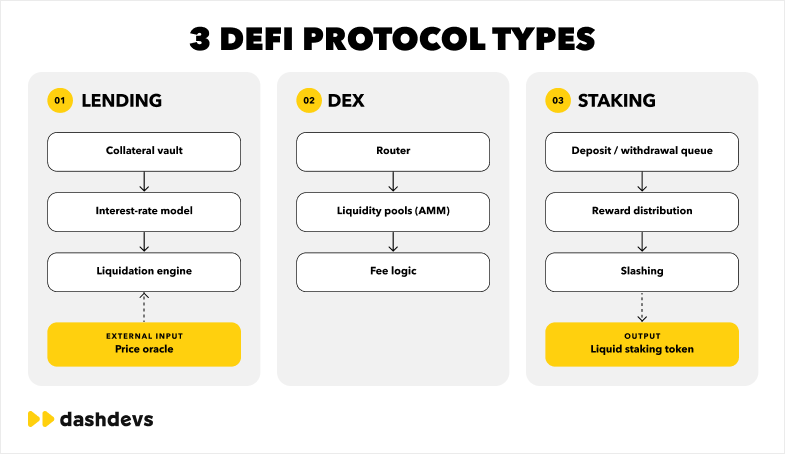
Here is the side-by-side view that most guides skip:
| Protocol type | Core contracts | Top risks | Audit focus |
|---|---|---|---|
| Lending | Vaults, interest rate model, liquidation engine, oracle adapters | Oracle manipulation, bad debt, flash-loan attacks | Price feed logic, liquidation math, health factor edge cases |
| DEX | Factory, pools, router, fee logic | Rounding errors, reentrancy, sandwich attacks | Swap math, fee accounting, callback safety |
| Staking | Deposit and withdrawal queues, reward distributor, slashing module, LST | Reward miscalculation, withdrawal lockups, LST depegging | Share accounting, queue fairness, slashing distribution |
How do you secure and audit DeFi smart contracts?
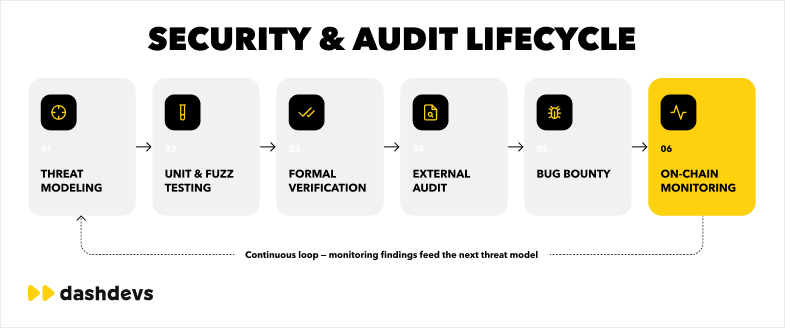
Secure DeFi smart contracts go through six stages: threat modeling, unit and fuzz testing, formal verification, an external audit, a bug bounty and on-chain monitoring.
Skipping a stage is how good teams end up in exploit reports.
The six-stage security lifecycle
- Threat modeling. Before coding, list who could attack and which functions they would call to get what they want.
- Unit and fuzz testing. Unit tests check expected behavior. Fuzz tests throw thousands of random inputs at your functions to find the weird ones.
- Formal verification. For core math (interest, liquidations, swap pricing), mathematically prove the code matches the spec.
- Independent external audit. A separate security firm reviews the code line by line.
- Bug bounty. Pay white-hat hackers to find what the audit missed.
- On-chain monitoring. Watch transactions in real time and pause the protocol if something looks wrong.
The vulnerabilities that cost the most
The OWASP Smart Contract Top 10 (2025) is a good starting checklist. In the 2024 incident data behind it, access control flaws alone accounted for $953.2M in losses across 45 incidents.
| Vulnerability | How it works | How to prevent it |
|---|---|---|
| Reentrancy | An external call re-enters your contract before state updates | Update state before external calls, use reentrancy guards |
| Oracle manipulation | Attacker moves the price your contract reads | Time-weighted prices, multiple sources, deviation checks |
| Flash-loan attacks | Attacker borrows huge sums for one transaction to distort pools or votes | Avoid spot prices, add delays to governance actions |
| Access control | Admin functions are missing checks or keys are compromised | Role-based permissions, multisig, timelocks |
| Proxy and upgrade risks | Storage collisions or unprotected upgrade functions | Standard proxy patterns, upgrade tests, restricted upgrade roles |
The good news? Teams are learning. Chainalysis reported more than $3.4 billion stolen across crypto in 2025, yet DeFi hack losses stayed low even as total value locked rebounded. Most of the 2025 total came from centralized services and private key breaches.
Upgradeability, governance and multi-chain deployment
Upgradeable contracts let you fix bugs after launch, but they also create a new attack surface. Protect every upgrade path with a timelock and a multisig.
| Pattern | What it gives you | What to watch |
|---|---|---|
| Proxy contracts | Ability to change logic without moving user funds | Storage layout must stay compatible between versions |
| Timelocks | A delay between approving a change and executing it, so users can react | Too short is useless; too long blocks emergency fixes |
| Multisig admin keys | No single person can push a change | Signers must use separate devices and locations |
| Cross-chain bridges and messaging | Assets and messages move between chains | Bridges are high-value targets; limit what any one message can do |
For multi-chain protocols, plan how prices and state stay consistent across networks. Our review of cross-chain fallback providers for crypto payments covers the options.
Admin and treasury keys deserve the same care. Read our guide on whether to build in-house digital asset custody infrastructure.
Gas optimization: a cost and UX decision
Gas fees decide whether small users can afford your protocol. Optimization helps, but aggressive tricks make code harder to audit.
Our rule of thumb: optimize the functions users call most (swaps, deposits) and keep admin functions readable. A slightly cheaper contract that no auditor can understand is a bad trade.
What compliance do DeFi protocols need when they connect to fiat?
Once your protocol touches fiat money or serves regulated users, you need identity and transaction checks around the smart contracts. You also need Travel Rule data sharing and licensed on/off-ramps.
Pure on-chain logic stays permissionless. The moment a user deposits euros or a bank becomes your partner, the rules change. If your users keep their own keys, see how to approach embedding non-custodial wallets into a fintech app.
The compliance layer usually includes:
- KYC/KYB: verifying users and businesses before they access fiat features
- KYT (know your transaction): screening wallet addresses and transactions for illicit funds
- Travel Rule: sharing sender and receiver data on transfers between service providers
- On/off-ramps: licensed partners that convert fiat to crypto and back
MiCA status as of November 2026: the MiCA transitional period ended on 1 July 2026. Only authorised crypto-asset service providers can now serve EU clients.
What we built: licensed digital-asset liquidity and Kleos
We built a regulated digital asset liquidity platform on Fintech Core by DashDevs for a licensed client that needed fiat and digital assets in one operating model. The compliance side included KYC, KYB, AML monitoring and Travel Rule workflows. In load testing, the matching engine handled above 30,000 transactions per second with sub-40ms execution latency. Those figures come from load tests and describe peak capacity. In production, onboarding time fell by 60%. Read the liquidity business case.
For our work with Kleos on tokenized yield vaults, we connected non-custodial vault deposits and withdrawals with EUR IBAN accounts and USDC support in one app. The release that added vault investing took 6 weeks. See the Kleos business case.
Both projects run on Fintech Core. Fintech Core by DashDevs is composable fintech infrastructure and orchestration for launching, expanding, or modernizing regulated financial products. It gives teams a faster starting point than custom build, with more flexibility and control than traditional white-label or SaaS platforms.
Outside DeFi, you can also see how we built Inablr’s tokenized sovereign bond platform.
Want to go deeper on the compliance side? Read about crypto compliance with Sumsub on Fintech Core and stablecoin banking.
For partner options, see our review of stablecoin API providers.
How much does it cost to build a DeFi protocol?
Costs depend mostly on protocol complexity and audit depth. Audits alone typically run from tens of thousands to over $100,000 for a DeFi protocol.
Public 2026 benchmarks for audits look like this:
| Project type | Typical audit cost (2026) | Source |
|---|---|---|
| Simple token | $1,000 to $15,000 | QuillAudits |
| Typical DeFi protocol | $20,000 to $100,000 | QuillAudits |
| Bridges and complex multi-chain systems | $50,000 and up | QuillAudits |
Sherlock put the overall 2026 market reference at $5K to $250K+.
Development cost on top depends on what you build. A fork of a proven protocol with custom smart contracts for your fee logic is far cheaper than a new lending design. Budget for at least two audit rounds if your protocol is new.
How to choose a DeFi development partner
Use this checklist when you compare teams offering DeFi app development or broader protocol work:
- They show audited contracts in production, with public audit reports
- They write tests and threat models as deliverables, before the audit
- They have shipped protocol logic similar to yours
- They understand the fiat side: KYC, KYT, custody and banking partners
- They stay after launch for monitoring and incident response
- They explain trade-offs in plain language, including what they would not build
If you are still shortlisting, our lists of top blockchain development companies and best blockchain consulting companies are a good start.
Conclusion
Good DeFi engineering starts with knowing exactly what each contract does and how it could fail.
- Lending: oracles and liquidations need the most care
- DEXs: swap math and fee accounting decide everything
- Staking: fair queues and accurate rewards keep users
Security runs through all of it, from the first threat model to live monitoring. And the moment your protocol meets fiat, compliance becomes part of the architecture.
DashDevs is a fintech product development company that designs, builds, and scales regulated financial products. 15+ years in regulated fintech. 100+ financial products delivered. Talk to our team.
Share article
