


Digital Account Opening Software: Costs, Benefits, and What to Expect

August 5, 2026
- Digital account opening software is an orchestration layer—identity, risk, core booking, funding—not a prettier web form.
- The commercial case is conversion and deposit growth: industry benchmarks still show multiple abandoned applications per completed account.
- Budget for licenses, KYC unit costs, core integration, case ops, and change control—not only the UI package.
- Buy when you need speed and certified patterns; build or compose when product differentiation and data ownership matter more than time-to-pilot.
- Score vendors on hot-path decisions, resume UX, funding speed, and evidence packs your risk team will defend.
Boards still fund “digital onboarding” as if a new form were the product. Applicants abandon, branches absorb the overflow, and marketing keeps buying traffic that never becomes deposits.
Digital account opening software is the operating system for that first relationship: identity, risk decisioning, core booking, funding, and the evidence pack your auditors will ask for. Get the stack right and you convert intent into funded accounts. Get it wrong and you pay acquisition costs for screenshots of incomplete applications.
This guide is for business leaders at banks, credit unions, and fintechs evaluating online account opening solutions—costs, benefits, architecture trade-offs, and what implementation actually feels like once legal and risk join the call.

Why account opening is a P&L problem in 2026
Direct answer: you are not short of applicants—you are leaking them in the funnel.
Cornerstone Advisors’ 2026 Digital Banking Performance Metrics work (widely summarized across industry coverage, including eMarketer’s write-up of the digital account opening gap) puts the pain in one ratio: on average, institutions see multiple abandoned digital checking applications for every one completed account, while digital openings still represent only a minority share of total checking openings. That is not a brand problem first. It is a process and systems problem.
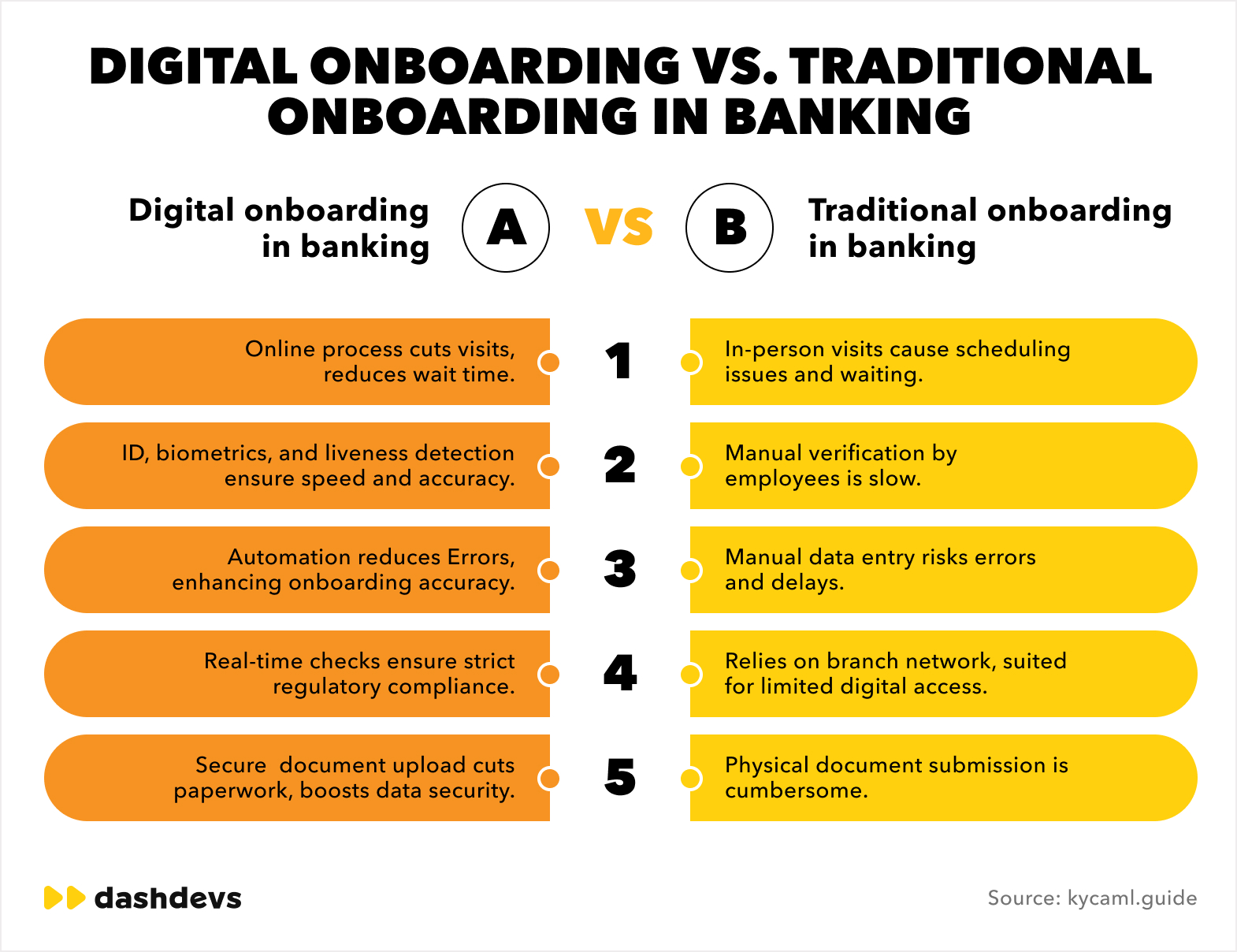
Customers compare your flow to neobanks and marketplaces that finish in minutes on a phone. A physical branch can still win complex relationships—but it cannot absorb every abandoned mobile session without destroying unit economics. Leaders who treat innovation in banking as AI slides while leaving onboarding friction untouched are optimizing the wrong layer.
In short: if your acquisition CAC is rising and digital completion is flat, evaluate the opening stack before you buy more media.
What digital account opening software actually is
Direct answer: orchestration across risk and core—not a CMS form with a “Submit” button.
Mature digital account opening software usually includes:
| Capability | Job in the journey | Failure if missing |
|---|---|---|
| Application UX (web/mobile) | Capture product choice, disclosures, data | Drop-off from length or device switch |
| Identity / KYC / KYB | Prove who the applicant is | Manual spiral or false declines |
| Sanctions / fraud / CIP rules | Hot-path risk decision | Late rejects after marketing spend |
| Decisioning & product eligibility | Approve, refer, or decline | Shadow spreadsheets in ops |
| Core / CIF booking | Create the real account | “Approved” accounts that never exist |
| Funding & activation | Instant ACH, card, wire, internal transfer | Empty accounts that go dormant |
| Case management | Human review with SLA | Slack archaeology |
| Audit & evidence | Reconstruct every decision | Exam pain |
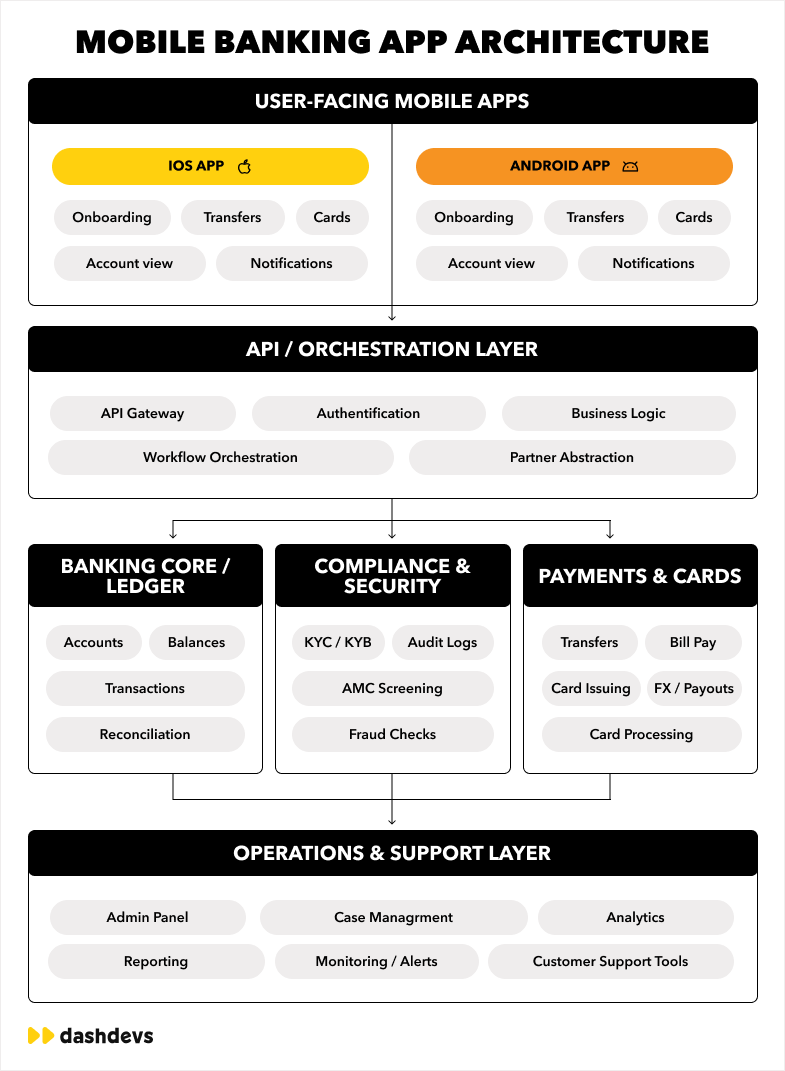
That stack sits next to—not inside—your core banking solutions. It also consumes identity vendors; patterns for KYC integration solutions matter as much as the brand of the onboarding UI.
For consumers and businesses, the journey looks simple. Behind it, deposit account rules, CIP, beneficial ownership for entities, and funding rails all have to agree in real time.
Online account opening software vs a DIY portal
Direct answer: DIY portals fail when exceptions, evidence, and core mapping are afterthoughts.
Many institutions already have “online account opening” as a PDF upload or a branch appointment scheduler. That is not an account opening solution. Online account opening software for banks and credit unions is designed for:
- Resume-later without restarting identity
- Real time identity verification with structured outcomes (pass / refer / fail)
- Consistent disclosures and e-sign across products
- Straight-through booking to the core when rules clear
- Measurable funnel analytics by step, device, and product
Deposit account opening software is a common packaging label for retail DDA/savings flows. Business and commercial opening adds KYB depth, multi-party signing, and longer review SLAs. One product SKU rarely covers both well without configuration debt.
When leaders compare online account opening software, they should score the exception path as hard as the happy path. Happy-path demos always look fast.
Benefits that show up in the numbers
Direct answer: conversion, cost-to-serve, and deposit readiness—not “digital transformation” as a slogan.
| Benefit | How it shows up | Who feels it |
|---|---|---|
| Higher completion rates | Fewer abandoned apps per funded account | Growth / marketing |
| Faster time-to-funded | Same-day usability vs multi-day micro-deposits | Product / deposits |
| Lower branch load | Routine accounts leave the lobby | Branch ops |
| Cleaner exams | Reconstructible CIP / decision evidence | Risk / compliance |
| 24/7 channel | Capture intent outside branch hours | Retail / SME lines |
| Data quality | Structured fields into CIF and CRM | Data / ops |
Digital account opening solutions also change competitive posture. Applicants who bounce to a fintech rarely return. Pairing a strong opening journey with best mobile banking apps features after day one is how you keep the relationship—not only win the application.
For institutions building broader digital banking programs, account opening is the front door. Weak doors waste every euro spent on the lobby redesign behind them.
Cost ranges: what you should actually budget
Direct answer: model three-year TCO—license, per-check KYC, integration, and people.
Published list prices vary wildly by vendor packaging (retail-only vs commercial, US credit-union suites vs multi-country banks). Use ranges as planning bands, then force vendors into a corridor- and volume-based quote.
| Cost bucket | Typical planning band | Notes |
|---|---|---|
| Platform / SaaS license | ~$50k–$400k+ per year | Seat or volume tiers; enterprise deals go higher |
| Implementation / SI | ~$100k–$1M+ | Core mapping dominates |
| Identity / KYC unit costs | cents to several dollars per check | Volume + document + biometric mix |
| Ongoing change & compliance | 15–25% of build effort yearly | Disclosures, products, rules |
| Ops case staffing | FTE cost × referral rate | Hidden if you only buy software |
| Funding / instant pay rails | Per-transaction + setup | Often a separate vendor |
Bank account opening software that looks “cheap” on license year one often loses on KYC overages and SI change orders. Online account opening solutions with transparent unit economics beat glossy unlimited tiers that throttle at the first growth spike.
Custom work via fintech software development services lands when your products or multi-entity structure do not fit templates—budget it as product infrastructure, not as “a few screens.”

What to expect in a real implementation
Direct answer: the critical path is core, CIP policy, and exception ops—not Figma.
A realistic program for account opening software for banks runs in phases:
- Product and policy freeze — Which deposit products, geographies, CIP rules, and decline reasons are in scope for v1?
- Data contract — CIF fields, dual control, beneficial ownership, joint owners, and what “approved” means in the core.
- Identity & screening design — Vendor outcomes mapped to pass / refer / fail; no dead-end “try the branch” without a ticket.
- Journey build — Mobile-first, save-and-resume, disclosure versioning.
- Funding design — Instant options vs delayed; activation metrics from day one.
- Parallel run & exam pack — Reconstruct sample decisions before marketing turns on the faucet.
Typical elapsed time: roughly three to nine months for a first retail product on an existing core, longer for multi-entity or commercial KYB. Teams that build a digital bank from a greenfield stack sometimes move faster on orchestration—and slower on licensing. A neobank app development company posture (product + compliance in one backlog) beats a pure IT ticket queue.
Expect risk to ask for: decision logs, vendor SOC reports, model/rules inventory, and proof that straight-through processing does not bypass required human review for high-risk cases.

Buy, build, or white-label: choosing a path
Direct answer: buy certified rails; own the orchestration when differentiation matters.
| Path | Best when | Watch-outs |
|---|---|---|
| Packaged online account opening software | Standard retail DDA, fast time-to-market | Template rigidity; exit fees |
| Composed (KYC + orchestration + core APIs) | You already invest in banking APIs | Integration ownership |
| White-label modules | You want speed with deeper product control—see white label digital banking patterns | Still need CIP design |
| Custom build | Unique products, multi-country, embedded partners | Longer runway; you own upkeep |
Market names you will hear in RFPs—Blend account opening, MeridianLink account opening, MANTL account opening, Prelim account opening, Alkami account opening—signal different strengths (mortgage-adjacent onboarding, credit-union suites, challenger-bank UX, community FI packaging, digital banking platforms). Treat them as archetypes, not a shopping list: demand production references in your charter type, not a logo wall.
A white label fintech solution can accelerate ledger and channel modules around opening, but it does not replace CIP policy ownership. Likewise, payment as a service may sit beside funding and card issuance after the account exists—do not conflate payout rails with the opening decisioning layer.
Architecture choices that decide conversion
Direct answer: keep identity outcomes and core booking on a single orchestration timeline.
Non-negotiables for a production account opening system include:
- Mobile completion without mandatory desktop document upload
- Structured vendor responses (not PDFs only) into rules engines
- Idempotent core booking (retries must not create duplicate CIFs)
- Clear refer queues with SLAs and applicant messaging
- Funding that can complete the same day the account is approved
- Analytics by drop-off step tied to product and channel
Where open banking solutions help: account-to-account funding verification and income/affordability signals when product rules allow. open banking integration is a workstream, not a magic shorten-the-form button—consent UX and fallbacks still matter.
Cross-border or remittance-heavy products inherit extra complexity; payment remittance corridors should not share a naïve retail CIP template without a deliberate risk review.
Selection criteria and RFP checklist
Direct answer: score evidence and exception SLAs as high as UI polish.
| Criterion | Pass signal | Fail signal |
|---|---|---|
| Production references | Same charter / core family | Only fintech pilots |
| Hot-path decisioning | Sub-second rules with explainability | Overnight batch CIP |
| Resume UX | Tokenized return within policy window | Restart from zero |
| Core connectors | Supported versions + sandbox proof | “API coming soon” |
| Case management | Roles, SLAs, audit trail | Email inbox |
| Funding options | Instant paths configurable | Micro-deposit only |
| Commercial model | Clear KYC overage math | Unlimited until surprise invoice |
| Exit | Data export + kill fee clarity | Hostage CIF mappings |
Digital account opening software vendors that cannot show a reconstructed decision from a past exam or internal audit are selling slides. Account opening solutions that win RFPs usually bring a joint workshop with risk in week one—not a marketing webinar. The same bar applies when you shortlist account opening software for banks: demand evidence packs, not only conversion claims.
Risks and failure modes leaders underprice
Direct answer: most failures are organizational, then technical.
- Policy lag — Product launches a flow legal has not approved for disclosures.
- Shadow process — Branch staff re-key approved apps into the core.
- Over-automation — High-risk segments auto-pass without documented rationale.
- Vendor sprawl — Separate KYC, fraud, and opening UIs with no shared customer ID.
- Activation gap — Account opens but funding takes days; dormancy rises.
- Metric vanity — “Applications started” celebrated while funded accounts stagnate.
Account opening automation should reduce keystrokes, not accountability. Secure digital journeys still need human review for edge cases—design the queue, do not pretend it away. Strong account opening solutions also document why a case was referred, who cleared it, and which rule version applied.
How DashDevs approaches digital account opening programs
DashDevs helps banks and fintechs treat opening as regulated product infrastructure: journey design, KYC orchestration, core mapping, and the evidence model risk will sign. Whether you buy a package or compose services, we keep the backlog honest—conversion metrics, CIP controls, and funding activation in the same program plan.
That work often sits beside broader transformation: channel apps, modular platform components, and deposit products that must clear the same control framework. We optimize for funded accounts and exam readiness—not demo theater. For community institutions comparing account opening software for banks against credit-union-oriented suites, we also stress-test whether the vendor’s CIF assumptions match how your core actually books joint owners and beneficiaries.
Decision checklist before you sign
| Question | If “no,” do this first |
|---|---|
| Do we know funded-account conversion by step today? | Instrument the current funnel |
| Is CIP / KYB policy frozen for v1 products? | Risk workshop before RFP |
| Can our core create accounts via API with dual control? | Core spike |
| Who owns refer SLAs after go-live? | Name an ops owner |
| Is instant funding in scope? | Separate rail decision |
| Do we have a three-year TCO model including KYC units? | Rebuild the business case |
If most answers are “no,” pause the software bake-off. Digital account opening software cannot fix an undefined operating model. Run a two-week discovery: instrument the current funnel, freeze CIP for one product, and prove one core booking path in a sandbox. That sequence costs less than a year of unused licenses.
Closing
The institutions that win deposit growth in 2026 will not be the ones with the loudest “fully digital” claim. They will be the ones whose digital account opening software turns intent into a funded, monitored relationship—with costs they can explain and controls an examiner can reconstruct.
Choose architecture for clearance and activation. Budget for the whole system—including the ops queue that account opening solutions always create when risk is honest. Then the benefits—speed, scale, and a channel that does not close at 5 p.m.—actually show up in the ledger.
Share article
