


Fireblocks vs. Building Your Own Custody Infrastructure: What Founders Need to Know

March 12, 2026
Summary
TL;DR
- Digital asset custody is the infrastructure that secures and manages crypto assets, wallets, and blockchain transactions.
- Fintech founders must choose between integrating crypto custody providers (e.g., Fireblocks) or building their own digital asset custody solutions.
- Fireblocks custody provides ready infrastructure for wallets, MPC key security, transaction governance, and exchange connectivity.
- Building internal crypto custody solutions typically takes 6–18 months and requires specialized security and compliance teams.
- Most fintech platforms choose third-party crypto custody services to reduce risk, cost, and time to market.
The moment a fintech platform decides to support crypto, a critical question appears: who actually holds the keys? Behind every wallet, token transfer, or blockchain payment sits digital asset custody — the infrastructure responsible for securing private keys and protecting user funds. Unlike traditional finance, a single mistake in crypto custody can lead to irreversible asset loss. That’s why custody is not just a technical detail. It is the foundation of trust for any crypto-enabled product.
For founders and product teams, the decision often comes down to two paths: integrate a proven crypto custody provider like Fireblocks, or build your own digital asset custody infrastructure from scratch. The first option accelerates time to market and reduces security risks. The second offers full control over how you store and manage digital assets. In this guide, we break down how digital asset custody solutions work, what Fireblocks custody infrastructure actually provides, and when building your own custody system may be the right move for your fintech platform architecture.
The Custody Infrastructure Challenge Fintechs Face
Launching a fintech product that supports digital asset custody requires far more than simply connecting an app to a blockchain network. While many founders initially focus on wallets and transactions, the real complexity sits in the infrastructure that secures and manages digital assets behind the scenes.
Institutional-grade crypto custody solutions must combine wallet infrastructure, key management, compliance monitoring, and operational governance. According to industry research from PwC, more than 70% of institutional investors say secure custody infrastructure is the biggest barrier to entering the crypto market. This explains why the market for crypto custody services is projected to exceed $100 billion in assets under custody by the end of the decade.
For fintech platforms planning to custody digital assets, the architecture usually includes several critical layers.
| Infrastructure Layer | Typical Complexity |
| Wallet engine | Address generation, token standards, multi-chain support |
| Key management | MPC or HSM-based private key security |
| Blockchain nodes | Node synchronization, upgrades, monitoring |
| Transaction policies | Governance rules, approval workflows |
| Compliance | AML monitoring, KYT screening and risk scoring |
Each of these layers requires specialized engineering expertise and ongoing operational management. For example, supporting multiple blockchains means maintaining nodes, handling different token standards, and ensuring transaction reliability across networks like Ethereum, Bitcoin, and Layer-2 chains.
This is why many fintech teams underestimate the complexity of building fintech backend architecture. What initially looks like a wallet integration quickly becomes a large infrastructure project involving security architecture, compliance tooling, and blockchain operations.
Why Custody Security Is Critical
At the heart of cryptocurrency custody services lies one core responsibility: protecting private keys.
Private keys are the cryptographic credentials that control ownership of digital assets. If a platform loses them, the funds are permanently inaccessible. If attackers obtain them, assets can be transferred instantly with no way to reverse the transaction.
This is fundamentally different from traditional banking infrastructure. Security failures in crypto custody infrastructure can lead to:
- theft of customer funds
- irreversible blockchain transactions
- regulatory penalties and investigations
- reputational damage for the platform
- suspension or shutdown of services.
The scale of the risk is significant. According to Crypto Crime Reports, more than $2.17 billion in crypto assets were stolen through hacks and exploits in 2025 alone, with many incidents linked to weak custody security or compromised private keys.
For business owners building blockchain wallet infrastructure, this means custody infrastructure must meet institutional security standards from day one. It must include strong key protection mechanisms, transaction governance, and compliance monitoring.
This is why many fintech companies rely on specialized crypto custody providers or digital asset custodians instead of building the entire stack internally. Providers like Fireblocks offer ready-to-use digital asset custody solutions that reduce operational risk while enabling fintech platforms to focus on product growth and user experience. Let’s come closer to Fireblocks and what it actually is.
So, What is Fireblocks?
Fireblocks is one of the most widely used platforms for digital asset custody and blockchain transaction infrastructure. It provides fintech companies, exchanges, banks, and institutional platforms with secure systems to store, manage, and transfer digital assets without having to build their own custody stack from scratch.
Instead of developing internal crypto custody solutions, companies can integrate Fireblocks APIs to enable wallets, blockchain transactions, and asset transfers within their applications.
The platform acts as a digital asset custodian infrastructure layer, combining multiple components required for institutional-grade crypto custody services into a single system.
Fireblocks infrastructure supports:
- crypto wallet creation and management
- secure blockchain transaction signing
- digital asset transfers across networks
- governance and transaction approval policies
- integrations with exchanges and liquidity providers.
This makes Fireblocks one of the most popular crypto custody providers used by fintech platforms launching crypto-enabled products.
Today the platform supports hundreds of institutions globally and helps secure trillions of dollars in digital asset transfers annually, according to company reports. Fireblocks has become a key infrastructure provider for fintech companies looking to implement digital asset custody solutions quickly and securely.

Core Capabilities of Fireblocks
Fireblocks provides several core components required to operate institutional-grade cryptocurrency custody services.
1. MPC Wallet Infrastructure
Instead of storing private keys in a single location, Fireblocks uses Multi-Party Computation (MPC) technology. This splits cryptographic key operations across multiple secure environments, reducing the risk of a single point of compromise.
This approach has become the preferred architecture for modern digital assets trading platform used by fintech platforms and exchanges.
2. Multi-Chain Asset Support
Fireblocks supports major blockchain networks including Bitcoin, Ethereum, Solana, and multiple Layer-2 ecosystems. This allows platforms to custody digital assets across different chains using one infrastructure layer.
3. Transaction Governance and Policy Engine
Fireblocks allows organizations to define transaction policies such as:
- multi-approval workflows
- spending limits
- role-based permissions
- transaction monitoring rules.
These governance controls are essential for institutional digital asset custody operations.
4. Exchange and Liquidity Integrations
Fireblocks integrates with major exchanges and trading venues, enabling platforms to move assets securely between wallets, liquidity providers, and trading environments.
5. DeFi and Web3 Connectivity
The platform also supports integrations with DeFi protocols, allowing fintech companies to interact with decentralized applications while maintaining secure custody controls.
Fireblocks in the Crypto Infrastructure Stack
In a typical fintech architecture, Fireblocks operates as the secure custody and transaction layer that sits between the application infrastructure and blockchain networks.
While the fintech application handles user interfaces and business logic, Fireblocks manages the sensitive operations required to securely custody digital assets and execute blockchain transactions.
Instead of building internal crypto custody services, developers connect their backend systems to Fireblocks APIs.
Below is a simplified architecture example.

In this architecture, Fireblocks becomes the secure transaction and digital asset custody layer, handling private key protection, transaction signing, and blockchain connectivity.
For many fintech startups and financial institutions, this approach dramatically reduces the complexity of implementing digital asset custody solutions while still meeting institutional security standards.
How Fireblocks Digital Asset Custody Works
Implementing digital asset custody requires secure key management, wallet infrastructure, and transaction governance. Fireblocks combines these components into a single platform designed for institutions that need reliable crypto custody services without building complex infrastructure internally.
The platform focuses on three core layers: private key security, wallet infrastructure, and policy-based transaction governance.
MPC-Based Private Key Management
The most critical component of digital asset custody solutions is protecting private keys. These keys control ownership of crypto assets, meaning any compromise can result in permanent loss of funds.
Fireblocks uses Multi-Party Computation (MPC) to secure private keys. Instead of storing a full private key in one location, MPC splits the key into multiple cryptographic fragments distributed across different secure environments.
During transaction signing, these fragments work together to generate a signature without ever reconstructing the full private key in a single place.
Benefits of MPC-based crypto custody solutions include:
- no single point of compromise
- secure distributed transaction signing
- reduced risk of insider attacks
- elimination of traditional hot wallet private key exposure.
MPC architecture has become the industry standard for institutional cryptocurrency custody services. According to Deloitte blockchain security reports, MPC-based custody models significantly reduce attack surfaces compared to traditional single-key wallet systems.
This approach is one of the reasons platforms like Fireblocks are widely used among crypto custody providers serving institutional markets.
Wallet Infrastructure
Beyond key management, digital asset custody requires full wallet lifecycle infrastructure. Fireblocks provides APIs that allow fintech platforms to create and manage wallets without building blockchain infrastructure internally.
Capabilities include:
- wallet creation and lifecycle management
- address generation across multiple blockchains
- asset balance tracking
- deposit monitoring and transaction status tracking.
This infrastructure enables fintech platforms to build applications that custody digital assets while maintaining a simplified backend architecture.
Fireblocks supports a wide range of assets including:
- major cryptocurrencies such as Bitcoin and Ethereum
- stablecoins used for payments and settlements
- tokenized assets and ERC-based tokens.
Multi-chain support is critical for modern digital asset custody solutions. The number of active blockchain ecosystems continues to grow rapidly, making multi-network custody infrastructure essential for fintech products.
Policy-Based Transaction Governance
Institutional platforms require more than secure wallets. They also need operational controls that govern how assets move within the system.
Fireblocks includes a policy engine that allows organizations to define transaction governance rules across their crypto custody infrastructure.
Examples of governance policies include:
- withdrawal approval workflows
- transaction limits for specific roles
- whitelisted destination addresses
- multi-user approvals for large transfers.
These controls provide institutional-grade operational security, helping fintech companies meet internal risk policies and regulatory expectations.
Governance tools are especially important for companies managing large volumes of assets. According to PwC global crypto reports, institutional investors prioritize transaction governance and operational controls as key requirements when selecting crypto custody providers.
By combining MPC security, wallet infrastructure, and policy governance, Fireblocks delivers a full-stack approach to digital asset custody that allows fintech platforms to launch crypto services faster while maintaining strong security standards.
Key Capabilities Fintech Platforms Unlock with Fireblocks
Integrating Fireblocks allows fintech platforms to launch digital asset custody capabilities without building complex security and blockchain infrastructure internally. Instead of developing custom crypto custody solutions, teams can focus on product features while Fireblocks handles wallet security, transactions, and governance.
Below are the key capabilities fintech companies unlock when using Fireblocks.
Secure Crypto Wallets
Fireblocks enables fintech platforms to offer secure wallet and blockchain integrations while outsourcing private key management and transaction signing to a specialized digital asset custody solution.
| Capability | Business Value |
| Secure wallet infrastructure | Protects private keys with MPC security |
| Wallet lifecycle management | Simplifies onboarding of new users and assets |
| Transaction signing APIs | Enables blockchain transfers directly from backend systems |
Business impact
- faster launch of crypto-enabled products
- reduced infrastructure security risks
- scalable wallet management across thousands of users.
For startups entering the market, integrating crypto custody providers like Fireblocks can reduce development timelines from 12–18 months to a few months.
Multi-Chain Asset Support
Modern fintech platforms must support multiple blockchain ecosystems. Fireblocks allows companies to manage digital asset custody across multiple networks through a unified infrastructure layer.
| Supported Blockchain Examples | Typical Use Cases |
| Bitcoin | payments and asset storage |
| Ethereum | tokens and DeFi integrations |
| Polygon | low-cost payments and scaling |
| Solana | high-speed trading and payments |
| Avalanche | DeFi and asset tokenization |
Supporting these networks internally requires maintaining nodes, monitoring chain upgrades, and managing token standards. Fireblocks simplifies this process by providing a single infrastructure layer for multi-chain crypto custody services.
Exchange and Liquidity Integrations
Many fintech products require connectivity to trading venues and liquidity providers. Fireblocks integrates with multiple market participants, enabling seamless asset movement between wallets and exchanges.
| Integration Type | Business Use Case |
| Centralized exchanges | trading and liquidity access |
| OTC desks | large institutional trades |
| Liquidity providers | asset swaps and treasury management |
This allows fintech companies to:
- execute trades directly from custody wallets
- rebalance digital asset reserves
- manage treasury operations securely.
For platforms offering brokerage or trading services, these integrations significantly simplify operational workflows.
Operational Security and Governance
Institutional crypto custody solutions require strong operational controls. Fireblocks provides governance tools that help companies maintain secure asset management practices.
| Security Feature | Purpose |
| Role-based access control | restricts actions by user roles |
| Transaction monitoring | detects suspicious activity |
| Audit logs | ensures traceability of asset movements |
These tools simplify compliance processes and help fintech companies maintain institutional-grade digital asset custody operations.
How Fireblocks Fits into Fintech Architecture

A fintech platform that supports crypto usually requires multiple infrastructure layers working together. These systems manage user interactions, transaction processing, wallet infrastructure, and blockchain connectivity.
| Architecture Layer | Purpose |
| User application | Customer interface and wallet access |
| API layer | Communication between frontend and backend |
| Ledger / core system | Transaction records and balances |
| Wallet infrastructure | Key management and transaction signing |
| Blockchain networks | Asset settlement and transfers |
Building every layer internally means developing a full digital asset custody infrastructure, maintaining blockchain nodes, and implementing secure key management systems. For many fintech startups, this quickly becomes one of the most complex parts of launching a crypto-enabled product.
Architecture with Fireblocks Integration
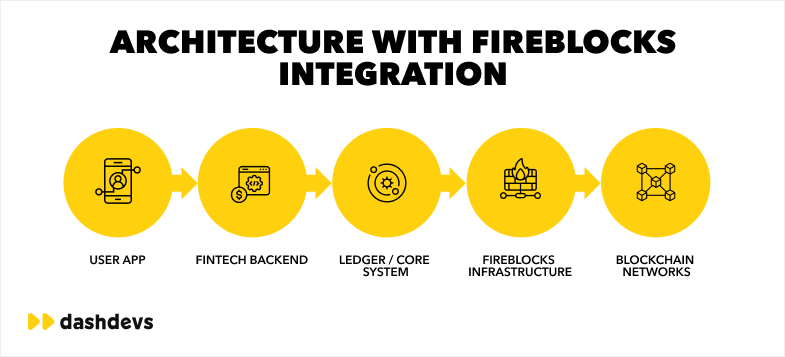
When Fireblocks is integrated, the architecture becomes significantly simpler because the platform replaces the internal wallet and custody infrastructure.
Instead of building crypto custody solutions from scratch, fintech teams can connect their backend systems directly to Fireblocks APIs.
Example architecture with Fireblocks integration:
| Architecture Layer | Role with Fireblocks |
| User application | Customer interface |
| Fintech backend | Product logic and APIs |
| Ledger / core system | Transaction accounting |
| Fireblocks infrastructure | Digital asset custody and transaction signing |
| Blockchain networks | Asset settlement |
In this architecture, Fireblocks becomes the secure custody and transaction layer responsible for private key protection and blockchain connectivity.
Business Benefits of This Architecture
For fintech founders and product teams, integrating crypto custody providers like Fireblocks significantly simplifies infrastructure complexity.
| Benefit | Impact for Business |
| Simplified architecture | No need to build wallet or key management systems |
| Faster time to market | Crypto products can launch months earlier |
| Lower engineering overhead | Teams focus on product features instead of infrastructure |
This approach allows fintech companies to implement digital asset custody solutions faster while maintaining institutional-grade security standards required to custody digital assets safely at scale.
Build secure digital asset custody infrastructure
Launch crypto wallets, payments, and digital asset platforms with expert support
Contact us
Build vs. Integrate: Why Fintechs Choose Fireblocks
Building fintech infrastructure from scratch requires multiple complex infrastructure components, including:
- cryptographic key management systems
- wallet engine development
- blockchain node infrastructure
- transaction governance policies
- compliance and monitoring systems.
Each of these systems must meet strict security and operational standards to safely custody digital assets.
Estimated Timeline for Building Custody Infrastructure
| Infrastructure Component | Estimated Timeline |
| Wallet infrastructure | 6–12 months |
| Key management system | 6–9 months |
| Security architecture | 6–12 months |
| Compliance integrations | 3–6 months |
Total estimated timeline: 12–24 months
This estimate assumes an experienced engineering team and strong security expertise. In practice, building institutional-grade crypto custody solutions can take even longer due to testing, audits, and regulatory requirements.
According to industry reports from PwC, infrastructure complexity and security requirements are among the main reasons fintech startups rely on crypto custody services instead of building custody systems internally.
Integrating Fireblocks Instead
Integrating Fireblocks allows fintech teams to bypass most of this infrastructure complexity.
Fireblocks provides ready-to-use digital asset custody infrastructure that includes key management, wallet systems, transaction policies, and blockchain connectivity.
| Capability | What Fireblocks Provides |
| Wallet infrastructure | Secure wallet creation and management |
| Key management | MPC-based cryptographic security |
| Blockchain connectivity | Multi-chain transaction infrastructure |
| Governance policies | Transaction approval workflows |
Business impact
- faster time to market
- reduced security risks
- lower infrastructure development costs.
For many fintech startups and banks entering the crypto market, integrating crypto custody providers allows them to launch cryptocurrency custody services in months rather than years.
When Companies Build Their Own Custody Infrastructure
Despite the advantages of integrating digital asset custody solutions, some organizations still choose to build custody systems internally.
This approach is typically taken by companies that require deeper control over how assets are stored, transferred, and managed.
| Reason | Explanation |
| Regulatory control | Some jurisdictions require direct control of private keys |
| Proprietary trading infrastructure | High-frequency trading systems require custom transaction flows |
| Custom transaction logic | Specialized blockchain operations or asset models |
| Vendor independence | Avoiding reliance on third-party crypto custody providers |
Building internal crypto custody infrastructure can also allow companies to create proprietary systems tailored to their business models.
Not all fintech companies need to develop their own cryptocurrency custody service infrastructure. The organizations most likely to build internal systems include:
| Organization Type | Reason |
| Large crypto exchanges | Full control over wallet operations |
| Institutional trading platforms | Custom transaction pipelines |
| Regulated digital asset custodians | Compliance-driven infrastructure ownership |
These organizations usually have large engineering teams, security specialists, and compliance departments capable of maintaining complex custody infrastructure.
Security and Compliance in Digital Asset Infrastructure
Any platform offering digital asset custody must meet strict security and regulatory requirements. Unlike traditional payment systems, blockchain transactions are irreversible, which makes custody infrastructure a critical risk management component.
Regulators and institutional investors expect strong operational controls when companies custody digital assets.
Key Compliance and Security Requirements
| Security Area | Purpose |
| Transaction monitoring | Detect suspicious blockchain activity |
| AML/KYC compliance | Verify user identity and prevent financial crime |
| Asset segregation | Separate client and platform funds |
| Audit logging | Maintain traceable transaction records |
| Access control | Restrict system permissions and approvals |
These requirements are particularly important for platforms offering crypto custody services to institutional clients.
Security Frameworks Used in Crypto Custody
Modern digital asset custody solutions rely on multiple layers of cryptographic and operational security.
| Security Technology | Purpose |
| MPC key protection | Distributed private key management |
| HSM hardware security | Secure key storage in hardware environments |
| Cold storage strategies | Offline asset protection |
| Transaction approval policies | Multi-user authorization controls |
According to Chainalysis and institutional crypto security reports, strong custody infrastructure significantly reduces the risk of hacks and operational failures.
This is why platforms offering crypto custody solutions must prioritize security architecture from the beginning. Whether companies build infrastructure internally or integrate crypto custody providers like Fireblocks, robust custody security remains the foundation of any platform that manages digital assets. Consider also our KYC verification infrastructure services.
Example: Building Wallet Infrastructure for a Crypto Fintech
To understand how digital asset custody fits into a real product, consider a fintech platform launching crypto investment services.
The company needed to combine traditional fintech infrastructure with blockchain capabilities. Specifically, the platform had to connect:
- fiat payment rails
- digital asset wallets
- crypto conversion and trading flows.
The existing system supported fiat payments but could not efficiently connect banking operations with blockchain transactions. This is a common challenge when companies try to combine traditional fintech systems with crypto custody solutions.
Infrastructure Challenge
| System Component | Requirement |
| Fiat payments infrastructure | deposits, withdrawals, payment processing |
| Digital asset wallets | secure wallet creation and management |
| Crypto conversion | converting fiat into digital assets |
| Transaction tracking | monitoring asset transfers across systems |
Without proper digital asset custody infrastructure, these flows become difficult to manage securely and efficiently.
Architecture Approach
To address this challenge, the platform implemented a hybrid architecture designed to simplify compliance while enabling crypto services.
The solution combined blockchain wallet infrastructure with a modular fintech backend powered by our white-label platform, Fintech Core.
| Architecture Component | Role |
| Fintech Core platform | core financial infrastructure and ledger |
| Non-custodial wallet infrastructure | users control private keys |
| Fiat payment integrations | connection to banking rails |
| Crypto conversion engine | asset swaps and transactions |
| Transaction monitoring | risk management and compliance |
Fintech Core acted as the orchestration layer connecting fiat payment flows with digital asset operations. This allowed the platform to manage balances, transactions, and compliance monitoring across both traditional financial systems and blockchain infrastructure.
Business result
- reduced regulatory complexity
- simplified licensing requirements
- faster rollout of crypto investment features.
This approach is increasingly common among fintech platforms looking to offer cryptocurrency custody services while minimizing regulatory exposure.
Read more about our payment orchestration platform development case study.
Summing up
As digital assets become part of mainstream financial products, digital asset custody is no longer an optional capability for fintech platforms. Whether companies are launching crypto wallets, enabling stablecoin payments, or building digital asset investment services, secure custody infrastructure is the foundation that protects user funds and ensures operational reliability.
However, building crypto custody solutions internally is a major undertaking. It requires specialized expertise in cryptography, blockchain infrastructure, security engineering, and regulatory compliance. For many fintech teams, developing a full digital asset custody solution can take years and demand significant engineering resources.
This is why many companies turn to crypto custody providers such as Fireblocks. By integrating an established custody infrastructure, fintech platforms can launch crypto-enabled products faster while relying on proven security architecture, governance tools, and multi-chain connectivity.
For business owners, the key question is not simply how to connect to blockchain networks, but how to build a secure, scalable architecture that can safely custody digital assets at scale.
Building a fintech product that needs secure crypto wallet infrastructure?
DashDevs helps fintech companies integrate digital asset infrastructure like Fireblocks into scalable fintech architectures using Fintech Core — enabling secure wallets, blockchain integrations, and multi-rail financial services.
Share article

