


How to Build a Secure Payment System: Digital Payment Security Best Practices

September 2, 2026
- Global losses from fraud scams and bank fraud reached $579.4 billion in 2025, and 90% of surveyed financial crime professionals reported rising AI-driven attacks.
- Under PCI DSS v4.0.1, the previously future-dated controls among 64 new requirements are now mandatory.
- End-to-end encryption and network tokenization together are the two most effective tools for reducing cardholder data exposure scope.
- Fraud detection built into the payment flow at the transaction level is the architectural decision that separates teams handling scale from those that get hurt by it.
- Most payment security failures happen because security was treated as a deployment step rather than a design constraint.
Most payment security failures happen because security was treated as a deployment step rather than a design constraint. Here’s the example.
A fintech ships its MVP, then tokenization gets added in Q2. Fraud detection comes after the first chargeback spike, and MFA gets implemented when a regulator asks. By that point, the system had multiple layers of compensating controls stacked on top of each other, none of them coordinated, all of them expensive to maintain.
CTOs and product leads building or scaling payment infrastructure need a different mental model. Digital payment security is a set of architectural decisions you make at the start and enforce at every layer (encryption, authentication, compliance, and fraud detection) consistently, from the first transaction to the hundred-millionth.
This guide is written for the teams making those decisions. It covers what each security layer does, where teams get it wrong in production, and what a properly structured secure payment system looks like at scale.
What digital payment security actually covers
Digital payment security best practices address four distinct categories of risk.
Data interception: someone reading payment data in transit. The controls here are TLS, end-to-end encryption, and network tokenization.
Stored data exposure: a breach of a database holding cardholder data. The controls are tokenization, vault architecture, and access controls on the cardholder data environment.
Unauthorized access: a user or system actor gaining access they shouldn’t have. The controls are multi-factor authentication, role-based access, audit logs, and session management.
Transaction fraud: legitimate systems being used for illegitimate transactions. The controls are real-time fraud detection, KYC/AML, behavioral analytics, and sanctions screening.
Most compliance frameworks, including PCI DSS, address all four, and usually teams implement them unevenly.
The systems that survive a breach intact are the ones where security architecture was decided before the first line of code.
Encryption in payment systems: the non-negotiable foundation
Encryption in payment systems operates at two levels, and confusing them is a common production mistake.
Data in transit must be protected with TLS 1.2 at minimum, with TLS 1.3 now the standard for any new build. This covers the communication channel between the user’s browser or app and the payment gateway, between the gateway and the acquiring bank, and between any internal microservices handling payment data. Teams that use TLS only on the consumer-facing endpoint but leave internal service-to-service communication unencrypted create an exploitable gap that is invisible in most security audits.
Data at rest requires a separate encryption scheme. AES-256 is the current standard for stored cardholder data. The critical implementation detail is key management: how encryption keys are stored, rotated, and separated from the data they protect. A common mistake is storing encryption keys in the same environment as the encrypted data. If that environment is compromised, both are exposed.
End-to-end encryption, where data is encrypted at the point of entry and decrypted only at the point of authorized processing, is the architecture that closes both gaps. It means the payment gateway, the acquiring bank, and any intermediate processor never see the raw PAN. They only ever see ciphertext or a token.
For teams building on electronic payment services infrastructure, this distinction matters at the integration level. Every third-party service you connect to is a potential point of decryption. Each one extends your compliance perimeter.
Network tokenization and the scope reduction principle
Tokenization replaces a sensitive value (a PAN, a bank account number, or an IBAN) with a non-sensitive token that carries no value outside its specific payment context. If intercepted, the token is useless.
There are two distinct tokenization approaches, and teams frequently use the wrong one.
Payment gateway tokenization is issued by a payment processor. The token is valid only within that processor’s environment. It reduces your exposure to stored card data but creates vendor lock-in. If you switch processors, all tokens are invalid, and customers must re-enter card details.
Network tokenization is issued by the card networks and travels with the card rather than with the processor. The token remains valid across processors, reduces interchange costs in some corridors, and provides higher authorization rates because the card network can bind the token to a specific device or merchant context. For performance and authorization impact in production, see our guide to network tokenization and payment performance.
The scope reduction principle is the most undervalued argument for tokenization in compliance conversations. Every system that never touches the real PAN is out of PCI scope. If your checkout page sends a token to your server, your server isn’t in the cardholder data environment. That reduces the number of systems, controls, and processes subject to PCI DSS assessment, which directly reduces audit cost and complexity.
Scope reduction is not a compliance shortcut. It is a legitimate architectural strategy that makes your system cheaper to operate and more resilient to breach.
PCI DSS compliance: what changed and why it matters
PCI DSS 4.0 became fully mandatory in March 2025. The previous version, 3.2.1, was retired in 2024. Teams still referencing the old framework are operating against a deprecated standard.
The changes in v4.0 are not cosmetic. Four areas matter most for builders.
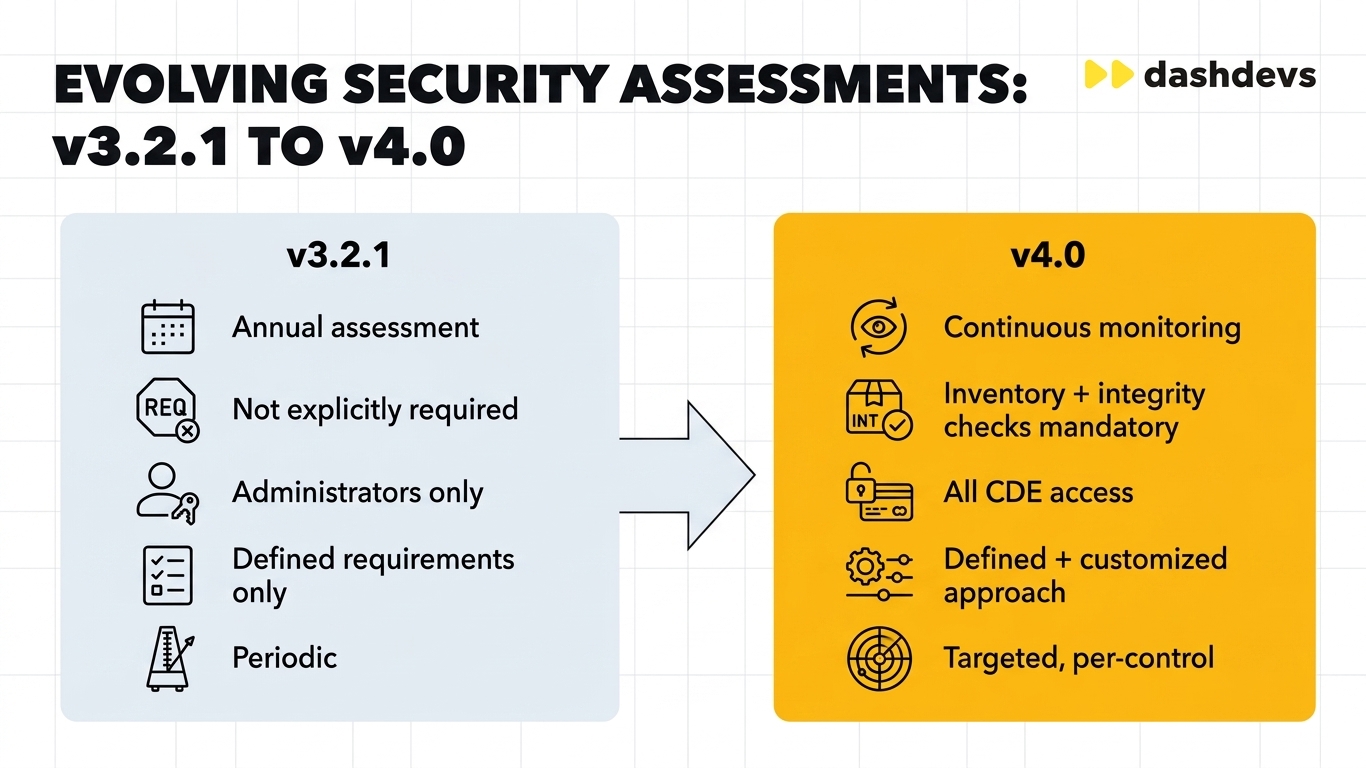
Continuous compliance replaces annual certification. PCI DSS 4.0 shifts the posture from “pass the audit, then relax” to continuous monitoring, real-time detection, and documented evidence of ongoing controls. This requires automation — manual quarterly reviews are no longer sufficient to meet the spirit of the standard.
Payment page script controls are now mandatory. Requirements 6.4.3 and 11.6.1 require that all scripts running on payment pages are inventoried, authorized, and integrity-checked. Any unauthorized change to a payment page script must trigger an alert within a defined detection window. This is a direct response to Magecart-style attacks, where attackers inject malicious JavaScript to skim card data before it reaches the payment processor.
MFA is required for all access to the cardholder data environment, not just administrative accounts. This is a meaningful scope expansion from v3.2.1, which allowed single-factor authentication in some contexts.
Customized approach validation allows mature security teams to demonstrate security objectives through their own controls rather than prescriptive requirements. This adds flexibility but requires a robust risk assessment process and documented evidence.
| PCI DSS Area | v3.2.1 Approach | v4.0 Approach |
|---|---|---|
| Compliance cadence | Annual assessment | Continuous monitoring |
| Payment page scripts | Not explicitly required | Inventory + integrity checks mandatory |
| MFA scope | Administrators only | All CDE access |
| Validation path | Defined requirements only | Defined + customized approach |
| Risk analysis | Periodic | Targeted, per-control |
Teams building new payment products should implement v4.0 requirements from day one. If you’re preparing for a PCI DSS audit and want to understand what a Qualified Security Assessor actually reviews, read our guide to what a PCI DSS QSA does and how to prepare.
Secure payment infrastructure: the layer model
A production-grade secure payment infrastructure is a coordinated stack of controls, each addressing a different attack surface.
Layer 1: Network and perimeter security
Firewalls, WAFs (web application firewalls), and DDoS protection form the outer perimeter. This layer blocks volumetric attacks and filters malicious traffic before it reaches application logic. A common gap: teams deploy a WAF on the consumer-facing API but not on the webhook endpoints or admin interfaces used by internal tools and third-party processors.
Layer 2: Application security
Secure payment gateways enforce input validation, prevent injection attacks, and manage session security. Payment gateway security at the application layer also means implementing idempotency keys. A request that fails mid-flight can be retried safely without creating a duplicate transaction or double charge. Under load, the absence of idempotency is one of the most expensive production bugs a payment system can encounter.
Teams learning how to build a payment gateway from scratch need to treat idempotency as a first-class requirement.
Layer 3: Authentication and access controls
Multi-factor authentication must be implemented at every trust boundary: user-facing authentication, operator access to the admin console, API access for third-party integrations, and developer access to production systems.
The practical implementation of MFA in payments involves trade-offs between security friction and conversion. For consumer-facing flows, adaptive MFA preserves conversion on low-risk transactions while enforcing stronger authentication on high-risk ones. The right balance depends on your fraud model, your user base, and the transaction types you process.
Layer 4: Data encryption and tokenization
Two controls work together here, and they protect different things.
Encryption protects data in motion and at rest. TLS 1.3 covers every channel, not just the consumer-facing API, but also internal microservice communication and outbound calls to processors and banking partners. AES-256 covers stored cardholder data. Key management is where most teams cut corners: encryption keys stored in the same environment as the encrypted data offer no protection if that environment is breached. Keys belong in a dedicated vault, rotated on a defined schedule, with access logging on every read.
Tokenization removes cardholder data from the equation entirely. A system that never receives the real PAN has nothing to encrypt, nothing to breach, and a PCI compliance perimeter that is a fraction of the size. For recurring billing and multi-processor environments, network tokenization is the stronger approach. Tokens issued by the card network travel with the card and maintain higher authorization rates on recurring charges.
Layer 5: Transaction monitoring and fraud detection
This layer operates in real time, on every transaction, before authorization. That last part matters. A fraud detection system that runs asynchronously can’t stop fraud. It can only measure it.
Effective real-time monitoring evaluates device fingerprint, behavioral signals (typing cadence and navigation patterns), transaction velocity against historical norms, geographic distance from the previous transaction, and account age relative to transaction value. Each signal contributes to a risk score. The score determines whether the transaction proceeds, gets routed to step-up authentication, or is declined.
The feedback loop matters as much as the real-time model. Chargeback data, manual review outcomes, and confirmed fraud cases should flow back into the model continuously.
Layer 6: Compliance and audit infrastructure
Audit logs, access trails, incident response playbooks, and reporting mechanisms. This layer creates the evidence base that satisfies PCI DSS, AML reporting requirements, and regulatory inquiries. If your audit log doesn’t capture who accessed what, when, and from where, it provides no value in a breach investigation.
Payment fraud prevention: what works at scale
According to the Nasdaq Verafin 2026 Global Financial Crime Report, global losses from fraud scams and bank fraud schemes reached $579.4 billion in 2025. Synthetic identity fraud alone accounts for an estimated $30 to $35 billion in annual US economic losses, based on industry modeling such as the FiVerity 2024 Synthetic Identity Fraud Report.
These are the baseline fraud environments that any payment system launching today must be designed to withstand.
Effective payment fraud prevention at scale requires three things working together.
Real-time transaction scoring evaluates every transaction against a risk model before authorization. The model considers device fingerprint, behavioral signals (typing speed, navigation patterns, time of day), transaction velocity, geographic anomalies, and historical patterns for the account. Transactions that breach a risk threshold are flagged for step-up authentication or declined.
KYC/AML at onboarding establishes the identity baseline. Sanctioned individuals, high-risk jurisdictions, and accounts created with synthetic identities are filtered before they ever reach the transaction layer. Sumsub’s Q1 2025 data shows synthetic identity document fraud in North America surged 311% compared to Q1 2024. A system that doesn’t catch synthetic identities at onboarding cannot protect against them at the transaction level. If you’re evaluating KYC vendors and integration approaches, our guide to protecting your fintech app from fraud with KYC walks through the main verification methods and what to look for.
Chargeback monitoring and pattern analysis close the feedback loop. Chargebacks are lagging indicators, but the patterns they reveal can be used to refine the real-time model. Teams that don’t connect chargeback data back to their fraud model are leaving their most reliable signal unused.
The architectural mistake that undermines all three: building fraud detection as a separate system that queries transaction data after the fact, rather than as an integrated component of the payment authorization flow. A fraud detection system that operates asynchronously can’t block a fraudulent transaction. It can only report it.
In practice: building PCI-compliant security for a global e-wallet
Abstract security principles are useful, and seeing them applied at production scale is more useful.
When MuchBetter came to DashDevs, the brief was straightforward on paper: build an award-winning e-wallet from scratch, in four months, for under $150K, with no existing product documentation or defined requirements. The security challenge was anything but simple.
MuchBetter needed to operate across 180+ countries, connect with 300+ merchants, and serve users who expected frictionless payments while meeting full PCI DSS compliance requirements and supporting multiple payment schemes including CHAPS, Faster Payments, SEPA, and SEPA Instant.
DashDevs designed the security architecture from the ground up. The solution included:
Device pairing and dynamic security codes: every transaction is tied to a verified device
Biometric authentication and Touch ID: reducing friction without reducing security
Dynamic tokens and CVV: so static card details are never the attack surface
A transaction review system: flagging anomalous activity before authorization
Full KYC and KYB flows: identity verification embedded at onboarding, not bolted on later
The result: a fully PCI DSS-compatible system launched in four months, now covering 400K+ users across 180+ countries, with transaction costs reduced from 3–4% per transaction to a few pennies — and a security architecture that has scaled without a fundamental redesign.
Read the full MuchBetter case study →
Authentication: beyond passwords
Multi-factor authentication payments’ implementations in 2025 have moved well past the question of whether to use MFA and into the question of which factors to use in which contexts.
Biometric authentication (like fingerprint, facial recognition, and voice) is now mainstream for consumer-facing payment flows. It reduces friction compared to OTP codes while providing stronger identity assurance, particularly in mobile environments. Deepfake-enabled biometric bypass is a real and growing threat. Biometric authentication deployed without liveness detection is a vulnerability.
Hardware tokens and device binding provide the strongest authentication assurance for high-value transactions. Binding a payment authorization to a specific device (through FIDO2, passkeys, or similar standards) means that stolen credentials without the registered device can’t complete authorization. This approach is now standard in open banking PSD2 implementations across Europe.
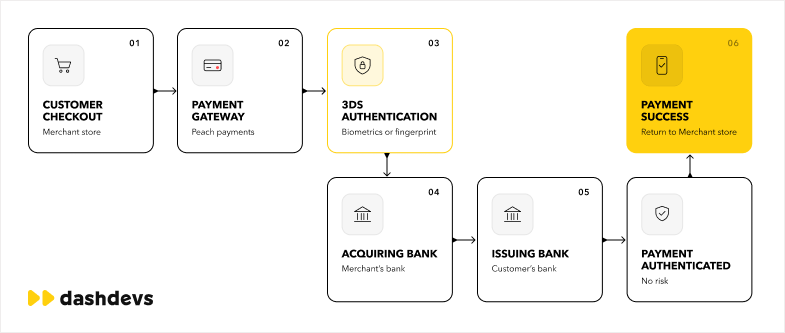
Adaptive risk-based authentication is the practical model for most payment systems at scale. Every authentication event is scored against contextual signals. Low-risk sessions proceed with minimal friction. High-risk sessions trigger step-up authentication. This preserves conversion on the majority of transactions while focusing friction where it actually reduces risk.
Fintech security best practices: common mistakes at scale
Fintech security best practices are well documented in theory. In production, the same mistakes appear repeatedly.
Overly broad access permissions. The principle of least privilege (every system and user has exactly the access they need and nothing more) is acknowledged everywhere and implemented rarely. Payment systems that give application services write access to the entire database, rather than scoped access to specific tables, turn a compromised service account into a full database breach.
Third-party integration blind spots. Every PSP, KYC provider, fraud vendor, and banking partner you integrate extends your security perimeter. Teams that vet their own code rigorously but accept third-party integrations without security review create an obvious entry point. Under PCI DSS 4.0, third-party service provider monitoring is an explicit requirement. Documented security responsibilities and defined incident response protocols between you and your partners are mandatory.
Insufficient logging granularity. An audit log that records “transaction processed” is not useful in a breach investigation. A useful audit log captures the actor, the action, the resource, the timestamp, the source IP, and the outcome for every meaningful event. The overhead of comprehensive logging is real but manageable.
Incident response as an afterthought. Teams that don’t have a documented incident response playbook before they need it will build one under pressure, during an incident, while managing a breach. The playbook must include detection criteria, escalation paths, customer notification timelines (which are often legally mandated), evidence preservation procedures, and a post-incident review process.
Secure checkout as an afterthought. Teams that accept payments on a website often implement checkout using third-party payment form libraries without reviewing what scripts those libraries inject. Under PCI DSS 4.0, every script on a payment page must be inventoried and authorized. An unreviewed third-party library is a compliance gap and a Magecart attack surface simultaneously.
Payment data security standards: building for multiple frameworks
Operating in multiple markets means operating under multiple compliance frameworks simultaneously. The interaction between them is where teams lose time.
PCI DSS applies globally to any system that stores, processes, or transmits cardholder data. It is a card network requirement that travels with every Visa and Mastercard transaction.
PSD2’s strong customer authentication requirements apply to payment service providers operating in the European Economic Area, requiring at least two independent factors from the categories of knowledge, possession, and inherence. SCA applies to most online card transactions and remote electronic payments.
GDPR applies to the processing of EU residents’ personal data, including payment data. It sets retention limits, deletion requirements, and breach notification obligations that must be coordinated with PCI DSS data handling requirements. These two frameworks sometimes pull in opposite directions: PCI DSS may require you to retain transaction data, and GDPR may require you to delete it. Resolving that tension requires an explicit data governance policy.
Local AML regulations add transaction monitoring, reporting, and sanctions screening requirements that vary by jurisdiction. Building a payments as a service model that expands across markets requires a compliance architecture that can accommodate these variations without rebuilding the core system for each one.
These security standards work best when the compliance architecture is designed to be additive. Start with the most comprehensive framework (typically PCI DSS), then layer in regional requirements as additional controls and processes, rather than treating each as a separate compliance program.
For a full breakdown of how these regulations interact across US, EU, UK, and MENA markets, see our guide to fintech regulations by region.
White-label gateways vs. custom build
The build-vs-buy decision for payment infrastructure has a direct security dimension that is often underweighted in the evaluation.
White-label payment gateway solutions come with pre-built security controls: encryption, tokenization, PCI-compliant card vaulting, and fraud detection are often included. The security risk shifts from implementation to vendor dependency. If the gateway vendor has a breach, it affects your customers. Evaluating a white-label solution requires scrutiny of the vendor’s own compliance certifications, their incident response history, and the contractual security responsibilities they accept.
Custom-built gateways put security implementation entirely in your team’s hands. The advantage is control: you define the security architecture, you own the compliance perimeter, and you can adapt faster to new threat patterns. The disadvantage is that implementing payment security correctly at every layer requires specialized expertise that most engineering teams don’t have in-house.
Teams evaluating how to start a payment processing company should understand that the security architecture decision is not separate from the product architecture decision. The two are inseparable. A payment processor that outsources compliance while building custom transaction logic ends up with a fragmented security model that is harder to maintain and harder to audit.
The most defensible approach combines a hardened, pre-compliant infrastructure layer with custom logic for transaction routing, risk scoring, and business rules. This is the model DashDevs has implemented for clients, including MuchBetter and Tarabut Gateway, where the compliance perimeter is clearly defined, and the product layer operates within it.
Watch-outs: where security fails in production
Five failure patterns appear consistently across payment systems, regardless of how well the team understood the theory.
Security by addition. Adding a security control to fix a specific incident creates a system where security is reactive, uncoordinated, and expensive. Each control is justified by the incident that prompted it but isn’t integrated with other controls. The result is overlapping, contradictory security policies that slow the system without protecting it.
Shared secrets in configuration. API keys, database credentials, and encryption keys stored in environment variables, code repositories, or shared configuration files are a persistent and preventable risk. Secrets management (using a dedicated vault with access logging and automatic rotation) is a basic control that many teams delay past their first production deployment.
No separation between production and non-production environments. Teams that use production payment data in test environments create a data exposure risk that is difficult to control. Test environments must use synthetic or anonymized data. This is also a PCI DSS requirement, not a suggestion.
Incomplete data classification. Not all data in a payment system is equally sensitive. Teams that apply the same security controls to all data, regardless of sensitivity, either over-protect low-value data or under-protect high-value data. Cardholder data requires the full PCI DSS control set. Transaction metadata, without the PAN, requires different but not identical controls.
Treating merchant service providers and banking partners as trusted by default. In an interconnected payment ecosystem, every party in the transaction chain is a potential vector. Third-party APIs must be authenticated, their responses validated, and their access scoped. Bank API integration points that accept data from external systems without validation are a common source of injection vulnerabilities in payment infrastructure.
The security architecture that scales
The payment security layer is the structural decision that determines whether your system can scale, survive a breach, and retain regulatory authorization to operate.
Teams that build digital payment security best practices into their architecture from day one spend less on compliance remediation, lose fewer transactions to fraud, and recover faster when incidents occur.
The difference between a secure payment system and a fragmented one is earlier decisions, more clearly enforced, across every layer of the stack.
As your transaction volume scales, the security architecture either compounds your resilience or compounds your exposure. Getting that architecture right is the decision that determines which direction you move.
For teams working across regulated markets, the most effective approach is to treat compliance as the floor of your security posture. PCI DSS 4.0 defines the minimum. Production-grade banking cybersecurity in 2026 demands considerably more. And online payment security decisions made at the design stage cost a fraction of what remediation costs after a breach.
DashDevs designs and builds payment infrastructure for fintechs, banks, and payment platforms operating in regulated markets. If you’re making architecture decisions about your security stack, we’re worth talking to.
Share article
