


Embedded FX Infrastructure: Building Cross-Border Payments Without a Banking License

September 2, 2026
- Embedded FX infrastructure gives non-bank products multi-currency ledgers, conversion, payout routing, and reporting while a licensed EMI or bank holds client funds.
- Correspondent banking has thinned for a decade; EMIs, payment institutions, and FX rails now fill corridors that banks left behind.
- The hard part is not any single component — it is running ledger, FX, adapters, compliance, orchestration, and reconciliation as one real-time system.
- Choose service-led build-around or product-enabled modular core based on what you already own; design multi-provider routing before corridor coverage stalls.
- UK safeguarding rules now expect daily reconciliation and audit depth — speed without fund segregation is a liability, not a launch win.
Your product needs to pay suppliers in Nairobi, contractors in Warsaw, and sellers in São Paulo. You do not hold a banking license, and chasing one would burn years plus eight-figure capital before the first corridor goes live. Plenty of teams stall right there. The workable path is narrower than a full bank charter and broader than bolting a gateway onto checkout: embedded FX infrastructure sitting under the product, with a licensed partner on the other side of the money.
What Is Embedded FX Infrastructure?
Call it the software stack that lets a non-bank company show balances, convert currencies, and push payouts inside its own UI while a regulated entity actually holds the cash. You run the ledger, the FX pricing logic, corridor routing, and the reports finance and compliance need. Your partner — typically an EMI or payment institution — safeguards client funds and sits in the examiner’s line of sight. That split is what lets non-bank cross-border payments scale without pretending you are a bank.
A payment gateway is a different animal. It authorizes a charge and returns a status. Serious FX infrastructure for fintech products lives underneath the whole money lifecycle: ten currency wallets updating in parallel, a Kenyan shilling payout choosing between two local rails, nightly matching of every movement against the partner’s safeguarded accounts. If you only integrate a “send” endpoint, you still own none of that operational truth.
How It Differs From a Banking License
A banking license authorizes deposit-taking and, depending on the jurisdiction, lending under your own name. Embedded FX does neither. You stay outside the deposit perimeter. The licensed partner remains the center of every fund movement. Product experience and routing intelligence stay with you; compliance weight stays with them. For the license-type trade-offs on the partner side, see EMI versus payment institution.

| Question to ask a vendor | Why it matters |
|---|---|
| Who holds client money overnight? | Someone always does — name the legal entity |
| Whose balance sheet shows safeguarded funds? | That is who the regulator will call first |
| What happens on partner insolvency? | Segregation and claim priority are not marketing slides |
| Can you switch EMI without rewriting the product? | Lock-in often hides in the ledger, not the API |
If a sales deck claims you can skip every licensed partner, stop the conversation until they name the entity that holds balances after 6 p.m. on a Friday. Ambiguity here is not a feature.
Why Cross-Border Payments Without a Banking License Is Now Realistic
A decade ago, non-banks had almost no clean route into international payouts. Correspondent banking was the default, and access was scarce. Today embedded finance treats cross-border flows as a product surface, not a bank-only privilege — and the market numbers reflect that shift.
The Correspondent Banking Problem
Most wire-style international payments still lean on correspondent banks holding nostro accounts with each other. That mesh has been contracting for years. BIS data on correspondent banking shows active relationships down by roughly 20% from 2011 to 2019, with emerging markets absorbing the sharpest cuts. Fewer links mean longer chains, stacked intermediary fees, and slower settlement.
Fintechs that could not buy into correspondent relationships routed through EMIs, payment institutions, and specialized FX infrastructure instead. Those rails did not remove regulation; they concentrated it in entities that already held the right permissions.
The Rise of Embedded Finance
Volumes followed the opening. Industry forecasts put cross-border payment processing revenue near $397 billion by 2026. FXC Intelligence valued the broader cross-border payments TAM at close to $195 trillion in 2024, with a path toward much larger figures later in the decade.
Marketplaces, payroll platforms, and B2B SaaS teams want international payouts in-product without becoming deposit-takers. Embedded FX is the layer that makes that product promise operable rather than aspirational.
How Embedded Cross-Border Payments Work Under the Hood
End users see a balance convert and a payout land. Underneath, six subsystems have to stay coherent under load.
The Core Building Blocks
| Component | Role | Failure mode if weak |
|---|---|---|
| Multi-currency ledger | Authoritative balances per currency and owner | Phantom funds, broken payouts, audit pain |
| FX engine | Mid-market or provider rates plus your markup | Margin leakage or customer trust hits |
| Provider adapters | Banks, EMIs, liquidity and local payout rails | Corridor dead ends when one vendor stalls |
| Compliance layer | KYC/AML, sanctions, transaction monitoring | Partner risk reviews and frozen corridors |
| Orchestration and routing | Pick rail by cost, speed, success probability | Single-rail outages become product outages |
| Reconciliation | Match your ledger to partner records | Silent breaks that surface months late |
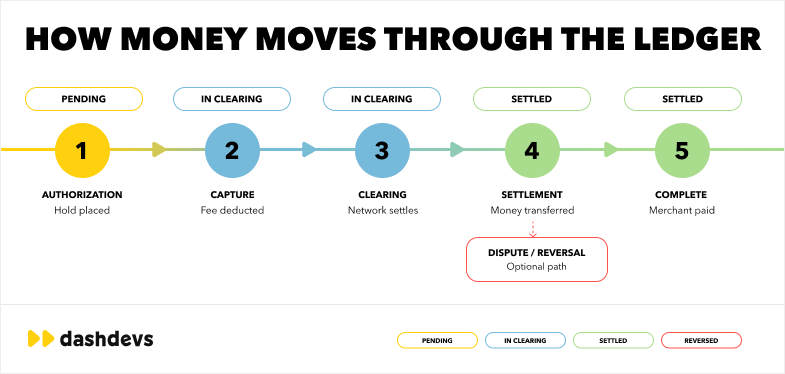
None of these pieces is exotic on its own. The engineering problem is keeping them consistent in real time across dozens of currencies and providers without losing a cent of economic truth. Your ledger design decides whether that consistency is possible.
Where the License Actually Sits
Founders sometimes hear “embedded” and assume regulation disappears. It does not. A sponsor bank or licensed EMI keeps the perimeter, safeguards client money, and fields examiner questions. You own UX and, increasingly, the orchestration that decides how value moves. That pattern is familiar from consumer neobanks: brand and app on the outside, licensed back end underneath — the same structural idea covered when teams study how to start a bank in the UK.
Remittance products are the same stack pointed at one use case: send money home. Licensing and rail choices for that path are unpacked in how to start a money transfer business.
Cross-Border Payment Infrastructure: Build, Buy, or Partner?
Once you accept infrastructure over a full bank license, delivery model becomes the next fork. Two patterns show up repeatedly in production programs.
Two Delivery Models
Service-led integration fits when the product, licensed partner, and some provider contracts already exist. Engineering work concentrates on adapters, orchestration, reconciliation workflows, and a ledger that can absorb multi-currency volume without weekend spreadsheet fire drills. You are wiring intelligence around assets you already run.
Product-enabled integration fits when there is no durable ledger or FX engine yet. Teams start from a modular core — balances, conversion, adapter framework — then customize corridors and compliance hooks. That path suits greenfield fintechs, international expansion programs, and replacements for correspondent-era workflows that were never designed for product-scale volume. DashDevs ships that second path through Fintech Core, white-label fintech infrastructure with ledger, FX foundations, and provider adapters ready to extend rather than rewrite from a blank repo.
| Factor | Service-led | Product-enabled |
|---|---|---|
| Best fit | Live product + partner already in place | Greenfield or corridor expansion rebuilds |
| Time to first corridor | Bound by existing architecture debt | Faster when core modules already coexist |
| Control vs effort | Maximum control, heavier build | Less greenfield, still customizable |
| Licensing | You bring EMI or bank relationships | Works with new or existing partners |
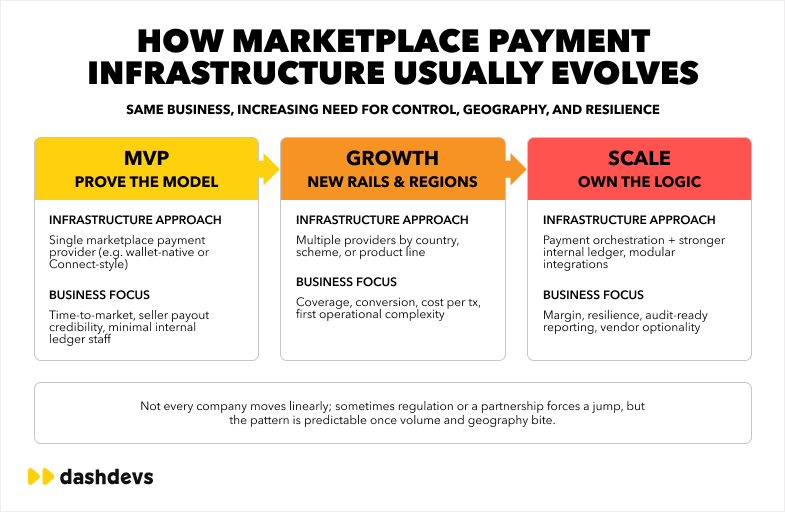
A company peeling off legacy correspondent flows rarely needs the same first sprint as a startup shipping its first international payout screen. Match the model to inventory, not to a vendor pitch template.
Choosing FX Infrastructure Providers
Provider selection fails when teams optimize for a demo corridor and discover coverage cliffs two years later. Pressure-test before you commit.
- Corridor coverage: confirm the actual country and currency pairs your customers need — not only G7 pairs on a homepage.
- Settlement speed: same-day, next-day, and multi-day all exist; know the SLA per corridor, not the marketing average.
- Compliance depth: sanctions, Know Your Transaction (KYT), and Travel Rule support should land inside the flow, not as a parallel spreadsheet process.
- Orchestration: automatic failover when the primary rail times out or the spread blows out.
- Exit cost: eighteen months from now, how much of the integration dies if you add or replace a liquidity provider?
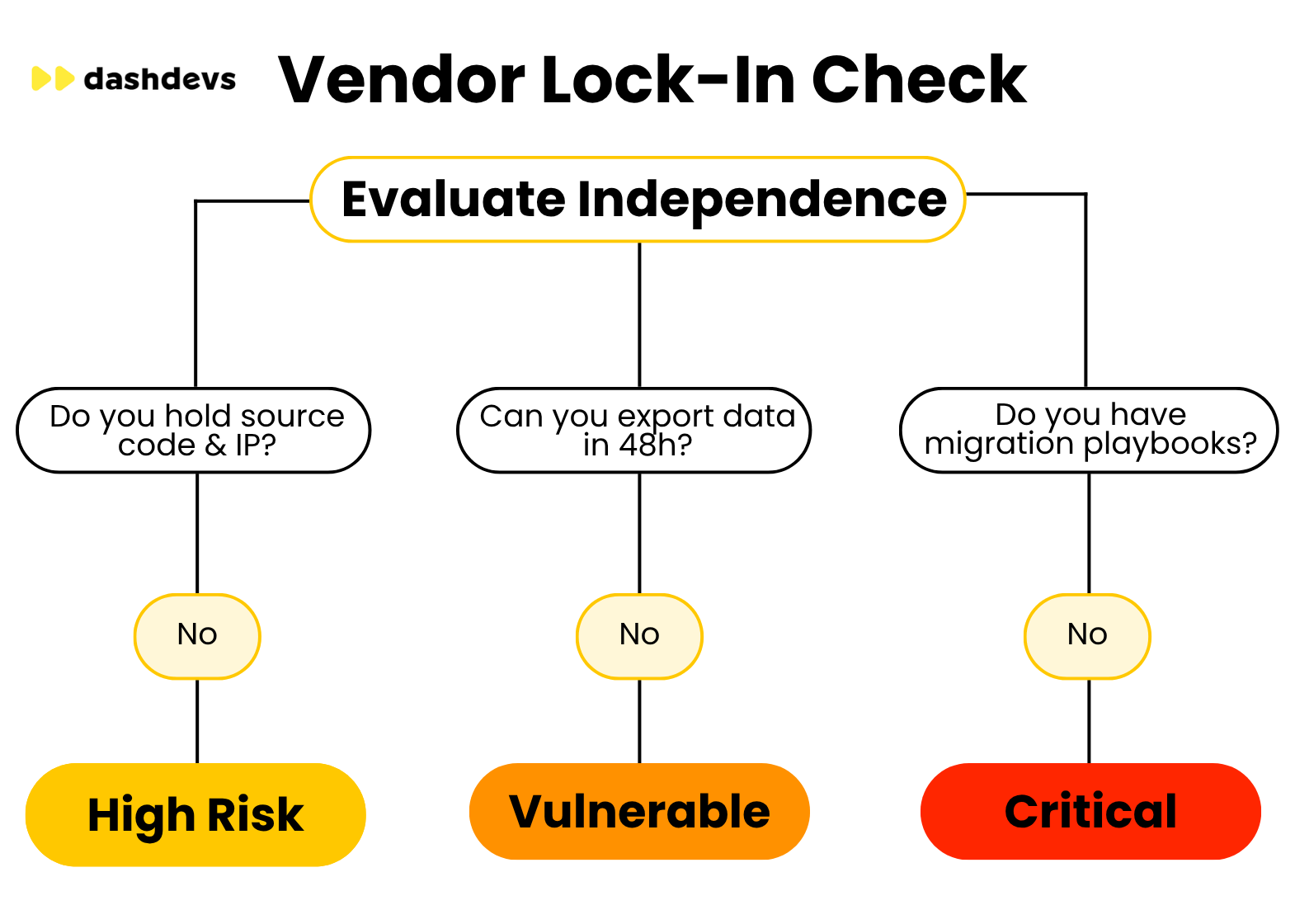
After 17+ years around payment stacks, the pattern is familiar: one FX vendor early, expanding customer geography later, then a scramble when coverage freezes. Multi-provider orchestration from day one costs more engineering up front and saves the rewrite when corridor demand outruns a single partner’s roadmap.
FX Payment API and Cross-Border Payment API: What to Look For
Whatever delivery path you pick, you will eventually judge an FX payment API or cross-border payment API on operational detail, not slide count.
| API capability | Why it matters in production |
|---|---|
| Real-time FX quotes | Price the conversion before the user confirms |
| Webhook status events | Drop polling; see pending, held, settled as they happen |
| Idempotency keys | Survive retries after timeouts without double payouts |
| Sandbox with ugly data | Catch partial failures and delayed settlements before go-live |
| Structured error codes | Cut hours off incident triage |
| ISO 20022-aligned messaging | Stay compatible with where bank messaging is heading |
An API that only exposes “send money” is a prototype surface. Production needs every meaningful state — initiated, compliance hold, provider accepted, settled, failed — visible to your systems and to support.
Multi-Currency Account Infrastructure and Treasury Management
Once payouts move, treasury asks a different question: why convert back to a home currency after every receipt? Multi-currency account infrastructure lets the business or end users hold EUR, GBP, USD, and corridor currencies natively, converting only when a payout actually requires it.
For a marketplace paying suppliers across five countries, unnecessary round-trips through a base currency are pure margin burn. Native balances also give treasury a cleaner exposure view — real positions per currency instead of one blended cash figure that hides risk until month-end.
Pair that with disciplined financial reconciliation against partner statements. Balances that look right in the product UI but disagree with safeguarded accounts are not balances; they are future incidents.
Embedded FX Payments in Practice: A Short Case
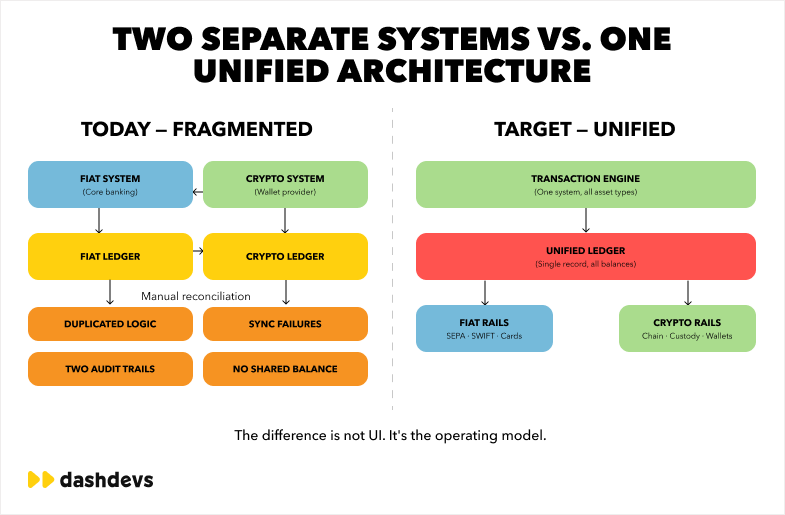
Abstract architecture is easier to trust when a build timeline is on the table. One branchless financial institution program reached a working neobank application in about nine months — payments, wallets, ledger, KYC, and international flows — from concept to license-adjacent product handling real cross-border volume. The accelerator was not a compliance shortcut. It was starting from components that already interlocked (ledger, wallet, KYC, international processing) instead of stitching six greenfield subsystems that had never posted against each other under production load. Similar delivery patterns show up across DashDevs case studies.
Cross-Border Payment Orchestration: Why Routing Logic Matters
Orchestration is the decision layer: for this amount, this corridor, this time of day, which provider moves the funds? Without it, every payment rides one fixed rail. Provider downtime or a sudden spread change becomes your customer’s problem in minutes.
With cross-border payment orchestration in place, a EUR→NGN payout can take the best live rate and fail over when the primary rail degrades. That is how a single integration becomes a resilient payment system rather than a brittle pipe.
Practical Steps: How to Build Embedded FX Infrastructure for Your Fintech
A sequence that holds up in real programs:
- Map corridors for the next 18 months — currency pairs and countries, not only what sales needs this quarter.
- Lock the regulatory partner before the tech shortlist. EMI and banking constraints define what adapters can legally do.
- Choose service-led vs product-enabled against engineering capacity and launch date, not against brand familiarity.
- Design multi-provider routing even if you go live on one rail. The second adapter is cheaper to add when the orchestration contract already exists.
- Make daily reconciliation a launch requirement, not a post-MVP chore. Small breaks stay small only while someone matches them.
- Integrate KYC, AML, and sanctions into the payment path. Bolting compliance on after first revenue usually means rebuilding the happy path under audit pressure.
Regulatory Compliance and the Sponsor Bank Relationship
An EMI or sponsor bank relationship is an operating partnership, not a one-time onboarding ticket. Supervisors have tightened expectations around safeguarding. In the UK, FCA reforms for e-money and payment firms — summarized around policy statement PS25/12 and May 2026 safeguarding changes — push daily reconciliation and harder audit standards after failed firms left customers short by roughly 65% of what they were owed on average.
That figure is why compliance depth outranks integration speed when you pick infrastructure. A fast launch that skips fund segregation and partner-level matching is a delayed crisis, usually timed for the worst possible week.
Building It or Partnering For It
Embedded FX infrastructure opened cross-border payments to companies that will never hold a banking license — and should not chase one just to pay abroad. The regulatory perimeter remains. It does not have to sit on your balance sheet. What you need is a licensed partner you can defend to an examiner, plus infrastructure solid enough that customers never see the seam.
When you prioritize corridors, study how leading cross-border payment companies assemble provider stacks, and how fintech API integrations typically span compliance, banking, and payment layers. If stablecoin rails sit in your corridor plan, stablecoin banking and fiat on/off ramps shows where those flows sit next to traditional FX.
Last updated: September 2026
Share article
