


Financial Reconciliation: What It Is, Why It Matters, and How to Automate It

August 28, 2026
- Financial reconciliation compares internal records with external sources so account balances stay trustworthy enough for reporting.
- Unreconciled accounts hide errors, fraud, and cash gaps until an audit, board pack, or funding round makes them expensive.
- Manual matching breaks under volume. Automation should raise auto-match rates and shrink exception queues — not remove human sign-off.
- Bank, vendor, customer, card, and intercompany checks are different reconciliations in finance that often run in parallel every month.
- If mismatches start in dirty multi-system data, fix the ledger and integrations first. A tool alone will not save a broken feed.
If your team still closes the books by chasing down a mismatched line item in a spreadsheet, you already know why financial reconciliation earns its reputation. Here is what it actually involves, why it matters more than most finance teams admit, and how to automate it without breaking your controls.
Quick answer: financial reconciliation is the process of comparing internal records with external sources, such as bank statements, to confirm they match. It matters because unreconciled accounts hide errors, fraud, and cash flow gaps until they become expensive. Automation fixes this by matching transactions against rules, flagging exceptions, and keeping an audit trail, without replacing the controls a finance team still needs to own.
| If you are… | Focus first on… | Why |
|---|---|---|
| Closing late every month | Exception volume and match rules | Speed dies in unmatched queues, not in report design |
| Preparing for audit | Documented trail and sign-off | Auditors ask how each gap was resolved |
| Scaling payments / multi-entity | Data quality at the source | Tools cannot fix inconsistent IDs and timestamps |
| Choosing software vs build | Ledger ownership and real-time need | Batch tools fail when posting never sleeps |
What is a financial reconciliation?
A financial reconciliation is the process of comparing two sets of financial records, usually your internal books against an external source like a bank statement, to confirm they agree. When they do not, someone has to find out why.
That gap can be as simple as a timing difference. A check written on the 30th might not clear until the 3rd of the following month. It can also be something worse: a duplicate charge, a missed invoice, or a transaction that should never have posted at all.
Reconciliation in finance exists to catch both. It is not glamorous work, but finance reconciliation is the process that keeps your account balances trustworthy enough to build a financial statement on.
Nobody notices reconciliation when it works. Everybody notices it the month it doesn’t — usually right before an audit or a board meeting.
Why financial reconciliation matters
After 17+ years around fintech infrastructure, the pattern repeats everywhere: companies treat reconciliation as a back-office chore right up until an unreconciled account costs them real money.
Here is what a solid financial reconciliation process actually protects.
| Outcome | What reconciliation protects | What breaks if you skip it |
|---|---|---|
| Accurate financial records | Account balances that match reality | Downstream forecasts and investor updates go wrong |
| Fraud detection | Early visibility into unexplained gaps | Duplicate payments and skimming surface months late |
| Audit readiness | A financial statement reconciliation trail | Close becomes a fire drill under auditor questions |
| Cash flow visibility | What cash is actually available | Ledger optimism replaces operable cash |
Track your reconciliation error rate as a metric, not just a pass/fail checklist.
| Tip | Why it matters |
|---|---|
| Measure exception rate and aging | Manual reconciliations can run error rates as high as 45% in complex operations (NetSuite analysis of finance close processes) |
| Age open items weekly | Old breaks become unexplained write-offs |
| Tie error rate to close SLA | If nobody owns the number, nobody reduces the risk |
Types of financial reconciliation
Financial reconciliation is not one process. It is a family of related checks — different reconciliations in finance — each comparing a different pair of records.
| Type | Compares | Common trigger for mismatches |
|---|---|---|
| Bank reconciliation | Internal cash ledger vs. bank statement | Timing differences, bank fees, unrecorded checks |
| Vendor reconciliation | Accounts payable ledger vs. vendor statements | Duplicate invoices, missed credits, pricing errors |
| Customer reconciliation | Accounts receivable vs. customer payment records | Partial payments, disputed charges, remittance mismatches |
| Credit card reconciliation | Card statements vs. expense records | Unrecorded fees, personal charges, delayed merchant posting |
| Intercompany reconciliation | Ledgers across related legal entities | Currency conversion, transfer pricing, timing gaps between entities |
Most finance teams run several of these in parallel every month. That is normal in reconciliation in finance: a company processing high transaction volume across multiple banking relationships, vendors, and entities can easily be running all five at once.
How the financial reconciliation process works
The reconciliation workflow follows a consistent shape regardless of which type you are running.
| Step | What happens | Where teams stall |
|---|---|---|
| 1. Gather both record sets | Pull internal ledger and external source | Missing files, late bank feeds |
| 2. Match transactions | Compare amount, date, and reference | Fuzzy matches and partial payments |
| 3. Flag discrepancies | Move breaks into an exception queue | Ignoring small gaps that compound |
| 4. Investigate exceptions | Timing vs error vs escalation | No owner for hard cases |
| 5. Adjust and document | Post corrections with a traceable reason | Undocumented journal noise |
| 6. Sign off | Named reviewer closes the balance | Shared inboxes with no accountability |
That workflow sounds straightforward on a whiteboard. At real transaction volume, step three is where most manual processes start to buckle.
Reconciliation is the process of comparing recorded financial transactions until the story is complete — not until the spreadsheet looks tidy.
The manual reconciliation problem
Here is where things get expensive. A Gartner survey found that 18% of accountants make financial errors daily, and 59% make several errors monthly, largely as a byproduct of repetitive manual data entry.
Spreadsheets do not scale gracefully with transaction volume. Every added bank account, every new vendor, every additional entity multiplies the manual matching burden linearly, while the time available to do it does not grow at all.
| Manual pain | What it costs | Signal you are there |
|---|---|---|
| Line-by-line matching | Finance hours and overtime | Close always slips to the same people |
| Late cash application | Working capital drag | DSO stays high despite collections effort |
| Undocumented fixes | Audit and rework risk | “Just journal it” becomes culture |
The cost shows up in places finance leaders do not always connect back to finance reconciliation. Companies running manual cash application processes wait an average of 78 days to get paid, compared to roughly 55 days when matching runs automated end to end. That gap is working capital sitting idle on the balance sheet for no reason other than a slow manual process.
How to automate financial reconciliation
Automate reconciliation and you are not removing the control. You are removing the repetitive matching that makes the control unreliable in the first place.
Modern financial reconciliation software handles the routine matching automatically and routes only genuine exceptions to a human reviewer. Vendors in this space report meaningful gains: some platforms now report auto-match rates in the 90 to 99% range on high-volume transaction sets, according to recent vendor and analyst reporting from 2026.
| Automation capability | What it does | What you still own |
|---|---|---|
| Multi-source ingest | Pulls bank files, ERP exports, processor feeds | Source-system access and data contracts |
| Rule-based matching | Exact matches auto-clear; fuzzy ones queue | Rule design and threshold policy |
| Learning from resolutions | Repeats last month’s partial-pay pattern | Review of model drift |
| Audit trail by default | Timestamps matches, adjustments, sign-offs | Retention and access controls |
| Exception-only escalation | Humans judge real breaks | Named approvers and escalation path |
Do not automate reconciliation and remove human sign-off in the same project. Speed belongs on matching. Accountability stays on approval — especially for intercompany reconciliation and anything that touches revenue recognition.
Build vs. buy: choosing how to automate
Two paths exist for automating matching and exception handling. Neither is universally right.
| Path | Best when | Watch out for |
|---|---|---|
| Off-the-shelf reconciliation software | Standard bank/vendor/intercompany flows and ERP connectors | Rigid data models against a proprietary ledger |
| Custom reconciliation infrastructure | High volume, complex entities, or real-time posting | Longer build, higher ownership of ops |
| RPA on top of existing tools | Repetitive file pulls and routing, limited architecture change | Brittle bots when source UIs change |
Off-the-shelf reconciliation software gets you running fast. Established platforms handle bank, vendor, and intercompany reconciliation with prebuilt ERP integrations. This is the right call if your finance reconciliation setups are fairly standard and you do not need deep customization against a proprietary ledger or a non-standard payment stack.
Custom-built reconciliation infrastructure makes more sense once your transaction volume, entity structure, or data sources outgrow what an off-the-shelf tool can flexibly handle. This is common for fintechs and payment companies running their own financial ledger, where reconciliation needs to run against transaction data in real time rather than a nightly batch file.
If your reconciliation problem sits downstream of a broader payments or banking system, the fix sometimes belongs at the architecture level rather than the reconciliation tool level. Our guide on real-time payment reconciliation for fintech ledgers covers what that looks like when transactions need to match the moment they post, not at end of day.
Robotic process automation is worth a separate mention here. RPA handles the repetitive, rules-based steps — pulling files, populating fields, and routing approvals — without touching the underlying system architecture. Our RPA in finance guide covers where it fits well and where it runs into limits compared to a purpose-built reconciliation platform.
Financial data reconciliation across systems
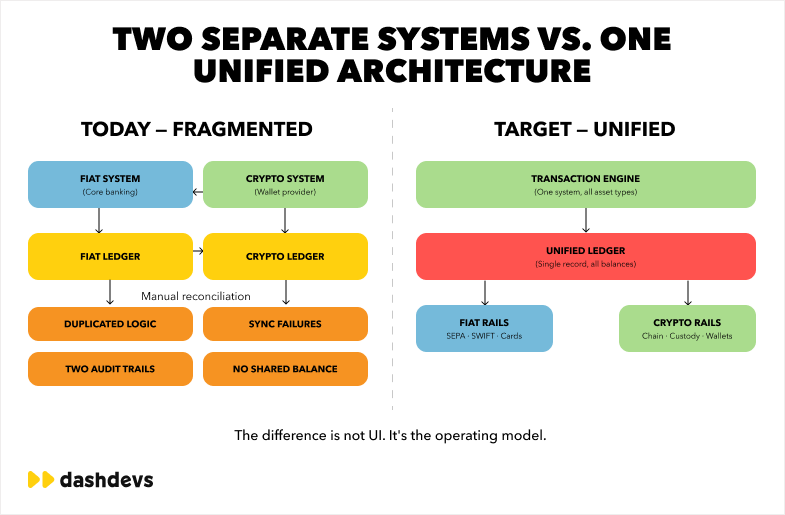
Reconciliation gets genuinely hard the moment data has to move between systems that were never designed to talk to each other. A core banking system, a payment processor, and an accounting platform each keep their own version of the truth, and financial data reconciliation is the process of forcing those versions to agree.
This is where a lot of homegrown reconciliation processes quietly fail. Data formats differ, timestamps do not align across time zones, and a transaction ID in one system means nothing to the next system in the chain.
| Multi-system failure | Typical cause | Fix upstream |
|---|---|---|
| Same payment, two IDs | No canonical reference | Shared transaction ID contract |
| Amount matches, date does not | Time zone / cut-off rules | Single posting calendar |
| Orphan fees | Bank fees not in product ledger | Fee event model in TPS |
| Entity vs group mismatch | Intercompany timing | Dual-entry rules and SLAs |
Solid fintech API integrations between your core systems reduce this friction at the source, so reconciliation software is matching consistent data rather than fighting format mismatches before it can even start comparing numbers.
This matters even more when specific payment rails are involved. A reconciliation process built around CHAPS payments in the UK, for instance, needs to account for same-day settlement timing that a generic ACH-based workflow was never designed to handle.
At the infrastructure layer, this usually comes back to how your transaction processing system captures and timestamps activity in the first place. Clean transaction data at the source is the single biggest lever for a reconciliation process that actually stays fast as volume grows.
Internal controls and reconciliation ownership
Automation changes how reconciliation gets done. It does not change who is accountable for it.
| Control | What good looks like | Failure mode |
|---|---|---|
| Segregation of duties | Initiator ≠ reconciler/approver | Same person posts and clears breaks |
| Exception escalation | Named path for automation-flagged items | Exceptions age in a shared inbox |
| Rule review cadence | Matching rules reviewed on a schedule | Old rules silently miss new break types |
| Evidence retention | Exportable trail for auditors | Screenshots with no context |
A strong internal control framework still requires segregation of duties, meaning the person who initiates a transaction should not be the same person who approves its reconciliation. It still requires a documented escalation path for exceptions that automation correctly flags but cannot resolve on its own. And it still requires periodic review of the rules themselves, since a matching rule that made sense a year ago can quietly become the reason discrepancies slip through unnoticed.
Treat your automated close controls the way you would treat any other financial control: tested on a schedule, owned by a named person, and adjusted when the business changes underneath it.
How DashDevs helps build reconciliation infrastructure
Choosing a reconciliation tool solves part of the problem. The harder part, especially for fintechs and payment companies, is making sure the systems feeding that tool produce clean, consistent data in the first place.
For companies still running finance reconciliation on disconnected spreadsheets and point solutions, a white-label modular fintech platform can consolidate ledger, payments, and reporting under one architecture instead of stitching them together after the fact.
We build the infrastructure layer this depends on. Our work on fintech integration services connects core banking, payment rails, and accounting systems so reconciliation software has consistent data to match against instead of format mismatches to fight through.
For companies that need matching against live transaction data rather than a batch file at end of day, the real-time payment reconciliation patterns above are the architecture target — not a nightly spreadsheet export.
If reconciliation is one piece of a larger decision about owning more of your financial infrastructure, our core treasury system build vs. buy guide walks CFOs through that decision in detail.
If you are building this from the ground up, our fintech development company team can help design a reconciliation architecture around your actual transaction volume and entity structure, not a generic template.
Final thoughts
Financial reconciliation is not a compliance formality. It is the process that tells you whether the numbers you are reporting on are actually true.
Manual reconciliation scales badly and hides risk in exactly the accounts you cannot afford to get wrong. Automation fixes the matching bottleneck, but the controls, the ownership, and the judgment calls still belong to your finance team.
Start with data quality and ownership. Buy or build tooling second. That order is what keeps financial reconciliation boring — which is exactly what you want.
Want help figuring out where your reconciliation process is actually breaking — the tooling, the data, or the architecture underneath it? Talk to our fintech infrastructure team and we will help you map it out.
Share article
