


Fintech Data Analytics: Why Dashboards Are Table Stakes (Not a Strategy)

September 1, 2026
- Real-time dashboards have moved from differentiation toward baseline functionality.
- Meaningful differentiation starts beyond basic reporting, particularly when predictive or prescriptive analytics are embedded into workflows.
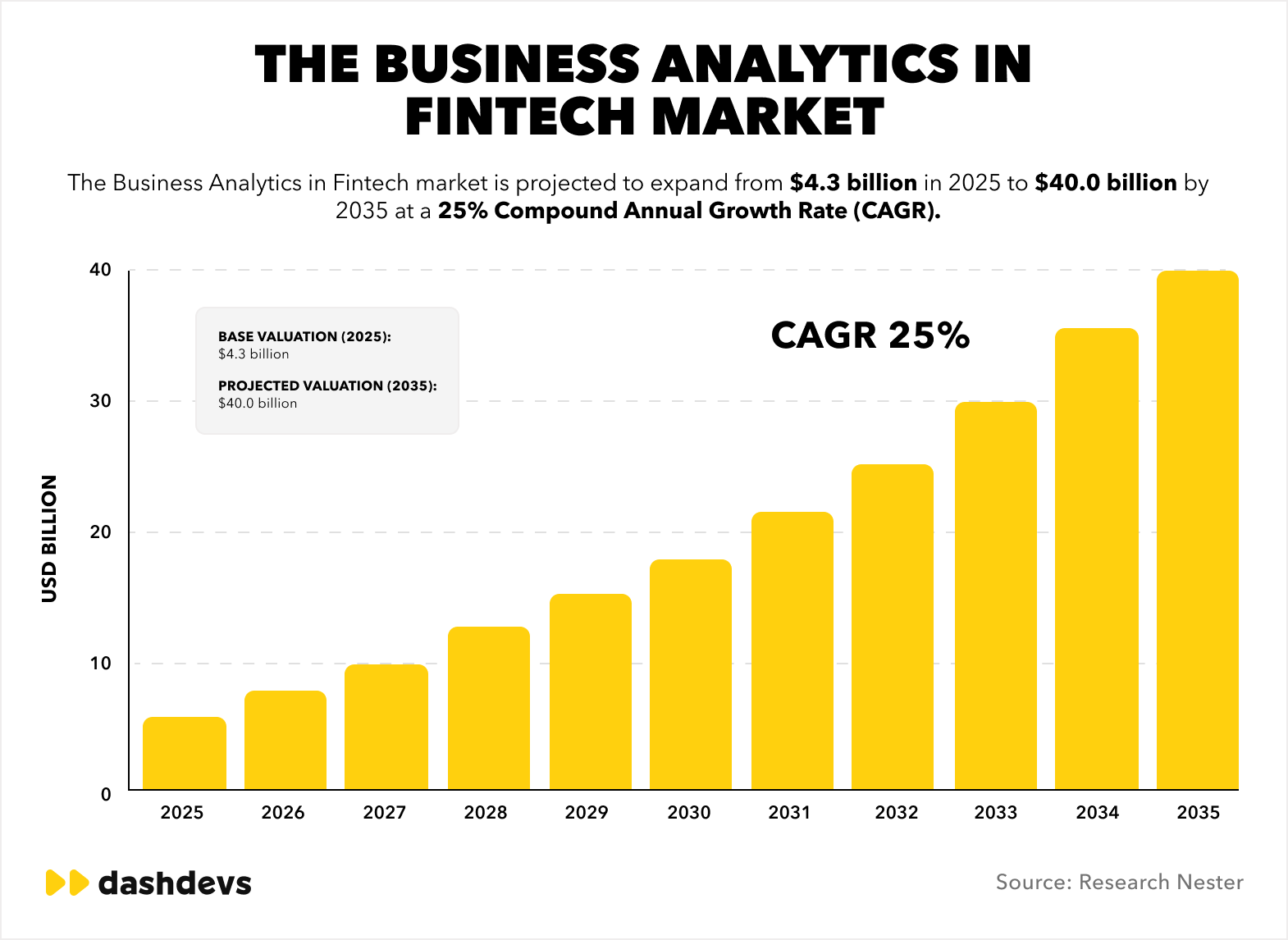
- The business analytics market in fintech grows from $4.3B (2025) to $40B (2035), driven by predictive and prescriptive investment.
- Fraud detection, credit scoring, and churn prediction require architecture well beyond a dashboard.
- Predictive analytics in fintech is an infrastructure decision.
Your product team shipped a real-time fintech analytics dashboard. Users can see balances, transactions, and KPIs update live. The roadmap calls it a win.
Your closest competitor just shipped churn predictions, fraud scoring at the transaction level, and a model that flags creditworthy thin-file applicants your current underwriting rejects outright.
That gap is a product architecture difference. And it is the primary axis on which fintech products compete in 2026.
The episode of Fintech Garden, DashDevs’ fintech podcast, is out. In this episode, Business Analytics Team Lead Yuliia Komaryn joined Igor Tomych, DashDevs’ CEO and founder, to dismantle the hype around analytics.
This article is for product and engineering leaders at fintech companies or fintech-adjacent SaaS teams shipping analytics as a feature to their customers. You already know users need data visibility. The harder question is where data visibility ends and the defensible product edge begins.
Real-time dashboards are infrastructure, not strategy
Fintech data analytics dashboards became table stakes when real-time payment rails did. FedNow launched in July 2023. Under the EU Instant Payments Regulation, euro-area banks faced October 2025 deadlines to send instant credit transfers. The UK is also redesigning retail payments infrastructure under the National Payments Vision. As instant-payment infrastructure becomes more widespread, users increasingly expect financial products to reflect transaction and balance changes quickly.
In 2026, shipping a real-time dashboard is roughly equivalent to shipping a mobile app that loads in under three seconds. Users expect it. They do not praise you for it.
The data confirms the shift. According to Research Nester, the business analytics in fintech market was valued at $4.3 billion in 2025 and is projected to reach $40 billion by 2035 — a 25% CAGR. The report points to growing demand for advanced data processing, predictive capabilities, real-time fraud detection, and risk-management analytics as important market drivers.
Many teams still focus heavily on the first two tiers of analytics maturity:
Descriptive analytics: What happened? (transaction reports, balance history, KPI summaries)
Diagnostic analytics: Why did it happen? (cohort breakdowns, funnel drop-off, variance analysis)
Both are necessary, and neither creates a moat. The third and fourth tiers are where many fintech products can create stronger differentiation:
Predictive analytics: What will happen? (churn probability, default likelihood, fraud scoring)
Prescriptive analytics: What should we do about it? (automated intervention triggers, dynamic pricing, risk-adjusted offer optimization)
Understanding where your analytics investment sits on this spectrum is the first roadmap decision to resolve — and it sits alongside broader data science in the fintech industry choices about how models, pipelines, and product workflows connect.
What the analytics maturity gap actually costs you
The analytics-to-action gap is well-documented and still wide. A similar implementation gap appears in AI adoption. Coverage of McKinsey’s State of AI survey found that 88% of companies now use AI in at least one business function, but only 7% have fully scaled it across the organization. For fintech products shipping data analytics in fintech contexts to B2B customers, that gap is a product opportunity as much as a competitive risk.
Here is what the gap costs in practice.
Fraud detection
Rule-based systems flag known patterns. They miss synthetic identity fraud, account takeover via behavioral mimicry, and attack vectors that emerged after the rules were written. U.S. consumers reported losing more than $12.5 billion to fraud in 2024, a 25% year-over-year increase according to the FTC’s Consumer Sentinel Network Data Book. Machine learning models trained on behavioral baselines detect anomalies in real time. Static dashboards report the fraud after it has cleared.
Credit decisioning
Thin-file applicants are rejected by score-based underwriting at rates that ML models can measurably reverse. A FinRegLab study found that the best-performing ML models increased credit approvals by nearly 4% over simpler analytics at mainstream risk cutoffs, with the strongest results for thin-file and underserved borrowers.
Showing that data on a dashboard doesn’t fix the problem. Embedding the model into the decisioning flow does — the same pattern covered in our guide to AI credit scoring.
Churn prediction
Fintech churn is often silent. Users don’t cancel. They reduce activity over weeks, then stop returning. By the time a dashboard surfaces the MAU decline, the intervention window has already closed. Predictive models trained on behavioral signals (declining app sessions, failed payment attempts, reduced feature usage) can identify behavioral patterns associated with future disengagement before the user fully churns.
If we are building the dashboard and nobody is looking at it, we are doing something that is not right at all.
The pattern across all three cases is the same. Dashboards confirm what happened. Predictive capabilities change what happens next. The difference between those two functions is a different product value proposition.
The four analytics tiers in practice: a comparison
Before evaluating build-vs-buy decisions, map each tier to its actual product output and infrastructure requirement. Here is how each tier looks in a real fintech product context:
| Tier | Function | Example Output | Infrastructure Required |
|---|---|---|---|
| Descriptive | Report what happened | Balance history, transaction log, KPI cards | Data warehouse, charting layer, row-level security |
| Diagnostic | Explain why it happened | Cohort drop-off, funnel breakdown, variance drill-down | Dimensional modeling, query engine, segmentation |
| Predictive | Forecast what will happen | Churn score, fraud probability, default likelihood | Feature store, ML pipeline, model registry, monitoring |
| Prescriptive | Recommend what to do | Intervention trigger, dynamic offer, risk-adjusted limit | Decision engine, feedback loop, A/B testing, audit trail |
The engineering lift between descriptive and predictive is architectural. A charting library doesn’t become a predictive system by adding an ML model to it. The data pipeline, feature engineering, model validation cadence, and drift monitoring must all be designed from the start.
Teams building predictive capabilities without resolving data architecture first tend to produce expensive proofs-of-concept that never reach production.
The three use cases with the clearest differentiation potential
Not every predictive use case offers the same ROI or defensibility. Three areas consistently produce measurable business impact in production fintech analytics solutions — and they map closely to practical AI in banking use cases.
Fraud detection at the transaction layer
Fraud detection offers the fastest payback of any predictive investment in production fintech analytics solutions. Rule-based systems were sufficient when fraud was largely transactional and patterned. In 2025 and 2026, synthetic identity attacks and AI-generated behavioral mimicry have broken that assumption.
ML models trained on individual behavioral baselines catch anomalies that rules miss. They also adapt. A rule written for last quarter’s attack vector is already stale. A model retrained on recent fraud signals is not.
The infrastructure requirement is non-trivial. Real-time inference at the transaction layer requires sub-100ms latency at p99. That is a serving architecture decision. Teams that build the model first and the serving layer second typically discover this during load testing.
As a fintech software development company, DashDevs engineers treat the serving architecture and the AML toolkit as a single design problem, because in production they are.
Credit risk and alternative data scoring
Traditional credit scoring excludes a significant portion of fintech’s natural customer base. Younger users, gig economy workers, immigrants, and new-to-credit customers have limited credit file depth. Reject them on FICO alone, and your addressable market shrinks. Accept them without a scoring model, and your default rate climbs.
Alternative data scoring addresses this directly. The model must be explainable. Any data science in finance application touching credit decisioning is subject to adverse action explanation requirements under ECOA in the US and equivalent EU frameworks.
Build the model governance framework before you build the model.
Churn prediction with intervention triggers
Churn prediction is only useful when it produces an action. A list of high-risk users is a report. A churn model connected to an intervention trigger (a targeted push notification, a changed offer, a proactive support contact) is a product.
The infrastructure requirement is a feedback loop. You need to know whether the intervention worked. That means tagging intervention cohorts, tracking re-engagement rates, and retraining the model on both predicted and actual outcomes. Without the feedback loop, churn model accuracy degrades as user behavior shifts.
The infrastructure conversation
Most articles covering this topic focus on use cases. Fewer address the infrastructure decisions that determine whether those use cases reach production.
Multi-tenant data isolation: If you are shipping analytics to B2B customers, Tenant A must never see Tenant B’s data. Row-level security at the query layer is the minimum. Audit logging for tenant-scoped access is required for SOC 2 evidence in regulated environments. Audit trails, query logging, and tenant-scoped access reviews are table stakes in fintech — whether you build or buy.
PCI DSS scope minimization: Embedding data analytics in fintech contexts that touch payment card data extends your PCI DSS scope unless the architecture is explicitly designed to minimize it. Data tokenization, scope segmentation, and compliant data residency decisions belong at the architecture stage, not during a QSA assessment.
Model monitoring and drift detection: Production models degrade, fraud patterns shift, and user behavior changes. A model that performed well at launch may produce unreliable outputs six months later without active monitoring. Drift detection, performance thresholds, and retraining cadences are operational requirements.
Explainability for regulated decisions: Any model influencing credit, lending, or risk decisioning must be explainable. The application of AI in banking at this layer requires explainability architecture from the start. The EU AI Act treats AI systems used to evaluate the creditworthiness or credit score of natural persons as high-risk in the relevant circumstances. The Act contains an explicit exception for AI systems used to detect financial fraud, so fraud-detection models should not automatically be described as high-risk under the AI Act.
Feature store design: A feature store can help teams serve consistent, governed features across training and inference pipelines, particularly as ML systems scale. Teams that skip it encounter training-serving skew, where the model was trained on data that doesn’t match what it receives at inference time. The results are unreliable at best and harmful at worst.
The hard part of predictive analytics in fintech is the infrastructure around the model. Feature stores, serving latency, audit trails, model monitoring, and explainability layers are production engineering problems that must be scoped before the first model ships.
Build vs. buy: where the decision actually sits
The build-vs-buy question for analytics almost always gets asked at the wrong layer. Teams ask whether to build dashboards or buy an embedded analytics platform. That is the wrong question if your goal is differentiating at the predictive tier.
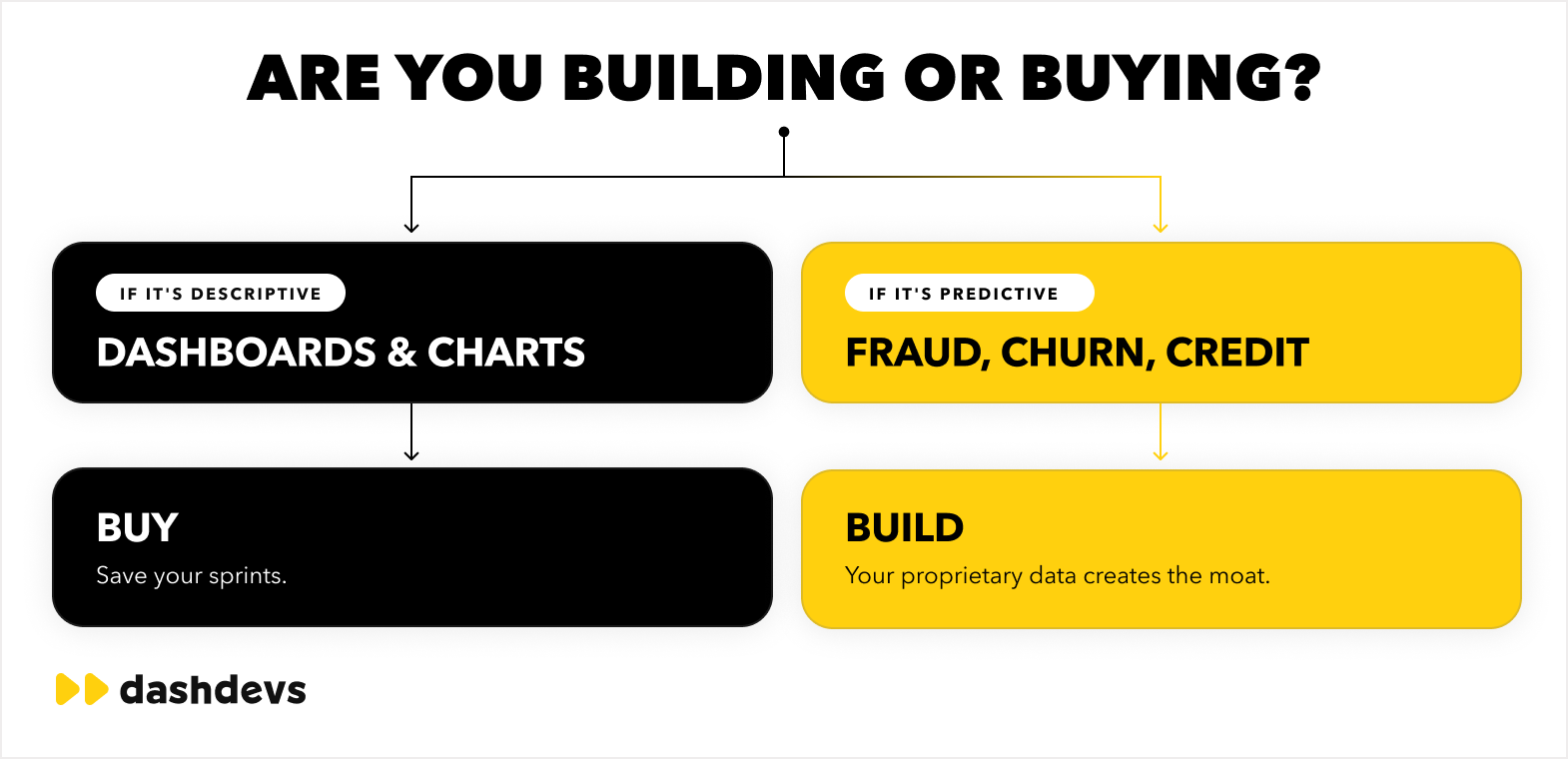
Here is a more useful framing. The decision depends on which analytics tier you are evaluating and where your product value actually lives:
| Analytics Tier | Build Signal | Buy / Embed Signal |
|---|---|---|
| Descriptive / Diagnostic | Analytics IS your core product SKU | Analytics is a retention feature, not the reason customers buy |
| Predictive (fraud, churn, credit) | You have proprietary data and model differentiation | You need working models faster than you can build them |
| Prescriptive (decision engine) | Intervention logic is core to your product workflow | Standard trigger logic with configuration is sufficient |
Time to first dashboard: 6 to 12 months built in-house vs. 4 to 8 weeks with an embedded SDK. The more important number is engineering opportunity cost. Every sprint spent rebuilding charting infrastructure is a sprint not spent on the predictive layer that creates product defensibility.
Most fintech product teams are better served buying the descriptive layer and investing engineering time in the predictive tier. The exception is when analytics is the product itself, in which case building is justified.
This is a common misallocation that surfaces in fintech consulting engagements. Engineering resources flow into dashboard infrastructure that could be purchased. The predictive capabilities that would actually drive retention and reduce risk sit on the backlog.
Regulatory requirements are reshaping the analytics roadmap
Explainability is not optional in fintech. In credit and lending, it was already required under ECOA, FCRA, and their EU equivalents. The EU AI Act adds new weight: systems influencing high-stakes decisions must be auditable, must document training data, and must demonstrate bias testing as part of model validation.
Risk management in fintech for teams that ship predictive models without built-in audit trails is not accruing technical debt. They are accruing regulatory exposure.
The architectural implication is specific. Audit logging must capture which model version produced which output on which input data at what timestamp for which tenant. That is a data engineering requirement. It belongs in the initial system design.
Three regulatory considerations directly shaping analytics architecture decisions today:
DORA (EU): Financial entities must manage ICT risk, operational resilience, ICT incidents, and third-party ICT dependencies. For AI-enabled analytics, this can affect infrastructure, monitoring, incident management, and vendor governance — see our DORA regulation overview.
EU AI Act (high-risk classification): Creditworthiness assessment systems for natural persons sit in the high-risk category in the relevant circumstances, with conformity assessments, technical documentation, and human oversight requirements. Fraud-detection systems should be assessed against the Act’s specific scope and exceptions rather than assumed high-risk by default.
GDPR and equivalents: Data used for model training must meet data minimization and purpose limitation requirements. This can constrain which behavioral signals may be collected or reused as model features and requires the organization to establish an appropriate lawful basis, purpose, transparency, retention, and governance framework.
This is where fintech data strategy and technical architecture intersect. A sound fintech data strategy accounts for regulatory constraints from the design phase.
AI in fintech teams that treat compliance as an afterthought typically encounter the cost during their first regulatory audit. The cost at that point is substantially higher than building compliance by design from the start.
What a production-grade analytics architecture looks like in practice
A real-time dashboard is one component of a larger system. Here is how the full architecture maps across a growth-stage fintech product:
| Layer | Components | Production Requirement |
|---|---|---|
| Data ingestion | CDC connectors, event streaming (Kafka), webhook receivers | Sub-second latency for real-time payment events |
| Storage and modeling | Data warehouse, dimensional models, feature store | Tenant-scoped partitioning, PCI DSS scope minimization |
| Analytics serving | Query engine, row-level security, caching | Sub-2-second dashboard load at scale; p99 SLO for interactive queries |
| ML pipeline | Training jobs, model registry, validation, monitoring | Drift detection, retraining cadence, version tracking |
| Decision layer | Model serving, trigger logic, feedback loop | Sub-100ms inference at transaction volume; audit logging |
| Compliance layer | Audit trails, explainability outputs, data lineage | Aligned to DORA, EU AI Act, GDPR, and local regulations |
The serving and compliance layers are where early-stage analytics builds most often stall. Charting libraries handle visualization well. They don’t handle multi-tenant isolation, audit logging, or sub-100ms inference at volume. These are separate engineering problems and need to be designed as such.
RPA in finance and automation layers can complement the analytics stack by handling downstream workflow triggers, but the analytics architecture itself must be sound before automation adds reliable value.
Final thoughts
Real-time dashboards are necessary. They aren’t sufficient, and they aren’t where the product competition is happening in 2026.
The teams gaining ground invest in the predictive and prescriptive tiers: fraud models that adapt to new attack vectors, credit scoring that reaches thin-file applicants static underwriting rejects, and churn prediction connected to intervention workflows rather than sitting in a report nobody reads.
The infrastructure decisions that enable those capabilities are engineering decisions. They need to be resolved before the first model ships.
If your analytics roadmap is currently structured around dashboards and KPI visibility, the question worth asking now is: what is the first predictive use case where your proprietary data creates a real model advantage?
Start there, build the infrastructure correctly, and the compound effect follows.
Want to hear the conversation behind these ideas? Listen to the episode of Fintech Garden, DashDevs’ fintech podcast, where we discuss the evolution from real-time analytics to predictive fintech intelligence.
DashDevs builds fintech products across the analytics, compliance, and infrastructure layers for growth-stage fintechs and embedded finance teams. If you are scoping the next tier of your analytics roadmap, we are a practical conversation to have early.
Share article
