


Galileo Financial Technologies: 2026 Platform Guide

October 8, 2026
- Galileo's active account count dropped from 168M to 134.8M after Chime migrated off the platform. Chime paid an $18M termination fee to exit.
- In 2026, Galileo began rebranding to SoFi Tech Solutions, combining its processing, core banking, and direct bank charter into one platform.
- Galileo is the only major issuer-processor in North America that supports both card issuing and deposit accounts natively.
- A full processor migration takes 6–12 months. BIN portability and digital wallet re-provisioning are the critical path, not the API build.
- Galileo suits enterprise programs at $10M+ monthly volume. For earlier-stage programs, Lithic or Stripe Issuing are more accessible entry points.
If you run a card program in North America, Galileo Financial Technologies has almost certainly come up in your processor evaluation. It powers some of the largest fintechs in the US. Its API surface is deep. Its sponsor bank network is established.
But the platform is in transition. In April 2026, Galileo began rebranding to SoFi Tech Solutions. Its largest client, Chime, completed a migration off the platform. The account count that once exceeded 168 million has declined.
This guide is for CTOs, Heads of Payments, and product leads who need a current, unfiltered view. You need to decide whether to stay, expand, or move. That decision deserves accurate data.
Galileo in 2026: What Has Changed
Galileo Financial Technologies is an issuer-processor and embedded banking platform founded in 2001 and acquired by SoFi Technologies in 2020 for $1.2 billion. It provides the technology layer behind card programs, deposit accounts, Galileo payments, and fraud controls for Galileo fintech clients: neobanks, consumer brands, and financial institutions.
In April 2026, SoFi announced the platform would transition to the SoFi Tech Solutions brand. The rebrand combines Galileo processing, Technisys core banking, and SoFi’s direct banking charter into one infrastructure offering. The Galileo name and APIs remain operational. For existing clients, the rebrand changes nothing at the contract or integration level. The operational impact is minimal in the near term; the strategic intent is to position the combined platform as a single vendor for processing, core banking, and a bank charter.
The account numbers tell an honest story. At its peak in Q4 2024, Galileo processed 168 million enabled accounts. By Q2 2026, that figure had declined to approximately 134 million, per SoFi’s Q2 2026 10-Q filing with the SEC. SoFi attributed the decline to Chime, which completed its transition off Galileo before the end of 2025. Chime paid an $18 million termination fee in March 2026.
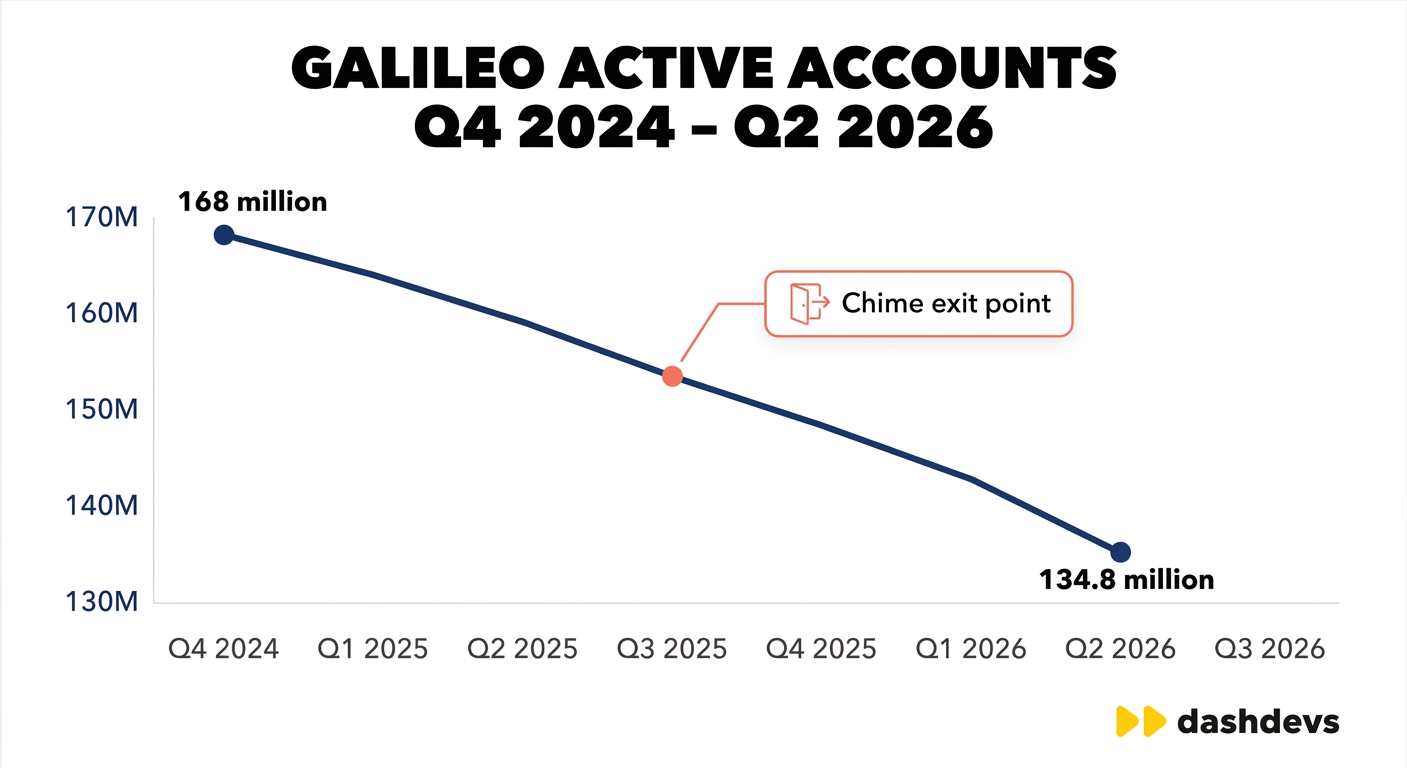
New contracts have partially offset that loss. The US Treasury selected Galileo as the processing partner for the Direct Express program. Direct Express is a prepaid debit card used by 3.4 million federal benefits recipients. In 2025, Javelin Strategy & Research named SoFi Tech Solutions Best in Class for Digital Issuance across 25 criteria.
Galileo’s Technology Platform segment posted net revenue of $114 million in Q3 2025, up 12 percent year-over-year, per SoFi’s earnings report. Revenue growth has continued even as the account count declined. The mix shifted toward higher-value, enterprise-grade clients.
| Attribute | Detail |
|---|---|
| Founded | 2001 |
| Parent company | SoFi Technologies (acquired 2020, $1.2B) |
| New brand (2026) | SoFi Tech Solutions |
| Active accounts | ~134.8M (Q2 2026) |
| Geographies | North America, Latin America |
| Card networks | Visa, Mastercard |
| Sponsor bank model | Direct (client holds sponsor bank relationship) and BaaS (Galileo as program manager) |
| Regulatory distinction | Access to SoFi Bank’s national charter |
| Key use cases | Card issuing, deposit accounts, ACH/RTP, fraud controls, embedded finance |
Core Platform Capabilities
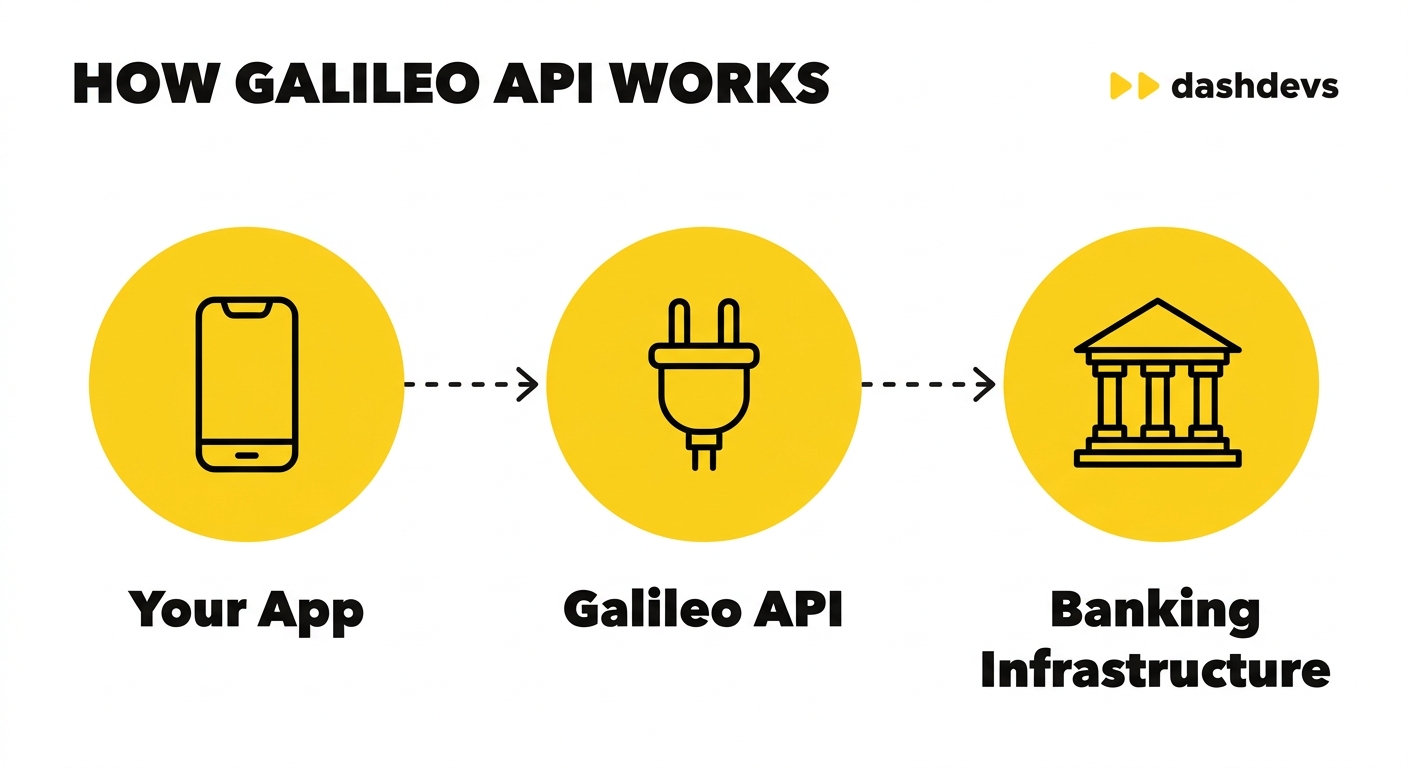
Galileo’s product surface covers card issuing, digital banking, payments, and developer tooling via API. The platform does not hold user funds; those sit at sponsor banks, with Galileo handling authorization, settlement, and card management.
Virtual and Physical Card Issuing
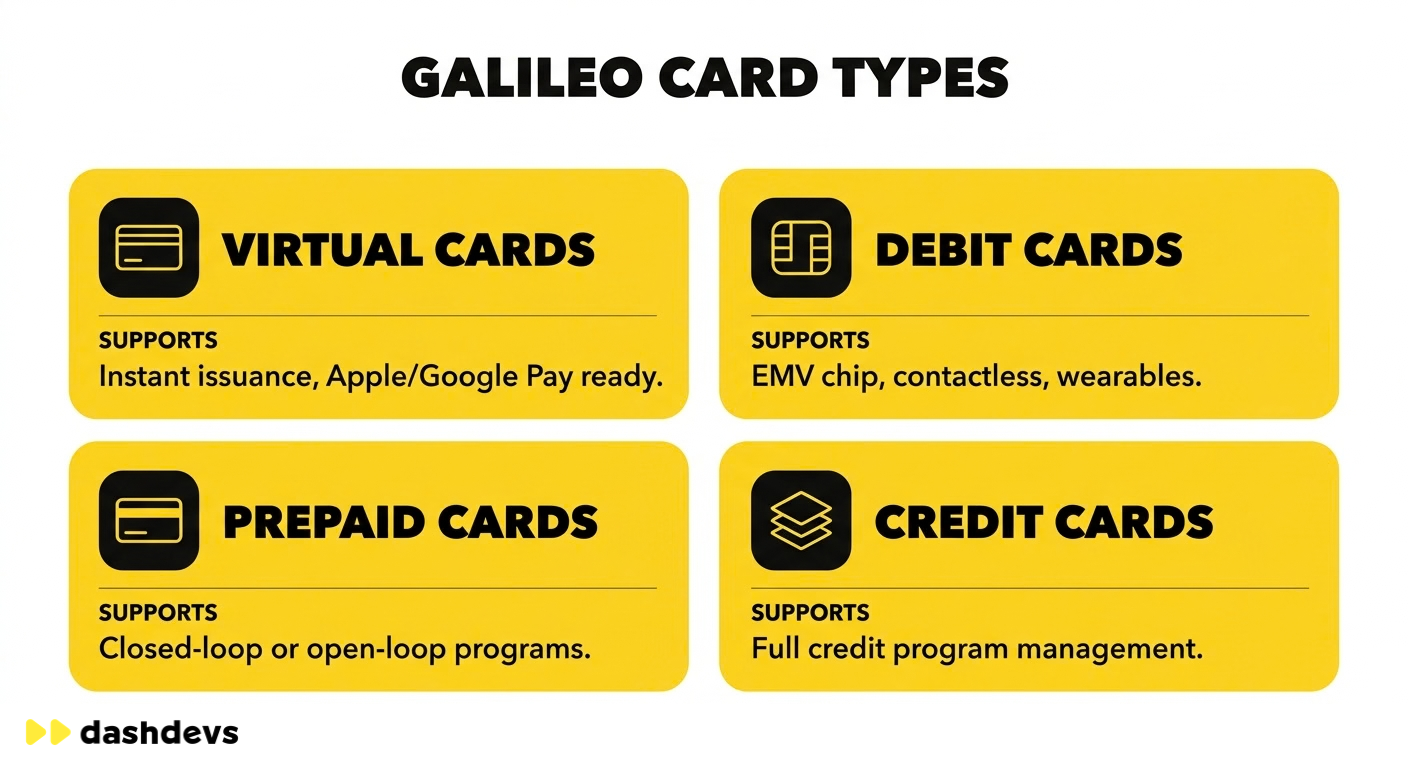
Galileo card issuing supports debit, credit, prepaid, and virtual cards across EMV chip, contactless, QR, and mobile wallet form factors. Each Galileo card is configurable at the program level via the Program Management API: card type, spend controls, network routing, velocity limits, and geofencing. Instant issuance is available at account creation, with push provisioning to Apple Pay and Google Pay through a single API call. Dispute resolution and chargeback management run through the same integration layer.
Just-In-Time Funding and Multi-Rail Payments
Galileo supports JIT funding. Spend authorization triggers a real-time fund pull from the source account. It requires low-latency webhook handling and a reliable ledger connection. For multi-rail programs, Galileo supports ACH, wire, RTP, P2P, and bill pay alongside card settlement, with debit and credit credentials manageable within one platform.
Sandbox and API Integration
The developer sandbox replicates the production environment with authorization simulation, webhook delivery, and fraud rule testing. The API surface is deep but negotiation-heavy: Galileo doesn’t have Stripe’s self-serve onboarding model. API access is granted post-onboarding and contract execution.
To bypass the heavy lifting of mapping complex backend endpoints, engineering teams often layer a composable platform like Fintech Core on top of Galileo to connect processing logic directly to pre-built user interfaces.
Galileo Pricing Model
All commercial terms are negotiated. Based on market benchmarks and practitioner-level data:
- Monthly minimums typically run in the 5,000 range at mid-market volumes. This reflects the cost of dedicated ledger infrastructure and 24/7 fraud coverage.
- Setup and implementation fees are moderate compared to Marqeta, estimated in the 50,000 range depending on program complexity.
- Interchange revenue can be shared depending on program structure. Galileo’s BaaS model captures a larger share than the direct processor model.
Pricing skews enterprise. Teams below $5M monthly volume will find Lithic or Stripe more cost-efficient.
What drives you above the monthly minimum range: credit programs, multi-rail complexity, and real-time fraud rule customization all add to the base cost. The BaaS model, where Galileo acts as program manager, captures a larger share of interchange than the direct processor model, where you hold the sponsor bank relationship directly. That distinction matters when you are modeling unit economics at scale. The SoFi Bank charter reduces sponsor bank procurement costs for qualifying programs, but it matters only if you need a national charter and don’t already have a banking partner.
Access to SoFi Bank’s national charter is a meaningful differentiator in pricing discussions. In practice, a Galileo Bank integration can reduce the cost of sponsor bank procurement for qualifying programs. You access the banking layer through the same relationship as the processing layer.
Galileo Outages and Reliability History
Galileo’s most significant public incident was in October 2019. A database failure caused 24+ hours of disruption for Chime and partial disruption for Varo Money. Millions of users lost access to their cards. It became the standard case study in processor concentration risk: when your processor goes down, your product goes down.
SoFi has disclosed that Galileo invested heavily in infrastructure remediation after 2019. No comparable outages have occurred in 2024–2026. Any production integration should pipe Galileo status into your monitoring stack.
Designing for Processor Redundancy
The 2019 Chime outage showed a structural risk most fintech teams underestimate at MVP. By the time a program reaches scale, a single-processor dependency is hard to unwind quickly.
Four measures that production teams use:
- Authorization abstraction layer. Route card authorization through an internal service that can fail over to a secondary processor without client-facing impact. This requires dual BIN registrations. Most teams skip it at MVP and spend months retrofitting it under live traffic at scale. Build it early or budget the cost of doing it later under pressure.
- Parallel ledger reconciliation. Running a second processor for a subset of transactions adds ongoing reconciliation cost. Budget it as a permanent ops function, not a one-time setup. Teams that treat it as a “set and forget” task typically surface settlement gaps during a compliance review, not before.
- Token migration planning. Token vaults (Apple Pay, Google Pay) are bound to the issuer-processor. Re-provisioning every active wallet token is a meaningful CX event. If 60–70% of your cardholders have stored your card in a digital wallet, that adoption rate is your real switching cost. Factor it into contract negotiations before you sign.
- Latency monitoring. Set p99 authorization response time thresholds in your own monitoring stack, independent of processor reporting. Latency degradation often precedes a visible outage by hours. Assign a clear owner for that alert and document the escalation procedure before an incident forces you to improvise.
The real cost of vendor lock-in in fintech is worth quantifying before you commit a program to a single processor at scale. DashDevs’ card issuing integration services include redundancy architecture as a standard part of program setup.
At MVP, a single-processor dependency is a necessary shortcut. At $10 million in monthly volume, it becomes a board-level risk. If you haven’t built an authorization abstraction layer by the time you hit scale, your product’s uptime is completely out of your hands.
Galileo vs. Marqeta vs. Lithic vs. Stripe Issuing
The Galileo vs Marqeta question comes up in almost every card program evaluation at the mid-market scale. According to Juniper Research’s November 2025 report, the card issuing platform market will grow from $1.8 billion in 2025 to $4.2 billion by 2030. The choice between processors is rarely about features. It is about program stage, volume, geographic scope, and operational ownership.
| Attribute | Galileo | Marqeta | Lithic | Stripe Issuing |
|---|---|---|---|---|
| Pricing model | Enterprise, negotiated; 2k–5k monthly minimums | Enterprise, negotiated; 5k–15k+ monthly minimums | Transaction-based, no stated minimums | Per-card and per-transaction; no monthly floor |
| JIT funding | Yes | Yes (core product) | Yes | Limited |
| Deposit accounts | Yes | No | No | No |
| BaaS / sponsor bank | Multi-bank network + SoFi Bank charter | Partner banks | Own charter (via subsidiary) + partner banks | Stripe’s bank partners |
| Digital wallet provisioning | Yes (Apple/Google Pay) | Yes | Yes | Yes |
| Regions | North America, LatAm | Global | US primarily | US, EU, UK |
| Time to launch (estimate) | 3–6 months | 3–6 months | 4–8 weeks (virtual), months (physical) | Days (virtual), weeks (physical) |
| Best fit | Full-stack fintechs, neobanks at scale | Enterprise card programs with JIT at high volume | Growth-stage programs, developer-first | Stripe-native platforms, early-stage validation |
Three things the table does not show:
Galileo’s deposit account capability is a real differentiator. Neither Marqeta nor Stripe Issuing supports deposit accounts natively. If your product needs a checking or savings account alongside the card, Galileo’s scope cuts the number of integrations and the number of vendor relationships you have to manage.
Stripe wins at early-stage speed. No monthly minimums, no enterprise negotiation. The trade-off is limited real-time authorization control and no deposit infrastructure. The Stripe Issuing deep-dive covers where those constraints become binding at scale.
Lithic is underrated at the growth stage. Transaction-based pricing gives teams between $500K and $10M monthly volume more leverage than Galileo at the equivalent stage.
When evaluating Galileo card issuing, the deposit account scope and SoFi Bank access typically tip the decision. They matter most for programs that need both a card and banking. layer from one vendor. The card issuing platform guide covers all major providers in 2026. For the Marqeta side of this comparison, the Marqeta alternatives overview covers the current landscape.
Migrating Onto or Off Galileo: A 6-Step Checklist
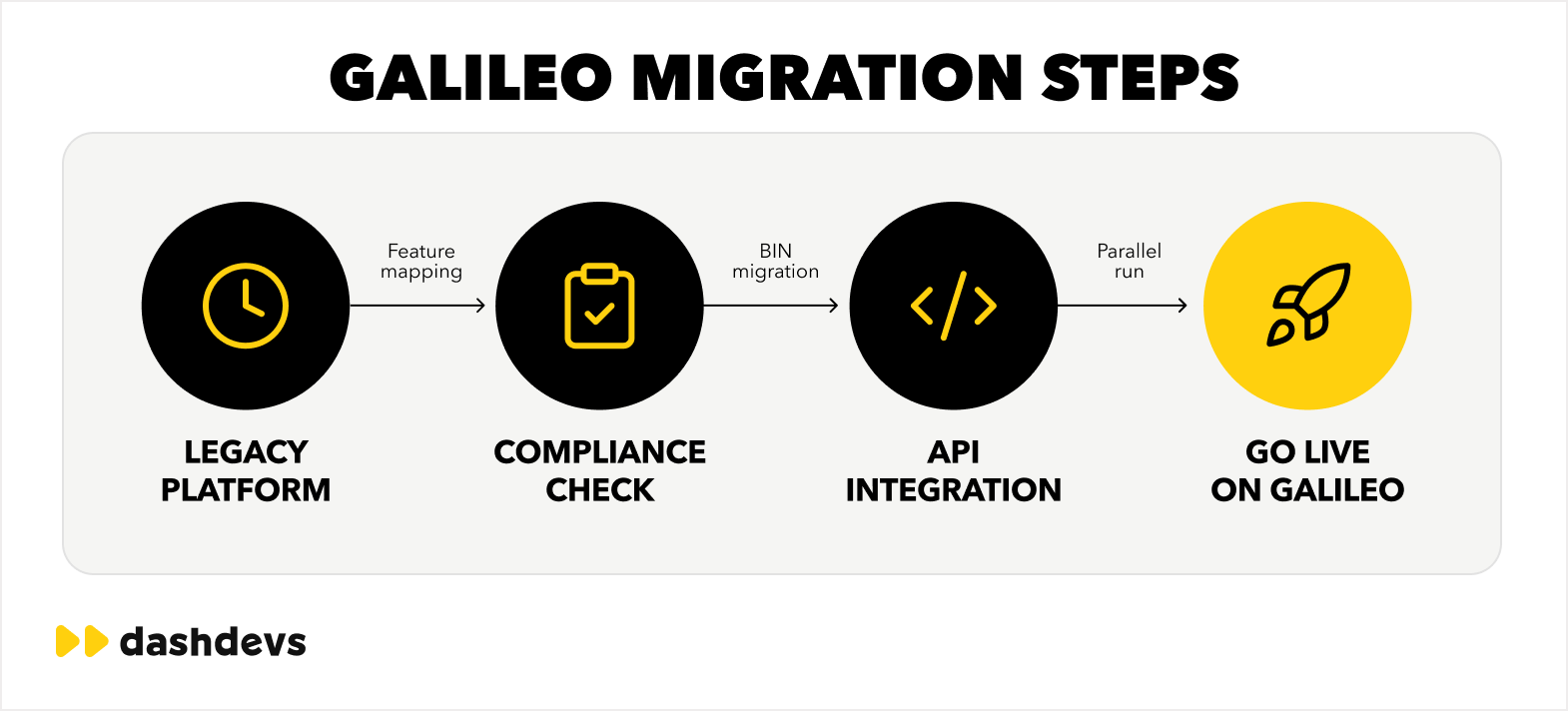
The technical scope is the same whether you migrate onto Galileo or off it. Most teams overbuild the API integration work and underestimate the non-card parts, ledger reconciliation, wallet token continuity, and regulatory notification. The Totavi 2025 US Issuer Processor Market Analysis projects the US issuer processor market will reach $15 billion by 2034. Migration activity will increase as programs mature and processor contracts are renegotiated.
Step 1: BIN and Program Portability Assessment
BINs are registered to the sponsor bank, not to you. Porting a BIN requires network approval, a sponsor bank agreement, and a program migration letter: 60–90 days minimum. Start it before any technical work begins. Some programs find it faster to reissue cards under a new BIN than to port the existing one.
Step 2: Card Reissue vs. Token Migration
Reissue forces a customer action (new card number, new expiry). Token migration is transparent to the cardholder. It requires coordination with the token vaults (Apple Pay, Google Pay, and Samsung Pay) and both processors simultaneously. Plan for 60–120 days of parallel processing. DashDevs teams handling card issuing migrations treat this phase as the critical path, not the API build.
Step 3: Ledger Reconciliation
During the parallel run, you are operating two ledgers simultaneously, one on the outgoing processor and one on the incoming platform. Transactions that authorize on one processor but settle on the other create reconciliation gaps. Those gaps compound faster than most teams anticipate, especially under high transaction volume.
The standard approach is to run automated daily reconciliation from day one, not after go-live. Build exception flagging into the pipeline: any transaction that appears on one ledger and not the other within a defined window should trigger an alert, not a morning report. Manual reconciliation at even moderate volume generates settlement risk that accumulates quietly until it surfaces as a balance discrepancy.
Three categories of exceptions to watch for: timing gaps (authorization and settlement on different days, different processors), reversals and disputes mid-migration (the cardholder disputes a transaction during the cutover window; both processors see it), and fee calculation differences (processors apply interchange and network fees differently; your revenue model will show variance until you normalize). Build a tolerance threshold and a resolution workflow before you start the parallel run, not after the first gap appears.
Step 4: Parallel Run and Cutover
Run both systems in parallel for 30–90 days. Direct new card activations to the new processor while existing cards run out of their lifecycle. Set a hard cutover date. Open-ended parallel runs create compliance and reporting complexity.
Our work on the multi-market BNPL platform included a structured parallel run for payments modernization. For a look at how a team replaced a provider-dependent stack entirely, the Kleos business case covers the architectural decisions that made that migration clean.
Step 5: Regulatory and Partner Notification
Migrations require notification to card networks, sponsor banks, and, in some cases, regulators. If your program runs under a partner bank’s license, the bank’s compliance team must approve the migration plan. Build 45–60 days of notification time before the technical cutover.
Step 6: Digital Wallet Re-Provisioning
Tokens in Apple Pay and Google Pay are bound to the issuing bank and processor. You cannot carry tokens across a processor switch. They must be re-provisioned. The blast radius scales with your active wallet adoption rate. This step is often underestimated in project plans.
The API build takes weeks; untangling ledger gaps from two systems running in parallel takes months. You budget for the API build, but you bleed on the reconciliation.
Who Builds on Galileo?
Galileo Financial Technologies has powered some of the most recognized US fintechs:
| Company | Use case | Status (2026) |
|---|---|---|
| Chime | Neobank debit and account infrastructure | Migrated off Galileo (ChimeCore) |
| SoFi | Full banking, investing, BNPL ecosystem | In-house (parent company) |
| Robinhood | Debit card and cash management | Active |
| Monzo US | US market account launch | Active |
| US Treasury (Direct Express) | Federal benefits prepaid card, 3.4M recipients | New (2025–2026) |
| Hotel rewards brand | Co-branded card program | New (2025) |
Chime’s exit cost $18 million in termination fees. A concrete illustration of how embedded a processor relationship becomes at volume. Factor that switching cost into your vendor decision from day one.
The Nexus digital bank platform case study shows how DashDevs approached full-stack neobank infrastructure. For teams at the planning stage, the how to build a neobank using vendors, platforms, or APIs guide maps the full decision tree before you select a processor.
Is Galileo the Right Processor for Your Program?
The right answer depends on program stage, geography, and product scope.
Galileo fits if:
- Your program is based in North America or LatAm and needs both cards and deposit accounts in one integration
- You are at or approaching enterprise volume ($10M+ monthly), where Galileo’s pricing structure becomes competitive
- You need access to a national bank charter (SoFi Bank) without sourcing your own sponsor bank relationship
- Your product roadmap includes both debit and credit programs under one platform
- You need production-grade JIT funding with real-time authorization control
Consider alternatives if:
- You are pre-launch or early stage: Stripe or Lithic will get you to market faster with a lower upfront cost
- Your program needs EU or UK card issuance: Galileo’s geographic scope is North America and LatAm
- You want self-serve API access without enterprise sales negotiation
- Processor concentration risk is a board-level concern, and you cannot operationally support a parallel processor architecture
- You are in a high-growth phase where pricing flexibility matters more than platform depth
For teams evaluating the full build vs. buy decision for financial infrastructure, a build, buy, or partner framework for fintech infrastructure is worth reading before committing to a processor strategy. DashDevs’ fintech integrations practice handles the vendor selection, BIN setup, and API integration work so your engineering team focuses on the product layer.
The Market Context in 2026
The modern card issuing platforms market will grow from $1.8 billion in 2025 to $4.2 billion by 2030, per Juniper Research’s November 2025 report.
Competitive pressure on established processors is coming from two sides. Newer entrants like Lithic, Highnote, and Unit are taking early-stage volume. At the top end, fintechs large enough to build proprietary processing (Chime’s ChimeCore being the clearest example) are migrating off external processors entirely.
Galileo’s response is the SoFi Tech Solutions rebrand, combining processing, core banking (Technisys), payments, and fraud infrastructure into one platform. Whether that positioning attracts net-new clients or mainly serves the existing enterprise base is the open question for 2026.
For a Galileo fintech program evaluating this landscape, the question is not whether competitors have emerged. It is whether your program’s stage and scope align with what Galileo Financial Technologies does best: enterprise-grade, full-stack card and banking infrastructure in North America and Latin America.
The leading banking-as-a-service company’s guide covers how BaaS connects to processor selection. The top core banking solutions overview helps teams decide whether a processor alone is enough or whether a full core banking layer is also needed.
Share article
