


Blockchain in Finance: Real ROI, Proven Use Cases, and the Infrastructure Decision

September 16, 2026
- Blockchain in financial services is no longer a pilot-stage technology. 83 of the top 100 global banks are running live blockchain systems. On-chain tokenized real-world assets crossed $30 billion in mid-2026.
- More than $1.4 trillion in FX trades is settled daily on a gross bilateral basis, fully exposed to settlement risk. Blockchain-based T+0 settlement eliminates that exposure.
- Blockchain processing reduced per-transaction trade finance costs from $1,209 to $82.
- For EU-regulated institutions, MiCA's full CASP authorization framework and DORA's operational resilience requirements are both in force in 2026.
- The build-versus-license decision is the most consequential one your team will make.
Blockchain entered the financial sector through the back door of crypto trading. In 2026, it is inside the front office of JPMorgan, HSBC, Goldman Sachs, and dozens of central banks.
That shift changes what the question is. It is no longer “should financial institutions use blockchain?” JPMorgan’s Kinexys platform has processed over $1.5 trillion in cumulative transaction volume. BlackRock’s tokenized Treasury fund holds over $2.5 billion in assets across six blockchains. DTCC, which custodies over $100 trillion in securities, received SEC clearance in 2026 for a multi-year pilot tokenizing DTC-custodied assets.
The question is now operational: which use cases generate real ROI, what does the right infrastructure decision look like, and how do you move from pilot to production without failing a regulatory audit?
This article is written for those who are past the curiosity stage and need a framework for making the actual decision.
What Blockchain in Finance Actually Means in 2026
Blockchain in finance is the application of distributed ledger technology to financial processes that currently depend on multiple parties maintaining separate records and reconciling them after the fact.
The core mechanics matter here because they define where the technology creates value and where it does not.
A blockchain records transactions as blocks, each cryptographically linked to the previous one. Once written, no block can be altered without invalidating every block that follows. This makes the ledger immutable. It also makes it shared: every authorized participant holds the same version of the record, in real time, without a central administrator.
Three properties matter most for banking institutions:
- Shared truth. Every counterparty sees the same transaction record. This eliminates the reconciliation gap that costs billions annually in operations and capital lock-up.
- Programmability. Smart contracts execute settlement logic automatically when conditions are met, removing manual approval steps.
- Selective transparency. Permissioned chains restrict access to vetted participants, which is why most banks use them rather than public networks like Ethereum.
Blockchain technology in financial services doesn’t replace existing financial infrastructure wholesale. In production, it integrates with it. What it removes is the administrative layer between parties: that layer of intermediaries, manual checks, and reconciliation cycles that slows settlement and inflates cost.
The technology doesn’t eliminate risk. It moves it. Understanding what risk transfers from where to where is the real implementation question.
Check out our article on distributed ledger technology in fintech if you’re building the one.
The ROI Case: Where Blockchain Generates Measurable Returns
Most discussions of blockchain in finance spend too much time on the technology and not enough on the numbers. Here are the documented impact areas.
Settlement Time and Capital Efficiency
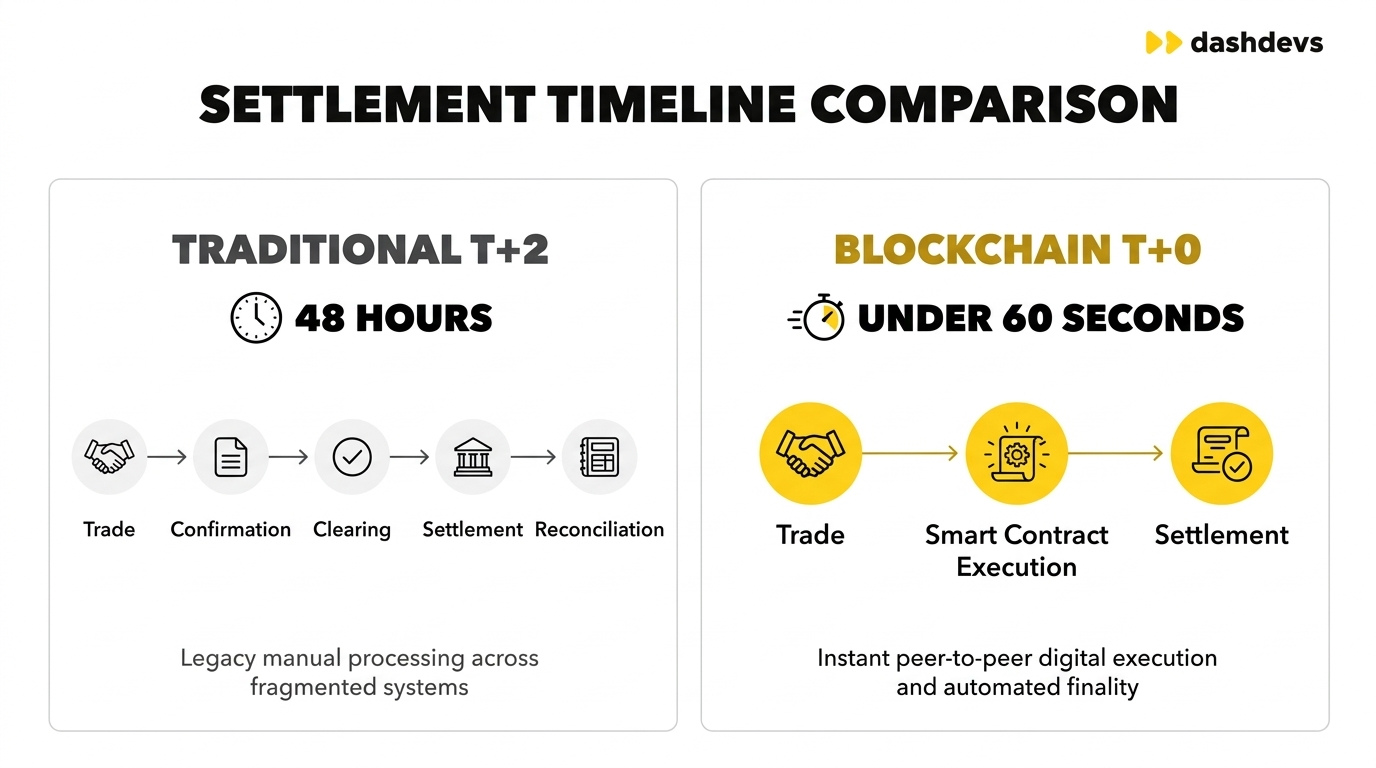
Traditional securities settlement takes two business days (T+2). Under T+2, capital is tied up in transit. According to the BIS Triennial Survey 2026, more than $1.4 trillion in FX trades is settled on a gross bilateral basis every day, exposing counterparties to full principal risk with no mitigation in place.
Goldman Sachs’ GS DAP platform demonstrated the alternative in a €100 million bond issuance for the European Investment Bank: settlement completed on the same day (T+0), with atomic Delivery vs. Payment in under 60 seconds. A process that normally takes five days.
JPMorgan replicated this in a different context. A JPMorgan executive noted that settlement times on their platform dropped from 48 hours to 15 minutes. It is a structural change in how capital moves.
Cross-Border Payment Costs
World Bank data puts the global average cost of sending $200 across borders at 6.36% in 2025, more than twice the UN Sustainable Development Goal target of 3%. With annual cross-border payment volume estimated at $190 trillion in 2024, even a 2% fee reduction represents billions in recoverable costs.
Businesses using blockchain in financial services for cross-border payments can reduce processing costs by up to 30%, with peer-to-peer transaction costs dropping by up to 70% for high-volume flows. Stablecoin payment rails for business carried $33 trillion in 2025, a 72% year-over-year increase, with USDC processing $18.3 trillion of that total.
Reconciliation and Compliance Cost Reduction
A 2025 peer-reviewed study published in Springer’s Digital Finance journal found that blockchain-based processing reduced per-transaction costs in trade finance from $1,209 to $82 (a drop of over 93%) and cut processing time from 8.4 days to 0.2 days. Smart contracts lower administrative costs by up to 42% in invoicing and settlement workflows. Smart contracts lower administrative costs by up to 42% in invoicing and settlement workflows, according to industry data tracked across supply chain finance deployments in 2025.
Industry data from 2025 supply chain finance surveys shows that 43% of banks reported cost savings from blockchain applications in finance in compliance and automation. Blockchain-based dispute resolution cuts annual dispute management costs by approximately 25%.
New Revenue Lines: Tokenization
Beyond cost reduction, tokenization opens revenue streams that did not exist in traditional finance.
Boston Consulting Group projects tokenized real-world assets could reach $16 trillion by 2030. By mid-2026, tokenized assets excluding stablecoins had already crossed $30 billion, up from $12 billion a year earlier. McKinsey research indicates that an end-to-end tokenized bond lifecycle could unlock operational efficiency improvements of at least 40% through automation, embedded compliance, and streamlined asset servicing.
Asset tokenization enables fractional ownership of previously illiquid instruments. Government bonds, private equity funds, real estate, and infrastructure assets can be split into smaller investable units, opening markets to a broader investor base while creating new fee and management revenue for institutions.
If a use case doesn’t require shared state, immutability, or multi-party coordination, it is usually a poor fit for blockchain in financial services.
Blockchain Use Cases in Finance: What Banks Are Actually Building
Cross-Border Payments and Settlement
This is the most production-ready use case in blockchain. RippleNet connects 300 financial institutions across 55+ countries for near-instant settlement. Citi’s blockchain-based platform moved into commercial use in 2024, facilitating multi-million-dollar daily transactions for corporate treasurers with 24/7 cross-border liquidity. JPM Coin handles instant settlement of payments between institutional clients in tokenized fiat.
Building a fiat-crypto reconciliation platform requires a unified balance system that keeps both rails in sync. That infrastructure problem is where most implementations stall.
We solved this exact bottleneck when building an EMI/VASP-compliant Digital Assets Trading Platform for an APAC fintech using Fintech Core. To eliminate liquidity fragmentation, we engineered a unified order-matching engine that processes 30,000 transactions per second at under 40ms latency. The system syncs fiat, stablecoins, and crypto in real time, while embedding automated KYC and Travel Rule checks directly into the pipeline to cut onboarding times by 60%.
Trade Finance
Traditional letters of credit take five to ten days and generate significant documentation overhead. HSBC integrated blockchain into its trade finance operation and reduced transaction times from the standard multi-day cycle to under 24 hours. The R3 Corda permissioned platform, designed specifically for banking and capital markets, has achieved the same compression at scale.
Tokenized Bonds and Asset Management
The European Investment Bank has issued multiple tokenized bonds on blockchain infrastructure. The Thai and Philippine governments used tokenized bonds to include small-ticket retail investors through fractionalization. BlackRock’s BUIDL fund and Franklin Templeton’s BENJI together represent a large share of tokenized Treasury value in production by 2026.
We applied this fractionalization model in practice when engineering the Inablr platform in Bahrain. By leveraging blockchain asset tokenization, we split large, illiquid sovereign bonds into smaller, tradable units, lowering the investment entry point for retail investors to enter the Islamic capital market. To satisfy strict regional banking mandates, the tokenized architecture was integrated directly with segregated fiat bank accounts and automated identity verification systems.
KYC, AML, and Identity Verification
Blockchain-based identity systems allow verified credentials to be shared across institutions without re-verification at each touchpoint. This reduces KYC duplication costs and improves AML audit trails. For financial institutions subject to FATF Travel Rule requirements, immutable transaction records reduce compliance overhead and the risk of reporting gaps.
Smart Contracts for Automated Settlement
Smart contracts encode the conditions for settlement directly into executable code. When conditions are met, the contract executes without manual approval. This eliminates approval queues, reduces processing errors, and creates a complete audit trail. In insurance, smart contract automation cut claim processing times by 50%, enabling settlements within hours rather than days.
Digital wallet infrastructure for fintech apps is increasingly the vehicle for these smart-contract flows in consumer-facing regulated products.
Public vs. Permissioned Blockchain: The Network Decision
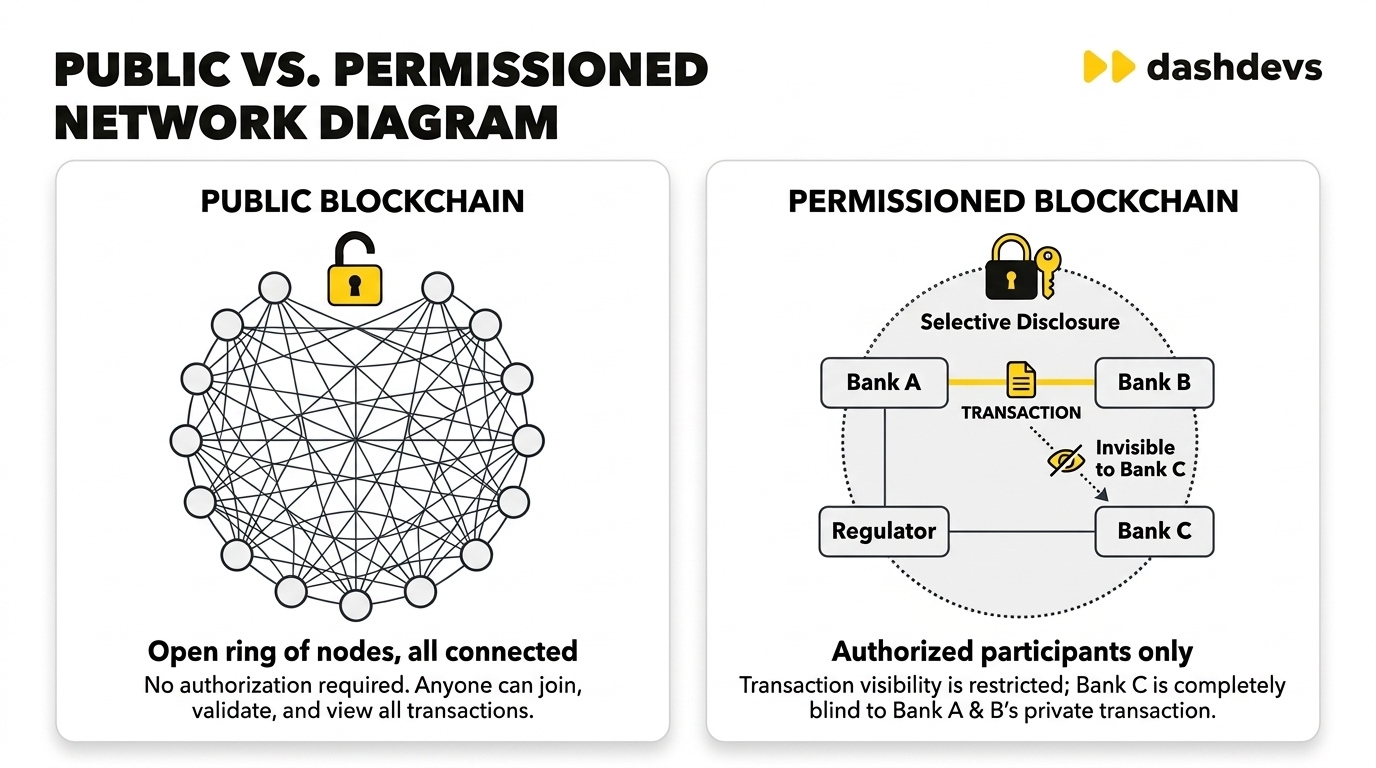
This is the most consequential technical decision for financial institutions, and most organizations get it wrong by defaulting to public chains because they are more visible.
| Factor | Public Blockchain | Permissioned Blockchain |
|---|---|---|
| Access control | Open to anyone | Restricted to vetted participants |
| Privacy | All transactions are visible | Selective disclosure possible |
| Regulatory fit | Limited, complex | Designed for institutional use |
| Governance | Emergent, community-driven | Explicit rulebooks, liability frameworks |
| Speed and throughput | Variable, network-dependent | Configurable, institution-controlled |
| Best for | Token markets, DeFi, broad access | Settlement, trade finance, custody |
| Examples | Ethereum, Solana, Bitcoin | Canton Network, R3 Corda, Kinexys |
Most tokenized bonds, funds, and structured products in 2025 were issued on permissioned platforms operated by banks or market infrastructure providers. The Canton Network, backed by Digital Asset and anchored by Goldman Sachs, handles trillions in tokenized asset settlement with selective disclosure: a bond trade between two institutions remains invisible to every other participant.
That said, the picture is not binary. JPMorgan arranged a US commercial paper issuance on the Solana public blockchain in December 2025. Public and permissioned infrastructure are increasingly being used in parallel, depending on the product.
For regulated institutions, the practical decision rule is this: if your use case requires auditability, counterparty privacy, and explicit compliance controls, start with a permissioned network. Public chains are relevant when global accessibility and open programmatic composability are the primary requirements.
When evaluating which network fits your product, check out our articles on top blockchain consulting companies and blockchain development companies with regulated fintech experience, which will save you the cost of getting this wrong.
DashDevs in Production: The Kleos Non-Custodial Finance Platform
When Kleos approached DashDevs, the challenge was concrete. They needed to transition away from a fragile, single-vendor-dependent custodial stack into a scalable dual-account architecture that banking partners would actually underwrite.
The product goal was a non-custodial finance platform combining a personal EUR IBAN, virtual and physical Visa cards, SEPA and SWIFT transfers, stablecoin operations on USDC/Ethereum, and tokenized investment capabilities built on yield vaults.
DashDevs engineered a unified fintech stack using Fintech Core as the foundation. This included fiat banking integration connecting traditional EUR rails (via Stanhope) with on-chain digital assets, a unified balance system syncing fiat and crypto states in real time, and compliance logic isolated into independent services so vendors can be updated or replaced without touching core settlement code. The compliance-ready fintech infrastructure includes a Sumsub integration that handled identity verification as a prerequisite for every fiat capability; the IBAN, the cards, SEPA, and crypto operations could only go live after a user cleared KYC.
DashDevs delivered the MVP in 10 weeks. Version 1.1, which added non-custodial investment vaults and Web3Auth wallet login, shipped 6 weeks later. Visa card issuance went live in version 1.2, 8 weeks after that.
The result was a non-custodial architecture with reduced infrastructure dependency, improved unit economics, and a compliance layer built to survive both MiCA and DORA scrutiny.
If you are building a regulated crypto-fiat platform, see the full Kleos Non-Custodial Finance Case Study for the infrastructure and compliance architecture details.
The 2026 Regulatory Snapshot: MiCA, DORA, and PSD3
For any institution operating in the EU or serving EU customers, blockchain technology in financial services now operates inside a binding regulatory perimeter. This is not prospective. It is current.
MiCA: Full CASP Authorization Framework in Force
The Markets in Crypto-Assets regulation reached its full CASP (Crypto-Asset Service Provider) compliance deadline in July 2026. MiCA covers the issuance and service provision of crypto-assets, including stablecoins, within the EU.
MiCA requires licensed CASPs to implement KYC and AML procedures equivalent to those of traditional financial institutions. It also mandates audit trails of all transactions, custody and disclosure obligations, and Travel Rule compliance for crypto-asset transfers.
One important structural point: MiCA does not replace AMLD obligations. It adds to them.
DORA: Operational Resilience Is Now Mandatory
The Digital Operational Resilience Act (DORA) has been in force since January 17, 2025. It applies to every financial entity regulated under EU law, including CASPs authorized under MiCA.
DORA mandates ICT risk management frameworks, incident reporting to regulators, third-party oversight of critical technology suppliers, and regular resilience testing. Critically, DORA is a regulation, not a directive. It has direct legal force in every EU member state without national transposition. There is no grace period for CASPs.
The one-sentence version: MiCA decides whether you are authorized to provide crypto-asset services. DORA decides whether your technology stack is resilient enough to do so. Both apply simultaneously from day one of authorization.
PSD3 & Open Finance Integration
Payment Services Directive 3 (PSD3) complements MiCA and DORA by modernizing the EU’s open finance framework and data-sharing rules. PSD3 directly intersects with blockchain payment rails by streamlining non-bank PSP access to core payment infrastructure, standardizing API access for open finance, and updating Strong Customer Authentication (SCA) requirements.
This creates a clearer regulatory bridge between traditional open banking networks and blockchain-based settlement systems, enabling hybrid payment architectures to operate with enhanced interoperability, fraud prevention, and user data protection.
What This Means for Infrastructure Decisions
For fintech teams building or modernizing blockchain products, the regulatory implication is architectural. Compliance with MiCA, DORA, and PSD3 isn’t something you layer on after building the product. It has to be embedded in the data architecture, the audit trail, the key management infrastructure, and the API design from the first day of development.
While MiCA dictates your crypto authorization and DORA demands operational resilience, PSD3 fundamentally changes how your platform must interact with fiat rails. PSD3 requires modernized open finance infrastructure, standardized API access, and stricter Strong Customer Authentication (SCA). If your product bridges Web3 and traditional banking, your infrastructure must securely process on-chain transactions while simultaneously handling PSD3-mandated data sharing and fraud prevention protocols on the fiat side.
Teams that attempt to bolt this compliance onto an existing stack consistently run into the same problem: the legacy infrastructure wasn’t designed to produce the audit records. MiCA expects, nor can it securely manage, the API integrations required for PSD3 open finance.
Want to go deeper on how compliant crypto on/off-ramps work in practice? Read our guide to compliant crypto on/off-ramps for fintechs.
Build vs. License: The Infrastructure Decision Framework
This section exists in none of the top-ranking competitor articles on blockchain in fintech. It is also the decision that determines whether your product launches in three months or three years.
The question is not whether to adopt blockchain in financial services. The question is how much of the underlying infrastructure you build yourself versus license from an existing provider.
What You Are Actually Deciding
Every blockchain-enabled financial product requires the same foundational infrastructure: a compliant ledger, custody architecture, KYC/KYB/AML workflows, fiat rails, settlement logic, and reporting for regulators. None of these are differentiating. They are table stakes.
Building this from scratch requires 12 to 24 months, depending on security architecture, blockchain integrations, and compliance requirements. During that time, your team is not building product features. They are building compliance infrastructure that your competitors have already built.
Licensing a compliant crypto-fiat infrastructure like Fintech Core compresses the foundation work to 8 to 12 weeks for certain product types, because the ledger, compliance toolkit, KYC integrations, and payment rails are already built and audited.
The Trade-offs in Practice
| Decision | Build In-House | License White-Label Infrastructure |
|---|---|---|
| Time to production | 12 to 24 months | 8 to 12 weeks |
| Compliance readiness | Must be designed and validated | Pre-built, audit-ready |
| Flexibility | Full control of every layer | Configurable within platform constraints |
| Ongoing cost | Large engineering team, continuous maintenance | Platform fees, smaller internal team |
| Vendor dependency | None | Dependent on platform evolution |
| Best for | Institutions with existing engineering capability and a genuinely novel infrastructure requirement | Fintech startups, growth-stage fintechs, institutions launching new product lines on proven infrastructure |
The correct answer depends on whether your differentiation is in the infrastructure layer or the product layer. If your advantage is in the user experience, the financial product design, or the distribution model, building compliance infrastructure yourself is a resource misallocation. If your advantage is in a genuinely novel settlement architecture that no existing platform supports, build.
Most teams overestimate how novel their infrastructure requirement is. The compliance and ledger layer for a regulated crypto-fiat product is not novel. The product built on top of it can be.
90% of blockchain fintech products require the same compliant infrastructure foundation. Build on it; do not rebuild it.
For institutions already licensed as PSPs, EMIs, or VASPs, fintech infrastructure for licensed institutions is designed to add blockchain-enabled capabilities without replacing the core banking stack.
Common Mistakes in Blockchain Finance Implementations
Treating Blockchain as a Database Upgrade
Blockchain adds value where multiple parties need to agree on the same record without trusting a central administrator. If a use case involves only one institution’s data, a conventional database is faster, cheaper, and easier to audit. Teams that deploy blockchain without multi-party coordination requirements consistently fail to realize the projected ROI.
Selecting Public Chains Without Considering Regulatory Exposure
Public blockchains offer accessibility and composability. They also create privacy and control challenges that most regulated institutions cannot accept without additional infrastructure. Starting a regulated product on a public chain and then attempting to add permissioning controls after the fact is a common and expensive mistake.
Underestimating the Fiat Rail Problem
Blockchain finance transactions are the fast part. The on/off-ramp, the KYC check, the fiat conversion, and the correspondent banking relationship: these are where implementation stalls. Teams that focus on the on-chain architecture and treat fiat rails as an afterthought consistently hit banking partner problems after the product is otherwise ready to launch.
Building Compliance as a Post-Launch Layer
Under both MiCA and DORA, compliance infrastructure is not a feature you add after launch. It is a prerequisite for authorization. Teams that attempt to obtain a CASP license with a product that was designed without audit trail architecture, incident reporting capabilities, or Travel Rule compliance built-in are facing a rebuild, not an approval.
What the Future of Blockchain in Finance Looks Like
The future of blockchain is already in production at the institutions that moved early. The next phase is standardization and interoperability.
SWIFT is connecting 11,000 banks to on-chain rails through a blockchain-based shared ledger addition to its infrastructure. The DTCC’s tokenization pilot, rolling out in the second half of 2026, represents core market infrastructure, not individual bank experimentation, moving on-chain. Google Cloud’s Universal Ledger, built with CME Group, targets 24/7 settlement for collateral, margin, and fees as a permissioned Layer 1 for financial institutions.
Blockchain in banking is bifurcating into two tracks. Permissioned institutional infrastructure for settlement, custody, and tokenization, and public chain participation for token markets, DeFi, and stablecoin operations. Most major institutions are building capability in both.
For fintechs and banks evaluating blockchain adoption now, the relevant question is how to build infrastructure that can operate on both, with compliance controls that work in either environment. If you’re evaluating digital asset custody infrastructure options, that decision interacts directly with your blockchain network selection.
For a broader perspective on CBDC development and what central bank digital currency means for financial institutions, the Fintech Garden Podcast Episode 155 covers it in detail.
We also recommend reading our CBDC pros and cons guide.
Is Your Infrastructure Ready for Production-Grade Blockchain?
The financial services sector has moved past blockchain as a concept. The institutions generating real ROI are the ones that solved the infrastructure question correctly: compliant by design, built for multi-party coordination, and integrated with existing fiat rails rather than positioned as a replacement for them.
The difference between a blockchain initiative that generates returns and one that stalls is rarely the technology. It is the infrastructure decision made at the start. Whether that means licensing a proven compliance-ready foundation or building a genuinely novel architecture from scratch, the decision needs to be made with a clear view of what creates competitive advantage and what is simply table stakes.
For teams working through that decision, DashDevs has built production-grade blockchain financial services infrastructure across non-custodial banking, digital asset trading, and bond tokenization. Talk to our team about what the right stack looks like for your product.
Share article
