


Launching a Payroll Card Program: Business Case, Margin Model, and Partner Selection

July 22, 2026
- A payroll card program is a monetization layer on wage volume — not just an HR disbursement feature. The question is whether you own the card wages land on.
- Unit economics hinge on interchange (often stronger on commercial prepaid BINs), sponsor share, processor fees, fraud reserves, and program management overhead — with EWA as a margin accelerator when early pay loads your card.
- Separate sponsor bank, network, processor, and program manager; early-stage teams usually outsource layers strategically and bring pieces in-house only at scale.
- BIN sponsorship for payroll is a risk and economics decision: shared vs dedicated BIN, revenue-share shape, and underwriting appetite for gig and hourly populations.
- Compliance (voluntary consent, fee disclosures, free access rules, state alternatives) is a real build and sales cost — budget it before promising employers a paycard program.
If you already move wages at scale, the strategic question is not “should we support another payout rail.” It is whether a payroll card program should sit on top of that volume as a monetization layer — so wages land on a card you help issue, rather than disappearing into an employee’s external bank where you capture nothing after the ACH.
That is the business case fintech founders and embedded-finance PMs are actually weighing: own the card surface, share in interchange, and optionally fold earned wage access (EWA) into the same load path — or stay a pure payroll pipe forever. Pair this with our webinar Everything You Need to Know About Card Issuing when you shortlist issuer partners.
This guide is a decision document for Series A–C HR-tech and payroll builders, plus workforce platforms in gig, logistics, hospitality, and staffing. It covers margin logic, partner layers, BIN sponsorship tradeoffs, and compliance cost — not an employer brochure about “paycards for the unbanked.”

The business case: wages as a monetizable rail
Payroll companies and workforce platforms already touch high-frequency, high-trust money movement. Routing every payday to external accounts leaves the valuable downstream — spend, ATM access, and early-pay delivery — to someone else’s card or bank.
A payroll card flips that: the wage load becomes a prepaid balance on a network-branded card. When workers spend, the program participates in interchange economics. When workers pull wages early, the same card can be the delivery instrument — which is where EWA stops being a pure cost center and starts interacting with card revenue.
The commercially interesting ICP is not only unbanked employees. It is high-velocity disbursement environments where real-time access to wages is the product moat: shift workers, contractors, drivers, healthcare staffing. Unbanked users remain a segment; they are not the whole thesis.
In short: evaluate a payroll card as financial infrastructure attached to wage volume, not as an HR accommodation checkbox.
Payroll cards in product terms — only as far as operators need
What is a payroll card, operationally? A reloadable prepaid account funded by employer (or platform) wage deposits, spendable at merchants and often withdrawable at ATMs, issued under a sponsor bank’s BIN and a card network brand. Employees typically choose it; employers cannot lawfully force it as the only pay method in the U.S. framework shaped by Regulation E prepaid rules (Federal Reserve §1005.18 disclosures for payroll card accounts).
That definition is enough. The rest of this article is about whether you should launch payroll card program infrastructure inside your product — and how the money works.
The margin model: how unit economics clear
The economics behind a payroll card are a stack of revenue lines minus a stack of structural costs. Exact basis points vary by network, MCC mix, geography, and sponsor contract — so treat the following as structural logic, not a pricing quote. Founders evaluating a payroll card business model should model scenarios, not hunt for a single published bps number.
Revenue drivers
Interchange on card spend. The primary engine. Commercial prepaid BINs used for many payroll cards can clear differently than consumer debit portfolios; sponsor and network classification matter. Higher spend velocity (workers using the card as daily money, not just a payday ATM) improves unit economics more than headcount alone.
Ancillary fees. ATM out-of-network, replacement cards, inactivity — possible but constrained. Fee schedules must survive short-form and long-form disclosures, employer sales scrutiny, and state rules that often require free access to wages each pay period. Overweighting fee income is how programs fail compliance and churn.
Float / balance economics. Secondary and unstable as a planning assumption; do not underwrite a Series B on float.
EWA-related economics. When early wage draws load your card, you may earn interchange on subsequent spend while charging a fee or spread for liquidity. The key insight: EWA delivered to an external bank generates little or no card interchange for you; EWA delivered to your payroll card can.
Cost and share lines
BIN sponsor revenue share or BIN rental. Flat fees, tiered interchange splits, or hybrids. Shared BINs usually mean less control and different economics than dedicated BINs at higher volume.
Processor fees. Authorization, settlement, card creation, API usage — the meter that grows with transactions, not just active cards.
Network and scheme costs. Assessment and brand fees baked into the stack.
Fraud, dispute, and reserve. Chargebacks, provisional credit, and sponsor-required reserves. Gig and high-velocity populations can change loss curves; underwriting appetite is not a footnote.
KYC/AML and support. Onboarding workers at scale, dispute handling, and employer admin tooling. This is where KYC integration and thoughtful kyc solution providers selection show up as margin, not just compliance.
Program operations overhead. Ops, reporting, reconciliation, network certifications, and incident response — whether you buy a program manager or staff card program management yourself.
Volume intuition (without fake precision)
Programs usually struggle while cardholders treat the card as a one-time cash-out tool. They improve when a meaningful share of wages stays on-card for spend. EWA that repeatedly loads the same card accelerates that behavior. Model scenarios around: active cards, load frequency, spend rate, sponsor split, and processor cost per auth — then stress fraud and support.
A practical way to pressure-test paycard program ROI before you sign a letter of intent: build three scenarios (pessimistic cash-out heavy, base mix of spend and ATM, optimistic daily-money use). Hold sponsor split and processor cost fixed, then vary only spend rate and active-card retention over twelve months. If only the optimistic case clears contribution margin after fraud and support, your go-to-market must change worker behavior — usually via EWA defaults, merchant incentives, or payroll UX that makes the reloadable pay card the path of least resistance. Interchange revenue payroll modeling without a behavior story is spreadsheet theater. Payroll card compliance UX and sponsor bank payroll card underwriting belong in the same model — they drive support cost and approval odds as much as bps do.
Also separate “cards issued” from “cards that generate spend.” Issuance vanity metrics hide programs where workers cash out at the first free ATM and never return. Your board-facing dashboard should show load-to-spend conversion, not plastic volume.
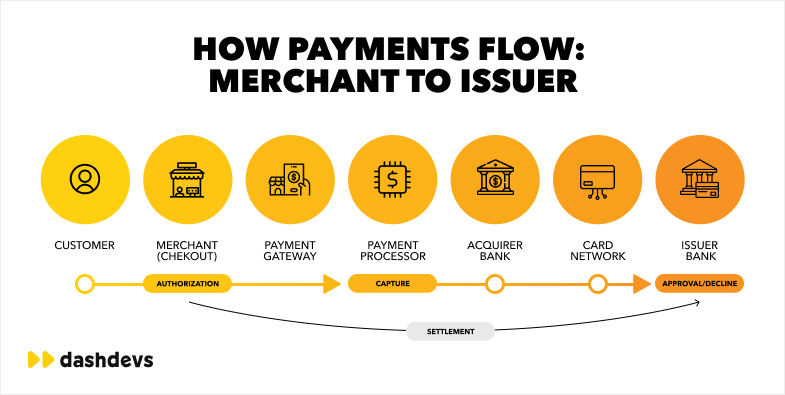
Four layers founders must not conflate
Clean infrastructure language prevents bad RFPs.
| Layer | Role | Early-stage default |
|---|---|---|
| Sponsor bank | BIN, regulatory relationship, program approval | Partner — non-negotiable for most fintechs |
| Card network | Brand, scheme rules, interchange framework | Via sponsor / processor path |
| Processor | Auth, clearing, card APIs, often tokenization | Partner (card issuing integration services) |
| Program manager | Day-to-day program ops, reporting, sometimes UX | Partner first; reconsider at scale |
Card issuing is the umbrella capability; within it, comparing top card issuing providers only helps after you know which layer each vendor actually owns. Many “payroll pay card providers” market all four layers as one bundle — fine for speed, dangerous if you cannot see the seams when something breaks.
At scale, some teams bring program management or even processor relationships closer in-house. Most Series A–C teams should not start by negotiating a dedicated BIN alone without operators who have shipped live wage-load card programs before. If your RFP still says “we need payroll prepaid debit cards by next quarter” without naming sponsor underwriting evidence, you are buying a timeline fantasy.
On Fintech Garden episode 108, BaaS, core banking, and embedded finance were separated as different jobs — the same discipline applies here: sponsor, processor, and program manager are different jobs even when sold in one deck.

BIN sponsorship as a strategic decision
BIN sponsorship for a payroll card program is not a logo pick from a vendor list. It is underwriting + economics + control.
Commercial prepaid classification. Payroll cards are commonly issued in commercial prepaid configurations that can differ from consumer portfolios in interchange treatment. Confirm classification with the sponsor; do not assume a consumer debit playbook.
Shared vs dedicated BIN. Shared BINs lower time-to-market and minimums; you inherit neighboring program risk and less customization. Dedicated BINs cost more and demand volume credibility, but improve control and negotiating posture. Your volume assumptions should drive the choice — not a sales preference for “premium.”
Revenue share shape. Flat BIN rental vs tiered interchange splits change when you break even. Model both against your spend-rate scenarios.
Risk appetite. Sponsors differ on gig contractors, non-resident workers, high-churn hourly populations, and EWA constructs. A sponsor that loves salaried enterprise payroll may reject your logistics contractor base. That mismatch kills programs after integration spend.
Banking-as-a-service adjacency. Some paths run through top BAAS providers or stacks similar to railsbank integration patterns — wallets, cards, and accounts under one orchestration. Useful when your roadmap includes more than a single payroll card; overkill if you only need wage loads.
When you evaluate fintech vendors, score sponsors on payroll-specific underwriting evidence, not generic “we issue cards” claims.
EWA inside the same margin story
Do not silo earned wage access as a separate product brochure. For a payroll card program, EWA is a load and engagement mechanism.
When a worker requests early wages:
- Your platform advances or facilitates liquidity.
- Funds settle to a destination — external ACH, or your card.
- If the destination is your card, subsequent spend can generate interchange that helps fund the advance economics.
That is why many EWA players push delivery onto their own cards. If you already operate payroll cards, making the card the default early-pay rail is often the difference between EWA as a retention feature and EWA as a margin contributor.
Trade-offs remain: liquidity risk, repayment from future wages, employer policy constraints, and state lending/wage rules. Engineering must connect payroll ledgers, advance ledgers, and card loads with clean reconciliation — classic fintech integrations work, not a weekend webhook.
Compliance is a product surface, not a footnote
Skipping compliance depth is how payroll card programs stall in employer procurement.
U.S. prepaid account rules under Regulation E require specific disclosures for payroll card accounts, including clear statements that workers do not have to accept the card and must be able to ask about alternatives. The same federal framework that defines short-form and long-form prepaid disclosures applies here — treat it as product requirements, not legal trivia after launch. Practically, your employer-facing UX and worker onboarding must support:
- Voluntary consent and documented choice
- Fee transparency (short form + long form style clarity)
- At least one alternative pay method (direct deposit to bank, check, etc., per applicable law)
- Free access expectations that often include in-network ATM or teller access each pay period (state-dependent)
- Error resolution and limited liability processes workers can actually use
State patchwork multiplies QA and legal review. Budget it. Sales teams selling employer-facing paycard programs to HR buyers will be asked these questions on every serious deal.
Licensing posture also matters: whether you operate via partner bank programs only, or need paths related to an electronic money institution (or PI) model in other markets. Do not copy a U.S. prepaid playbook into the EU or UK without a local license map.
Who should launch — and who should wait
Strong fit: You already process payroll or disbursements at meaningful volume; employers or workers want faster access to wages; you can staff or buy compliance UX; you will measure spend rate, not just cards issued.
Weak fit: You want a logo feature for a pitch deck; you cannot explain sponsor share; you plan to force card adoption; you have no path to EWA or spend engagement.
Embedded finance companies in workforce SaaS often fit the strong case — card issuance as retention and revenue, not a side experiment. Payment as a service thinking helps when you want modular rails instead of a monolith build.
Build, partner, buy — a practical split
| Capability | Typical early move | Bring closer in-house when… |
|---|---|---|
| Sponsor / BIN | Partner | Volume justifies dedicated BIN negotiation |
| Processing / issuing APIs | Partner | You need multi-processor resilience or cost control |
| Program management | Partner | Ops volume and margin support an internal team |
| Worker & employer UX | Own | Always — this is your product |
| Payroll ↔ card ledgering | Own / specialist | Always — reconciliation is your risk |
| KYC/AML orchestration | Partner + own policy | Scale and typology demand custom flows |
How to launch a payroll card program in practice: freeze the margin model and compliance UX, select sponsor/processor/program manager with payroll underwriting evidence, integrate loads and identity, run a controlled employer pilot, then expand. “Launch payroll card program” as a slogan without those gates is how certifications slip and sponsors exit.
A prepaid payroll card is only as good as the operating system behind it — disputes, employer reporting, and day-to-day operations. Prepaid payroll card programs that underinvest there look fine in sandbox and fail in month three of live payroll.
Employer go-to-market: what HR buyers will ask
Your sales motion for business payroll cards is not the same as selling payroll software. Paycard program implementation succeeds when product, legal, and sales share one disclosure story — not when engineering ships enrollment while sales improvises fee answers. HR and finance buyers ask:
- Can we keep offering direct deposit and checks as alternatives?
- What fees will workers see, and can we show disclosures before enrollment?
- How fast can we get free access to wages each pay cycle?
- Who supports lost cards and disputes — you, the processor, or the bank?
- How does early pay (if offered) appear on our policies and worker agreements?
If your product team cannot answer those in a one-pager with screenshots, sponsor diligence will feel the gap. Package compliance UX as a feature of the payroll card program, not a PDF annex.
Partner scorecard (use in vendor calls)
| Question | Good signal | Weak signal |
|---|---|---|
| Shared vs dedicated BIN path | Volume-triggered plan in writing | “We’ll see later” |
| Interchange share | Scenario model with your MCC mix | Single “up to X bps” slide |
| Workforce underwriting | References in gig/hourly payroll | Only salaried enterprise logos |
| EWA loads | Supported load types and limits documented | “Custom project” hand-wave |
| Disclosure tooling | Configurable short/long forms | “Employer handles that” |
| Exit / portability | Card number continuity plan | Lock-in silence |
Run this scorecard against two finalists. The winner is usually the partner that argues with your assumptions — not the one that agrees with every deadline.

Implementation realities DashDevs sees on this stack
Across fintech delivery — including modular work on white label fintech platform patterns and engagements such as Kleos — the hard parts are rarely “can we print plastic.” They are: sponsor underwriting for your workforce mix, ledger integrity between payroll and card loads, disclosure UX that employers will actually deploy, and EWA liquidity that reconciles without heroic spreadsheets.
That is why fintech development services matter on a payroll card program: you are assembling regulated money movement, not installing a widget. On Fintech Garden episode 152, complex fintech systems — ledgers, rails, onboarding, card issuing — were framed as places where shallow delivery breaks. Payroll cards sit in that category.
Decision checklist before you commit
- Written P&L scenarios (spend rate × sponsor split × processor cost × fraud)
- EWA path: card load vs external ACH — and which you will push
- Sponsor shortlist scored on payroll/gig risk appetite and BIN shared vs dedicated
- Processor vs program manager responsibilities in writing
- Compliance UX: consent, disclosures, alternatives, free access rules by target states
- KYC/AML vendor and escalation design for worker onboarding volume
- Pilot employer success metrics beyond “cards issued”
- Exit plan if sponsor or processor relationship changes
If those boxes are empty, you are not ready to launch payroll card program infrastructure — you are ready for a discovery sprint.
Closing: treat payroll cards as infrastructure
Payroll cards succeed when founders treat them as a payroll card program with unit economics, partner architecture, and compliance product — not as a cosmetic pay card. The margin story is interchange plus engagement (including EWA loads), minus sponsor, processor, fraud, and ops. The partner story is four layers with clear ownership. The compliance story is voluntary, disclosed, and state-aware.
Get those three right, and the card layer becomes a durable product on wage volume. Get them wrong, and you will have issued plastic that workers cash out instantly while your support queue inherits every fee complaint.
Share article
