


Marqeta Alternatives: Top 10 Competitors Compared 2026

September 3, 2026
- Marqeta competitors today span four distinct architecture models: issuing-only, processor-first, acquiring-first, and unified platforms.
- Paymentology raised $175 million in May 2026 and launched its cloud-native Lume platform.
- NIUM launched US domestic card issuance in August 2026, completing multi-region coverage across APAC, Europe, the Middle East, and North America.
- The card issuing platform market was valued at $14.2 billion in 2025 and is projected to reach $38.7 billion by 2034 at a 13.8% CAGR.
- Migration from Marqeta typically takes 3 to 6 months. The highest cost is not the work itself — it is the timing.
- DashDevs has integrated 50+ fintech vendors and built card programs in the US, UK, and MENA.
Most card issuing platforms get chosen for the wrong reason: speed to market. That decision holds until the program scales, hits a geographic wall, or needs features the architecture was never built for. Card programs don’t stand still.
This guide is for fintech product managers and engineering leads who need an honest shortlist of Marqeta competitors in 2026 — what each platform actually does, where it fits, and what migration looks like in practice.
For a deeper look at what Marqeta itself offers, start with our guide to what Marqeta does and our broader card issuing guide.
Why Teams Look for Marqeta Alternatives in 2026
Marqeta processed $383 billion in total payment volume in 2025, up 31% year-over-year. The platform is growing, but growth at the vendor level doesn’t always mean the platform still fits your program.
Three patterns show up repeatedly when teams start evaluating Marqeta alternatives:
| Pattern | What it looks like in practice |
|---|---|
| Pricing opacity at volume | Fee structures require renegotiation as programs scale, which makes program economics hard to model across growth stages |
| Geographic gaps | Strongest coverage remains the US and parts of Europe; LatAm, Southeast Asia, or MENA expansion often needs separate processing capacity |
| Architecture mismatch | Built for issuing; teams that need acquiring, a real-time ledger, or credit on the same platform hit a structural ceiling |
That is the actual decision: whether your program has outgrown the architecture.
Most teams discover the platform ceiling late. By the time reconciliation overhead becomes visible in finance reports, the migration cost has already grown significantly larger than it would have been twelve months earlier.
The Architecture Decision That Most Evaluations Skip
Before shortlisting companies like Marqeta, understand which model you are buying. The card issuing platform market has split into four categories.
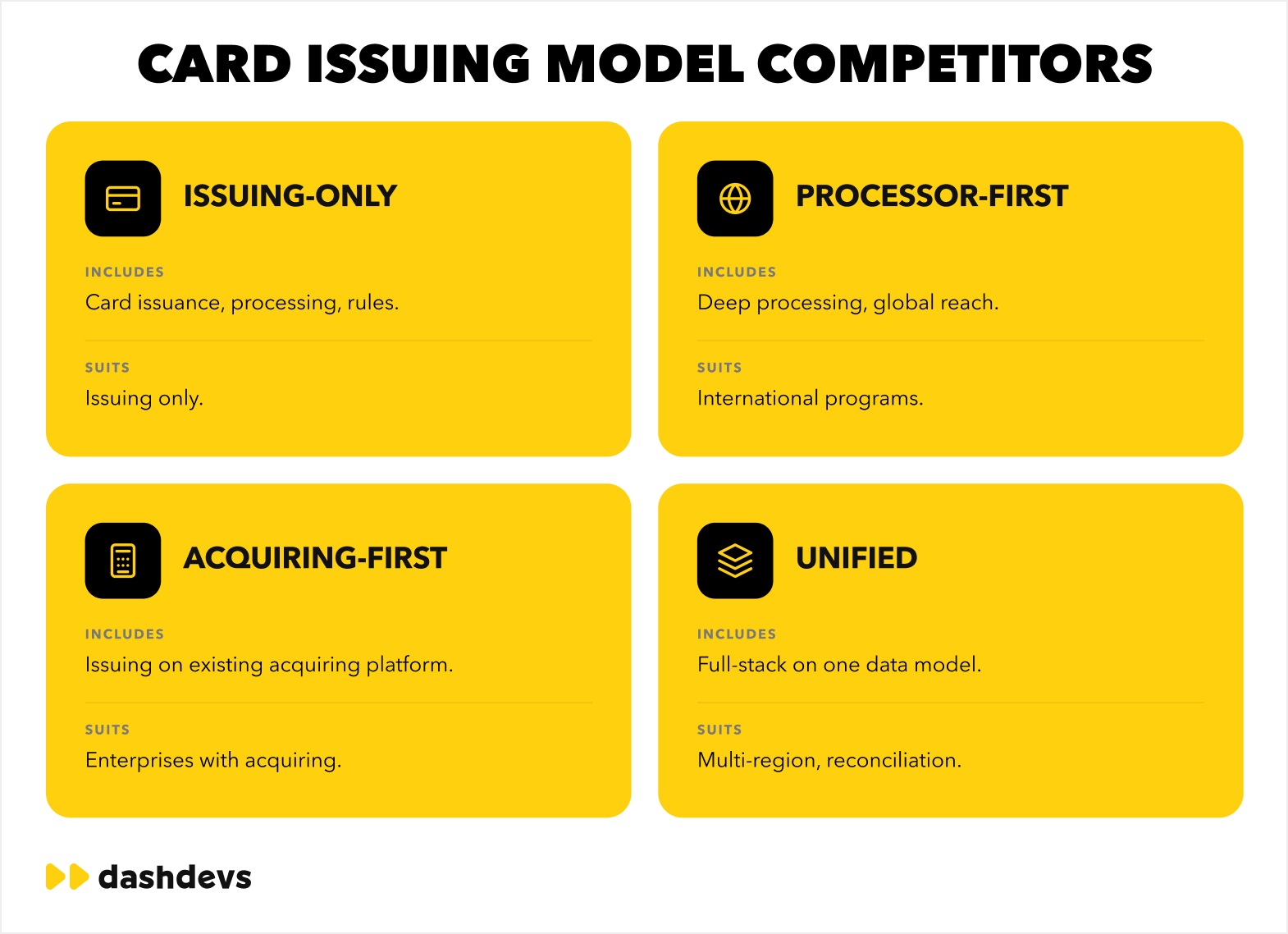
| Model | What it includes | Who it suits |
|---|---|---|
| Issuing-only | Card issuance, transaction processing, program rules | Programs that need issuing and nothing else |
| Processor-first | Deep processing with global geographic reach | International programs where processing coverage matters most |
| Acquiring-first | Issuing added to an existing acquiring platform | Enterprises already processing payments on the same vendor |
| Unified | Issuing, acquiring, credit, and ledger on one data model | Programs where reconciliation across money flows is critical |
Most Marqeta competitors are issuing-only or processor-first. That was the right model when card programs were standalone products. It becomes a constraint when financial features are embedded in a larger product and operators need full-stack visibility.
At-a-Glance Comparison: 10 Marqeta Competitors
| Platform | Pricing model | Best for | Integration effort | Geographic strength | | — | — | — | | Galileo (SoFi Tech Solutions) | Enterprise contract | Neobanks, LatAm/North America | Medium | US, LatAm | | Stripe Issuing | Pay-as-you-go + interchange | Startups, platforms, speed-to-market | Low | US, EU | | Thredd (formerly GPS) | Negotiated per program | European and global fintechs | Medium | Europe, APAC, MENA | | Paymentology | Custom enterprise | Emerging markets, Africa, APAC, MENA | Medium | 49 countries | | Solaris | BaaS bundled pricing | EU programs needing own banking license | Medium-high | EEA (30 countries) | | NIUM | Volume-based | Cross-border, multi-region B2B | Medium | 190+ countries | | Fiserv | Enterprise | US banks, large-scale programs | High | US, 40+ countries | | Adyen Issuing | Bundled with Adyen acquiring | Enterprises already on Adyen | Low (if on Adyen) | Global | | Highnote | Custom | Unified issuing + acquiring programs | Medium | US | | Railsr / Equals Group | Custom BaaS | European embedded finance | Medium | UK, EU |
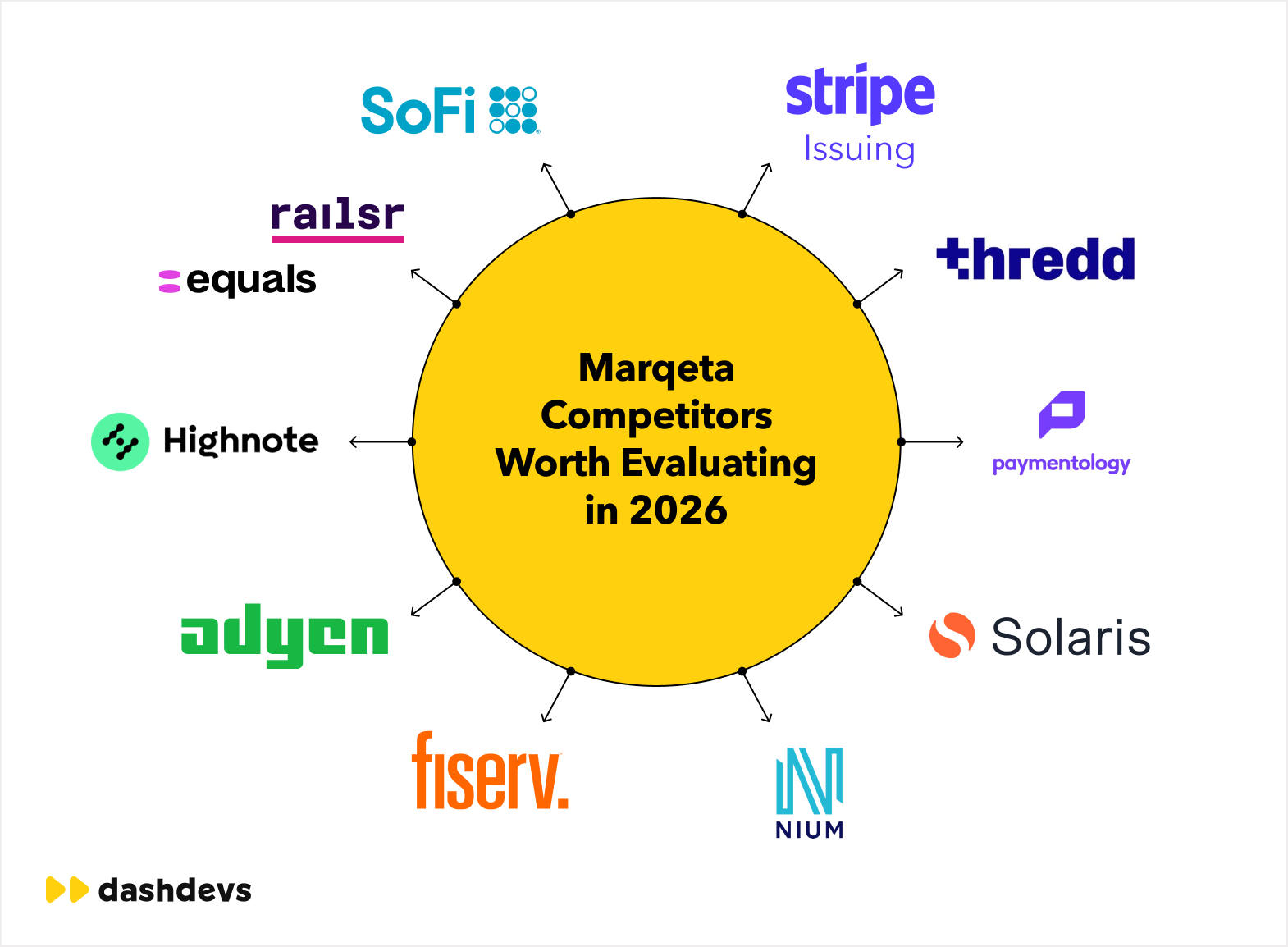
10 Marqeta Competitors Worth Evaluating in 2026
1. Galileo (Now SoFi Tech Solutions)
Galileo is one of the oldest players in the card issuing fintech space, founded in 2000 and acquired by SoFi in 2020. The platform earns its position on almost every shortlist of Marqeta competitors because of its API depth and geographic reach across North America and Latin America.
In 2025, Galileo earned the top position in Javelin Strategy & Research’s Digital Issuance Provider Scorecard, recognized for its flexible, API-first platform and broad digital wallet support. The platform now serves as the processor for the US Treasury’s Direct Express prepaid debit card program (3.4 million users) and signed Southwest Airlines for a debit rewards card in 2025.
| Best for | Neobanks, brokerage apps, complex loyalty programs, North America and LatAm programs |
| Watch-out | Pricing skews enterprise. Self-serve access is more limited than newer entrants |
| Migration effort | Medium. Preexisting relationships with 20+ issuing banks simplify BIN sponsor transitions |
When comparing Galileo vs Marqeta, the deciding factor is usually geography and program complexity. Galileo has deeper LatAm coverage; Marqeta has stronger European infrastructure. For North American programs at scale, both are viable — negotiate hard on pricing, because neither is transparent on rates below enterprise volume.
2. Stripe Issuing
Stripe Issuing is the fastest path to a credit card issuing platform for teams where time-to-market matters more than deep customization. If you already use Stripe for payments, adding Issuing is a single-platform decision with minimal additional integration work.
Stripe recently expanded Issuing into charge cards, giving platforms the ability to offer credit rather than just debit. The company’s internal 409A valuation reached $106.7 billion in January 2026. Stripe Issuing supports virtual and physical cards across the US and Europe, with real-time spend controls, webhook-based authorization, and direct integration into Stripe Connect for platforms.
| Best for | Startups, vertical SaaS platforms, B2B spend management, teams already on Stripe |
| Watch-out | US and EU only. Customization hits a ceiling faster than processor-first alternatives. Interchange goes to Stripe, not the program |
| Migration from Marqeta | Low effort for programs under a certain scale. API surface is well documented; geographic ceiling may limit future expansion |
For a broader view of where Stripe sits in the payments landscape, see our guide on Stripe’s competitors.
3. Thredd (Formerly GPS)
Global Processing Services rebranded as Thredd in 2023. The renaming matters because older Marqeta competitors lists still carry GPS as a separate entry. The underlying platform is the same infrastructure that powered Revolut, Monzo, and Curve in their early stages.
Thredd now describes itself as an AI-first issuer processing platform. It processes over 2 billion transactions annually for clients across 50+ countries. The platform supports the full card product range — prepaid, debit, credit, and BNPL — from a single client instance, with Visa, Mastercard, and Discover scheme connectivity.
| Best for | European, APAC, and MENA programs that need proven processing depth and scheme breadth |
| Watch-out | Program management and acquiring remain external dependencies; ledger reconciliation needs separate integration |
| Migration from Marqeta | Medium. Scheme-certified infrastructure reduces risk in geographies Marqeta under-serves |
4. Paymentology
Paymentology is moving faster than most platforms on this list right now. In May 2026, the company raised $175 million co-led by Apis Partners. In June 2026, it launched Lume, a cloud-native issuer processing platform designed to reduce time-to-market for new card programs.
Paymentology operates in 49 countries and is particularly strong in Africa, the Middle East, and Asia Pacific. It supports Visa, Mastercard, and UnionPay and offers virtual, physical, numberless, and tokenized cards.
The platform includes a deep data analytics layer and a product control service for automating highly customized program rules. That combination — global reach, real-time controls, and analytics depth — is what separates Paymentology from lighter Marqeta alternatives in those markets.
| Best for | Programs expanding into Africa, the Middle East, and APAC; multi-cloud processing and multi-scheme coverage |
| Watch-out | Enterprise pricing and a more complex implementation than startup-oriented alternatives |
The programs that scale cleanest are the ones that chose their processor for where they are going, not where they are today. Geographic footprint is the hardest thing to retrofit.
For DashDevs’ perspective on choosing the right fintech vendor, see our guide to fintech API integrations.
5. Solaris
Solaris (formerly Solarisbank) is a European Banking-as-a-Service platform with a full German banking license, operational across 30 EEA countries. For programs that need a licensed banking partner in Europe, Solaris removes the BIN sponsor search entirely — the license is the product.
The platform supports card issuing, lending, savings accounts, payment processing, and crypto services through open APIs. Early clients included Penta and Tomorrow Bank. The licensing advantage is real, but it comes bundled into a BaaS pricing model that is more complex to unpack than pure-play processor contracts.
| Best for | EU programs that need a banking license as part of the stack; EEA expansion from a single legal entity |
| Watch-out | Limited to EEA. Pricing requires careful total cost of ownership analysis across the full BaaS bundle |
For programs considering Solaris alongside other top core banking solutions, the licensing question is the first filter.
6. NIUM
NIUM is a Singapore-based infrastructure platform for real-time cross-border payments and debit card issuing, now operational in 190+ countries. On August 19, 2026, NIUM launched domestic card issuance in the United States, completing its multi-region coverage across APAC, Europe, the Middle East, and North America.
NIUM issued more than 41 million card credentials in APAC, the Middle East, and Europe in the past 12 months. In March 2026, it launched a stablecoin card issuance platform, enabling companies holding stablecoins to issue spending cards on both the Visa and Mastercard networks through a single API.
| Best for | Cross-border, multi-region B2B programs; corporate travel; payroll providers across multiple jurisdictions |
| Watch-out | B2B-focused. Less suited to high-volume consumer card programs. US issuance launched August 2026 — market maturity is still developing |
Just-in-time funding is one of NIUM’s differentiators: card funds are released only at the point of transaction, improving working capital rather than tying it up in prefunded pools.
7. Fiserv
Fiserv is a Fortune 500 company founded in 1984, headquartered in Wisconsin, and operational in over 40 countries. It processes 12,000+ financial transactions per second and is the infrastructure behind approximately one in three banks in the United States.
The platform offers instant card issuing, physical branded card production, payment processing, wallet-as-a-service, and real-time ledger capabilities. Its open APIs were named Best in Finance APIs by API World in 2021. Fiserv’s scale and regulatory credibility make it the default card issuing solution for large US financial institutions.
| Best for | Large US banks and financial institutions; extreme scale and battle-tested compliance infrastructure |
| Watch-out | Implementation complexity is significant. Not a fit for fast iteration or developer-first APIs. Sales cycles run long |
| Migration from Marqeta | High effort. Implementation model is designed for enterprise timelines, not startup velocity |
8. Adyen Issuing
Adyen Issuing is the natural extension for enterprises already processing payments through Adyen. Adding issuing on the same platform reduces vendor count and eliminates reconciliation gaps between acquiring and issuing because both sides of the money flow live on the same data model.
Adyen’s core business is acquiring. Issuing is an extension of that platform, not its foundation. That distinction matters: programs that need issuing as the primary product will find Adyen’s issuing feature set less deep than dedicated issuer-processors.
| Best for | Enterprises already on Adyen for acquiring; platforms that want unified payment flows without a new vendor |
| Watch-out | Issuing is a secondary product within Adyen’s suite. Dedicated issuer-processors offer more issuing-specific depth |
For context on how Adyen fits in the broader payments landscape, see our review of top payment processing companies.
9. Highnote
Highnote is a US-based unified payments platform that combines issuing, acquiring, credit, and a real-time ledger on a single API and data model. It is one of the few Marqeta alternatives that directly addresses the reconciliation problem that issuing-only platforms create at scale.
The platform serves vertical SaaS companies, online travel agencies, marketplaces, and enterprises embedding financial products. The unified architecture means cards out and payments in live on the same data model, with no reconciliation seams between the two sides of money movement.
| Best for | US programs that have outgrown the issuing-only model; vertical SaaS, OTAs, and marketplaces |
| Watch-out | US-focused. Less suited to EU licensing and multi-currency programs. Newer entrant with a smaller client base than processor-first alternatives |
| Migration from Marqeta | Medium. Straightforward configurations can migrate in under 90 days; enterprise programs with complex dependencies typically need 4 to 6 months |
10. Railsr / Equals Group
Railsr (originally Railsbank) went through a prepackaged bankruptcy and was sold for approximately $500,000 to a consortium led by D Squared Capital. In April 2025, TowerBrook Capital Partners and JC Flowers completed a £283 million acquisition of Equals Group and merged Railsr into that entity.
The resulting business operates as a UK-regulated embedded finance platform with EMI licenses in the UK and Lithuania. It serves fintechs and corporates with card issuing, account-to-account payments, and credit products.
| Best for | UK and European programs that need embedded finance with regulatory coverage and an established client base |
| Watch-out | Bankruptcy history requires due diligence. Evaluate the combined Equals Group entity, not the pre-2023 Railsr brand |
Platform continuity is the risk that shows up in year two, not at launch. A vendor’s financial health matters as much as its API documentation.
A Note on SynapseFI
SynapseFI filed for Chapter 11 bankruptcy on April 22, 2024, and is no longer operational. Over 100,000 end users lost access to more than $265 million in funds. The CFPB filed an enforcement action against the company in August 2025. Any comparison listing that still includes Synapse as a Marqeta alternative is not current. Do not use it as a reference for vendor selection.
This is also a useful reminder about BaaS-layer risk. For programs relying on a middleware provider between the bank and the product, the middleware’s financial health is a material risk factor. See our broader guide on payments as a service for context.
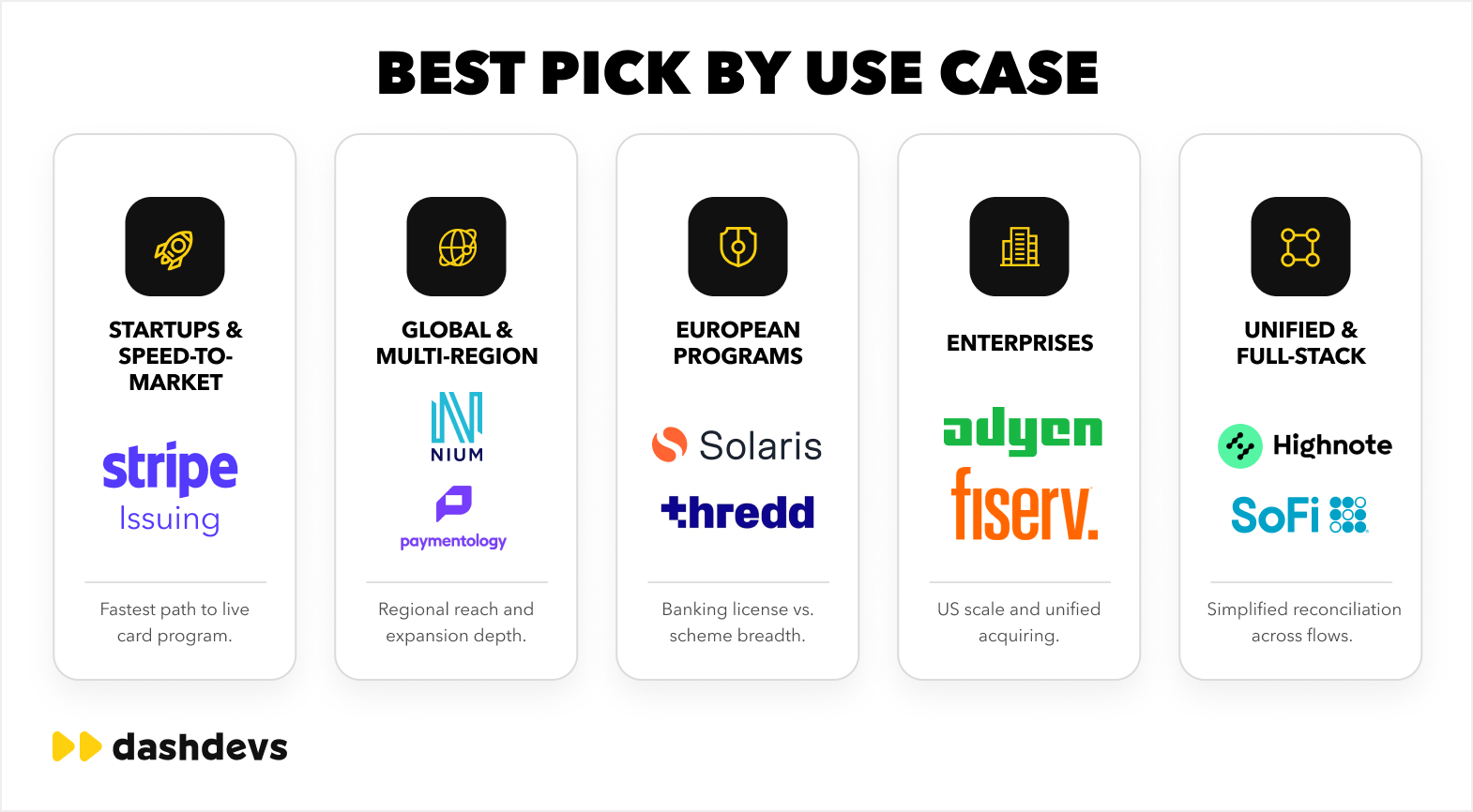
Our Pick by Use Case
| Use case | Pick | Why |
|---|---|---|
| Startups and speed-to-market | Stripe Issuing | Self-serve API, developer docs, and existing Stripe infrastructure — geographic ceiling applies |
| Global or multi-region | NIUM or Paymentology | NIUM for cross-border focus and new US coverage; Paymentology for 49 countries, Africa/APAC depth, and fresh capital |
| European programs | Solaris or Thredd | Solaris if you need a banking license bundled; Thredd for deep European processing without BaaS overhead |
| Enterprises | Fiserv or Adyen Issuing | Fiserv for US-centric large institutions; Adyen Issuing if you already run payments on Adyen |
| Outgrowing issuing-only | Highnote or Galileo | Highnote in the US for unified architecture; Galileo for North America and LatAm fuller-stack programs |
How to Evaluate Card Issuing Platforms Without Disrupting Your Current Program
Before you request demos or enter contract negotiations, run a structured audit. This is the sequence we use when helping clients evaluate Marqeta competitors.
- Map your current integration surface. Document every system connected to your issuing platform: authorization logic, ledger connections, fraud tooling, reconciliation pipelines, customer support workflows, and tokenized card relationships. This defines migration scope before any vendor conversation.
- Define your program ceiling. Not where you are today, but where you need to be in 24 months — card types, geographic expansion, credit vs. debit, unified vs. issuing-only. Most teams make this decision after they hit the constraint rather than before.
- Clarify BIN economics. Shared BIN programs carry lower initial costs but limit customization and create migration risk. Dedicated BINs cost more upfront and are worth it for programs that will evolve. Ask every vendor which model you are on by default.
- Get a consolidated cost view. If program management sits outside the processor contract with a third party, the per-transaction rate comparison is misleading. Build the full cost model, including interchange pass-through, volume minimums, and program management fees.
- Ask about the second product, not the first. Time-to-first-card is a marketing number. Time-to-second-product is the real benchmark. If every new card type requires a new integration, your roadmap is capped by the vendor’s release cadence.
For a detailed framework on how to build a product using vendor APIs, see our guide on building a neobank with vendors and APIs.
Case Study: Building a Card Program That Scales Beyond Issuing
When the founding team behind Dozens came to DashDevs, the brief was deceptively simple: build a UK challenger bank that profits only when its customers grow their savings. What that meant in engineering terms was far more complex — card issuing, KYC/AML, fraud detection, investment rails, and real-time balance reconciliation all had to operate on a single coherent architecture.
A standalone issuer-processor could have handled the cards. It couldn’t have handled everything else.
We built a custom core banking orchestration platform on a microservices architecture, integrating 20+ third-party vendors into one system. Card issuance was one integration inside a larger infrastructure decision. The platform earned a dual FCA license (eMoney + MiFID), which unlocked both everyday banking and investment features from a single legal entity.
| What was built | Outcome |
|---|---|
| Concept to fully licensed mobile bank | 9 months |
| Customers acquired and retained | 60,000 |
| Third-party vendor integrations | 20+ |
| Go-to-market cost reduction vs. market alternatives | 40% lower |
| Compliance breaches during FCA-regulated operation | Zero |
The platform ceiling question was answered at design time.
We built together a pretty complicated platform with 40 vendors in less than 18 months. DashDevs is much more than a technical agency. It gives you a one-team feeling. — Aritra Chakravarty, CEO and Founder, Dozens
The Platform Decision Is a Ceiling Decision
The card issuing platform market was valued at $14.2 billion in 2025 and is projected to reach $38.7 billion by 2034. The virtual cards market is growing even faster: from $6.43 trillion in 2026 to $15.14 trillion by 2031 at an 18.7% CAGR, according to Mordor Intelligence. Programs that choose the right infrastructure now will scale on it. Programs that choose for convenience today will pay a migration cost at a worse time.
The right Marqeta alternative isn’t the one with the best comparison table. It is the one whose architecture matches where your program is going.
DashDevs has integrated 50+ fintech vendors across card programs in the US, UK, and MENA. We have seen what the spec sheets don’t show: the reconciliation overhead, the support escalation timelines, and the API gaps that only appear under production load. If you are evaluating platforms or planning a migration, talk to our team about what we have built and where each platform performed.
For related reading, see our guides on top card issuing providers and KYC integration options.
Last updated: September 2026
Share article
