


Mobile App Monetization: The 2026 Guide to Monetizing Web Apps and Monetizing Mobile Apps

August 13, 2026
- Mobile app monetization is a sequence of decisions: which model fits, who pays, and when to layer a second stream.
- The global app market runs $330B–$740B depending on methodology; embedded finance adds $85.8B–$197B, growing over 20% a year.
- Fintech apps unlock monetization options—and face compliance constraints—that generic guides skip.
- Growth and funding rounds aren't proof of a working monetization strategy.
- Who pays should be decided before the model—it drives pricing, UX, and roadmap.
- Optimize costs before layering revenue streams. An underpriced model won't survive real unit economics.
- 2026's app store commission changes now shape which model keeps the most margin.
A fintech founder we spoke with recently had the opposite problem most guides assume: the app was short on a plan for what users were worth. Downloads were healthy, retention was decent, and the app still hadn’t decided who was going to pay for any of it.
That gap is common, and it’s more expensive in regulated products than anywhere else. A consumer app can experiment with an ad network over a weekend. A digital wallet or a lending app cannot bolt on a monetization model without checking it against compliance scope, card network rules, and the underlying cost structure of holding and moving money.
This app monetization guide is written for fintech founders and product leads shaping a monetization model pre-launch or at a pricing pivot and for any app founder or product manager comparing monetization strategies for apps more broadly. The core models below apply to both, and the fintech-specific sections apply wherever money movement, compliance, or a banking relationship sits underneath the product.
DashDevs has built the monetization layer into products ranging from a UK challenger bank to a global e-wallet used in 180+ countries. The frameworks here come from what actually holds up in production when delivering mobile app development services.
What is mobile app monetization
App monetization is the set of methods a business uses to convert an application’s users, data, or transaction volume into recurring or one-time revenue. Application monetization is distinct from app funding (venture capital, grants, or internal budget) because monetization has to be sustained by the product itself, not by a cap table.
While there are various business models available today, most products rely on six primary ways to monetize apps:

- Advertising: revenue from third parties who pay to reach your users.
- In-app purchases (IAP): one-time or recurring purchases of digital goods or features.
- Subscription: recurring access fees, typically monthly or annual.
- Paid downloads: one-time fee to install and use the app.
- Affiliate marketing and referrals: commission for driving traffic or sales to a partner.
- Transaction and interchange fees: a cut of the value that moves through the app, standard in fintech mobile app development and marketplace products.
The first five apply broadly across consumer and business apps. The sixth is where fintech, payments, and banking products diverge from the standard app monetization methods playbook.
The market opportunity in 2026
The scale of mobile application monetization opportunity in 2026 is substantial. Fortune Business Insights values the global mobile app market at $330.02 billion in 2026. It expects the market to pass $1 trillion by 2034. Statista’s broader forecast, which adds advertising revenue, puts 2026 revenue closer to $739.61 billion.
For fintech, the sharper number sits one layer down. Research firms size the 2026 embedded finance market differently, from $85.8 billion to $197 billion. But every major firm agrees the category is growing over 20% a year. US embedded fintech products alone should carry over $7 trillion in transaction volume by the end of 2026.
Searches for “mobile app monetization” usually come from teams close to a build or hire decision. Treat the model choice like choosing your mobile app development technologies. It shapes the stack as much as the reverse.
Who pays? The three-payer framework for choosing a model
When evaluating how to monetize an app, it’s important to first answer one question: who is actually paying for the value your app creates? There are three possible payers, and most successful apps can name theirs in one sentence.
| Payer type | How it works | Fintech examples |
|---|---|---|
| The user | Users pay directly for the value they receive (a subscription, a premium feature, a one-time purchase) | A budgeting app charging a monthly fee after a free trial. A trading app charging per-trade commissions |
| A third-party seller | External advertisers or partners pay for access to your user base via ads, referrals, or lead generation | A comparison or lending-marketplace app earning referral fees from partner banks and lenders |
| A third-party beneficiary | An outside organization gains value indirectly from your app’s usage and pays for that value | A card network paying interchange to the issuing program every time a user’s card is swiped |
Most apps default to “the user pays” because it is simplest to build. But it is not always the best fit. A high-engagement, low-price app is often a stronger match for interchange or partner revenue than a subscription wall.
How to use this framework: name your primary payer before you name your monetization model. If you can’t clearly explain why that payer benefits enough to keep paying, the model won’t hold past the first few cohorts.
Core models: how to monetize a web app and mobile app
Advertising
Advertising monetization shows third-party ads to your users in exchange for payment from advertisers. It needs no direct payment relationship with the user at all.
Common formats: video ads, banner ads, native ads, full-screen display ads, and rewarded ads that unlock content in gaming apps.
| Pros | Cons |
|---|---|
| Easily scalable with user base growth | Lower revenue per user |
| Low entry threshold | Dependency on third-party ad networks |
| Requires minimal product changes | Can degrade user experience if overused |
| Fits well in hybrid models | Rarely viable for regulated financial products |
Where it fits, and where it doesn’t: It suits apps with large, low-friction audiences and low willingness to pay. It rarely suits a banking app, since regulators and users expect financial apps to stay ad-free. DashDevs used this model for TMZ, a US news portal built to scale on volume.
In-app purchases
In-app purchases let users buy features, content, or virtual goods from inside the app. There are two types: consumable (a one-time benefit) and non-consumable (a lasting one).
| Pros | Cons |
|---|---|
| Stable, ongoing revenue stream | App store commission cuts into margin |
| Higher revenue per paying user than ads | Requires a genuinely valuable “extra” to sell |
| Direct, easy-to-track user value | Price sensitivity among free-tier users |
How to use it well: the offer has to be genuinely additive. DashDevs used a consumable IAP model on Keen, a lifestyle app where users purchase one-off expert consultations. That’s a model that works because each purchase maps to a discrete, high-perceived-value unit of service, not an artificially gated core function.
Platform commission shapes IAP margin directly. Apple charges a 30% standard, dropping to 15% under its Small Business Program for developers under $1 million in annual proceeds. Google matches 15% on the first $1 million per year. Google is also cutting its subscription fee from 15% to 10% in the US, UK, and EEA from June 30, 2026. Build these rates into your pricing early.
Subscription
A subscription charges users a recurring fee, usually monthly or annually, for ongoing access. It comes in two forms: auto-renewing and non-renewing.
| Pros | Cons |
|---|---|
| Predictable, recurring revenue | Price sensitivity at conversion |
| Strong retention economics | Vulnerable during downturns |
| Lower repeat acquisition cost | Needs a credible free tier |
How to use it well: keep the free tier real enough that upgrading feels like an expansion. Offer tiers (basic, premium, custom) instead of one price point. Track churn by cohort, not just in aggregate.
DashDevs used a tiered subscription model on AI Bot, a B2B support platform with a custom enterprise tier. Vidby, a transcription tool serving both B2B and B2C users, runs four packages across monthly and annual billing.
Paid downloads and freemium
Paid downloads charge a one-time fee before install, with no purchases after. It is the least forgiving model, since users pay before they try the product. Microsoft’s Office suite still sustains this model, mostly through incumbency rather than because paid downloads are easy for new apps.
| Pros | Cons |
|---|---|
| Immediate, stable revenue per install | Smaller addressable user base |
| Highest revenue per user | Piracy and side-loading risk |
| Reinforces a premium brand position | Limited long-term ceiling |
Freemium softens this by giving the app away free and monetizing a premium layer through subscriptions or IAP. It is now the default distribution strategy for most new apps, since it removes the biggest barrier: paying before trying.
Affiliate marketing and referral revenue
Affiliate marketing earns a commission when your app drives users to a partner’s offer. There are three payout structures: pay-per-click, pay-per-sale, and pay-per-lead.
| Pros | Cons |
|---|---|
| Low entry threshold | It takes time to build partners |
| Scales with a niche audience | Depends on third parties |
| Combines well with other models | Payouts can fluctuate |
This shows up in fintech as third-party seller revenue. Comparison and personal-finance apps often earn fees when a user takes a card or loan through the app.
Transaction fees and interchange revenue
For fintech, payments, and marketplace apps, transaction-based monetization is often the strongest model available — and it’s the one most generic monetization guides skip entirely.
Two structures cover most of the category:
- Transactional fees — a small percentage or flat fee per transaction. Money-transfer apps often charge 1–3% or a flat fee by corridor.
- Interchange revenue — a fee paid by the merchant’s bank each time a card is swiped. A share flows to the card issuer.
Interchange economics are more nuanced than most product teams assume, and getting the assumptions wrong shows up directly in the financial model:
- In the US, the Durbin Amendment caps debit interchange at $0.21 plus 0.05% of the transaction for banks over $10 billion in assets. Smaller banks are exempt.
- Credit interchange runs higher than debit, but it also carries more fraud liability and underwriting cost.
Interchange revenue looks passive from the outside. It is not. The issuing bank you choose can be the difference between capped and uncapped economics on every swipe.
This is where e-wallet and card-issuing products earn a structural advantage over pure-software fintech apps: every transaction that flows through the product generates revenue without requiring the user to make an active purchasing decision.
DashDevs built this into the MuchBetter e-wallet, now live in 180+ countries with 400,000+ users and 300+ merchants.
For a deeper technical walkthrough on building this architecture, see our digital wallet development guide.
API and embedded finance monetization
API-as-a-product monetization charges other businesses for access to your app’s functionality. Open banking rules pushed this forward, since European banks must expose free regulatory APIs and often build paid, higher-tier ones alongside them.
Pricing usually looks like a flat platform fee, a per-call fee, or tiered plans with rate limits and support levels. This model works best layered on top of a proven product, since it needs a stable, well-documented API surface other teams will build against.
Embedded finance monetization comes from powering financial features inside someone else’s product—a ride-share app offering driver cards or an e-commerce platform offering financing. Engaging an ewallet app development company allows non-fintech brands to integrate these payment rails and split interchange revenue without taking on full regulatory overhead.
Revenue here comes from platform fees, a share of interchange, and lending or float income. This is the layer Fintech Core, DashDevs’ modular banking infrastructure, is built to support.
Advertising, IAP, subscription, and paid downloads monetize your own users. API and embedded finance monetize other companies’ users, using your infrastructure as the product. Treat this as a different go-to-market motion, not another line on the same checklist.
Growth is not a monetization strategy
Monzo, Revolut, and N26 built billion-dollar valuations before profit was the headline metric. N26 has said profitability was not always its primary near-term focus. That made sense for a funded growth story. It is not a template most teams can copy on a normal budget.
Figuring out how to monetize an app after burning through capital rarely works. Heavy spend on growth without a matching revenue model is not deferred monetization. It avoids monetization, and it only works while funding keeps arriving.
Making a fintech app’s revenue work starts with cost discipline, not aggressive pricing. A model layered onto an expensive product just makes losses scale faster.
A quick set of app monetization tips before you sequence anything: price against your real build cost, not a guess. Our mobile app development cost breakdown shows how fast an underpriced model erases margin.

Practical sequencing:
- Optimize the cost base first. Infrastructure inefficiency, redundant vendor integrations, and unnecessary compliance overhead all erode margin before a single monetization decision gets made.
- Pick one primary revenue model and prove it. Teams that run three untested models at once can’t tell which one is actually working. A fintech launching with both a subscription tier and transaction fees before validating either usually ends up with two broken revenue lines instead of one solid one.
- Add a second revenue stream only once the first is stable. Layering too early signals an unproven core model, not smart diversification. If retention data doesn’t yet show room for an additional revenue line, a second model won’t fix that. It will just make the problem harder to diagnose.
How to choose the right monetization model
There is no universal set of mobile app monetization strategies that works for every product, only the model that fits a specific product’s value proposition, users, and stage. Use these factors together:
| Factor | What to evaluate |
|---|---|
| Value proposition | Is the core value something users experience before or after paying? Products with delayed value (education and wellness) fit freemium better than paid downloads. |
| User behavior | High-frequency, habitual use supports subscriptions and transaction fees; occasional, task-based use fits IAP or one-time purchases better. |
| Transaction frequency | Apps with frequent, low-value transactions (payments, transfers) suit transaction/interchange fees over subscriptions. |
| Willingness to pay | Test pricing early — a target audience’s stated interest rarely matches actual conversion at a real price point. |
| Target customer | B2C, B2B, and B2B2C audiences convert on completely different pricing psychology. A B2B buyer expects negotiated tiers, and a B2C user expects a flat, visible price. |
| Business stage | Pre-launch and early-stage products should optimize for signal (what will users actually pay for), not maximum revenue per user. |
Competitive benchmarking checklist (before committing to a model or starting the app store review process) review:
- Competitor pricing across every tier they publish, not just the entry price.
- App store positioning—how competitors describe their premium features in store listings, which reveals what they believe users will pay for.
- User reviews, specifically complaints about pricing, paywalls, or “too many ads”—this is a free, direct signal about where competitors’ monetization is failing.
- Monetization mechanics in practice—install a competitor’s app and go through their actual paywall and upsell flow, not just their marketing page.
This benchmarking step is the difference between a monetization model chosen from a framework and one that’s actually calibrated to what your specific market will bear.
Hybrid app monetization
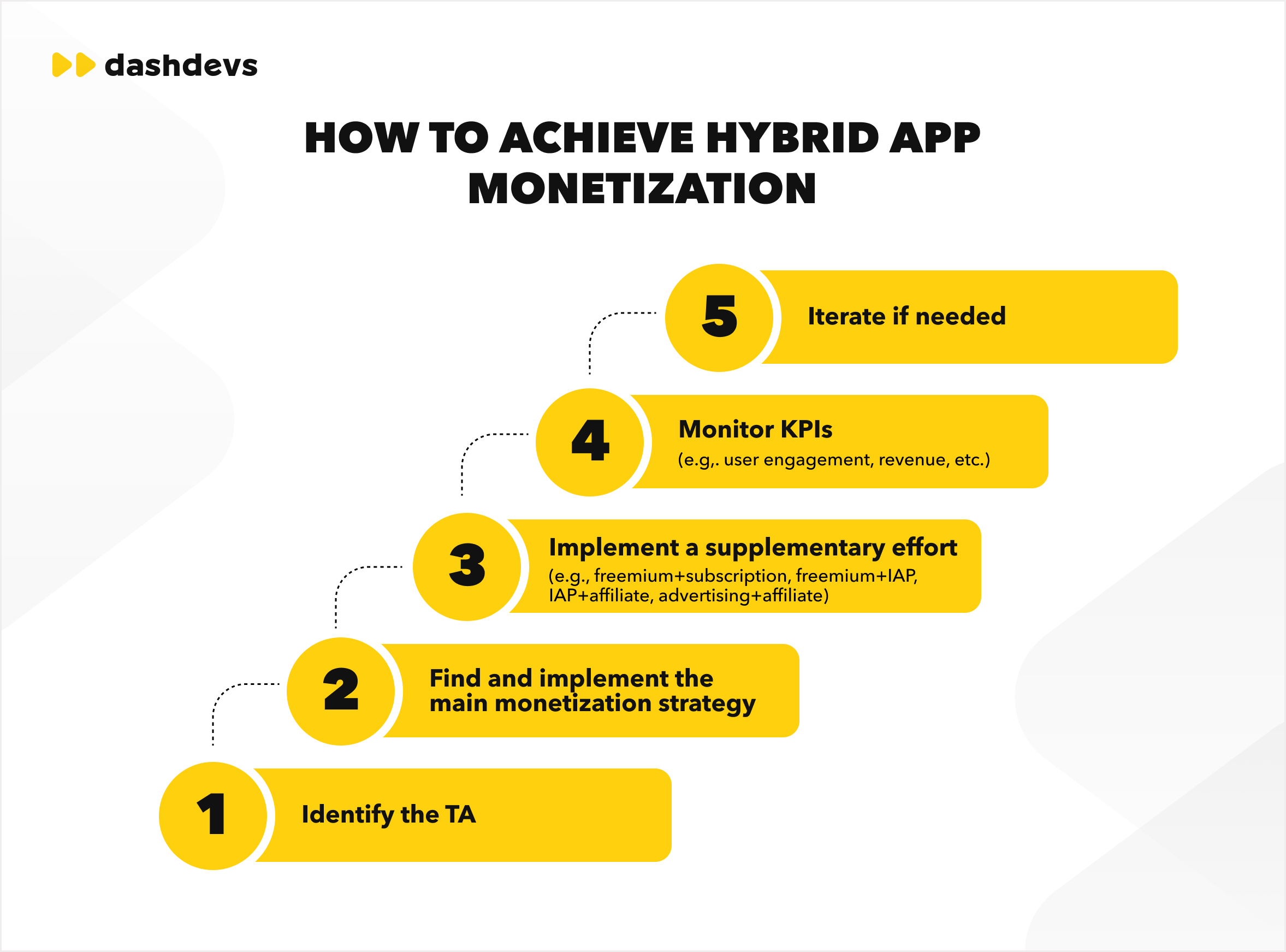
Executing hybrid mobile app monetization strategies (combining subscriptions with limited ads, or freemium with transaction fees) can outperform any single model, but only within limits. An app carrying too many simultaneous revenue mechanisms (ads, IAP, subscription upsells, and affiliate offers stacked together) becomes confusing and adversarial from the user’s perspective. Each additional mechanism adds engineering and support overhead disproportionate to the incremental revenue it generates.
Watch out: hybrid monetization should be the result of validating each layer independently. Add a second model when the first is proven, and retention data shows room for an additional, non-cannibalizing revenue line.
Common app monetization mistakes to avoid
- Choosing a model before naming the payer. Teams that skip the three-payer framework often build a subscription wall for a product whose real payer should have been a third-party partner.
- Ignoring app store commission in pricing. A $4.99 IAP that “works” on paper can quietly underperform once the 15–30% platform cut and payment processing costs are subtracted.
- Treating growth metrics as proof of monetization fit. Downloads and DAU growth with no revenue signal is a marketing outcome, not a business model.
- Layering monetization onto an unoptimized cost base. Revenue growth without cost discipline compresses margin instead of building it.
- Copying a competitor’s model without checking the payer match. A model that works for a competitor with a different user base, geography, or licensing structure will not automatically transfer.
- Under-investing in the free tier. A freemium product with a weak free experience converts poorly regardless of how the premium tier is priced.
Fintech app monetization in practice
DashDevs built Dozens, one of the UK’s first challenger banks, from an early idea to a licensed institution. Budgeting sat at the core, alongside transfers, investing, and risk tools. Monetization logic like this has to be designed alongside the banking license, not bolted on after launch—which is why planning the best mobile banking app features belongs inside fintech app development planning from day one.
MuchBetter shows the transaction model in practice. Built in four months by a four-person team, it now serves 400,000+ users across 180+ countries through transaction and interchange economics, not ads or subscriptions.
Both cases point to the same lesson: fintech monetization is an architecture decision. It depends on your ledger, your card-issuing partner, and your compliance layer—a different starting point than picking an ad network.
The bottom line
The most effective mobile app monetization strategies rely on a sequence of deliberate decisions: name the payer, pick one model and validate it, optimize cost before adding a second stream, and reassess as the product and its app-store economics evolve. Fintech products carry a wider set of options (transaction fees, interchange, API monetization, and embedded finance) but also a narrower set of constraints, since compliance scope and banking relationships shape which models are even available.
DashDevs has built the monetization layer into regulated fintech products from first ledger entry to public launch, including the digital wallet infrastructure and card-issuing programs that transaction-based monetization depends on. If your team is weighing a monetization model against a pricing pivot or a pre-launch roadmap, talk to DashDevs about what the model actually costs to build before it’s the thing holding up the launch, whether you need mobile or web development services.
Share article
