


Multi-Rail Payments in Europe: The Architecture Behind Not Breaking at Every Border

October 1, 2026
- A multi-rail payments system routes each payment across SEPA Instant, Faster Payments, cards, and local A2A schemes instead of pinning the product to one path.
- Eurozone sending of SEPA Instant at standard-transfer prices has been mandatory since 9 October 2025, yet instant still sat at 23% of euro-area credit transfers by number in H1 2025.
- The UK stack is separate: Faster Payments, CHAPS, and Bacs. A euro-only integration does nothing for sterling.
- T2's seven-hour outage in February 2025 and the Iberia blackout showed that a second wired path is what keeps money moving.
- Build rail adapters, orchestration, one ledger, in-path compliance, and reconciliation. Partner for access; own the routing rules.
Your payment flow works fine in Germany. Then you launch in the Netherlands and onboard UK customers, and things start to crack. A local method you never integrated turns out to be the default checkout. A cut-off you didn’t know about delays a payout. Multi-rail payments in Europe fix this, but only when the architecture is designed for it. Here’s how to build that architecture before your next border.
What Is a Multi-Rail Payments System?
A multi-rail payments system connects your product to several payment rails at once and decides, payment by payment, which rail moves the money. Payment rails are the networks underneath every transfer: SEPA Credit Transfer, SEPA Instant, Faster Payments, CHAPS, card networks and local account-to-account (A2A) schemes.
Your product talks to one API. Behind it, a routing layer looks at currency, amount, urgency, cost and rail health, then picks a path. If that path fails, it picks another.
I like to think of it as a routing table for money. Every rail speaks its own message format and keeps its own cut-off times and limits. It also fails in its own way. A multi-rail payment platform absorbs those differences so your customers never see them.
Multi-Rail vs Single Rail Payments
A single-rail setup sends everything through one path, usually one sponsor bank or one PSP. It is quicker to launch. It also means one provider incident takes your whole payment flow down with it.
| What you compare | Single rail | Multi-rail |
|---|---|---|
| Time to first payment | Fast: one integration | Slower: several integrations plus routing |
| Market coverage | Whatever your one provider supports | Local payment rails per market |
| Provider or scheme outage | Payments stop | Traffic shifts to the next rail |
| Cost control | Your provider sets the price | You route by cost per corridor |
| Operational load | One reconciliation source | Several sources to reconcile |
I’ll be honest. Multi-rail payments add real work for your ops and finance teams. That work is the price of staying online when a provider goes dark.
Why Do Payments Break at European Borders?
Payments break at European borders because every market runs its own mix of rails and payment habits, even inside the euro area. A flow tuned for one country rarely survives the next one unchanged. That is the core problem multi-rail payments solve.
One Currency, Many Local Habits
The euro area looks unified on paper. Since 9 October 2025, eurozone PSPs must send SEPA Instant transfers at the same price as standard ones, with funds arriving within ten seconds, under the Instant Payments Regulation. They must also run Verification of Payee before every credit transfer. Our guide to instant payment implementation covers those requirements in detail.
Adoption still lags the mandate. ECB figures for the first half of 2025 put instant transfers at 23% of euro area credit transfers by number and only 7% by value. Corporates still push large flows through batch SEPA Credit Transfer. So you need both rails, with routing between them.
The checkout layer is even more local. In the Netherlands, iDEAL handles about 72% of e-commerce transactions and more than 1.5 billion payments a year, according to ABN AMRO. That method is now migrating into Wero, the wallet from the European Payments Initiative (EPI), with full migration planned by 2027.
If you serve Dutch shoppers, your most important checkout method is changing rails underneath you. Right now.
Wero reports 57 million users and went live for e-commerce in Germany in late 2025 and in Belgium in March 2026. Meanwhile, Spain runs on Bizum, Portugal on MB WAY, Italy on Bancomat Pay and the Nordics on Vipps MobilePay. Those schemes formed the European Payments Alliance (EuroPA), and its partnership with EPI covers 15 countries and more than 382 million people.
The UK Runs Its Own Stack
Outside the euro, the UK runs a separate set of payment rails. Pay.UK counted about 5.5 billion Faster Payments in 2025, worth £4.8 trillion. Faster Payments settles in seconds, around the clock, with a scheme-wide cap of £1 million per payment.
Anything above that cap goes over CHAPS, the same-day high-value system. Recurring collections still run on Bacs, which processed 5 billion Direct Debits in 2025. A euro-only stack does nothing for a customer in Manchester paying in sterling.
Here are the rails you’ll usually meet first:
| Rail | Where it runs | Speed | Typical use |
|---|---|---|---|
| SEPA Credit Transfer (SCT) | SEPA countries | Within one business day | Payroll and supplier payments |
| SEPA Instant (SCT Inst) | SEPA countries | Under 10 seconds, 24/7 | Payouts, P2P, pay-by-bank checkout |
| Faster Payments | UK | Seconds, 24/7, up to £1 million | Real-time retail transfers and payouts |
| CHAPS | UK | Same day, business hours | High-value and time-critical sterling |
| Bacs Direct Debit | UK | Three-day cycle | Subscriptions and bills |
| Card rails | Global | Authorization in seconds | Checkout with credit and debit cards, recurring card payments |
| Local A2A and wallets (iDEAL, Wero, Bizum, MB WAY, BLIK) | Domestic, increasingly linked | Instant, on top of bank rails | Checkout and P2P |
What Do Recent Outages Teach About Payment Rails?
Recent outages show that any single rail can stop for hours. The products that kept moving money in 2025 already had a second path wired in. This is where multi-rail payments earn their cost.
The Day T2 Stopped
On 27 February 2025, a hardware defect took down T2, the ECB system that settles more than €3 trillion in payments a day. The ECB post-mortem says the outage lasted about seven hours. The customer payment cut-off moved from 17:00 to 23:00. The Bundesbank said salaries and pensions arrived late.
Seven hours. On the backbone of euro wholesale payments.
Here’s the detail I find most useful. TIPS, the ECB’s instant settlement service, saw only minor delays that day. Teams with an instant path and pre-funded liquidity could keep urgent euro payouts moving. Teams wired to one batch path simply waited.
When the Lights Went Out in Iberia
On 28 April 2025, a blackout hit Spain and Portugal, and card terminals and ATMs went offline across both countries. Banco de Portugal later reported that terminal purchases dropped 36% that day against the previous two weeks. ATM withdrawals fell 34% by volume, while the average withdrawal rose to €90 from €78.
Banco de Portugal is now drafting a National Payment Resilience Plan together with other critical sectors, including energy and telecoms. Andréa Toucinho of Partelya Consulting put the lesson well on the Fintech Garden podcast about European payments entering execution mode. Resilience comes from having several operational options ready, such as offline card acceptance with later reconciliation and redundancy across rails.
For a fintech, the takeaway is concrete. You can’t control the grid. You can control how many independent paths your payments have.
The Architecture Behind a Multi-Rail Payment Platform
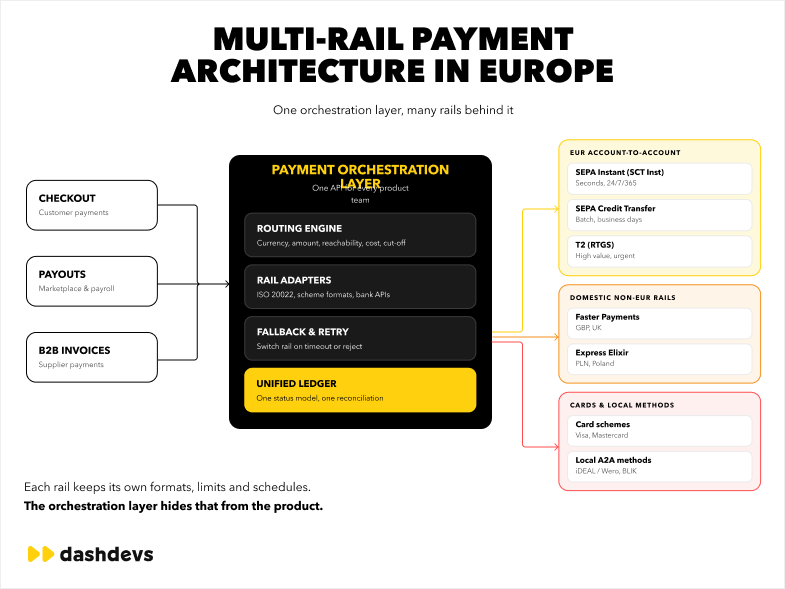
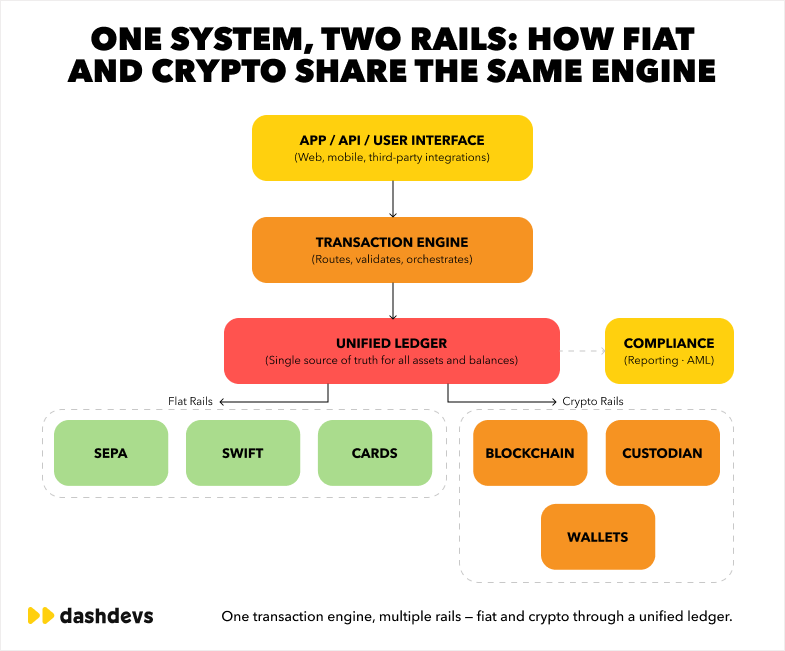
A multi-rail payment platform rests on five layers: rail adapters, a payment orchestration layer, a single ledger, compliance inside the payment path, and reconciliation with rail health monitoring. Each layer has one job, and none of them leaks scheme details into your product.
Payments flow down from your API through compliance and routing to the rail adapters. Confirmations flow back up through reconciliation into the ledger.
Rail Adapters: Translate Once, at the Edge
Each adapter turns your internal payment object into the scheme’s message. It also maps the scheme’s responses back into one internal status model. SEPA schemes already speak ISO 20022, and Pay.UK publishes an ISO 20022 standards library for Faster Payments.
Keep scheme codes at the edge. Your product logic should only ever see your own statuses. A reject code you’ve never seen before maps to an explicit needs_review state, so nobody guesses.
The Payment Orchestration Layer Decides the Route
The payment orchestration layer is where your multi-rail payment strategy turns into code. It chooses a rail for each payment based on rules like these:
- Corridor and currency. EUR to a SEPA IBAN, GBP to a UK sort code.
- Amount against scheme limits. A £1.5 million payment skips Faster Payments and goes to CHAPS.
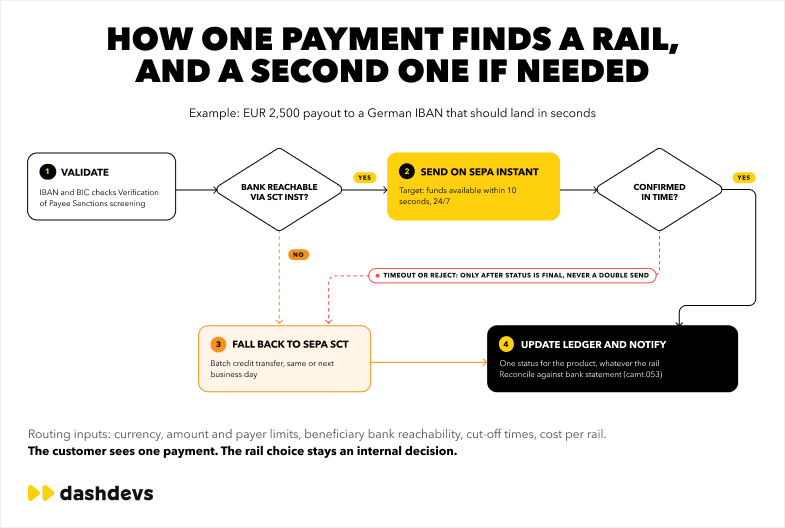
- Urgency. Payouts a user is waiting for go instant. Supplier batches can wait for the next SCT cycle.
- Rail health. A rising reject rate or latency on one route shifts traffic to the next.
- Cost per route, when two paths are equally good.
Failover needs one hard rule. Instant payments are irrevocable, so a timeout is an unknown state. Check the payment status before you retry on another rail, and carry the same idempotency key across every attempt. Skip that, and you will eventually pay the same person twice.
When our team built the payment service behind MuchBetter, an e-wallet with 400,000+ users in 180+ countries, we integrated CHAPS, Faster Payments, SEPA and SEPA Instant behind one unified service. Adding a new bank or payment method then meant writing one more adapter. The product code stayed the same. You can see a similar setup in the Twisto payment orchestration platform, and our guide to payment orchestration goes deeper into routing logic.
One Ledger, Many Rails
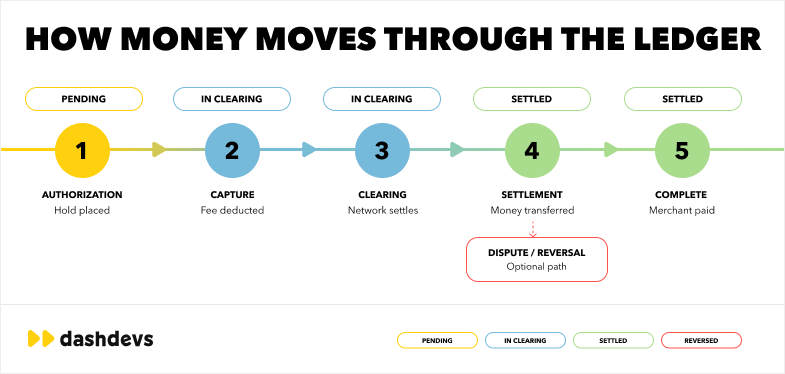
Your ledger is the only place where a balance is true. Every rail posts events into it: initiated, accepted, settled, returned. The ledger keeps pending and settled states apart, so a customer never sees money a rail hasn’t confirmed.
If you run several products on one stack, a ledger architecture built for multi-product banks keeps one core ledger as the system of record. Product sub-ledgers roll up into it.
Compliance Inside the Ten-Second Window
SEPA Instant leaves you ten seconds end to end, so compliance has to live inside the payment path. Under the Instant Payments Regulation, PSPs screen their own customers against EU sanctions lists at least once a day. That keeps per-payment sanctions screening out of the ten-second window.
Verification of Payee runs before the payer confirms. Early numbers from Luxembourg show why this needs real product design. In the first weeks, 60% of checks returned a full match and 19% a close match. Another 14% returned no match, and 7% couldn’t be verified (ABBL).
That’s 40% of payers who see something other than a green light. Your UX has to handle that calmly.
Reconciliation and Rail Health
Each rail sends its own confirmations and returns. Real-time payment reconciliation should work as a continuous check that your ledger already matches the rails.
The same data feeds rail health: reject rates and latency per route. Those signals tell the orchestration layer when to move traffic.
How to Build a Multi-Rail Payment Strategy in Europe
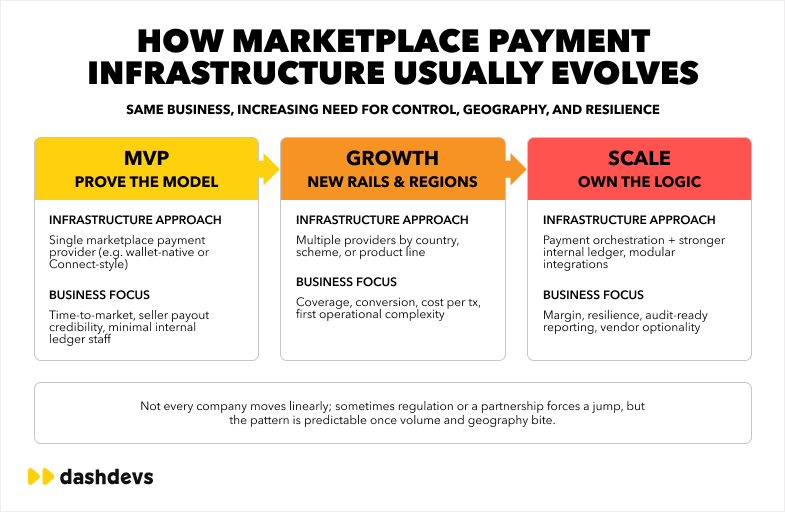
Start from where your money actually moves, then add rails in order of risk. Here’s the sequence I recommend to teams planning instant payments in Europe and the rails around them.
- Map your real corridors. List payer and payee countries, currencies, amounts and urgency for the next 12 months. Your rail list falls out of that map.
- Pick a primary and a fallback path per corridor. For euro payouts, that might be SEPA Instant first and standard SCT second. Ideally, the two run through different access routes.
- Diversify access as well as rails. Two schemes behind one sponsor bank still share one point of failure. For licensed EEA PSPs, the Bank of Lithuania’s CENTROlink is one route: a single integration covers SCT, SCT Inst, SDD Core and Verification of Payee. Our guide to direct technical access to SEPA walks through it.
- Design your internal payment model before any adapter. Statuses and error categories come first, with idempotency built into the same model. Adapters plug into them later.
- Keep scheme limits and cut-offs in configuration. Ops should be able to change a cap or a cut-off time without a release.
- Rehearse failover on a schedule. Switch a corridor to its fallback route in production during a quiet hour. A fallback nobody has tested is a hope.
- Put 2027 on your roadmap now. iDEAL completes its move into Wero by 2027. Payment and e-money institutions must offer SEPA Instant by 9 April 2027, and non-euro SEPA banks follow by July 2027. Wero also plans interoperability with Bizum, MB WAY, Bancomat and Vipps MobilePay from autumn 2026.
Pro tip: Store the route each payment took and the reason the router chose it. When finance asks why a payout cost more, or support asks why it was slow, the answer is one query away. After 17+ years integrating payment vendors, that column is cheaper than reconstructing the route from emails.
If your corridors leave Europe, you’ll also need wire transfers over SWIFT and a currency layer. Our guides on handling both SEPA and SWIFT payments and embedded FX infrastructure cover that part. Our overview of cross-border payment providers helps you shortlist partners.
Should You Build, Buy or Partner for Multi-Rail Infrastructure?
Most teams should partner for rail access and license a proven ledger and orchestration core. The part worth building yourself is the routing logic, because it encodes how your business makes money.
Ezequiel Canestrari, COO at ClearBank Europe, made a point on the Fintech Garden episode about why reliability beats speed in European payment infrastructure that every payments team should tape to the wall. Connecting to payment rails looks like a modular choice from the outside. Inside, it becomes a structural dependency, and shortcuts taken at launch come back later with interest.
I’ve integrated more than 50 fintech vendors over 17 years, and I agree with him completely. Our build, buy or partner framework scores each component of the stack on its own. For regulated players, infrastructure for licensed PSPs and EMIs like Fintech Core gives you wallets, accounts, payment processing and KYC/AML workflows pre-built. Teams launching a full bank can extend it through banking software development or neobank development.
Multi-Rail Is How You Cross the Next Border
Multi-rail payments in Europe have become an architecture decision you make early. The rails under your product will keep changing: SEPA Instant is now mandatory in the eurozone, and iDEAL is turning into Wero. Your customers shouldn’t feel any of it.
It’s no surprise that payments infrastructure and scaling across multiple regulated markets sit on the agenda at Fintech Meetup Europe 2026 in Lisbon, 6 to 8 October. Every border you add is a new set of rails.
Planning your next market? Talk to our team about cross-border payment integration solutions. Or listen to the Fintech Garden episodes already linked above on European payments entering execution mode and why reliability beats speed.
Share article
