


Network Tokenization: How It Improves Payment Performance and Reduces Declines

August 12, 2026
- Network tokenization replaces the PAN with a scheme-issued credential that updates when cards are reissued—so auth fails less from stale card data.
- Traditional vault tokens protect storage; network tokens improve issuer trust and authorization outcomes on card-not-present traffic.
- Lifecycle sync, cryptograms, and domain controls drive higher authorization rates and lower fraud false declines—not only PCI scope reduction.
- Ask PSPs for token coverage by scheme, cryptogram pass-through, account-updater behavior, and auth-rate reporting by corridor—not a logo slide.
- DashDevs helps payment teams wire network tokens into orchestration, billing, and reconciliation so performance gains show up in the P&L.
Fraud is the risk most boards discuss first. Soft declines and stale credentials often cost more in practice.
Cards expire. Banks reissue plastic. Issuers reject credentials that used to work. Customers abandon checkout. Subscriptions fail, and teams spend hours in reason codes before they see the pattern.
Network tokenization addresses that problem at the credential layer. You stop relying on the raw primary account number and use a credential the card network issues and keeps current. Done well, you improve authorization rates, reduce lifecycle declines, and hold less cardholder data in your own systems.
This guide is for Heads of Payments, CFOs, and product leaders who select PSPs and payment infrastructure. It explains how payment network tokenization differs from vault tokenization, what drives authorization outcomes, and how to evaluate vendors on measurable impact—not marketing claims.
What is network tokenization
In simple terms, the card scheme issues a substitute credential for the card. Merchants or wallets store that credential and use it for later charges. In many flows, each authorization also includes a one-time cryptogram.
Visa, Mastercard, and American Express each operate their own token services. The model is consistent. The card network keeps the mapping from token to real PAN. What you store may look like a card number, but it only works within the domain the scheme allows.
If your reference point is classic payment tokenization, this is the key difference. A vault token mainly keeps raw card data out of merchant systems. Scheme credentials also change how issuers assess and approve the charge.
Network tokenization vs traditional payment tokenization
The practical distinction is ownership. A vault token lives in your environment or your PSP’s vault. Payment network tokenization is issued and maintained by the card network.
| Dimension | Traditional / vault tokenization | Network tokenization |
|---|---|---|
| Who issues the token | PSP, gateway, or merchant vault | Card network (Visa, Mastercard, American Express, etc.) |
| What gets stored | Vault token mapped to PAN in a processor vault | Scheme token mapped by the network |
| Lifecycle updates | Often need account updater or customer action | Scheme can refresh when cards are reissued |
| Auth signal to issuer | Depends on how PAN is later used | Token domain + cryptogram improve trust |
| Main business win | PCI scope and breach blast radius | Auth lift + lifecycle + security |
You do not have to choose only one approach. Many mature stacks keep a vault token for internal systems and provision a scheme credential behind it for authorization. One identifier for your applications. Another for the payment rails.
Card network tokenization is also not the same as encryption. Tokenization replaces the sensitive value with a substitute. Encryption transforms data with a key. You still need key management, access control, and monitoring. What you remove is the need to store live PANs in product databases.
If a stored credential fails every time the bank reissues the card, you have improved storage security—not card lifecycle management.
How network tokenization works in the charge path
In practice, network tokenization works by provisioning a scheme credential at card capture, then using that credential—often with a cryptogram—on each authorization instead of the raw PAN.
For card-on-file or checkout, the flow typically looks like this:
- The customer enters payment card details once (or pays from a wallet).
- Your PSP or token service asks the card network for a credential.
- The scheme issues it for a domain—merchant, wallet, or device.
- You store the network token, or a vault pointer to it—not the live PAN.
- On charge, the processor builds the authorization with the token and cryptogram.
- The issuer validates the cryptogram and domain, then approves or declines.
- If the card is reissued later, the scheme updates the mapping. Your stored credential can remain usable.
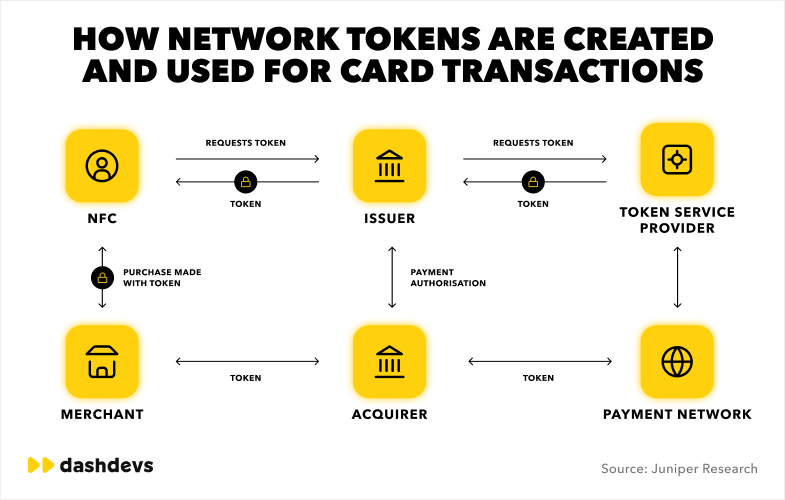
Those messages still travel on familiar rails. ISO 8583 structures card authorization messages. Tokenization changes which credential and security fields you send. It does not remove the need for a reliable authorization pipeline.
Digital wallets apply the same model at consumer scale. Apple Pay and Google Pay present device-bound credentials that are scheme tokens under the hood. If wallets are on your roadmap, define token domains early. Our guide to types of digital wallets can help you choose a model before wallet tokens and merchant card-on-file tokens are mixed in one ledger design.
Why network tokenization improves authorization rates
Higher authorization rates come from fresher credentials, stronger issuer trust signals, and fewer false declines—not from automatic approval.
Visa has reported roughly a mid–single-digit authorization lift for tokenized card-not-present traffic versus PAN, with a material reduction in fraud on the same comparison set (Visa on tokenized transactions). Mastercard has published smaller average lifts that are still meaningful at scale. Your result will vary by corridor, MCC, and card mix. Treat scheme averages as a planning range, not a contractual guarantee.
Most of the improvement comes from three mechanisms:
- Credential freshness. When primary account numbers PANs change after reissue, older card-on-file records fail. A maintained scheme mapping can continue to charge successfully.
- Cryptogram validation. Many tokenized transactions carry a dynamic cryptogram. That helps issuers distinguish legitimate merchant use from reused stolen card data.
- Domain binding. Tokens are limited to a merchant or wallet context. Stolen credentials are harder to reuse elsewhere, which can reduce risk-based declines.
Tokens will not resolve every decline. Step-up authentication and liability rules still shape the funnel. Align token strategy with how you manage decline rate trade-offs in the authorization funnel and when 3DS liability shift protects merchants from fraud chargebacks. Tokens reduce credential friction. They do not replace authentication policy.
A simple revenue framing
Assume $10M in monthly card volume and a 3% recoverable authorization lift from better credential and lifecycle handling:
| Input | Value |
|---|---|
| Monthly card volume | $10,000,000 |
| Recoverable auth lift | 3% |
| Recovered volume / month | $300,000 |
| Annualized (order of magnitude) | ~$3.6M |
Not every merchant will see that exact figure. Even a real 50-basis-point lift on large CNP volume often pays for the integration several times over. That is why CFOs should treat this as a revenue and retention topic, not only a security project.
Card lifecycle management: where declines quietly pile up
Lifecycle failures are often the first place teams notice the cost. Cards expire. Plastic is replaced. Customers ignore update requests. Support receives billing tickets that are actually credential failures.
Without scheme lifecycle support, common outcomes include:
- Subscription failures tied to expiry
- Reissued PANs that never reach your vault
- Customers who do not update payment details
- Retry logic spent on credentials that will not recover
Scheme-level mapping helps because the token issued by the network can follow the active card relationship. Billing keeps the same stored credential. The underlying mapping updates.
This matters most for a recurring payment system. Retries and dunning cannot recover a dead PAN. Lifecycle-aware credentials reduce the share of failures that retry logic will never fix.
Operational checklist:
- Segment declines by reason code: expired, invalid, do-not-honor, lost/stolen
- Separate credential failures from temporary funds declines
- Track token provision success and update latency by scheme
- Alert when refresh stalls in a corridor
- Keep a customer update path for cases the scheme cannot resolve
Benefits of network tokenization for security and compliance
Security teams focus on exposure. Finance teams focus on approvals. Leadership needs both views.
The practical benefits of network tokenization for businesses include:
- Less live cardholder data and payment information stored in your applications
- Smaller impact if application databases are affected by data breaches
- Credentials that are harder to reuse outside their approved domain
- Stronger signals that support reduced fraud on many CNP paths
- Fewer involuntary churn events from expired or reissued cards

PCI obligations do not disappear when tokens are enabled. Tokenization can shrink PCI scope when PANs never enter your applications. You still need PCI DSS controls for people, process, and any system that handles card data at capture. If a mobile app logs PANs for debugging, no token program will fix that finding.
Treat credential security as part of broader fraud and risk management strategies in fintech. A token is a control. It is not a complete risk framework.
When boards ask about the benefits of network tokenization, separate security savings from revenue impact. PCI scope reduction has value. Authorization lift and lower involuntary churn usually matter more in dollar terms.
Where scheme credentials show up: wallets, issuing, and acceptance
Consumers encounter these credentials in digital wallets. Merchants store them for card-on-file. Issuers encounter them when their own programs tokenize at scale.
On the acceptance side, your PSP or gateway provisions and charges tokens. On the issuing side, token services sit next to BIN and card programs. If your organization does both, align the event model early so finance and support work from one source of truth.
If you are building card programs, start with how card issuing works, compare top card issuing providers, and decide whether you need card issuing development support to connect lifecycle events to ledgers and support tools.
American Express, Visa, and Mastercard do not share one identical token API. Coverage, cryptogram rules, and updater behavior vary by region. Multi-scheme merchants need a processor or orchestration layer that normalizes those differences without hiding them from operational metrics.
Card network tokenization also looks different for issuers and merchants. Issuers focus on token service integrations and wallet experience. Merchants focus on whether network tokens remain chargeable after reissue—and whether provision rates hold under peak traffic.
Implementation timeline and ownership
If your PSP already supports the schemes you need, a one-corridor pilot can often launch in weeks. A full multi-scheme rollout with billing hooks and reliable reporting takes longer. Plan for that gap.
| Phase | Timebox (order of magnitude) | Owner | Exit test |
|---|---|---|---|
| Discovery | 1–2 weeks | Payments + PSP SA | Decline taxonomy + scheme coverage map |
| Pilot provision | 2–6 weeks | Eng + PSP | Provision success ≥ target on pilot BINs |
| Auth cohort read | 2–4 weeks after traffic | Analytics + finance | Token vs PAN auth delta with confidence |
| MIT / subscription paths | 3–8 weeks | Billing + eng | Cryptogram + lifecycle cases green |
| Multi-scheme / multi-PSP | Ongoing | Payments architecture | Same metrics per scheme and processor |
Recommended ownership:
- Payments lead owns the KPIs: authorization rate, involuntary churn, and token health
- Engineering owns event integrity and safe retries
- Risk monitors fraud false positives after rollout
- Finance owns revenue impact and fee line items
- Support owns customer communication when a credential cannot refresh
If no one owns the KPI, the initiative becomes a security task. Security tasks alone rarely move approval rates.
How to evaluate PSP and infrastructure support
Do not stop at a sales claim that tokens are supported. Score scheme coverage, cryptogram handling, lifecycle SLAs, reporting quality, and exit options.
Diligence questions
- Which schemes and regions are live for scheme token provisioning today?
- What is your token provision success rate by scheme and card type?
- Do you pass cryptograms correctly on every MIT and CIT path we use?
- How quickly do card updates reach stored credentials?
- Can we see authorization rate for token vs PAN cohorts by corridor?
- What happens to our stored credentials if we leave your platform?
- How do tokens interact with 3DS, retries, and account updater?
- Who owns support when a token charge fails but the PAN would have worked?
Vendor scorecard
| Criterion | Weak answer | Strong answer |
|---|---|---|
| Scheme coverage | “Major schemes soon” | Live list by region with dates |
| Auth evidence | Logo case study only | Reporting on your traffic cohorts |
| Lifecycle | “We have updater” | Measured refresh latency and fail codes |
| Portability | Tokens locked to PSP | Documented export / re-provision path |
| Ops clarity | Unclear ticket ownership | Reason codes mapped to token states |
| Cost model | Bundled undefined fee | Clear lines for provision, auth, updater |
Evaluate unit economics the same way you evaluate credit card processing costs. Token fees are rarely the largest item. Lost approvals and involuntary churn usually are.
Ask for evidence, not adjectives. Request a week of anonymized authorization outcomes with a token flag, provision failure codes, and update latency data. If a vendor cannot provide that, you are being asked to buy on trust.
Build vs buy: when you need more than a PSP checkbox
Buy token capability from your processor when flows are standard. Add a build partner when orchestration, multi-PSP routing, or custom billing requires one consistent credential model.
Buy / configure when:
- One primary PSP covers your schemes and corridors
- Card-on-file and subscriptions follow standard MIT patterns
- You can get token-vs-PAN reporting without a separate analytics project
Build / extend when:
- You route across acquirers and still need one merchant credential model
- Billing, ledger, and support tools need token state machines
- Leadership needs authorization lift reported by product line
- You must migrate off a legacy vault without interrupting recurring revenue
A network tokenization platform—whether PSP-native or in the orchestration layer—should expose events you can operate on: provisioned, active, updated, suspended, and failed. A boolean tokenized=true is not enough. You cannot manage performance you cannot measure.
What good looks like in production logs
- Every charge attempt links to a credential ID and scheme
- Cryptogram presence is explicit for MIT vs CIT
- Lifecycle updates create auditable timestamps
- Support can see why a credential was suspended
- Finance can join authorization outcomes to product and corridor
Network tokens should be treated as product objects. If they remain opaque processor details, teams cannot improve outcomes over time.
Testing plan before you flip the default
Do not make tokens the default for every new card until provision, charge, refresh, and failure paths are tested on each scheme.
Minimum test matrix:
- First CIT with provision success and provision failure
- Immediate second charge using the stored credential
- Merchant-initiated recurring charge with correct cryptogram rules
- Simulated expiry / reissue where the PSP can inject updater events
- Soft decline retry on a tokenized credential
- Refund and capture against the same credential
- Processor failover or dual-PSP path if you route
Demo environments usually pass the happy path. Production includes updater lag, scheme differences, and wallet device tokens your ledger may not expect.
When network tokens and vault tokens both exist, document the mapping rules. Which ID is canonical for billing? Which ID is sent to the issuer? Which ID should support quote to a customer? Ambiguity here creates double charges and missed retries.
Common failure modes (and how to avoid them)
- Enabling tokens without cohort measurement, then debating whether the program worked
- Storing PANs “just in case” beside tokens and retaining full PCI scope
- Omitting cryptogram fields on merchant-initiated charges
- Assuming American Express and regional schemes behave like your main Visa path
- Locking credentials to a PSP with no export path before a commercial renegotiation
- Treating wallet tokens and card-on-file tokens as the same database object
- Expecting tokens to fix declines caused by weak 3DS design or poor soft-decline retry logic
Payment network tokenization fails as a program when only security owns it. It succeeds when payments, finance, and engineering share one metric: approved revenue that should have been approved.
Decision checklist for payment leaders
Before you sign or renew:
- We know authorization rate and decline reasons by corridor and MCC
- We know what share of declines are credential, expiry, or reissue related
- Our shortlist supports the schemes we actually process
- Cryptogram and MIT paths are tested, not assumed
- Lifecycle update SLAs are part of the operating review
- Token portability and re-provision steps are documented
- Finance can see token vs PAN performance monthly
- Support has playbooks for token-specific failures
If three or more boxes remain empty, you are buying a feature label—not a payment performance program.
Closing recommendation
Start with the decline reasons you can already measure. If credential failures and issuer distrust appear in the data, network tokenization belongs on the roadmap before the next PSP renewal cycle.
Choose the smallest implementation that still provides scheme coverage, cryptograms, and lifecycle updates. Prove lift on one corridor, then expand. Payment network tokenization delivers value when product, risk, and finance work from the same token events.
When the hard part is integrating those events across processors, wallets, and billing—not interpreting another scheme document—work with a partner that has shipped payment infrastructure under real authorization and reconciliation constraints. That is how DashDevs helps teams move from “tokens supported” to measurable payment performance.
Share article
