


How to Open a Corporate Bank Account for a Stablecoin Business

August 26, 2026
- A stablecoin business needs two accounts: a fiat-holding account at a crypto-friendly bank or EMI and a custodial account for on-chain assets.
- Most Tier 1 banks reject stablecoin applications because internal risk policy was not written to accommodate the category.
- Which stablecoin you use (USDC, USDT, EURC) affects which banking partners will onboard you. This is a product architecture decision with direct banking consequences.
- The application is a narrative exercise. Banks assess whether your compliance story holds together end-to-end.
- Getting approved is one milestone, but staying banked requires ongoing compliance. We unpack the operational requirements in our live webinar on August 27.
There’s one problem no one warns you about. Imagine a situation: the stablecoin integration works, USDC moves between wallets correctly, and settlement logic is clean. Then you try to connect that flow to a corporate bank account so payroll runs, suppliers get paid, and treasury balances somewhere auditors can verify.
That’s the moment when you realize you hit the wall. Not on the chain side, but on the fiat side.
Finding a crypto-friendly business bank account that supports stablecoin workflows, rather than simply tolerating crypto exchange transfers, is a different problem from finding general business banking. Crypto banking for stablecoin operations is harder than it looks because the problem is about what banks need to see before they accept the compliance risk of a business whose revenue touches digital assets.
This article is for those who are preparing to open or structure a corporate bank account. We have helped teams across multiple jurisdictions move from a rejected application to an active fiat account, and the pattern of what works is consistent enough to document.
Why crypto-friendly banks are not a simple list
The phrase “crypto-friendly bank” overpromises. It usually means an institution that will not close your account when it sees a crypto exchange transfer. That is not the same as an institution equipped to serve a stablecoin business.
Crypto business accounts in 2026 sit across three institutional tiers:
Full banking licenses
Traditional banks with digital asset frameworks: JPMorgan’s wholesale JPM Coin rails, BNY Mellon custody, and Citi Token Services. These are institutional-grade and largely inaccessible to companies below the Series B scale. In late 2025 and early 2026, Circle, Ripple, BitGo, Paxos, and Fidelity Digital Assets received conditional OCC national trust bank charter approvals in the United States.
EMI and payment institution licenses
The realistic entry point for most stablecoin businesses. EMIs provide business accounts, IBANs, and cross-border payment services without lending client funds. In Lithuania, the Netherlands, and Malta, EMIs have become the standard banking partner for crypto-adjacent companies. EMI-based accounts get most stablecoin operations to working fiat infrastructure within a realistic timeline. If you are still choosing the regulatory wrapper, compare an electronic money institution vs payment institution path before you lock partner outreach.
Neo-banks and fintech platforms
Mercury in the US, Revolut Business in the EU and UK, and comparable platforms that allow crypto exchange transfers and hold fiat. Some offer FDIC-insured deposit protection on fiat balances, which matters for treasury risk management. Useful for early operations and lightweight Web3 payment use cases but limited for treasury-scale flows or corridor-specific settlement.
The tier you choose should follow your corridor and your compliance posture, not the simplest onboarding flow.
The jurisdictional layer matters as much as the institutional tier. The full picture of what banks assess, why they reject, and how jurisdiction shapes your partner options is covered in detail in our stablecoin banking guide. This article picks up where that one ends: the practical setup of the account itself.
The dual-account architecture banks expect to see
Most teams approach this as a single question: “Which bank will take us?” The right framing is two separate questions:
- Which institution holds our fiat?
- Where do we custody our on-chain assets?
These are not the same provider, and mixing them is what banks flag.
A stablecoin business in production runs two parallel structures:
The fiat side
A corporate account at a crypto-friendly bank or licensed EMI. This is where ACH, SEPA, and SWIFT flows land. It holds operating capital, processes payroll, and is what your accountant and auditor see. The institution here is your banking counterparty.
The on-chain side
A custodial arrangement for digital assets: a qualified custodian (Fireblocks, BitGo, or Anchorage), an exchange account, or a self-custody wallet under a defined signing policy. This is where USDC, USDT, and other digital currencies live before they are converted to fiat or sent on-chain. Understanding how custody infrastructure works for crypto-holding businesses before you apply is preparation, not an advanced topic.
These two sides connect through an on/off-ramp layer.
- The on-ramp converts fiat to stablecoins (cash in, tokens out).
- The off-ramp does the reverse: stablecoins in, fiat to your bank account out.
This conversion step is where most operational complexity lives and where stablecoin payment rails architecture matters.
Banks want to see this separation documented clearly in your application. A business model description that conflates the fiat account with the custody arrangement or implies the bank is also holding on-chain assets creates a compliance problem the bank cannot resolve without rejecting you.
Which stablecoin you use affects who will bank you
This is the question almost no banking guide addresses. Banks assess the token you use as part of underwriting your business model.
| Stablecoin | Issuer | Regulatory status (2026) | Banking partner fit |
|---|---|---|---|
| USDC | Circle | US-regulated, OCC applicant, monthly attestations | Widest acceptance; most EU and US EMIs comfortable |
| USDT | Tether Ltd | Not US/EU licensed; MiCA EMT not met | Accepted by crypto-native platforms; declined by some EU institutions |
| EURC | Circle | MiCA-compliant EMT, euro-denominated | Best fit for EU EMIs; limited outside EU corridors |
| PYUSD | PayPal/Paxos | US-regulated, Ethereum and Solana | Growing acceptance; lower B2B liquidity than USDC |
USDC is the lowest-friction choice for most stablecoin businesses because Circle’s monthly public attestations give compliance teams a paper trail they recognize. A business holding USDT raises more questions with EU-regulated EMIs because Tether doesn’t meet MiCA’s e-money token requirements. This doesn’t make USDT unusable, but it limits which banking services partners will accommodate it and often requires a more detailed source of funds narrative.
If your model involves cross-border payments in EUR, EURC on a MiCA-licensed platform is increasingly the cleaner path to EU banking access than converting a dollar stablecoin at the point of settlement. For the broader corridor economics, our guide to stablecoins for cross-border payments covers where each rail beats traditional correspondent chains on cost and speed.
Partner selection: what to actually compare
Finding the right partner means comparing institutions on the dimensions that determine whether the relationship survives beyond onboarding, not just whether they will open the account.
| Evaluation criterion | What to ask | Pass signal |
|---|---|---|
| Corridor coverage | Which countries can send and receive? | Written corridor matrix |
| Stablecoin acceptance | Which tokens do you support? | Named list with any exclusions stated |
| Client fund segregation | How are our funds held? | Documented account structure you can audit |
| Off-ramp SLA | How long to fiat after an off-ramp request? | Hours or days with failure modes in writing |
| Travel Rule handling | Who owns originator/beneficiary data? | Explicit RACI between you and the partner |
| KYB re-underwriting | When do you re-underwrite the relationship? | Defined triggers (volume threshold, model change) |
| Exit path | What happens if you exit the crypto category? | Data portability and dual-rail fallback confirmed |
The last two rows are what most teams skip in the onboarding conversation and what causes the most expensive surprises later. Banks that accept stablecoin businesses periodically re-underwrite them, especially after regulatory changes or volume spikes. Building the fintech vendor dependency assessment into partner selection upfront is what separates a stable banking setup from one that surprises you mid-growth.
For early-stage operations, a single banking partner is workable. At scale, two EMI relationships across different corridors are the structure that survives a partner exit without becoming a quarter-long fire drill. The orchestration layer is where choosing your BaaS provider moves from theoretical to operational.
How to prepare the application
Preparation determines whether approval comes in week six or week sixteen.
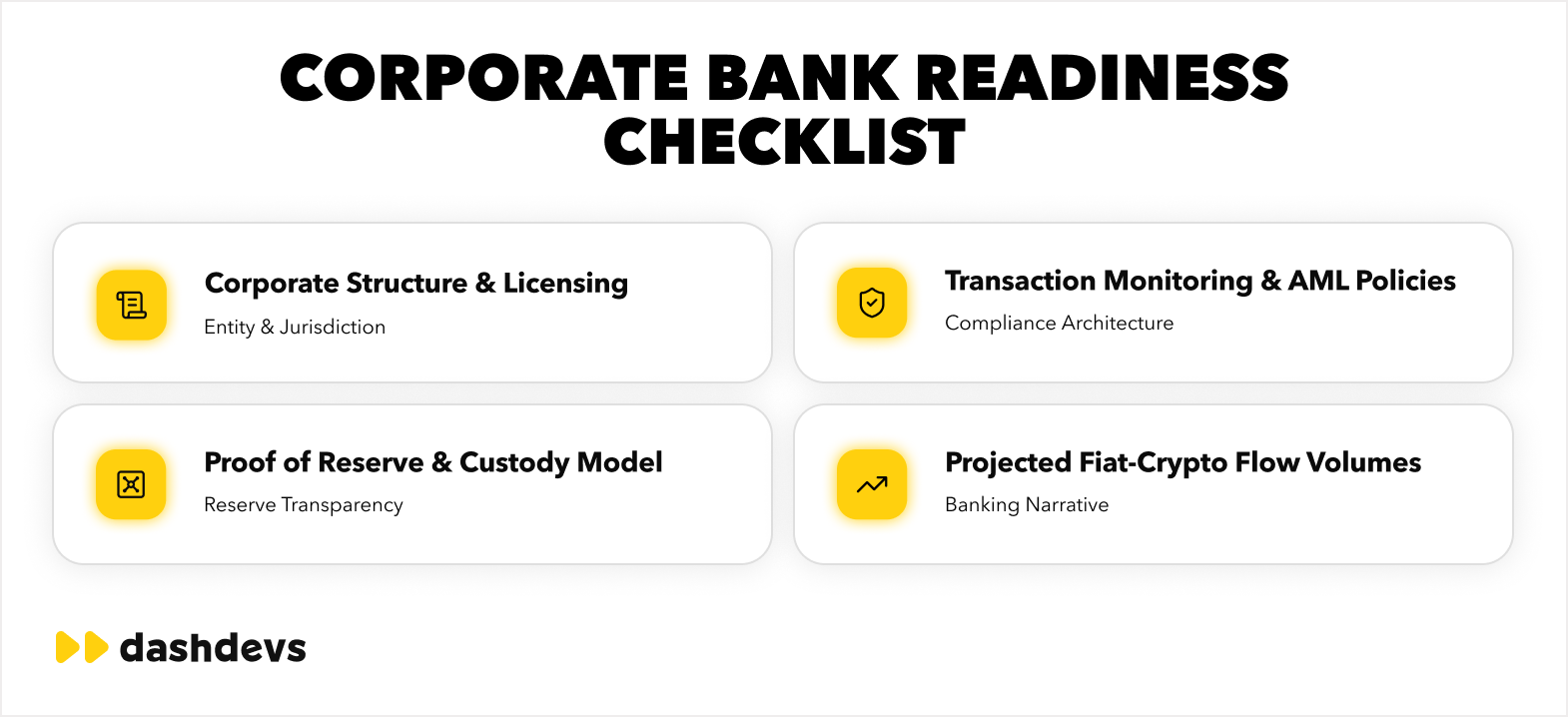
Fix your legal structure first. The account must be in the business name. Unverified UBO layers will stop your application before it reaches a decision-maker. Resolve ownership documentation before approaching any institution.
Match jurisdiction to your corridor. EU EMIs with SEPA access handle EUR flows. North American USD requires a FINTRAC-registered entity or US MSB registration. When evaluating crypto accounts for business across multiple jurisdictions, the regulatory framework in your primary territory determines which institutions will even review your application. Opening a bank account for crypto business in a jurisdiction where your model is unrecognized creates a problem no document package solves.
Prepare the document package before outreach. Expect to provide:
- Certificate of incorporation
- Shareholder register with UBO identification
- AML/KYB policy with implementation evidence
- Source of funds narrative
- Business plan covering the stablecoin model
- Prior financial statements
- Custody model description
Include a clear explanation of whether your flows touch crypto exchanges, direct custody, or banking services at each stage. Teams with a complete package before first contact move through onboarding significantly faster.
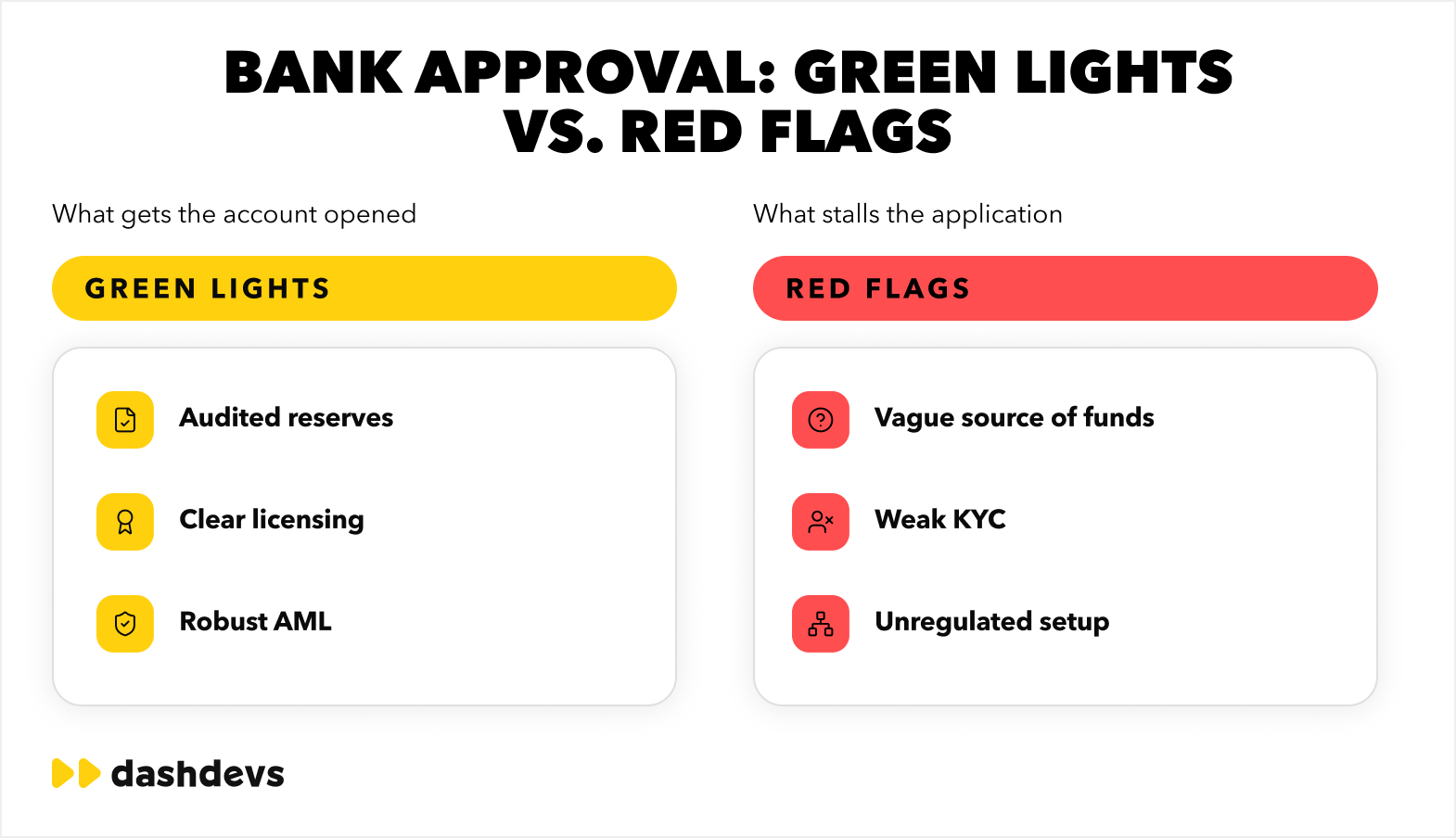
Lead with compliance posture, not product. Compliance teams assess whether your risk controls protect the bank from regulatory exposure. Digital account opening and identity workflows are part of that story: how you identify and monitor counterparties, not just whether you have a policy document.
Build response time into the timeline. KYB loops are the primary reason approvals take twelve weeks rather than four.
Banks don’t reject stablecoin businesses because of the token. They reject them because the compliance story doesn’t hold together end-to-end.
Staying banked: what happens after approval
Getting approved is one milestone. Staying banked as volumes grow is the harder operational challenge.
Banks that serve stablecoin businesses run ongoing transaction monitoring with defined triggers for re-underwriting. The most common triggers:
- Monthly transaction volume exceeds three to five times what was described at onboarding
- New counterparty types appear that were not disclosed
- A regulatory change affects your model classification
- A compliance exception is filed against your account
Teams that stay banked long-term treat the banking relationship as an ongoing compliance partnership. That means named reconciliation ownership with a daily break threshold. It means a documented client-money flow the bank can verify on request. It means check-ins with the institution’s compliance team before volume milestones, not after.
The KYC architecture that supported your onboarding needs to generate the same quality of evidence under volume. A process adequate for 100 transactions a month will not survive a periodic review at 50,000. See our guide to KYC providers for options at scale.
Webinar: Stablecoin On/Off Ramps, 27 August 2026
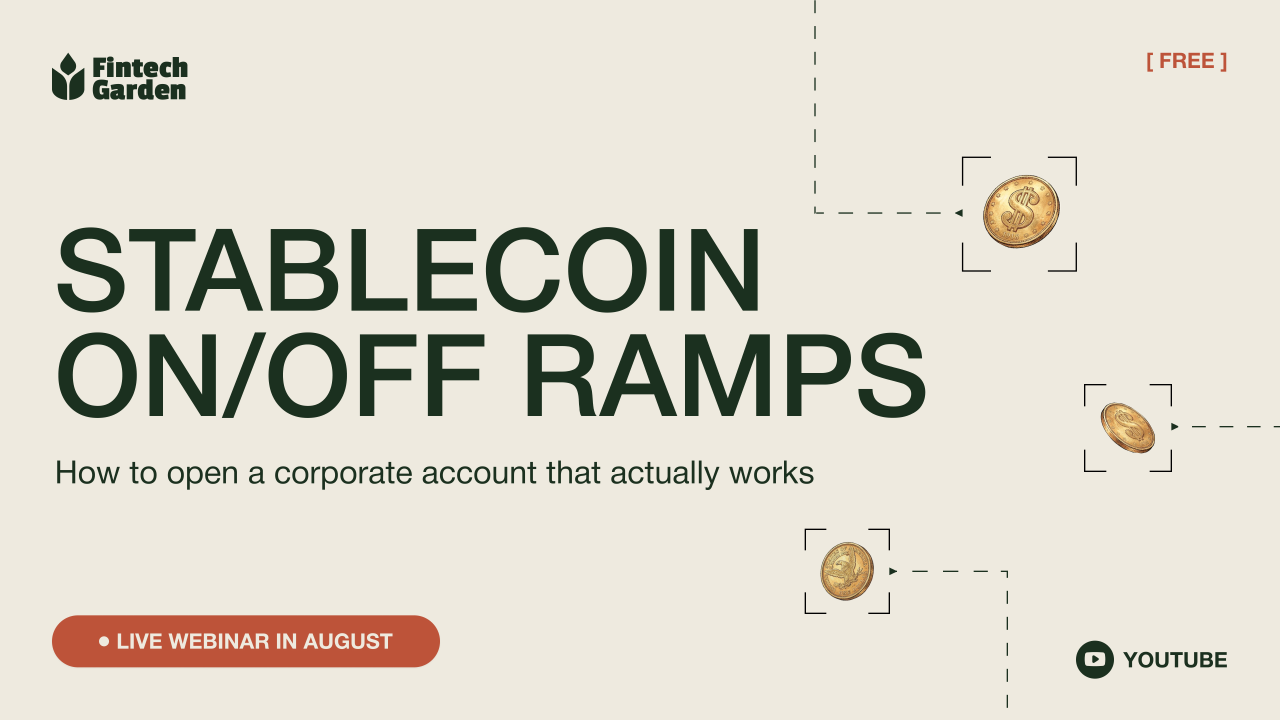
If this article covers the setup, the webinar covers the real cases.
Stablecoin On/Off Ramps is a free 60-minute live session hosted by Fintech Garden on Thursday, 27 August 2026, at 18:00 CET on YouTube. It is built for companies that have hit the banking wall trying to operationalize stablecoin flows.
Igor Tomych (Founder and CEO, DashDevs) and Dumitru Condrea (Founder and CEO, NOVAFIN) will cover corridor economics, custody and wallet architecture, jurisdiction-specific banking outcomes with real approval and rejection cases, and the operational implications of MiCA, FINTRAC, and the GENIUS Act. If you are working through the banking question right now, this is the practical next step.
Register for the Stablecoin On/Off Ramps webinar on LinkedIn, or use the registration form. Session details also live on our webinar news page.
Common mistakes to avoid
Applying to a traditional retail bank without researching their crypto policy. Major European institutions (BNP Paribas, Barclays, and Deutsche Bank) have documented high rejection rates for crypto SMEs regardless of documentation quality. Their risk policies were not written to accommodate crypto services, stablecoin platforms, or related business models. For this category, access is a partner-selection problem, not a documentation problem.
Mixing stablecoin treasury with operational fiat in one account. Banks that accept crypto-adjacent businesses expect segregation between reserves, operational funds, and client funds. A commingled account raises questions even where individual transactions are clean.
Choosing your stablecoin after choosing your bank. Token selection affects banking partner options. If your banking partner only accepts USDC but your product runs on USDT, you have an architecture problem that re-underwriting will eventually surface.
Treating KYC and KYB as a one-time step. Banks run ongoing monitoring. A company that passes onboarding but shows flows inconsistent with the original business model description faces account restrictions. The open banking integration layer and the compliance monitoring layer need to be designed together, not sequenced.
DashDevs: solving dual-account complexity in production
Theory and compliance checklists are clean, but getting underwriters to approve your fiat-to-crypto setup needs battle-tested proof. At DashDevs, we engineer the core systems that satisfy institutional risk teams while keeping Web3 user experiences seamless. Here’s why we want to showcase one of our recent cases with our client, Kleos.
When a client approached us to build a next-generation non-custodial finance platform, they faced the exact friction outlined in this guide. They wanted to transition away from fragile third-party dependencies to a scalable, dual-account architecture that banks would actually underwrite.
To bridge traditional fiat rails with on-chain digital assets, we engineered a unified fintech stack from the ground up:
- Fiat banking integration: Euro IBAN accounts supporting automated SEPA and SWIFT cross-border flows, giving operational and client fiat funds a stable home.
- Stablecoin and non-custodial infrastructure: Native USDC support on Ethereum, alongside Web3Auth MPC (multi-party computation) and account abstraction, to secure digital assets without compromising user control.
- Card and payment rails: Visa card issuing connected directly to a unified ledger layer, enabling instant spending across both digital asset and fiat balances.
- Compliance and risk alignment: Structurally separated custody environments from fiat accounts, eliminating single-vendor lock-in and providing the exact audit trail institutional underwriters require.
Kleos launched a fully bank-underwritten platform, eliminating single-vendor lock-in and reducing operational delivery costs across cross-border payment flows.
The fintech software development layer is what makes this kind of dual-account architecture work in production as a live system auditors and banking partners can verify.
Read how we built the ledger, integrated the banking partners, and passed compliance in the full Kleos Non-Custodial Finance Case Study.
Securing long-term banking stability
Opening a crypto business bank account for a stablecoin operation is a preparation problem. Banks that serve this category exist, and well-prepared applications with a clear dual-account structure, a documented rationale for the stablecoin type, and a live KYB process have meaningfully higher approval rates than those that treat banking as an afterthought.
DashDevs has built technical infrastructure for stablecoin-adjacent fintech products across the EU, UK, and North America, from product delivery to fintech business model structuring. Contact our team to discuss what the stack looks like for your corridor.
Share article
