


QSA Explained: The Role of a PCI DSS Qualified Security Assessor in Payment Compliance

August 27, 2026
- A PCI DSS QSA is the only party authorized to issue a Report on Compliance for Level 1 merchants and service providers.
- QSA engagement is an architecture decision. The scope defined today determines your compliance burden for years.
- Under PCI DSS v4.0.1, 64 previously optional requirements are now mandatory.
- Service providers processing over 300,000 card transactions annually require QSA-led validation.
Most fintech founders encounter the term PCI DSS QSA while scoping a build or negotiating a card program. The immediate instinct is to treat it as a late-stage audit requirement. That instinct is the single most expensive mistake a payment product team can make.
A QSA is not a final gate before launch. The QSA’s scope criteria directly shape which architectural decisions are reversible and which are not. By the time an assessor reviews your cardholder data environment, changing what they find costs a multiple of what it would have cost upfront.
This article is for fintech founders, CTOs, and product leads approaching PCI DSS for the first time, specifically those building neobanks, payment platforms, BNPL products, or marketplaces adding embedded payments. Our goal is to explain what a QSA actually does, when you need one, and how QSA engagement interacts with your build timeline.
What is a PCI DSS QSA?
A QSA is an individual or organization certified by the PCI Security Standards Council (PCI SSC) to evaluate whether a company’s systems, processes, and controls comply with the Payment Card Industry Data Security Standard.
The PCI SSC was founded by five major card networks: Visa, Mastercard, American Express, Discover, and JCB International. It operates the QSA qualification program and maintains the official list of approved assessor companies. The “QSA” designation applies to both individual assessor employees and the companies employing them, sometimes called QSACs (Qualified Security Assessor Companies).
QSAs are independent third parties. They don’t work for card networks, acquiring banks, or compliance software vendors. That independence is a PCI SSC certification requirement, not a convention.
PCI QSA certification confirms that the assessor met all PCI SSC requirements to conduct assessments. It doesn’t mean the PCI SSC endorses their business practices. Certification is a floor, not a quality guarantee.
The QSA definition in regulatory terms is precise: a QSA is the only party authorized to conduct a formal assessment and issue a Report on Compliance (ROC). No security firm, consultant, or internal team can substitute for a QSA when a ROC is required.
What QSA means is also an organizational distinction. You engage qualified security assessor companies, and their individual QSA employees conduct the assessment. PCI SSC requires that QSA employees complete annual training and pass all associated exams before participating in any assessment.
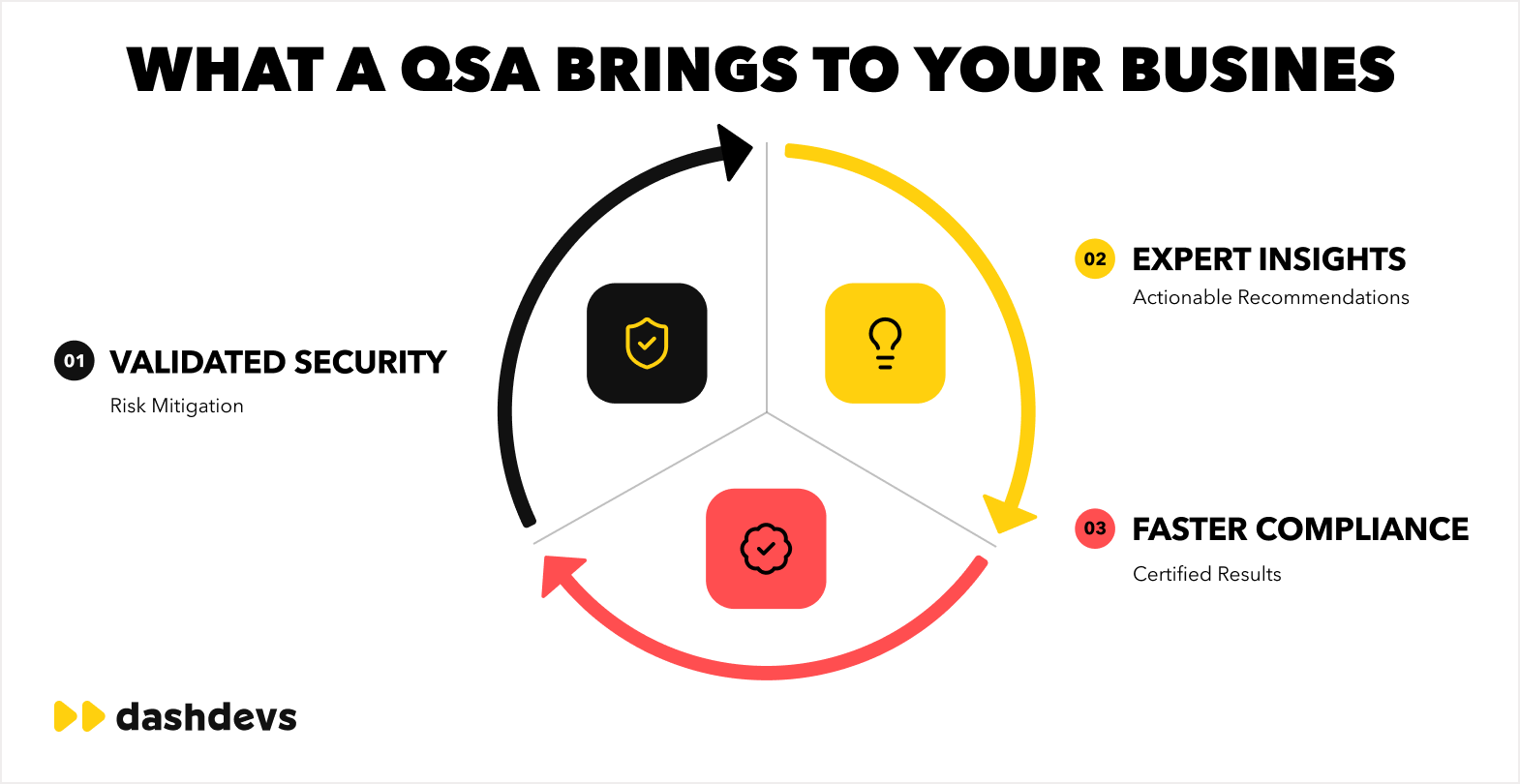
Who needs a QSA and when
Not every company touching card payments requires a QSA. The obligation is determined by compliance level, which is based on annual transaction volume and entity type.
Merchant levels and validation requirements
Here is how the four merchant levels map to QSA requirements:
| Merchant level | Annual transactions | Validation required |
|---|---|---|
| Level 1 | 6M+ (any channel) | Annual QSA-led ROC + quarterly ASV scans |
| Level 2 | 1M–6M | Annual SAQ (self-assessment) + quarterly ASV scans |
| Level 3 | 20K–1M (e-commerce) | Annual SAQ + quarterly ASV scans |
| Level 4 | Below Level 3 thresholds | Annual SAQ (some brands) + ASV scans |
For service providers (the category most early-stage fintechs fall into), the thresholds differ. Service providers processing over 300,000 card transactions annually are Level 1 and require a full PCI QSA-led ROC. Those below that threshold may self-assess, though your acquiring bank can require an ROC regardless.
One non-obvious point: card networks can escalate any entity to Level 1 after a data breach, regardless of transaction volume. That escalation is retroactive and immediate.
The architecture implication most teams miss
Your merchant or service provider level determines the validation method, not which requirements apply. A Level 4 merchant and a Level 1 processor both need to meet all 12 PCI DSS requirement areas. The difference is how compliance is proved, not whether it exists.
A founding team building a payment product at low initial volume still needs to architect for PCI DSS compliance from day one. The only thing that changes when you cross a transaction threshold is whether a QSA formally validates what you built or finds out you built it incorrectly.
Teams building on a secure software development life cycle framework typically arrive at QSA engagement with significantly less remediation debt. Security controls are embedded at the architectural level rather than retrofitted.
What a QSA actually does
A formal PCI QSA validation has a defined structure that most first-time compliance teams underestimate in both scope and depth.
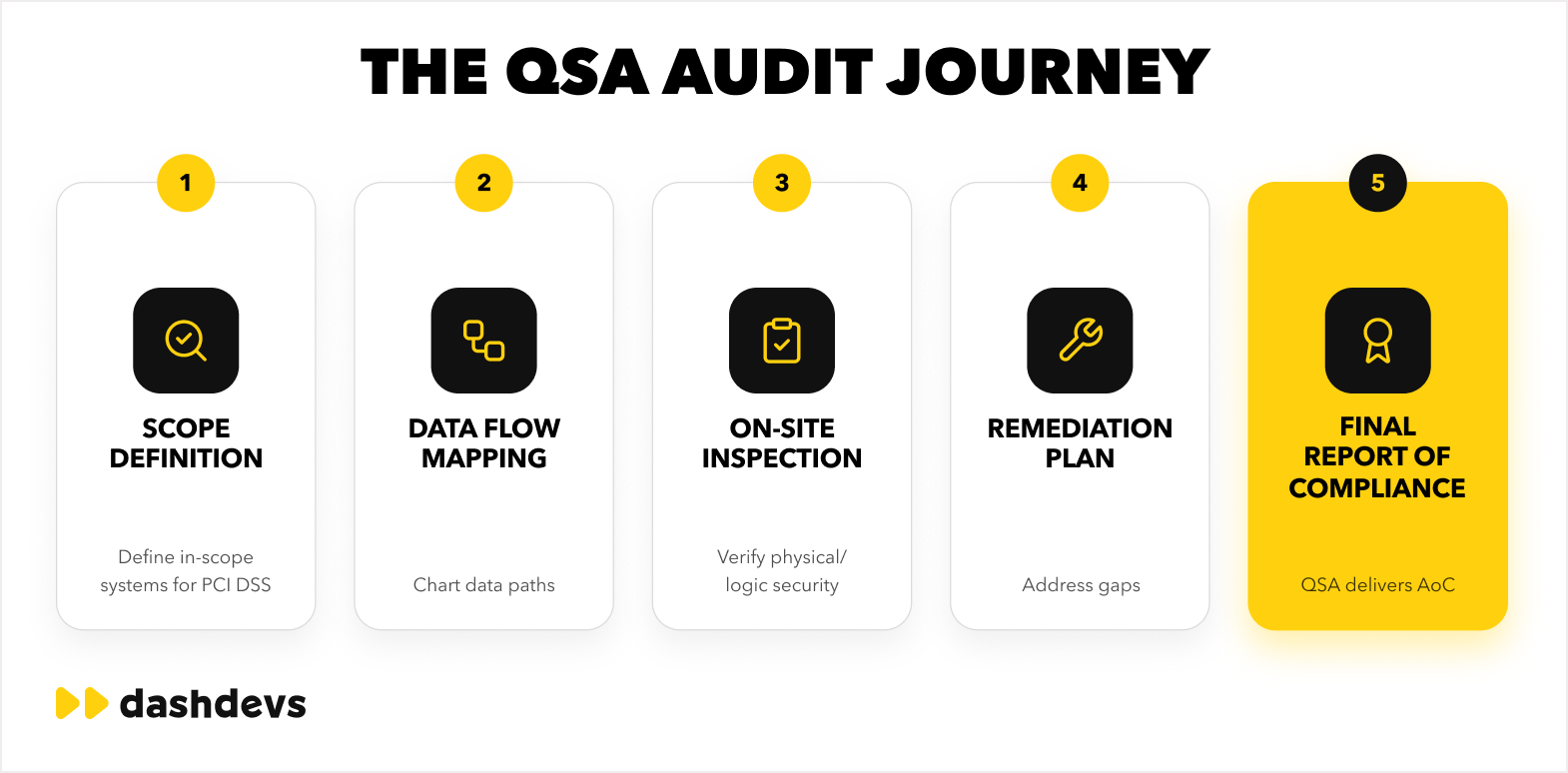
Scoping and the cardholder data environment
The first thing a QSA does is disagree with your scope diagram. The cardholder data environment (CDE) includes every system that touches primary account numbers (PAN) plus every system connected to anything that does. Most teams draw the boundary around where they intended card data to flow. The QSA draws it around where card data actually flows, which is almost always larger.
PCI DSS v4.0 requires documented scope review at least annually and after any significant change. An assessor will not accept a scoping claim without segmentation evidence. “We descoped it” as a verbal assertion does not survive a QSA review.
Scope sprawl is where most early-stage fintechs encounter their first major cost surprise. Application logs capturing partial card data, development environments with copies of production data, and email archives containing cardholder data all surface as in-scope during assessment. Scope creep of this kind causes 30–50% cost inflation in compliance programs.
The assessment: four parallel activities
A QSA audit has four activities. Each one surfaces a different category of problem for payment product teams:
Documentation review checks whether your network diagrams, data flow diagrams, and policies reflect how your system actually operates. Most early-stage teams fail here because the documentation was written during design and never updated after the first three sprints.
Personnel interviews are where the gap between policy and practice becomes visible. The assessor doesn’t only interview the compliance lead. They talk to the engineers, the DevOps team, and whoever handles access provisioning. If your on-call runbooks say one thing and your Terraform configs show another, that is a finding.
Process observation means watching how change management, access reviews, and incident response actually work. A written process that exists only in Notion and has never been run in a real incident will not satisfy a QSA.
Technical control testing covers configuration reviews, penetration test evidence sampling, and segmentation verification. For cloud-native payment products, this is where ephemeral infrastructure causes surprises. If your CDE boundary is defined by an IP range that changes every deployment, segmentation evidence is effectively absent.
The output is a Report on Compliance (ROC). It’s the formal document your acquirer, card network, or enterprise client will require. The ROC is accompanied by an Attestation of Compliance (AOC), which is used in vendor due diligence and partner onboarding.
PCI DSS v4.0.1: what changed
PCI DSS v4.0 became the only valid assessment baseline on 31 March 2025. The 64 requirements previously designated “best practice” are now fully enforced. There is no longer any valid basis for conducting an assessment against v3.2.1.
The most material changes for payment product teams are continuous monitoring requirements replacing point-in-time controls, expanded MFA scope covering all CDE access, application-layer security testing for payment page scripts, and phishing-resistant authentication for administrative CDE access.
These requirements affect CI/CD pipeline design, secrets management, access control architecture, and how development environments are separated from production. A product built without these as architectural constraints will have mandatory v4.0 gaps that a QSA will find.
Why engagement timing changes the outcome
The conventional model is to build the product, then hire a QSA to identify what to fix. The math is unfavorable.
A pre-audit scoping engagement typically costs $3,000–$8,000 and prevents $12,000–$25,000 or more in mid-audit remediation. The cost multiplier between pre-architecture compliance discovery and post-launch correction runs 10x to 40x across fintech build engagements.
Risk management in fintech frameworks consistently treat PCI scope as a first-sprint architecture decision, not a final-quarter compliance task. The three inflection points where QSA involvement changes architecture outcomes are:
- Before system design: A scoping consultation at this stage finds where your CDE boundary sits. This determines your tokenization strategy, network segmentation approach, and which third-party processors carry the compliance burden.
- During development: Not a formal audit, but a gap assessment against the 12 requirement areas. This is where payment page script security and logging controls are verified before they become ROC findings.
- Pre-launch: The formal assessment. A well-prepared team expects the ROC to confirm what they already know, not to discover what they got wrong.
Products built on Fintech Core, DashDevs’ composable payment and banking platform, include pre-built compliance-ready components: audit logs, KYC/AML workflows, access controls, and transaction processing with traceability built in. Teams using this infrastructure arrive with core requirement areas already addressed at the platform level, rather than building compliance evidence from scratch for each control.
For BNPL products and embedded payment platforms, DORA regulation compliance requirements now overlap with PCI DSS on ICT risk management and third-party vendor oversight. A QSA with regulated financial services experience will identify where these frameworks share evidence requirements, reducing duplicate compliance work.
What a QSA looks for in your architecture
What does a PCI compliance QSA actually examine that affects engineering decisions? The answer is more specific than most resources convey.
Segmentation and tokenization
Segmentation keeps your CDE small. A QSA will test whether segmentation controls (firewalls, network security groups, micro-segmentation, and zero-trust policies) actually isolate your cardholder data environment from adjacent systems.
Tokenization reduces the scope of systems that must implement all 12 requirement areas. A payment architecture that routes a PAN to a compliant payment processor’s hosted fields never touches your application servers. That shrinks your CDE materially. This is a system design decision, not a compliance configuration.
The payment processor vs. payment gateway distinction matters for scope. Your compliance perimeter depends on which component actually handles PAN and where it sits relative to your infrastructure.
Access control and logging
Under v4.0.1, MFA is required for all access to the CDE. The assessor verifies that your IAM architecture enforces this at the infrastructure level, not just in policy documentation.
The QSA also samples log evidence across requirement area 10 — log centralization, event correlation, anomaly alerting, and time synchronization across CDE systems. Applications not designed with centralized logging typically require infrastructure work to satisfy this requirement area.
Cybersecurity in banking frameworks treat logging as a first-class security control. DashDevs’ engineering teams treat logging architecture as a core infrastructure decision from the first sprint. The compliance benefit follows from good security engineering.
Here is how the scope consequence plays out across the three most common payment integration patterns:
| Integration pattern | Does PAN touch your servers? | CDE scope |
|---|---|---|
| Hosted payment page (iframe/redirect) | No | Minimal: your parent page may still carry 6.4.3/11.6.1 obligations |
| Direct API to processor (no hosted fields) | Yes | Full: your app servers, databases, and connected systems are in scope |
| Own card issuing / BIN sponsorship | Yes, plus storage | Maximum: ledger, HSM, and all downstream systems in scope |
This single architectural decision (which integration pattern you choose in sprint one) determines whether your QSA audit takes six weeks or six months.
What QSAs are finding in 2025–2026 assessments
Based on published QSA findings and assessor commentary from the 2025–2026 assessment cycles, the most common reasons assessments fail, or stall, are the following:
Missing script inventory on payment pages. Requirement 6.4.3 is absent in most environments that haven’t specifically been built for it. QSAs need evidence of authorization per script and a documented baseline, not just a tool that claims coverage.
Manual evidence instead of continuous evidence. QSAs need continuous monitoring logs, not screenshots taken during assessment week. This applies to both logging (req. 10) and payment page change detection (req. 11.6.1).
Assuming processor compliance transfers to you. Your payment processor being PCI compliant doesn’t make your environment compliant. Each entity in the data flow is assessed on its own controls.
Scope surprises from third-party integrations. Analytics tools, A/B testing scripts, and tag managers loading on payment pages all expand CDE scope. Most teams discover this mid-assessment.
How to find and evaluate PCI compliance audit companies
The PCI SSC maintains the authoritative PCI QSA list on their website. Any assessor you engage should appear there as an active QSAC. A company in remediation status can’t issue a valid ROC until that status is cleared, so check current status at the point of engagement.
Beyond active status, the evaluation criteria that matter for payment product teams are the following:
Fintech and payment infrastructure experience
Ask, “Can you walk me through an assessment you ran on a cloud-native card issuing or BaaS-adjacent environment in the last 18 months?”
An assessor who cannot answer with a specific stack and a specific finding is not the right partner for your build.
Pre-assessment engagement model
Ask, “If our acquiring bank sends questions about the ROC six months after it’s signed, is that covered?”
The answer separates compliance-event QSAs from compliance-partner QSAs. You want the latter — especially when you are growing transaction volume and approaching threshold escalation.
Cloud and API-first experience
Ask, “How do you handle CDE boundary definition for microservices with ephemeral infrastructure? What evidence do you accept for segmentation?”
If the answer defaults to IP-range-based segmentation controls, the assessor hasn’t kept up with how modern payment infrastructure is actually built.
When evaluating how to choose a KYC provider or any compliance vendor, the same qualification rigor applies to QSA selection. Credentials are table stakes, and operational fit with your team and stack is the differentiator.
QSA vs. ISA vs. compliance consultant
Teams approaching PCI compliance for the first time often conflate three distinct roles:
| Role | Who they are | What they produce | When you need them |
|---|---|---|---|
| QSA | PCI SSC-certified third-party company | Report on Compliance (ROC) and Attestation of Compliance (AOC) | Required for Level 1 merchants/providers; advisory role for others |
| ISA (Internal Security Assessor) | Employee certified by PCI SSC through employer | SAQ validation, internal audit support | Level 2 merchants as alternative to QSA-led SAQ |
| PCI compliance consultant | Security consultant without PCI SSC QSA certification | Gap analysis, remediation roadmap, SAQ preparation | Lower-level merchants preparing SAQ or pre-audit gap remediation |
The distinction matters operationally. A consultant prepares your documentation for a QSA review. An ISA validates your SAQ internally. Only a QSA can produce an ROC. Authority as a PCI DSS auditor doesn’t transfer to uncertified parties.
For cross-border compliance requirements, some jurisdictions require locally based QSA companies or assessors with specific regional certifications. European operations under DORA and PSD2 frameworks should confirm that the QSA understands local financial supervisor requirements alongside PCI SSC certification.
The cost of getting this wrong
The financial sector’s average breach cost reached $5 million in 2026. The PCI-specific cost layer adds card-brand monthly fines from $5,000 to $100,000 per merchant ID, card reissuance costs of $5–$15 per affected card, and mandatory PCI forensic investigator engagement of $200,000–$2 million for Level 1 entities following a breach.
Non-compliance penalties escalate rapidly: initial fines start at $5,000–$10,000 per month, rising to $50,000–$100,000 monthly if issues persist. At the extreme end, card networks terminate card-acceptance agreements, which ends a payment business.
For fintech products managing vendor relationships, fintech vendor reliance and the compliance perimeter of each partner relationship are areas a QSA will examine. Your assessment scope includes controls of any third-party service provider in your CDE data flow, not just your own systems.
3D Secure authentication and 3DS2 liability shift mechanics also sit within scope when they touch cardholder data flows. Authentication architecture choices affect both fraud liability and PCI compliance perimeter at the same time.
Final thoughts
A PCI DSS QSA is not a bureaucratic checkpoint. The assessor’s scope criteria define which systems your engineering team must harden, which architectural patterns reduce compliance burden, and which third-party relationships bring compliance obligations with them.
The fintech teams that arrive at their first formal assessment with minimal findings treat the compliance scope as an architectural constraint from the first sprint. Scope definition, tokenization strategy, network segmentation, and CDE boundary decisions made at design time determine audit outcomes.
Understanding what a QSA evaluates is, in practice, a prerequisite for building a payment product correctly — whether you are launching a neobank or adding card acceptance to an existing platform. DashDevs’ fintech software development teams treat PCI scope as infrastructure, not paperwork.
Share article
