


RPA in Insurance Claims Processing: How Robotic Process Automation Cuts Costs and Errors

September 30, 2026
- RPA removes the administrative layer that consumes adjuster capacity without replacing the human judgment those workflows feed into.
- 46% of claims professionals spend 30–40% or more of their working day on administrative tasks, a capacity that RPA directly releases for higher-value work.
- Insurers that implement claims automation report 40–70% reductions in cycle time.
- Legacy system integration is the most common implementation blocker.
The situation where you can think that your adjusters are slow and reviewers are careless isn’t unusual. But usually, the bottleneck is the process itself: manual data entry across disconnected systems, re-keying the same claim details three times, and waiting on a human to verify a document that could be checked automatically in seconds.
Most insurers know this. The harder question is where to start and whether the business case holds up at the scale of their operation. McKinsey’s 2025 insurance AI report notes that claims is one of the few domains where end-to-end rewiring produces measurable unit-cost impact, because commissions and claims together consume the largest share of every premium dollar. For a carrier processing 10,000 claims per month, even marginal inefficiency at each step compounds into significant rework, reserve misstatement, and compliance exposure.
RPA in insurance claims processing addresses that by deploying software bots to handle the repetitive, rule-based steps that consume adjuster time without requiring adjuster judgment. This article covers both the business case and what implementation actually involves.
The Cost and Error Problem in Manual Claims Processing
The numbers tell the story quickly.
| Metric | Manual processing | RPA-driven processing |
|---|---|---|
| Claims management cost reduction | Baseline | 20–40% lower with automation |
| Claims professional time on admin tasks | 46% spend 30–40%+ of hours on admin | Under 15% with RPA |
| Average cycle time (simple claims) | 5–15 days | 1–5 days |
| Fraud detection lag | Days to weeks | Hours to same-day |
| Data entry error rate | 4–7% | Under 0.5% |
The efficiency figures draw from McKinsey’s July 2025 insurance AI report and the Deloitte Center for Financial Services’ 2026 P&C claims analysis, which assessed nearly 4,000 customer data points across 12 US carriers. The admin time figure comes from the Rising Medical Solutions 2025 Benchmarking Study of 1,300+ frontline claims professionals.
Incorrect data at claims intake flows into reserves, finance systems, and compliance records. By the time a manual audit catches it, the exposure has already accumulated. Deploying RPA services on structured claims workflows addresses both problems at once: speed and data integrity improve together, because the bot follows the same logic every time.
Data accuracy in claims isn’t a quality-of-life issue. It is a solvency and regulatory issue at scale.
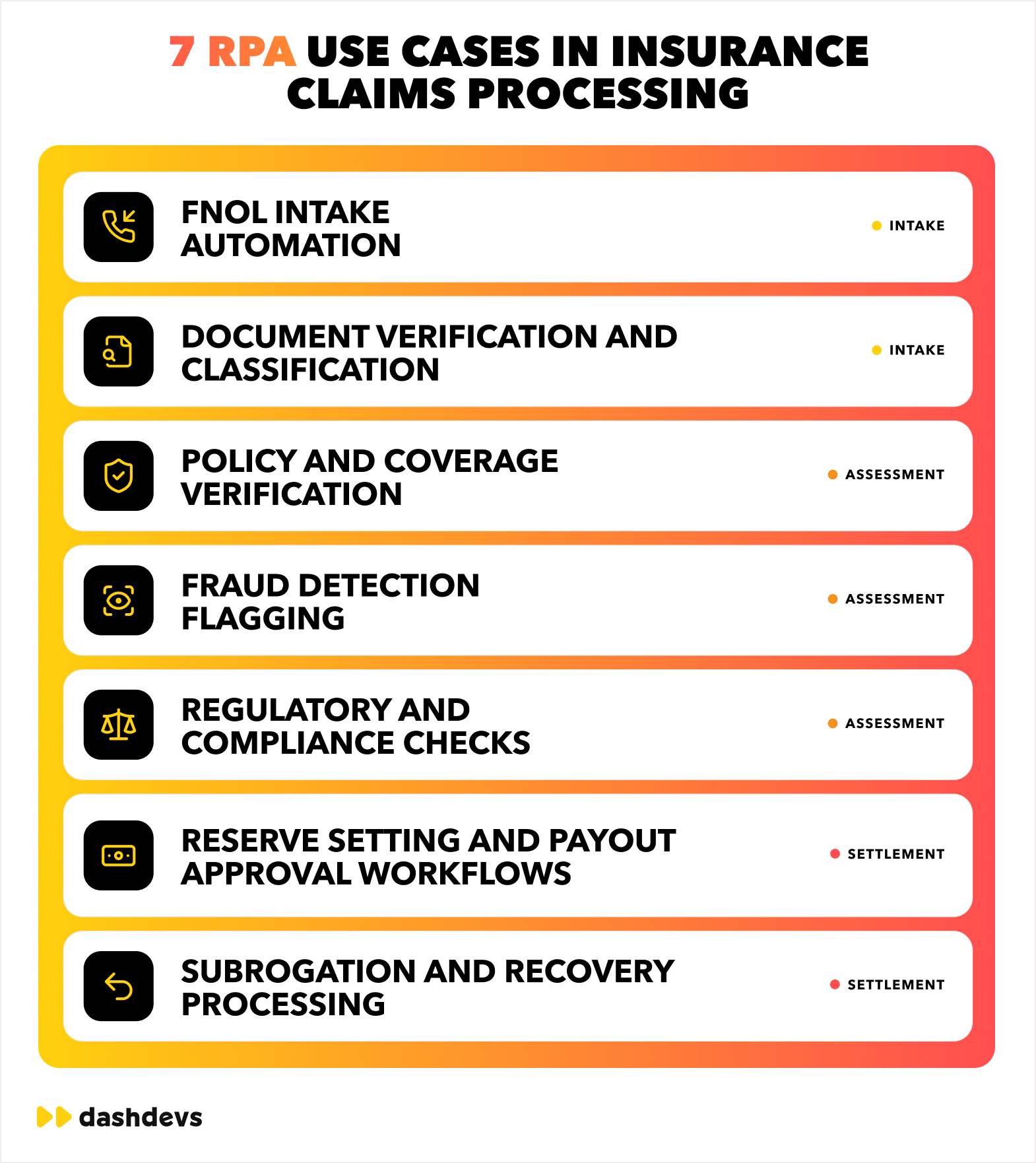
7 Claims Processing Use Cases Where RPA Delivers Measurable Impact
Robotic process automation works best on high-volume, rule-driven tasks where the steps are well-defined and exceptions are the minority. The use cases of RPA in insurance span the full value chain, but claims is where the ROI concentrates, partly because volume is high, partly because the manual burden is so visible.
1. First Notice of Loss (FNOL) intake
FNOL sets the tone for the entire claim. Policyholders submit through multiple channels: web forms, mobile apps, call transcripts, email, and agent portals. Someone has to pull the relevant data from each of them, validate it against the policy record, assign a claim number, and route the file to the right queue. When that is done manually, it is the first place a claim slows down.
RPA bots handle all of that as a single automated sequence. The adjuster’s file arrives pre-populated, pre-routed, and already validated. Intake time drops by more than 80% on standard submissions, and the misrouting that creates downstream delays largely disappears.
2. Document verification and classification
Claims files are a mix of police reports, medical records, invoices, photos, and signed declarations, arriving in inconsistent formats, sometimes incomplete, sometimes duplicated. Manual verification of that stack is slow and error-prone.
RPA bots combined with intelligent document processing use OCR to extract data from unstructured documents, classify each by type, check for completeness, and flag gaps before an adjuster ever opens the file. What took hours of review compresses to minutes.
3. Policy and coverage verification
After FNOL, someone needs to confirm that what happened is actually covered: check the policy management system, verify limits and deductibles, and confirm the policyholder’s status. Three or four system queries, all manual.
With RPA, it runs as a background process the moment the claim is logged. By the time an adjuster touches the file, coverage is already confirmed, and the relevant policy details are sitting in the claims system. One less thing to chase.
4. Fraud detection flagging
RPA in insurance claims doesn’t replace fraud investigators. What it does is handle the screening work that currently gets in their way. Bots cross-reference claim data against internal fraud databases, claims history, and industry watchlists in real time, applying rule-based scoring logic to flag duplicate claims, inconsistent incident dates, or address anomalies.
The investigators then work from a filtered queue of genuinely suspicious cases rather than reviewing thousands of clean claims looking for basic red flags. For a practical parallel in financial services, the same logic applies to fintech risk management. The rules differ, but the principle of automated triage feeding human judgment is identical.
5. Regulatory and compliance checks
Sanctions screening, anti-money laundering compliance, KYC validation on new claimants, and jurisdiction-specific documentation requirements. Every claim has a compliance layer, and running it manually is one of the most consistent sources of processing delays and missed obligations.
RPA bots run those checks automatically against integrated data sources and log every result with a full audit trail. For insurers operating across multiple jurisdictions, that consistency matters. A manual compliance process that works at 1,000 claims per month starts breaking down at 10,000. Automation scales without degrading.
6. Reserve setting and payout approval workflows
For low-complexity claims that fall within defined parameters, there is no reason a human needs to be in the loop for every approval step. RPA can calculate the reserve from coverage and loss data, generate a settlement recommendation, route it for sign-off, and trigger payment initiation in the accounts payable system, all without manual intervention.
This is straight-through RPA claims processing, and it is where the per-claim efficiency gains are most dramatic. Cases that previously spent three to five days moving through manual approval queues settle in hours.
7. Subrogation and recovery processing
Subrogation (recovering claim costs from liable third parties) is valuable work that tends to get deferred when teams are stretched. Identifying which cases have recovery potential, gathering the documentation, generating demand letters, and tracking follow-ups. All of it is repetitive, rule-based, and easy to automate.
Insurance process automation in subrogation consistently improves recovery rates. Carriers that have automated the identification and initiation steps report double-digit increases in recovery dollars, not because the legal or commercial strategy changed, but because the process runs more completely and more consistently than any manual team can sustain at volume.
Overcoming Legacy System Integration Challenges
For established carriers, the core system the bot must interact with is the primary implementation barrier. Most mature insurers run deeply customized legacy platforms (older Guidewire ClaimCenter installs, Duck Creek, or AS/400 mainframes), and the integration approach depends entirely on what those systems expose.
Where core systems offer REST or SOAP APIs, bots connect directly to the application logic layer, bypassing the UI entirely. This is faster, more stable, and immune to front-end changes that would otherwise break the automation.
Where no API exists, the bot reads the screen and interacts with it the way a human adjuster would, navigating fields, copying data, and submitting forms. It works, but it is brittle. A minor interface update can break the bot’s navigation logic and push claims into an exception queue.
Successful implementations isolate that brittleness early. Wrapping UI-based automations in real-time error monitoring and alerting a central maintenance owner when navigation logic breaks prevents silent failures in the claims pipeline.
Pro tip: Treat API access as a go/no-go for the first workflow, not a nice-to-have. After 17+ years shipping regulated products, the programs that stall are almost always the ones that discovered in week six that ClaimCenter only exposes the screen. Map the integration surface before you buy licenses.
Handling Unstructured Data: Beyond Basic OCR
Claims data rarely arrives clean. FNOL files include handwritten doctor’s notes, unstructured email bodies, police reports in varying jurisdictional formats, and low-resolution damage photographs. Standard OCR fails here because it reads coordinates, not context. If a medical invoice’s total field moves, the extraction breaks.
Where it gets operationally useful is confidence scoring. Every extracted field gets a confidence rating. High-confidence fields route straight into the claims system. Low-confidence fields go to a human review queue for that field only, not the whole document. Straight-through processing rates improve without removing human judgment where it is actually needed.
Before/After: What Changes When You Automate Claims
Speed is the obvious change, but it isn’t the most important one. Deloitte’s analysis of nearly 4,000 P&C customer responses found the claims process ranked lowest of all experience drivers in generating positive sentiment, yet with above-average influence on future purchase intent. Faster, cleaner claims processing directly affects whether policyholders renew. The J.D. Power 2025 U.S. Claims Digital Experience Study found only 4% of customers who rate their digital claims experience as excellent are at risk of switching, compared to 52% of those who rate it poor.
Error rates at the compliance layer fall sharply, reducing regulatory exposure and audit remediation costs. Faster settlements produce measurably higher retention. When catastrophe events spike claim volumes, bots absorb the surge without the onboarding lag a headcount response requires.
Compliance cost is the less visible side of the same equation. When incorrect data moves through a manual claims process, it generates audit findings, remediation work, and, in some jurisdictions, regulatory penalties.
RPA’s audit trail changes that exposure directly: every bot action is logged with a timestamp, data source, and decision rule, so internal audit and regulators work from a complete record rather than reconstructed documentation. That shift alone reduces remediation costs that most carriers never bother to measure until an audit forces the calculation.
How to Implement RPA in Insurance Claims Processing
Most failed RPA projects share the same starting point: the technology gets bought before the process is understood. Whether procuring RPA insurance services from a specialist or building in-house, sequencing is what separates implementations that deliver from ones that stall. For a detailed methodology, a step-by-step RPA implementation plan is a practical reference.
Step 1: Process audit and candidate selection
Map the current workflow end-to-end. Identify the highest-volume, most rule-driven tasks: FNOL intake, document classification, and coverage verification, where error rates are high and exceptions are rare. The goal is to find the bots most likely to succeed first.
Step 2: Bot pilot on one workflow
Pick one process. FNOL data entry is a common entry point. Run a controlled pilot, but do so with rigorous telemetry. Engineering teams must measure end-to-end API response times, compute load, and queue-processing speed against a documented baseline. Utilize process mining tools prior to the pilot to capture the exact keystrokes and time delays of the human workflow, ensuring you are measuring the bot’s cycle time, error rate, and exception volume against empirical data, not anecdotal estimates.
A successful pilot proves the infrastructure works in your environment and generates the hard data needed for the CFO’s approval to scale.
Step 3: IDP and OCR integration
Most claims workflows involve unstructured documents (medical records, repair estimates, handwritten forms), but pure rule-based bots need structured inputs. Adding IDP and OCR extends automation to that full document set. Most teams underestimate this step early and retrofit it later at higher cost; it belongs in the initial roadmap.
Most carriers run Guidewire, Duck Creek, or a legacy claims platform. RPA connects via API where available and falls back to UI-based automation for systems that expose no integration layer.
Step 4: Compliance and audit controls
Before any bot touches a compliance-sensitive workflow, a highly secure audit logging architecture must be deployed. In a regulated insurance environment, regulators require proof of how a machine made a decision. Every RPA action must generate a log detailing the timestamp, the specific data payload extracted, the logic rule applied, and the outcome.
These logs should be written directly to immutable cloud storage (such as AWS S3 with Object Lock or AWS CloudTrail) to guarantee they cannot be altered post-execution. By establishing strict IAM (Identity and Access Management) roles for the bots, you ensure SOC 2 and internal audit requirements are baked into the architecture, rather than retrofitted at high cost.
For KYC-related compliance processes, see our overview of KYC service providers.
Step 5: Scale across workflows
Once the pilot model is proven and the governance layer is in place, expanding to additional workflows is significantly cheaper than the first deployment was. The bot infrastructure, compliance logging, integration patterns, and exception-handling logic are already built. Each additional process inherits them.
The fourth workflow costs a fraction of the first. The infrastructure investment happens once; the value compounds across every process that runs on top of it.
Common Implementation Watch-Outs
Automating a broken process. A bot will execute whatever logic it is given, consistently and at scale. If the underlying workflow is inefficient, RPA makes the inefficiency faster and harder to reverse. Map and fix the process first.
Underestimating exception handling. Even the most structured claims processes generate exceptions: unusual document formats, policy edge cases, and claimants with complex histories. If the bot has no clear path for handling them, they stall in a queue and create a worse outcome than the manual process they replaced. Exception routing to human queues is part of the initial design.
Skipping change management. Operations staff who see automation as a headcount threat will route unnecessary exceptions, work around bots, or quietly undermine adoption. The framing matters: automation removes the administrative drag from a claims professional’s day. It doesn’t replace the professional. Successful deployments make that case early and visibly.
Unclear bot ownership post-deployment. Once bots are live, someone needs to own exception queues, monitor error rates, and update logic when workflows change. Without a named operational owner (typically a claims ops lead or a shared RPA center of excellence), maintenance debt accumulates silently until a process change breaks something in production.
Treating compliance as an afterthought. Automation in insurance runs inside a regulated environment. Data residency, audit logging, and regulatory reporting requirements must be designed from the start. Retrofitting them onto a live bot layer is expensive and usually incomplete.
Real-World Proof: DashDevs and the Centinel Insurance Platform
DashDevs partnered with Centinel, a US-based insurance platform, to deliver a working MVP in three months: automated risk assessment, contract generation, and claims data processing built on machine learning and process automation.
- 75% faster risk assessment: ML risk-scoring algorithms analyze datasets in real time, bypassing manual underwriting queues.
- 4x faster contract generation: Rules-based document assembly eliminated manual binding bottlenecks.
- 2x faster data processing: Real-time data routing eliminated API latency across the platform.
The result was an AWS-backed insurance platform MVP delivered in three months, with automated workflows for risk assessment, contract generation, and claims data processing.
The Centinel insurance case study covers the architecture and results in full.

The Connection Between RPA and AI in Claims
RPA for insurance increasingly runs alongside machine learning, and understanding the division of labor between them matters for anyone scoping an implementation.
RPA handles the process layer: data extraction, routing, compliance checks, system updates, and logging. ML models handle the decision layer: fraud likelihood, reserve estimates, claim complexity scoring, and subrogation potential. Neither works well without the other. RPA without ML misses the patterns that rules can’t capture. ML without RPA has no reliable mechanism for acting on its outputs at a production scale.
For teams building insurance technology from the ground up, our fintech product development work covers how the two layers fit together. The pattern holds consistently across financial services: see AI use cases in banking for the adjacent applications.
When Claims Operations Are Ready for RPA
Not every operation is at the same starting point. Understanding the use cases of RPA in insurance is useful; knowing whether you can execute is more practical. A few indicators that the conditions are right:
Claim volumes justify the investment. Carriers processing fewer than 2,000 claims per month typically see longer payback periods. A single-workflow pilot is the right entry point. It limits upfront cost while generating the baseline data needed to justify broader deployment.
The current process is documented well enough to map into bot logic. If different adjusters handle the same claim type differently, the process audit phase will surface that inconsistency before any automation is written. That is actually useful. It forces process standardization that should have happened anyway.
Core systems have accessible APIs or web interfaces. Legacy policy management and claims systems vary significantly here. Some expose clean APIs; others require UI-based automation that is functional but more brittle. Knowing which you have before scoping avoids the most common cause of budget overruns in insurance RPA projects.
The Rising Medical Solutions 2025 Benchmarking Study found 46% of claims professionals spend 30–40%+ of their working day on administrative tasks. If that figure looks close to home, it is a direct measure of the capacity RPA can release.
The Compounding Case for Claims Automation
The insurers pulling ahead on claims efficiency aren’t the ones with the most headcount. They are the ones that decided, at some point, to stop asking people to do work that software can do more reliably.
Robotic process automation insurance claims deployments typically pay back within 12–18 months, driven by reductions in processing labor, error rework, and compliance remediation costs. What comes after payback is the more interesting part: the cost advantage doesn’t erode. Bots don’t require salary reviews, don’t slow down under catastrophe-level volume, and don’t make the same data-entry mistake on claim number 8,000 that a tired adjuster might make on claim number 80.
RPA in insurance industry deployments has moved past the pilot stage at most carriers. The question is how much longer it makes sense to wait.
Share article
