


RWA Tokenization Companies: How Issuers Should Pick a Vendor

November 17, 2026
- RWA tokenization companies fall into four groups: issuance platforms, infrastructure providers, asset issuers and development partners. Compare vendors inside a group.
- Your asset class and jurisdiction narrow the list fastest. A tokenized money market fund and a tokenized building need different vendors.
- Issuance is the easy part. Most vendor differences show up after launch, in NAV pricing, redemptions, corporate actions and investor reporting.
- Buy a platform when your asset and investor model are standard. Build on infrastructure when you need custom compliance or a product of your own.
You searched for “top RWA tokenization companies” and got ten lists. Each one mixes fund issuers with custody providers and outsourcing agencies in a single ranking. Half of them put their own company at number one.
That makes it hard to compare anything.
This guide sorts asset tokenization companies by the job they actually do in the stack. Then it helps you decide what to buy and which vendor to call first.
What is RWA tokenization?
RWA tokenization, short for real world asset tokenization, is the process of representing ownership of a real-world asset, such as a bond or a building, as a digital token on a blockchain.
The token carries the asset’s rights and the rules about who can hold it. The legal ownership record and the custody of the underlying asset still live off-chain. Somebody has to connect both worlds.
That somebody is usually a mix of vendors. A real world asset tokenization platform handles part of the job, and infrastructure providers cover the rest. Which is why choosing one is confusing.
BlackRock’s CEO Larry Fink and COO Rob Goldstein summed up the regulatory view well:
A bond is still a bond, even if it lives on a blockchain.
— Larry Fink and Rob Goldstein, BlackRock, in The Economist
So every securities rule that applies to the asset still applies to the token. Keep that in mind as you read the list.
How big is the RWA tokenization market?
Tokenized real-world assets, excluding stablecoins, reached about $39.5 billion in distributed value in November 2026, according to rwa.xyz. On 16 November 2026 the same dashboard showed about $39.52 billion excluding stablecoins, as reported in industry coverage of that snapshot. Tokenized US Treasury products were around $14.2 billion in early November 2026.
Real estate is still tiny on-chain. rwa.xyz counted roughly $213 million of distributed tokenized real estate in November 2026, about 0.5% of the market.
That split matters for vendor choice. Most production experience in the market sits in funds and Treasuries.
How we selected these companies
We picked companies that meet three tests:
- They have live tokenized assets or production infrastructure, verified through public announcements or on-chain data
- They serve regulated issuers: banks, asset managers, funds or licensed platforms
- Their role in the stack is clear enough to compare against peers
We grouped them by role and listed them alphabetically inside each group. DashDevs appears in the development partner group, since that is what we do. We did not rank ourselves.
Looking for a wider view of the market? See our lists of blockchain development companies and blockchain consulting firms.
Before you read any vendor list (including this one), check who published it. If the author ranks itself first, read the criteria twice.
Top RWA tokenization companies compared
Here is the shortlist. Data reflects public sources as of November 2026.
| Company | Role | Asset classes | Token standard / model | Compliance and transfer controls | Custody model | Secondary trading | Chains |
|---|---|---|---|---|---|---|---|
| Securitize | Issuance platform | Funds, Treasuries, credit, private equity, stocks | Own permissioned token framework | SEC-registered transfer agent, broker-dealer and investment adviser | Via its broker-dealer and partners | Own SEC-regulated ATS | Multi-chain |
| Tokeny (Apex Group) | Issuance platform | Funds, securities, alternatives | ERC-3643 (creator) | Identity-based eligibility rules in the token | Integrates third-party custodians | Through partner venues | EVM chains, T-REX Ledger on Polygon CDK |
| Zoniqx | Issuance platform | Multi-asset | DyCIST (ERC-7518) | Jurisdiction rules embedded in token | Wallet partners | Distribution and trading modules | XRPL, Hedera, EVM |
| Brickken | Issuance platform | Private equity, debt, real estate, funds | Own smart contracts | Automated KYC/AML, EU focus | Pursuing MiCA custody licensing | Via partners | Polygon and other EVM chains |
| Centrifuge | Infrastructure (fund and credit protocol) | Treasuries, CLOs, private credit, index funds | Protocol-level fund tokens | Issuer-level investor permissions | Qualified custody via partners | DeFi distribution | Ethereum, Base and others |
| Ondo Finance | Asset issuer | Treasuries, tokenized stocks and ETFs | Own tokens (OUSG, USDY, Ondo Global Markets) | Investor gating per product | Qualified custodians | Via Oasis Pro broker-dealer and partners | Multi-chain |
| Fireblocks | Infrastructure (custody and tokenization engine) | Any, plus stablecoins | Pre-built or custom contracts | Policy engine, approvals | MPC wallets | Via Fireblocks Network counterparties | Multi-chain, including Canton |
| Taurus | Infrastructure for banks | Securities, deposits, structured products | CMTAT and others | FINMA-regulated securities firm | HSM and MPC custody | TDX marketplace | Ethereum, Polygon, Canton and others |
| Chainlink | Infrastructure (data, interoperability, compliance) | Any | Works with ERC-3643, ERC-1400 and others | Automated Compliance Engine | Not a custodian | Not a venue | Multi-chain via CCIP |
| Ripple | Infrastructure (XRP Ledger) | Treasuries, funds, commodities | Native Multi-Purpose Tokens | Credentials, permissioned domains | Ripple custody offering | Permissioned DEX on XRPL | XRP Ledger |
| DashDevs | Development partner | Bonds, sukuk, yield products, crypto-fiat | Built per project on chosen standard | KYC/KYT integrations, compliance workflows | Integrates custody providers | Builds trading venues and apps | Per project |
Vendors add networks every quarter. Treat the chain column as a starting point and confirm the current list in your RFP.
What types of RWA tokenization companies exist?
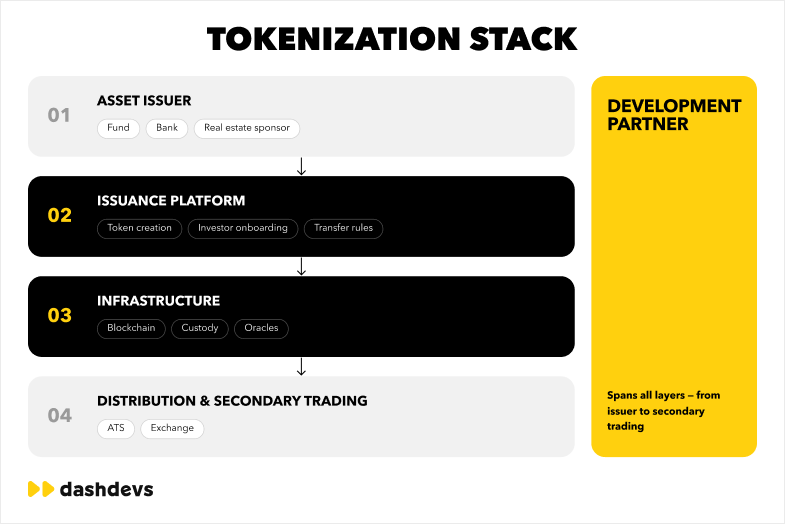
RWA tokenization companies fall into four roles: platforms that issue tokens, infrastructure that moves and secures them, issuers that create the assets and developers who build custom products.
Mixing these up is what makes most vendor shortlists impossible to compare.
Issuance platforms: ready-made tokenization software
RWA tokenization platforms give you a dashboard and APIs to create a token, onboard investors and manage the cap table. You bring the asset and the legal structure.
- Securitize is the most vertically integrated name here. It combines an SEC-registered investment adviser, broker-dealer, ATS and transfer agent, and reported $5B+ AUM as of July 2026. It is the issuance and transfer agent partner for BlackRock’s BUIDL fund.
- Tokeny created ERC-3643, the open standard for permissioned tokens. Apex Group acquired a majority stake in May 2025, and in 2026 Tokeny launched T-REX Ledger on Polygon technology.
- Zoniqx offers Tokenization Platform as a Service with its DyCIST token standard (ERC-7518), and has partnered with Ripple to bring multi-asset tokenization to the XRP Ledger.
- Brickken is a Barcelona-based no-code platform. It reports 150+ clients and more than $500M in tokenized value, with a strong EU focus.
Infrastructure providers: custody, data and rails
Tokenization infrastructure sits under the platforms. You use it directly when you build your own product.
- Fireblocks provides MPC custody plus a tokenization engine. Its network connects more than 2,400 institutions, from banks and exchanges to market makers.
- Taurus is a Swiss, FINMA-regulated securities firm that serves banks with custody and tokenization software, plus its TDX marketplace. In May 2026 it secured a MiFID II licence for EU-wide tokenization services.
- Chainlink supplies oracles and cross-chain messaging (CCIP), plus an Automated Compliance Engine. Its Digital Transfer Agent standard uses NAVLink to bring fund NAV on-chain for subscriptions and redemptions.
- Ripple backs the XRP Ledger, which activated Multi-Purpose Tokens on mainnet so issuers can launch bonds and funds without custom smart contracts.
- Centrifuge runs fund and credit infrastructure with strong DeFi distribution. It powers JTRSY and JAAA, the tokenized Janus Henderson Anemoy funds.
Asset issuers: companies that tokenize their own products
Ondo Finance is the clearest example. It issues tokenized Treasury products (OUSG, USDY) and tokenized stocks. In July 2026, its broker-dealer Oasis Pro Markets received FINRA authorizations to offer tokenized equities and funds to US investors.
Asset issuers can be your competitors. If you plan to launch a tokenized Treasury fund, treat Ondo as a benchmark to study. Planning on-chain yield products of your own? Our DeFi development services team can help.
Development partners: a team to build your stack
A development partner, or RWA tokenization development company, builds the product a platform cannot give you: your own investor app, custom compliance flows, bank integrations or a secondary venue. DashDevs sits here. For examples of our work, see the Kleos business case on tokenized yield vaults.
Buy a tokenization platform or build on tokenization infrastructure?
Buy a platform when your asset and jurisdiction match what it already supports. Build on infrastructure when either one is unusual.
Ready-made tokenization platforms save months when your case is standard. Use these five factors to decide.
| Factor | Points to buying a platform | Points to building on infrastructure |
|---|---|---|
| Asset type | Standard fund, Treasury or private placement | Sukuk, sovereign bonds, deposits, hybrid products |
| Jurisdiction | US or EU with a supported legal wrapper | Regulatory sandbox, GCC, multi-jurisdiction offers |
| Investor model | Institutional or accredited only | Retail, fractional, app-based investing |
| Integrations | Platform’s built-in KYC and custody are fine | Your own banks, KYC vendors, core systems |
| Lifecycle servicing | Simple NAV and redemptions | Coupons, Sharia rules, corporate actions, custom reports |
What building looks like in practice
We learned this on our work with Inablr on sovereign bond tokenization. Inablr is a Bahrain-based wealthtech that wanted retail investors to buy fractions of bonds and sukuk. Public reporting noted the platform aimed to lower the entry ticket to around $1,000 from the typical $200,000.
No off-the-shelf platform covered that mix: Islamic capital market rules, retail onboarding, bank connections and asset tokenization. So we built it, with KYC through Veriff and investor funds held in segregated bank accounts.
The first release shipped in 6 months. The partnership has now run 3+ years. Read the Inablr investment platform case.
Our stakeholders and investors are fully satisfied with the platform DashDevs has built for us.
— Anver Jalaldeen, CEO, Inablr
Honest admission: the tokenization code was the smaller job. Regulatory requirements and bank connections took far more of our time.
A faster middle path
If building from scratch sounds heavy, there is a middle ground. Fintech Core by DashDevs is composable fintech infrastructure and orchestration for launching, expanding, or modernizing regulated financial products. It gives teams a faster starting point than custom build, with more flexibility and control than traditional white-label or SaaS platforms.
It is typically 12 weeks into production, with 20+ vendor integrations available in Fintech Core. See how it supports compliant crypto-fiat infrastructure.
For a deeper decision guide on custody, read digital asset custody: Fireblocks vs building infrastructure. Need investor wallets too? See our crypto wallet development services.
What happens after issuance? The lifecycle most vendors skip
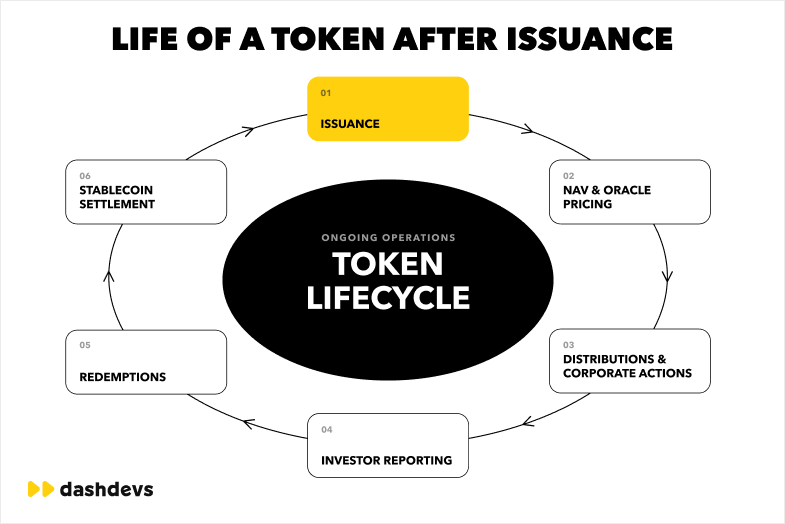
After issuance, your tokenization platform has to price the asset, process redemptions, run corporate actions, report to investors and settle cash. This is where vendors differ most.
Most reviews of RWA tokenization platforms stop at issuance. Your operations team lives with everything that comes next.
| Lifecycle task | What it involves | Questions to ask a vendor |
|---|---|---|
| NAV and oracle pricing | Publishing net asset value on-chain so subscriptions and redemptions use the right price | Who publishes NAV, how often, and what happens if the feed is late? |
| Redemptions | Burning tokens and paying cash or stablecoins back | What is the redemption window, and can it run on weekends? |
| Corporate actions | Coupons, dividends, splits, votes, maturities | Are these automated in the contract or handled manually? |
| Investor reporting | Statements, tax documents, regulator reports | Which reports are built in, and in which formats? |
| Stablecoin settlement | Paying subscriptions and redemptions in USDC or similar | Which stablecoins and on/off-ramps are supported? |
We saw the trading side of this lifecycle up close on a unified platform for digital asset markets.
Chainlink’s DTA standard shows where the market is heading: NAVLink pulls the authoritative NAV from the fund administrator and publishes it on-chain before a subscription settles.
If stablecoin settlement is on your list, our reviews of stablecoin API providers and crypto on-ramp and off-ramp providers will save you weeks of research.
What are the rules for RWA tokenization in the US and EU?
In both the US and EU, a tokenized security is still a security. New 2026 rules mostly change where and how tokens can trade.
Status as of November 2026:
- United States. On 17 September 2026, the SEC issued a five-year, conditional Innovation Exemption for permissioned trading of tokenized NMS stocks through automated market makers on Tokenized Securities Venues. It covers secondary trading only. Earlier in 2026, SEC staff stated that tokenized securities remain securities under existing law.
- European Union. The MiCA transitional period ended on 1 July 2026, so only authorised crypto-asset service providers can serve EU clients. Tokenized financial instruments generally sit under MiFID II rather than MiCA.
Rules move fast here. Ask every vendor which licences they hold themselves and which ones you will need.
Vendor due diligence checklist
Use this checklist before you sign with any of the top RWA tokenization companies:
- Which legal role does the vendor play (transfer agent, broker-dealer, custodian, software only)?
- Which token standard do they use, and can tokens move if you leave?
- How are investor eligibility and transfer restrictions enforced on-chain?
- Who holds the private keys, and what is the custody model?
- Which KYC, KYB and AML vendors are integrated? See our guide on choosing KYC vendors.
- How are NAV, coupons and corporate actions handled after issuance?
- Which secondary trading venues are connected, and under which licence?
- Which chains are supported today, and how does cross-chain movement work?
- What audits have the smart contracts passed, and how recent are they?
- What happens to your tokens and data if the vendor shuts down?
The last question is the one people skip. Please don’t.
Which RWA tokenization company fits your business?
Match your issuer type to a vendor group first, then compare vendors inside that group.
| Your situation | Best-fit option |
|---|---|
| Asset manager tokenizing funds | Issuance platform with transfer agent services (Securitize, Tokeny) plus NAV infrastructure (Chainlink) |
| Treasuries or money market fund issuer | Issuance platform plus fund infrastructure with DeFi distribution (Securitize, Centrifuge) |
| Private credit lender | Credit-focused infrastructure (Centrifuge) or a platform with lifecycle tools (Zoniqx) |
| Real estate sponsor | No-code platform with fractional ownership (Brickken, Zoniqx) |
| Bank adding tokenized deposits or bonds | Bank-grade infrastructure (Taurus, Fireblocks) with a development partner for integration into core systems |
| Smaller issuer with an unusual asset or market | Build on infrastructure with a development partner, using a framework like Fintech Core by DashDevs |
If you plan a secondary market for your tokens, our guide on building a trading platform covers the matching engine and liquidity side. We also offer trading platform development for regulated venues.
For a crypto-fiat product around the tokens, see how to build a fiat-crypto platform with a unified balance system.
Conclusion
The best RWA tokenization companies for you depend on your asset and your licences. Start by naming the role you need filled. Then compare three vendors inside that role, using the checklist above.
And if your product does not fit a platform’s template, that is fine. Most interesting tokenization products don’t.
DashDevs is a fintech product development company that designs, builds, and scales regulated financial products. 15+ years in regulated fintech, with delivery experience in tokenized bonds and digital asset markets. Ready to talk? Contact the team.
Share article
