


SME Digital Banking: How Fintechs and EMIs Can Launch Business Accounts Faster

October 8, 2026
- To launch SME business accounts faster, fintechs and EMIs rely on pre-integrated composable infrastructure rather than full custom builds, cutting time-to-market by up to 30%.
- SME digital banking is regulated infrastructure, IBAN issuance, KYB, and payment rails, not just a mobile interface for small businesses.
- Fintech Core typically reaches production in 12 weeks; a comparable custom build takes nine months.
- MVP scope is narrow: multi-user roles, IBAN, SEPA/Faster Payments, KYB, and AML screening. Everything else is Phase 2.
- KYB is the most common reason SME account launches slip, not technology.
- Your licensing model (own EMI, PI, BaaS) determines your product limits before a single line of code is written.
- An EMI adding SME accounts to a consumer wallet is a different build than a SaaS platform embedding business accounts. The infrastructure path is not the same.
- Liquidity cut onboarding time by 60% after restructuring its KYB flows.
Most teams building an SME account product treat it as a technology sprint. Connect the rails, issue a card, and ship the app.
Then the first business applicant submits incomplete UBO documentation. The manual review queue forms. The launch slips six weeks.
This guide is for CEOs, CPOs, and heads of product at licensed EMIs and fintechs adding SME digital banking to their stack. Not for banks modernizing portals. For operators who need to know what to build, in what order, and which infrastructure path gets them to market without rebuilding in Year 2.
DashDevs has built this layer for licensed institutions across the UK and EU, including Dozens, one of the UK’s first challenger banks, and Liquidity, a licensed EMI that cut onboarding time by 60%. What follows is what we learned.
SME Digital Banking Definition and Scope
SME digital banking is regulated financial infrastructure that enables licensed fintechs and EMIs to offer business accounts, payment rails, and team-level controls to small and medium enterprises. The scope covers IBAN issuance, KYB orchestration, multi-user approval flows, and AML screening.
That definition matters because it sets the scope. You are not building a consumer app with a business skin. You are building regulated infrastructure: IBAN issuance, KYB orchestration, multi-user approval flows, and AML screening. The technology is the easy part. The hard part is sequencing the decisions correctly before the build starts.
For teams earlier in the decision process, what it takes to build a digital bank covers the full scope before the SME-specific layer.
What an SME Business Account Needs at Launch
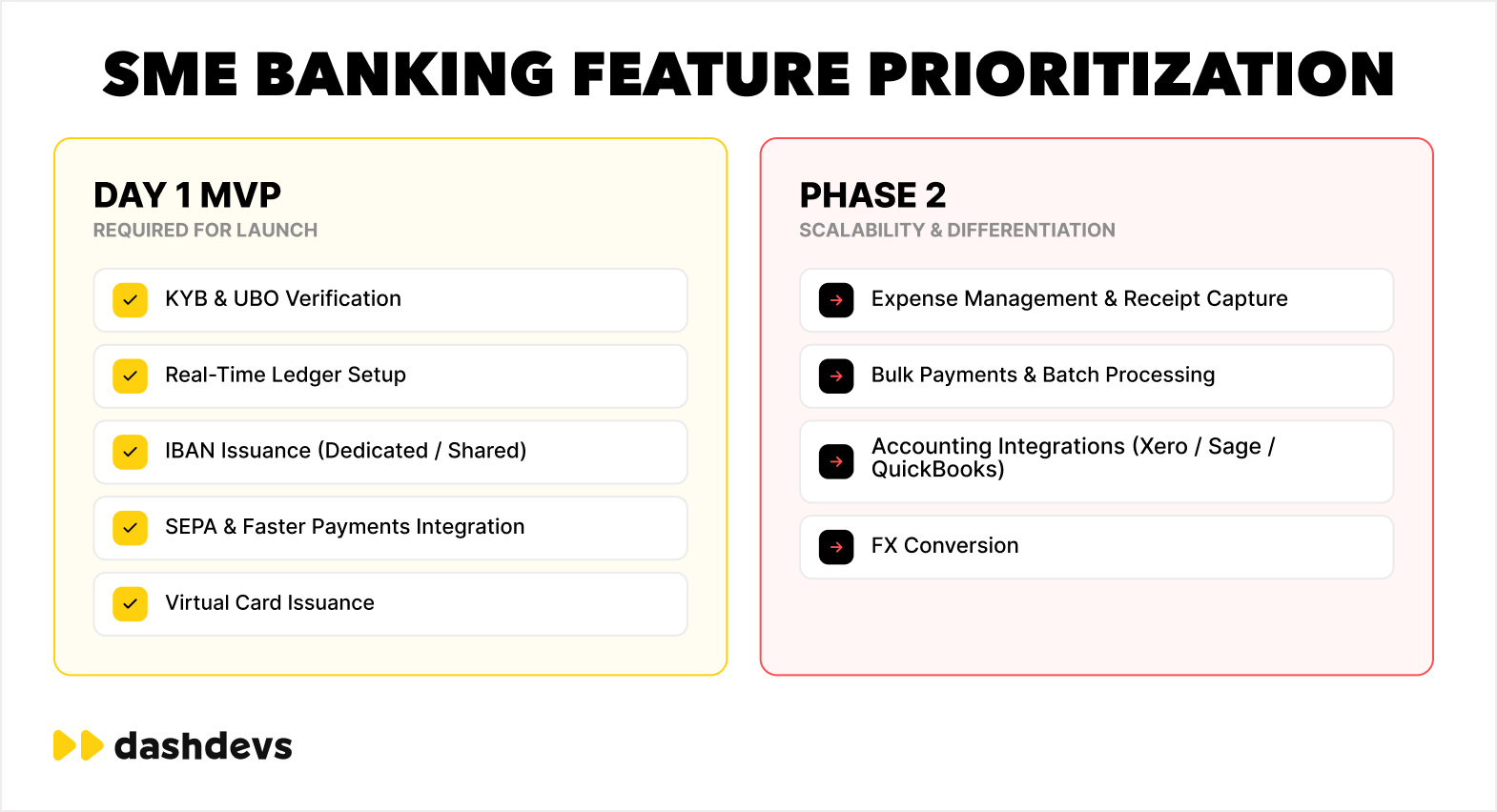
An SME business account needs KYB and UBO verification, IBAN issuance, SEPA/Faster Payments rails, multi-user approval workflows, and AML screening on day one. Everything else can wait for Phase 2.
Teams that miss their go-live date almost always scope too broadly. They include expense management, FX, accounting integrations, and bulk payments in the MVP. Then KYB takes longer than expected, the ledger needs rework, and Phase 2 features are blocking the launch.
The table below shows what must ship on day one and what can wait.
| Feature | MVP (Day 1) | Phase 2 |
|---|---|---|
| KYB and UBO verification | Required | |
| Multi-user roles and approval workflows | Required | |
| IBAN issuance (dedicated or shared) | Required | |
| SEPA Credit Transfer and Direct Debit | Required | |
| Faster Payments (UK-specific) | Required (UK) | |
| Real-time balance and transaction ledger | Required | |
| Basic virtual card issuance | Recommended | |
| Transaction monitoring and AML screening | Required | |
| Multi-currency accounts | Conditional* | Required |
| Physical business debit card | Required | |
| Expense management and receipt capture | Required | |
| Bulk payments and batch processing | Required | |
| Invoicing and accounts payable tools | Required | |
| Xero / Sage / QuickBooks integrations | Required | |
| FX conversion | Required |
*Multi-currency IBAN is day-one critical for products targeting international SMEs or cross-border sellers. For purely domestic products, it can wait.
The Ledger Decides More Than Teams Expect
The ledger architecture dictates multi-entity support, real-time reconciliation, and race-condition-free approval queues. Most teams treat the ledger as a backend detail, but if you get the architecture wrong, you discover it when the first enterprise client tries to configure a three-signatory approval flow. All of these capabilities trace back to a core ledger decision made in week two of the build.
The DashDevs guide to multi-account ledger system design at fintech scale covers the critical architecture choices.
The SME Bank Account Opening Flow is a KYB Problem
The SME bank account opening flow is fundamentally a KYB configuration problem that dictates whether a business goes live in ten minutes or ten days. While many teams treat account opening as a UX problem, in production, what triggers a manual review, what documentation each step requests, and how the result feeds back into account activation is what actually matters.
DashDevs has a dedicated guide to account opening solutions for teams evaluating providers at this layer.
The MVPs that ship on time make one hard call early: no expense management, no FX, and no accounting integrations in the MVP. The MVPs that slipped tried to be a full banking suite on day one.
Licensing and Partner Models for SME Business Accounts
The main licensing models for SME business accounts are an own EMI license, a Payment Institution registration, a sponsor bank or BaaS partner arrangement, and a licensed bank adding an SME line. Each model sets different limits on IBAN issuance rights, safeguarding obligations, and the transaction types available from day one.
The model you choose defines IBAN issuance rights, safeguarding obligations, and the transaction types available from day one. Most teams pick a model based on speed-to-market alone, then hit constraints they cannot engineer around eighteen months later.
| Model | Time to Launch | Account Control | Safeguarding | Compliance Burden |
|---|---|---|---|---|
| Own EMI license (UK/EU) | 4–8 weeks post-infrastructure | Full | High: client funds ring-fenced | High: ongoing FCA/NCB reporting |
| Payment Institution registration | 6–12 weeks post-infrastructure | Partial: no e-money issuance | Medium | Medium |
| Sponsor bank/BaaS partner | 8–16 weeks (partner onboarding) | Low: partner policy constraints | Delegated to sponsor | Shared: sponsor retains primary |
| Licensed bank adding SME line | 2–6 weeks (internal approval) | Full | Full: balance sheet | Highest |
Own EMI license gives you full control: IBAN issuance, client fund holding, and ownership of the onboarding flow. The safeguarding and reporting obligations are manageable with the right infrastructure from day one.
The BaaS partner model is faster to reach the market. Partner constraints on features and pricing are a ceiling most growth-stage fintechs hit inside eighteen months. The detailed breakdown in DashDevs’ guide to choosing between an EMI and a payment institution license covers exactly where the two paths diverge.
The UK and EU Require Different Compliance Architectures
In the UK, FCA safeguarding rules require segregation of client funds in a designated account or an insurance/guarantee product. No exceptions at the EMI level.
In the EU, PSD2 governs until PSD3/PSR is transposed.
Status as of October 2026: PSD3 and the Payment Services Regulation (PSR) are in the final stages of the EU legislative process. Full member-state transposition is not expected before late 2027. Build against current PSD2 obligations now and plan PSD3 modularization for 2027.
For fintechs pursuing a faster path to a digital business banking product without the full EMI obligation, a review of BaaS providers matters more than most teams expect. Partner constraints on geography, transaction limits, and acceptable business types have ended products that looked viable on day one. The episode on why EMI licenses hit a structural ceiling on Fintech Garden, the DashDevs podcast, covers how this plays out in practice.
KYB Onboarding: The Real Bottleneck in SME Banking Launches
KYB onboarding is the most common reason SME banking platform launches slip past their go-live date. UBO verification depth, document format inconsistency across markets, and the absence of a structured manual review workflow are the three friction points that consistently add weeks to the timeline.
Watch-outs: three friction points appear consistently across UK and EU projects.
#1 UBO verification breaks on non-standard structures
A UK Ltd with a single director-shareholder is a clean, fast lookup. A holding structure with a Jersey-registered intermediate, or an SME whose UBO is a trust, fails automated checks and enters manual review.
Most teams build no protocol for this. The queue grows faster than the ops team can clear it.
#2 Document formats vary by market and break single-flow assumptions
You cannot use one document collection flow across markets:
- A German GmbH presents a Handelsregisterauszug
- A Polish Sp. z o.o. presents a KRS extract
- A French SAS may have no certificate of incorporation in the English-language sense
Digital SME banking products that assume document uniformity either reject legitimate applicants or create manual exceptions for most non-domestic businesses. We covered the data inconsistency problem in depth on Fintech Garden, the DashDevs podcast, Episode 166.
#3 Ongoing monitoring doesn’t scale without automation
KYB isn’t a one-time check. A business that passed onboarding in January may have a new director by March.
Without automated company data refresh connected to Companies House, Handelsregister, or the relevant national registry, ongoing monitoring stays manual. At scale, it doesn’t hold.
Manual KYB review isn’t an edge case. It is a workflow. Build it intentionally, or it builds itself, and it will build ugly.
What 60% faster onboarding looks like in production: Liquidity, a licensed EMI on DashDevs infrastructure, restructured its KYB flows in two ways: pre-integrating an automated company registry lookup, and building a structured exception-handling queue for UBO edge cases instead of routing all exceptions to the same inbox. The result was a 60% reduction in onboarding time, measured across the first quarter post-launch. The figure reflects the period outcome across Liquidity’s full onboarding cohort for that quarter. Full breakdown of the Liquidity business case.
For teams building their own KYC integration from scratch, provider selection is only part of the answer. The orchestration logic is where the time-saving comes from.
The document inconsistency problem across EU markets is still largely unsolved at the provider level. Teams that rely on a single provider flow for multi-market KYB are building a manual review backlog from day one, whether they know it or not.
Build, Buy, or Partner: SME Launch Timelines Compared
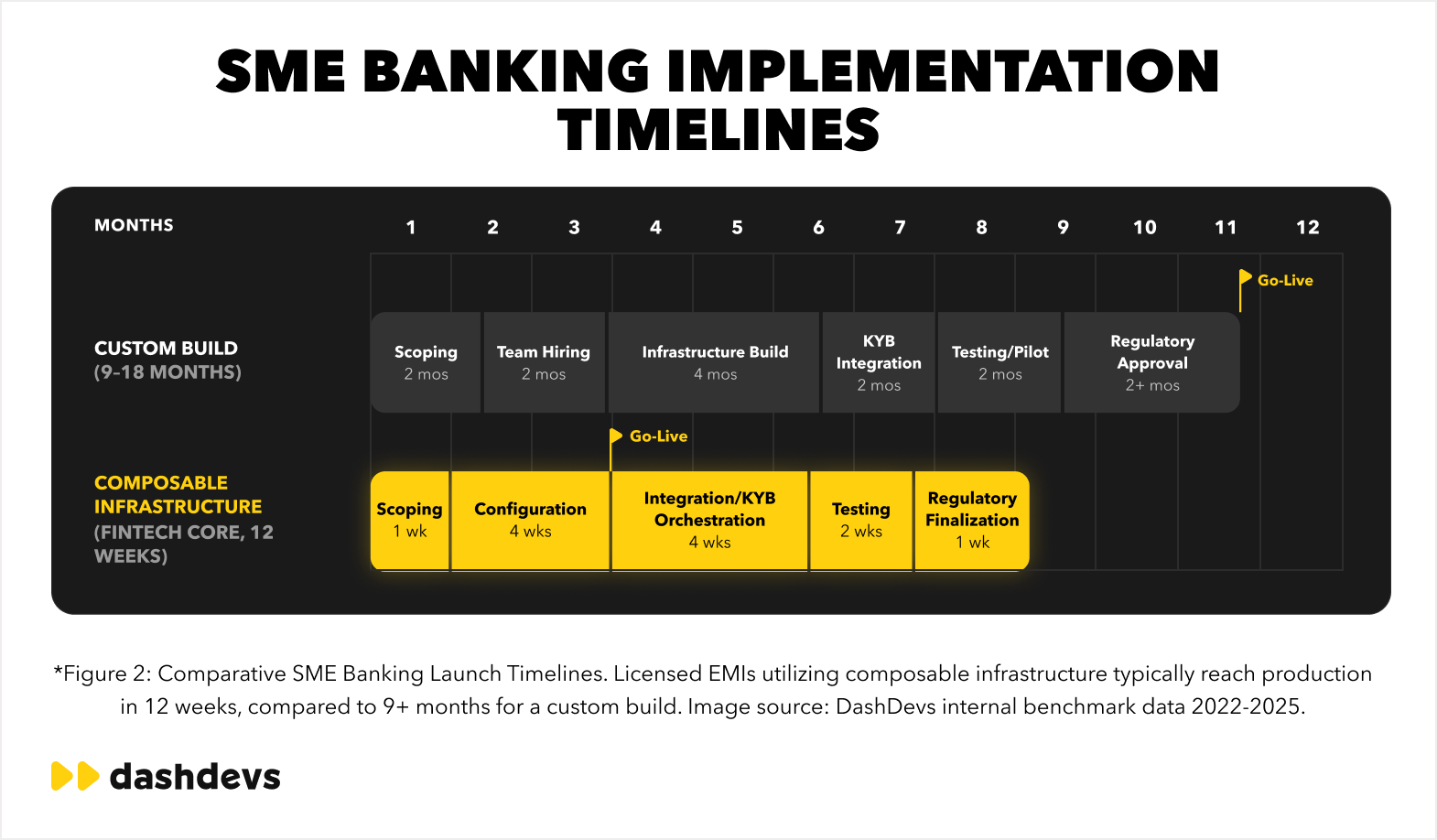
The three main paths for launching an SME business banking product are a custom build (9–18 months), a white-label or SaaS platform (3–6 months), and composable infrastructure such as Fintech Core (10–14 weeks). The right choice depends on how much time you have, how much product control you need, and how much compliance integration work you want to own. It is about how much time you have, how much product control you need, and how much compliance and integration work you want to own.
| Path | Realistic Timeline | Control | Key Risk |
|---|---|---|---|
| Custom build | 9–18 months | Full | Scope creep; regulatory review lag; hiring. |
| White-label / SaaS platform | 3–6 months | Low to Medium | Product ceiling; vendor dependency; price lock. |
| Composable infrastructure (e.g., Fintech Core) | 10–14 weeks | High | Configuration complexity requires technical ownership. |
Custom build: right only in specific situations
Custom build is the correct choice when your SME product requires proprietary differentiation. No pre-built module covers a sector-specific lending product or a vertically integrated treasury function, for example.
The benchmark is Dozens (Project Imagine). DashDevs built one of the UK’s first challenger banks in nine months, completing 40 vendor integrations and securing a dual FCA license. Nine months is fast for a full-stack custom build. Most teams without that accumulated integration library take longer.
White-label / SaaS: fast to launch, limited at scale
Most SaaS digital banking for SMEs platforms serve a single market, lock you into a fixed UX, and don’t expose the APIs needed for custom approval workflows or a proprietary KYB provider.
That is manageable at MVP. By Year 2, it becomes a competitive problem. Before committing to any platform, work through the core banking vendor due diligence checklist.
Composable infrastructure: the option most licensed EMIs underuse
Fintech Core is a composable fintech infrastructure and orchestration platform with 16+ pre-built modules and 20+ vendor integrations, covering payment rails, KYB providers, card issuers, and open banking connectors.
A licensed EMI adding digital SME banking to existing infrastructure typically reaches production in 12 weeks. The KYB orchestration, ledger, and payment rail connections are already built and tested under production load. That is what compresses the timeline.
The 30% faster time-to-market figure is a DashDevs internal benchmark derived from Fintech Core implementations completed between 2022 and 2025, across licensed EMI and PSP clients in the UK and EU. It reflects the reduction in integration cycles compared to equivalent custom builds scoped over the same period. Individual results vary by product complexity and existing infrastructure. The 12-week figure applies to mid-complexity digital SME banking account products where the EMI’s compliance infrastructure is already in place.
The most common miscalculation teams make when working through a build, buy, or partner framework for fintech infrastructure is treating custom build as the safe, controllable path. A 14-month build spans two product cycles. The operational risk of that timeline is often higher than the configuration complexity of a composable platform.
If virtual card issuance is a day-one requirement, the comparison of the best card issuing platforms is worth reviewing separately. Provider selection here directly affects your go-live date.
Three Mistakes That Delay SME Account Launches
The three most common mistakes that delay SME account launches are scoping the approval workflow for Phase 2, treating virtual card issuance as optional, and skipping reconciliation-friendly transaction formatting. All three are avoidable at the scoping stage and expensive to retrofit after go-live.
Watch-out 1: Scoping the approval workflow for Phase 2
Multi-signatory controls are the product for business accounts. An SME finance director will reject an account that routes all payments through a single approver.
Your approval flow needs role-based permissions (admin, approver, viewer), transaction limits per role, and a deferred-approval queue for out-of-hours requests.
DashDevs → Nexus platform project → approval workflow scoped for Phase 2 → first enterprise client rejected onboarding because dual-signatory was missing → workflow moved to Phase 1, adding three weeks to the launch timeline. The trade-off was predictable. The retrofit cost was not. Full context in the Nexus platform case study.
Watch-out 2: Treating virtual card issuance as optional
For SaaS subscriptions, supplier payments, and team expenses, a virtual card is the primary payment instrument.
Teams that defer virtual card issuing ship a business banking solutions product that misses their users’ most frequent payment need. The integration is not lengthy. The deferral decision usually comes from scope pressure. The cost shows up in activation rates.
Watch-out 3: Skipping reconciliation-friendly transaction formatting
Business customers export transaction data. They need references that match their invoicing system, merchant category codes that work in Xero, and bulk export formats their bookkeepers recognize.
Accounting integration is Phase 2. Reconciliation-friendly formatting is not. This is a data modelling decision made at ledger design. It cannot be retrofitted cleanly after go-live.
The broader digital onboarding in banking guide covers how onboarding architecture decisions compound from first login through daily active use.
SME Digital Banking Infrastructure: Which Path Fits Your Situation
The right infrastructure path for your SME digital banking product depends on your licensing status, your existing infrastructure, and whether your use case requires full product control or a faster route to market.
EU EMI adding SME accounts to an existing consumer wallet: Composable infrastructure is the natural fit. Licence, safeguarding, and AML infrastructure are in place. The build scope is the SME-specific layer: KYB flows, multi-user roles, and business IBAN issuance. Target timeline with Fintech Core: 10–14 weeks from scoping to production.
UK payment institution launching its first SME account: You need a sponsor bank or EMI partnership for IBAN issuance before anything else. Resolve the digital business banking relationship first, then evaluate infrastructure. A white-label product with the right sponsor can get you to market in four months.
Licensed bank launching a digital SME line: The license is not the constraint. Your existing core banking system is. DashDevs’ SME accounts payable platform for a major UK bank is the closest reference case for building a bank-grade SME product without replacing the core.
Vertical SaaS platform embedding business accounts: BaaS is almost always the right answer. Select a partner whose acceptable use policy covers your industry and use a composable front-end layer to retain product control. The breakdown of the open banking providers worth comparing is a useful reference for the API connectivity layer.
MiCA-licensed or crypto-regulated entity adding SME fiat accounts: KYB requirements are materially higher than for a standard EMI. UBO checks must cover the source of crypto funds. Custom KYB configuration is required, not a standard provider workflow. This is also a business banking platform decision with direct regulatory consequences: the wrong infrastructure choice delays FCA or BaFin approval, not just the launch date.
Sequence the Infrastructure Decisions First. The Product Follows.
Launching an SME digital banking product on schedule requires resolving the licensing model, KYB orchestration, and ledger architecture before product design begins. Teams that sequence these decisions correctly reach production faster and avoid the retrofitting costs that delay most launches.
The SME business account market in the UK and EU has room for more specialized operators: sector-specific accounts, embedded products inside accounting software, and accounts built for specific incorporation structures. The gap is execution capacity.
DashDevs builds the infrastructure layer that puts licensed EMIs and fintechs into production faster. If you need a partner for custom banking software development rather than a pre-built platform, that page covers the engagement model.
Check out DashDevs’ article on the fintech infrastructure for licensed PSPs and EMIs, in case you’re not sure where to start.
Share article
