


9 Types of Software Insurance Companies Use in 2026

November 19, 2026
- Insurance companies run a core trio (policy administration, billing and claims), plus rating and underwriting, distribution (agency management system and CRM), data and AI, and document and compliance software around it.
- The core trio is the system of record. Everything else connects to it through an integration layer.
- Core systems eat the budget. For large insurers, core represents more than half the total IT budget, according to Datos Insights.
- You rarely need a full replacement on day one. API wrapping and phased migration are often safer first steps.
- Pick vendors for their APIs and data migration path first. Features come second.
Ask ten insurance CIOs what software they run and you will hear twenty system names. A policy system from 2009. A claims tool bought last year. A CRM the sales team loves. Three spreadsheets that hold it all together.
Sound familiar?
This guide maps the software used by insurance companies, one layer at a time. You will see what each system does and how they connect. You will also get a practical framework for modernizing the oldest pieces without breaking the business.
What is insurance software?
Insurance software is any application that helps an insurer, MGA or agency sell, issue, bill, service or settle insurance policies, or analyze the data behind them.
Some of it is built for insurance only, like a policy administration system. Some is general business software adapted for insurers, like CRM or document management.
Different players need different software for insurance companies of their type:
- Carriers run the full stack, from core systems to AI.
- MGAs (managing general agents) need policy and billing tools, often as cloud subscriptions.
- Agencies and brokers live in agency management systems and CRM.
- Insurtechs usually build portals and APIs on top of a cloud core.
Together, these tools form the insurance technology stack. And the stack is big business: Gartner forecasts that global insurance IT spending will grow 9.4% in 2026 to $256.8 billion, as reported by ETCIO.
How does the insurance software stack fit together?
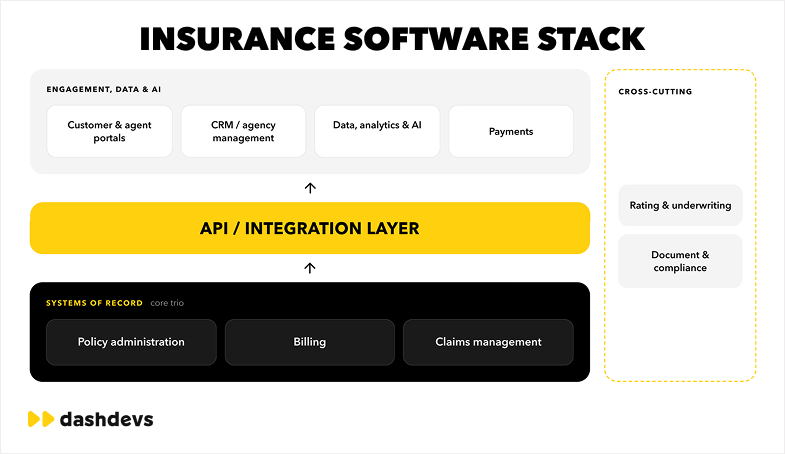
Insurance software works in three layers: core systems of record at the bottom, an integration layer in the middle and engagement, data and AI tools on top.
Most guides list tools in isolation. That hides the most important question: how do they talk to each other?
- Engagement, data and AI layer: customer and agent portals, CRM, analytics, AI models
- API and integration layer: APIs, event streams, payments, third-party data
- Systems of record (core): policy administration, billing, claims
Here is the full stack map, with the nine software types we cover below.
| # | Category | Role in the stack | Typical users | Example vendors (context only) | Legacy pain point |
|---|---|---|---|---|---|
| 1 | Policy administration system | Core: policy record, products, endorsements | Carriers, MGAs | Guidewire PolicyCenter, Duck Creek, Majesco, Sapiens | Months to launch a new product |
| 2 | Billing software | Core: invoices, installments, collections | Carriers, MGAs | Guidewire BillingCenter, Duck Creek Billing | Limited payment methods |
| 3 | Claims management software | Core: FNOL to settlement | Carriers, TPAs | Guidewire ClaimCenter, Duck Creek Claims | Manual triage, slow payouts |
| 4 | Rating and underwriting | Pricing and risk selection | Carriers, MGAs | Earnix, Guidewire, in-house rating engines | Rates buried in code |
| 5 | Agency management and CRM | Distribution, sales, service | Agencies, carriers | Applied Epic, Vertafore, Salesforce | Duplicate data entry |
| 6 | Portals and digital insurance platforms | Self-service for customers and agents | Carriers, insurtechs | Custom builds, vendor portals | Poor mobile experience |
| 7 | Payments and embedded insurance | Premium collection, payouts, partner distribution | Carriers, insurtechs, platforms | Payment processors, embedded insurance APIs | Checks and slow bank transfers |
| 8 | Data, analytics and AI | Reporting, fraud, pricing models | All | Data platforms, fraud and AI vendors | Data trapped in old cores |
| 9 | Document, compliance and workflow automation | Forms, regulatory reports, task routing | All | Document generation, RPA and BPM tools | Manual, paper-heavy processes |
The first three types are the core trio. Insurance core systems hold the legal record of every policy, invoice and claim. Let’s start there.
1. Policy administration system
A policy administration system (PAS) is the core software that stores every policy and runs its lifecycle, from quote and issuance to endorsements, renewals and cancellations.
It is the heart of an insurer. Product rules and policy documents all live here.
- Who uses it: carriers and MGAs. Agencies usually see it through a portal.
- Example vendors: Guidewire InsuranceSuite (PolicyCenter), Duck Creek, Majesco, Sapiens.
- Modernization priority: highest. A slow PAS slows every new product launch.
The pressure here is real. Datos Insights reports that two-thirds of large carriers are planning or continuing PAS replacements in 2026.
2. Insurance billing software
Insurance billing software creates invoices, manages installment plans, collects premiums and handles commissions, refunds and non-payment cancellations.
Billing sounds boring. Until a payment fails and a policy lapses by mistake.
- Who uses it: carriers and MGAs, plus agencies on agency-billed policies.
- Example vendors: Guidewire BillingCenter, Duck Creek Billing, Majesco Billing.
- Modernization priority: high, especially if customers ask for card payments or instant payouts.
3. Claims management software
Claims management software runs the claim from first notice of loss (FNOL) through investigation, reserving and payment to closure.
This is where customers decide whether your insurance is any good.
- Who uses it: carriers and third-party administrators (TPAs).
- Example vendors: Guidewire ClaimCenter, Duck Creek Claims, Sapiens.
- Modernization priority: high, with fast gains from automation.
Claims is also where AI adoption lags. In the WTW 2026 Advanced Analytics and AI Survey, only 25% of North American P&C insurers used analytics in claim triage models to route complex claims.
For a practical look at automating claims, read our guide to RPA in insurance claims processing.
4. Rating and underwriting software
Rating and underwriting software calculates premiums and decides which risks to accept, using rules engines and predictive models.
In property and casualty insurance, pricing analytics is now table stakes. Per WTW, close to 80% of insurers rely on advanced rating and pricing models, with another 11% planning to implement them soon.
- Who uses it: underwriters and actuaries at carriers and MGAs, especially in commercial lines.
- Example vendors: Earnix, rating modules inside Guidewire and Duck Creek, in-house engines.
- Modernization priority: medium to high. The goal is to let actuaries change rates without a developer.
5. Agency management systems and CRM
Agency management systems (AMS) and CRM tools manage clients, quotes, commissions and sales pipelines for agencies and carrier sales teams.
If you work at an agency, this is probably the screen you look at all day.
- Who uses it: independent agencies and carrier distribution teams.
- Example vendors: Applied Epic, Vertafore AMS360, Salesforce Financial Services Cloud.
- Modernization priority: medium. The biggest gains come from syncing the AMS with carrier systems so nobody retypes data.
6. Customer and agent portals
Portals let policyholders and agents get quotes, buy policies, pay bills and file claims online, without calling anyone.
When people talk about a digital insurance platform, they usually mean this layer plus the APIs behind it.
- Who uses it: carriers and insurtechs serving direct customers or agents.
- Example vendors: portal modules from core vendors, or custom builds on top of core APIs.
- Modernization priority: high for direct-to-consumer insurers. Your customers compare you with their banking app.
7. Payments and embedded insurance
Payment software collects premiums and sends claim payouts. Embedded insurance APIs let partners, like retailers or travel apps, sell your policies inside their own checkout.
This is where insurance meets fintech. And it is often the most overlooked opportunity.
- Who uses it: carriers, MGAs, insurtechs and distribution partners.
- Typical integrations: card processors, bank transfers, instant payout rails, digital wallets.
- Modernization priority: high if you sell through partners or want faster payouts.
Across client projects, DashDevs has integrated 70+ fintech providers. The same integration patterns that power banking apps work for premium collection and claims payouts. See our overview of financial API integration.
8. Data, analytics and AI
Insurance data and AI software turns policy, claims and external data into reports, fraud alerts, pricing models and automated decisions.
Artificial intelligence is moving fast here. Moody’s found that about 34% of North American insurers are implementing AI broadly across their organizations.
But insurers are drawing a clear line. In a mea Platform survey of 150 insurance leaders, 86% insisted people must retain authority over consequential decisions, while 83% backed AI for repeatable tasks.
- Who uses it: actuaries, claims teams, fraud units, finance and management.
- Example vendors: cloud data platforms, fraud detection vendors, AI model providers.
- Modernization priority: depends on your data. AI on top of messy legacy data gives you confident, wrong answers. Fast.
Our guide to practical AI use cases in financial services covers patterns that translate well to insurance. Want help applying them? See our AI solutions for fintech.
9. Document, compliance and workflow automation software
Document and workflow software generates policy documents, routes tasks between teams and produces the regulatory reports insurers must file.
This is the glue nobody notices until it breaks.
- Who uses it: operations and compliance teams.
- Example vendors: document generation tools, BPM platforms, RPA tools and low-code workflow builders.
- Modernization priority: quick wins. Workflow automation often pays back faster than any core project.
If you are weighing bots against deeper fixes, read about robotic process automation in financial services.
Why legacy insurance core systems are so hard to change
Legacy cores absorb most of the IT budget and hold decades of product rules, which makes them risky to replace and expensive to keep.
| Finding | Source |
|---|---|
| For large insurers, core represents more than half the total IT budget | Datos Insights |
| Nearly half of surveyed insurers run core platforms 6 to 10 years old, some over 15 | West Monroe via Insurance Business |
| 54% of insurers spend more than half their IT budgets just to keep systems running | West Monroe via PropertyCasualty360 |
| Average cost to implement a single core system is nearing $1 million | INTX survey via Carrier Management |
A Baringa expert put it bluntly when describing the industry: many insurers are likely sitting on a core insurance platform capability that’s 20, 30 years old.
Banks went through the same pain. Our guide on the digital transformation challenges banks face shows how they handled it. Our overview of core banking systems also shows how another regulated industry compares core vendors.
How to modernize legacy insurance core systems
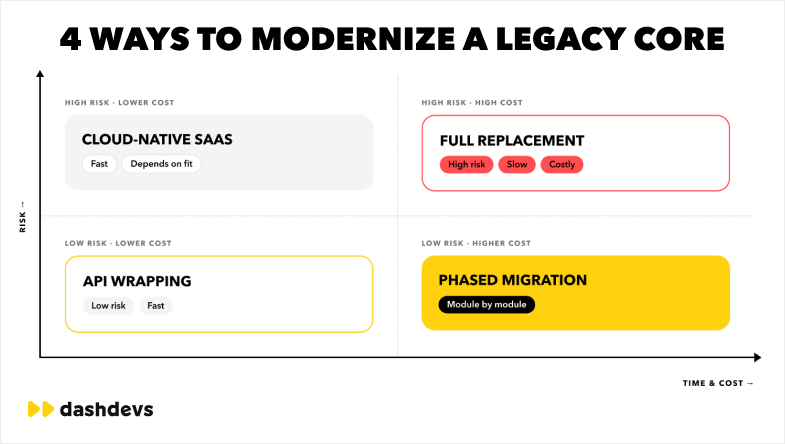
Choose between four paths: full replacement, API wrapping, phased module-by-module migration and cloud-native SaaS. Most insurers combine two of them.
| Approach | Cost | Risk | Timeline | Data migration effort | When to choose |
|---|---|---|---|---|---|
| Full replacement | Highest | Highest | Multi-year | Full | Core is unsupported or blocks every product change |
| API wrapping | Low to medium | Low | Months | Minimal | Core works, but channels and partners need modern access |
| Phased migration | Medium to high | Medium | Spread over years | Incremental, line by line | You can move one product line or module at a time |
| Cloud-native SaaS | Subscription | Medium (vendor dependence) | Fast for new products | Low for new books, high for legacy books | New products, MGAs, greenfield lines |
Cloud based insurance software is attractive for new books of business. Moving decades of legacy policies is a different project, so plan it separately.
Which approach fits your company?
| Your situation | Recommended path |
|---|---|
| Regional P&C carrier on a mainframe PAS | Wrap the core with APIs, then phase migration by line of business |
| MGA launching a new product line | Cloud-native SaaS core |
| Insurtech MVP | Custom build on cloud, with a clear path to scale |
| Large carrier with several acquired cores | Consolidate onto one platform in phases, starting with the smallest book |
| Insurer selling through partners | Add an API and payments layer first, then modernize the core behind it |
Before you commit to one vendor, read how to avoid vendor lock-in and our framework for weighing build vs buy for a core system. Different industry, same decision logic.
Start modernization at the integration layer. A clean API in front of your old core lets you launch new portals and partners now, and swap the core later without rebuilding them.
Fintech Core by DashDevs is a configurable layer for customers, payments, accounts, vendors, controls and reporting. It is not a bank, a licence or a BaaS provider. Some insurers use it to add payments and back-office workflows in front of a legacy PAS. See how Fintech Core is structured.
What we learned building Centinel
Centinel showed us that a focused MVP with automation at its core can reach the market in months, even on a tight budget.
Centinel is a US insurance app focused on secure, transparent coverage. You can read the full story in our work with Centinel on insurance automation. Three lessons stood out:
- Scope hard, ship fast. The budget was tight, so we prioritized essential features. A 4-person team delivered the MVP in 3 months, from October to December 2024.
- Automate the slowest steps first. We added ML-driven risk scoring and automated contract generation. Per the case study, risk assessment time dropped by 75% and contract generation efficiency increased 4x.
- Payments are part of the product. Stripe integration went in from the start. Premium collection should never be a phase-two problem.
A narrow MVP that real users touch teaches you more than a perfect architecture document.
For more on where the industry is heading, read our take on insurtech trends.
How to choose insurance software companies: a checklist
Use this checklist when you compare insurance software companies and their insurance software solutions:
- API maturity: are there documented, versioned APIs for policies, billing and claims?
- Data migration path: how will your legacy policies and claims history move?
- State regulatory reporting: does it support the filings and reports your states require?
- Vendor lock-in: can you export your data and swap modules later?
- Total cost of ownership: licenses, implementation, integrators and run costs over five years
- Configuration vs code: can business users change products and rates without developers?
- Security and compliance: certifications, audit logs, data residency options
For a more detailed list, adapt our vendor due diligence checklist for your next RFP.
Conclusion
The software used by insurance companies looks complicated because it grew one system at a time. Once you see it in layers, the picture gets simpler. Core systems hold the record, and everything else plugs into them through an integration layer.
Start with the layer that hurts most. For many insurers, that means a clean API layer and modern payments before any core replacement.
Ready to map your own stack? DashDevs is a fintech product development company that designs, builds, and scales regulated financial products. 15+ years in regulated fintech. 100+ financial products delivered. Talk to us about financial software development.
Share article
