


Stablecoin Banking Explained: How Companies Move Between Fiat and Stablecoins

August 3, 2026
- Stablecoin banking is the fiat edge—on-ramps, off-ramps, custody, and ledger reconciliation—not the token issuer alone.
- Headline on-chain volume is not bankable volume: only a small share of transfers is real-world payments that still need payroll-grade accounts.
- Banks underwrite three different stories (issuer, platform, corporate treasury) and reject when reserves, segregation, Travel Rule, or model clarity fail.
- MiCA (EU), FINTRAC (Canada), and the US GENIUS Act make corridor choice an architecture decision before partner selection.
- Register for the Stablecoin On/Off Ramps webinar (27 Aug 2026) for corridor economics, stack design, and approval reality.
Every company that touches stablecoins eventually hits the same wall: the money still has to land somewhere a payroll provider, a tax authority, or a supplier will accept. That “somewhere” is a bank account—and getting one willing to work with digital assets is often harder than the chain integration itself.
This is stablecoin banking: the plumbing that connects blockchain-based dollars to the accounts, ledgers, and compliance systems that keep a business running. It sounds simple in a pitch deck. In practice, it is where many stablecoin programs stall—and where crypto banking conversations should start.
The scale is real — the bankable share is smaller
Direct answer: treat headline transfer volume and “payments that still need a bank” as different metrics. Boards often conflate them.
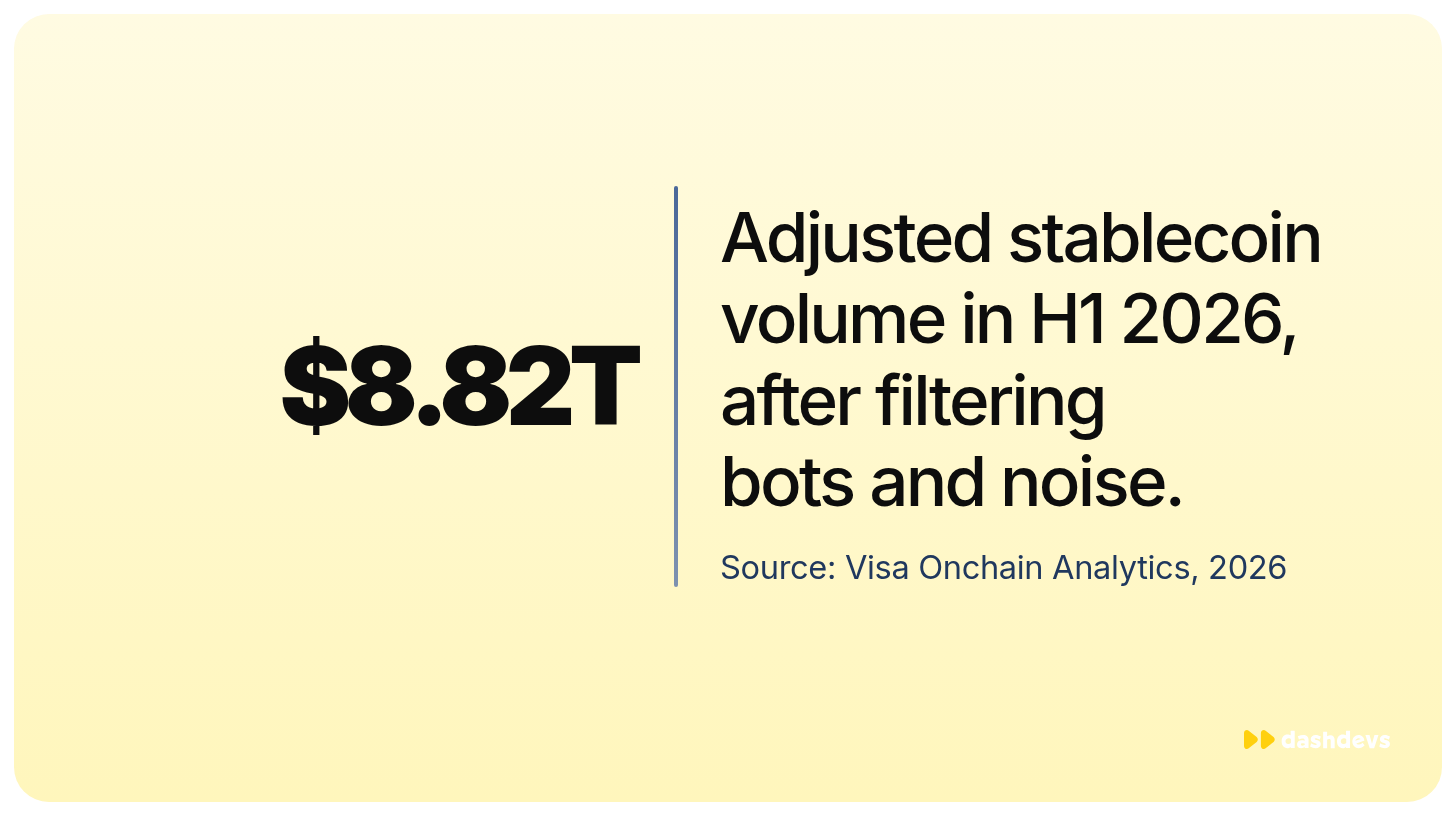
Visa’s Onchain Analytics (adjusted with Allium Labs to filter bots and non-economic noise) put stablecoin activity at a record $1.79 trillion in June 2026—about 63% above May and roughly 125% above June 2025—with about $8.82 trillion in adjusted volume in the first half of 2026. That is the demand curve sales decks cite.
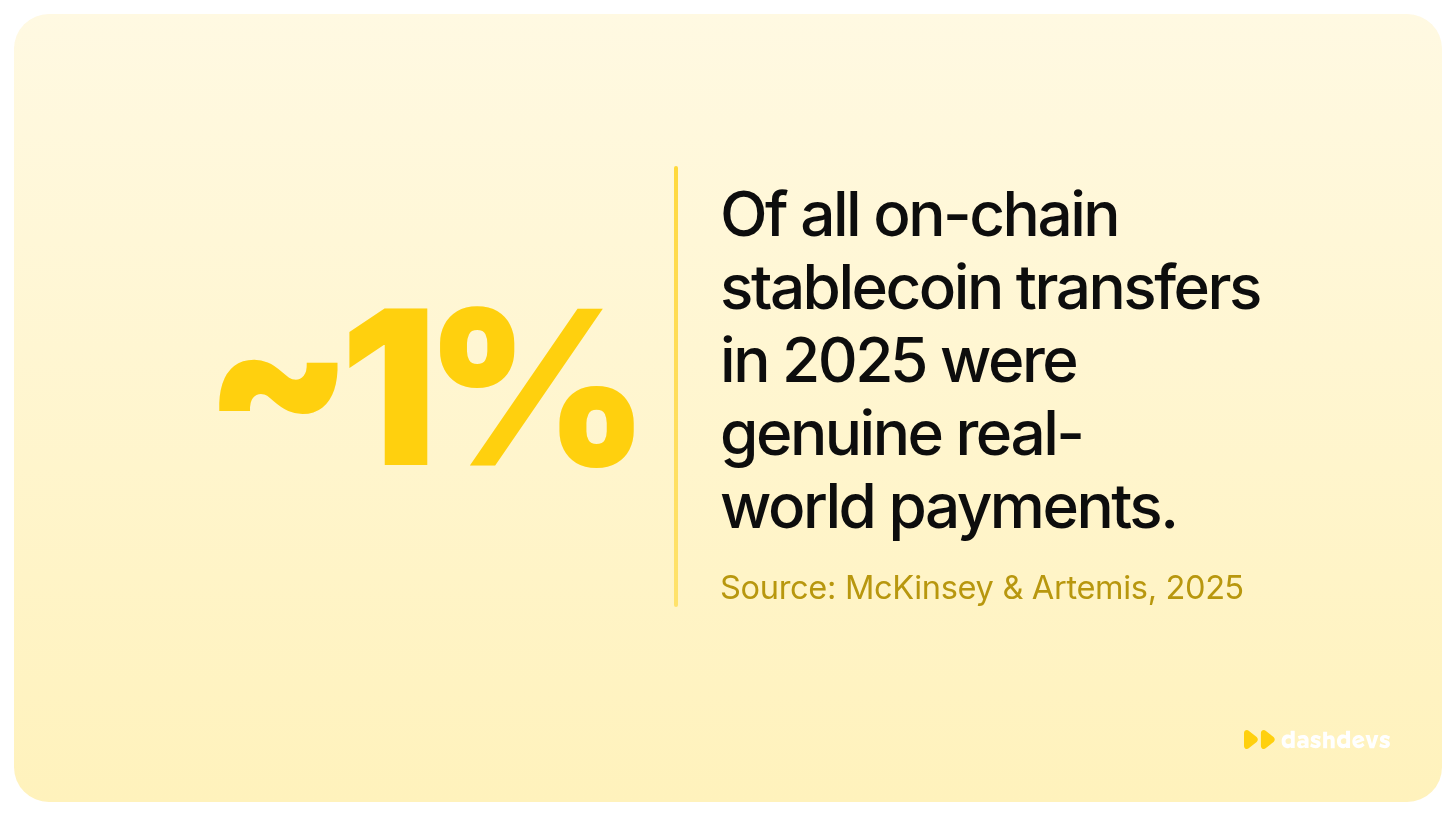
The operating curve is narrower. McKinsey and Artemis estimated that of roughly $35 trillion in 2025 on-chain stablecoin transfers, only about 1%—on the order of $380–390 billion—was genuine real-world payments (supplier settlement, payroll, remittances, and similar). Within that payments slice, B2B was about $226 billion. The chain can move trillions; the share that must clear a named fiat account is what forces a bankable setup.
| Metric | Figure | Banking implication |
|---|---|---|
| Adjusted volume (Jun 2026, Visa) | ~$1.79T | Demand signal—not proof your corridor is underwritable |
| Adjusted volume (H1 2026, Visa) | ~$8.82T | Rails are busy after bot filtering |
| Real-world payments (2025, McKinsey/Artemis est.) | ~$380–390B (~1% of gross transfers) | This is the slice that needs payroll-grade off-ramps |
| Of which B2B (2025 est.) | ~$226B | Corporate corridors dominate “real” use |
The stack behind on-ramps, off-ramps, and settlement
Direct answer: treat on-ramp, off-ramp, and custody as separate failure domains with different owners.
| Layer | What it solves | What breaks if it fails |
|---|---|---|
| On-ramps | Fiat in → stablecoins out | You cannot fund wallets or treasury on-chain |
| Off-ramps | Stablecoins in → fiat out that can be spent, paid, or reported | Payroll, taxes, and suppliers stop clearing |
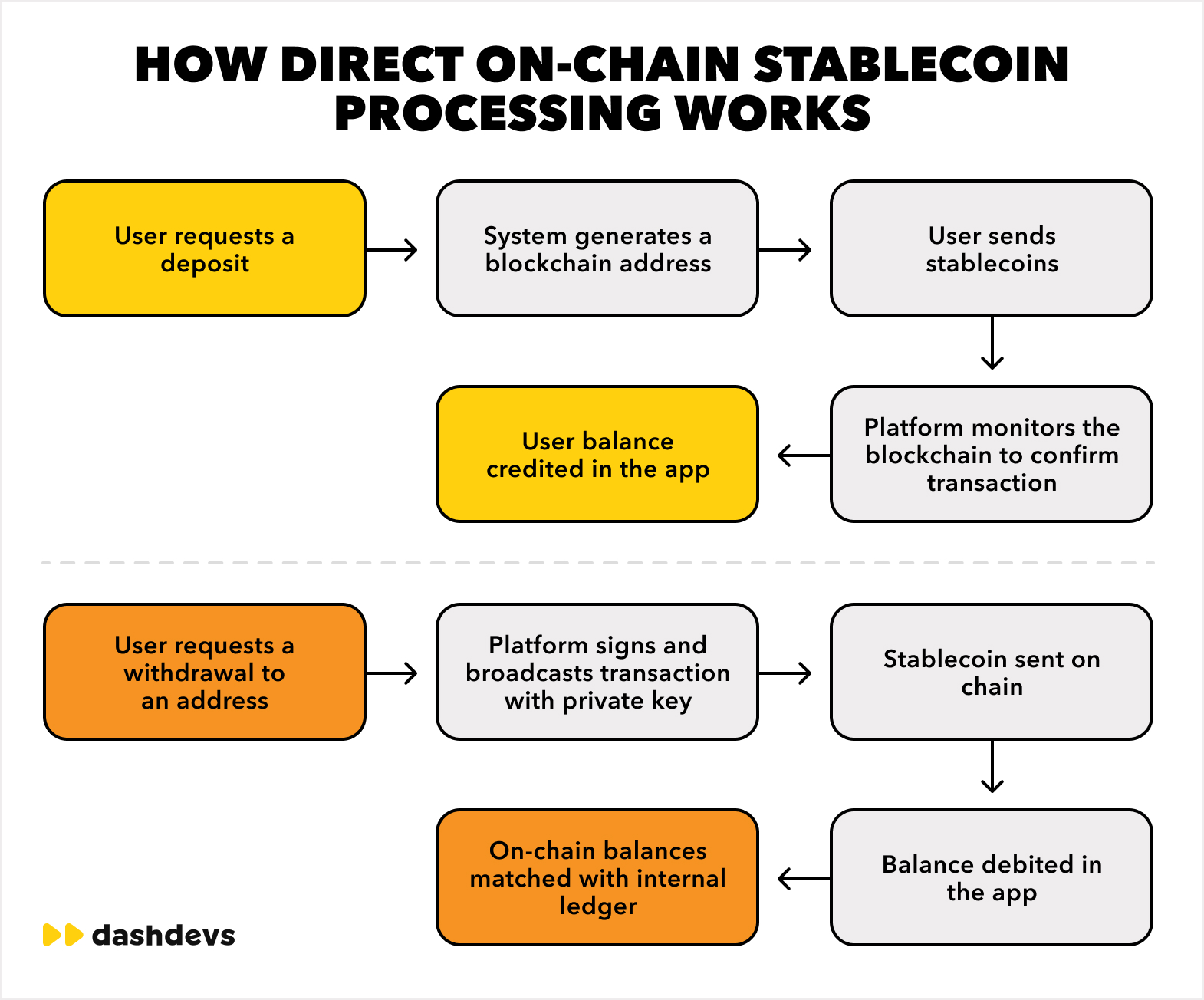
| Custody and settlement | Where funds sit, who controls keys, how ledgers reconcile to the bank | You cannot prove balances or survive an exam |
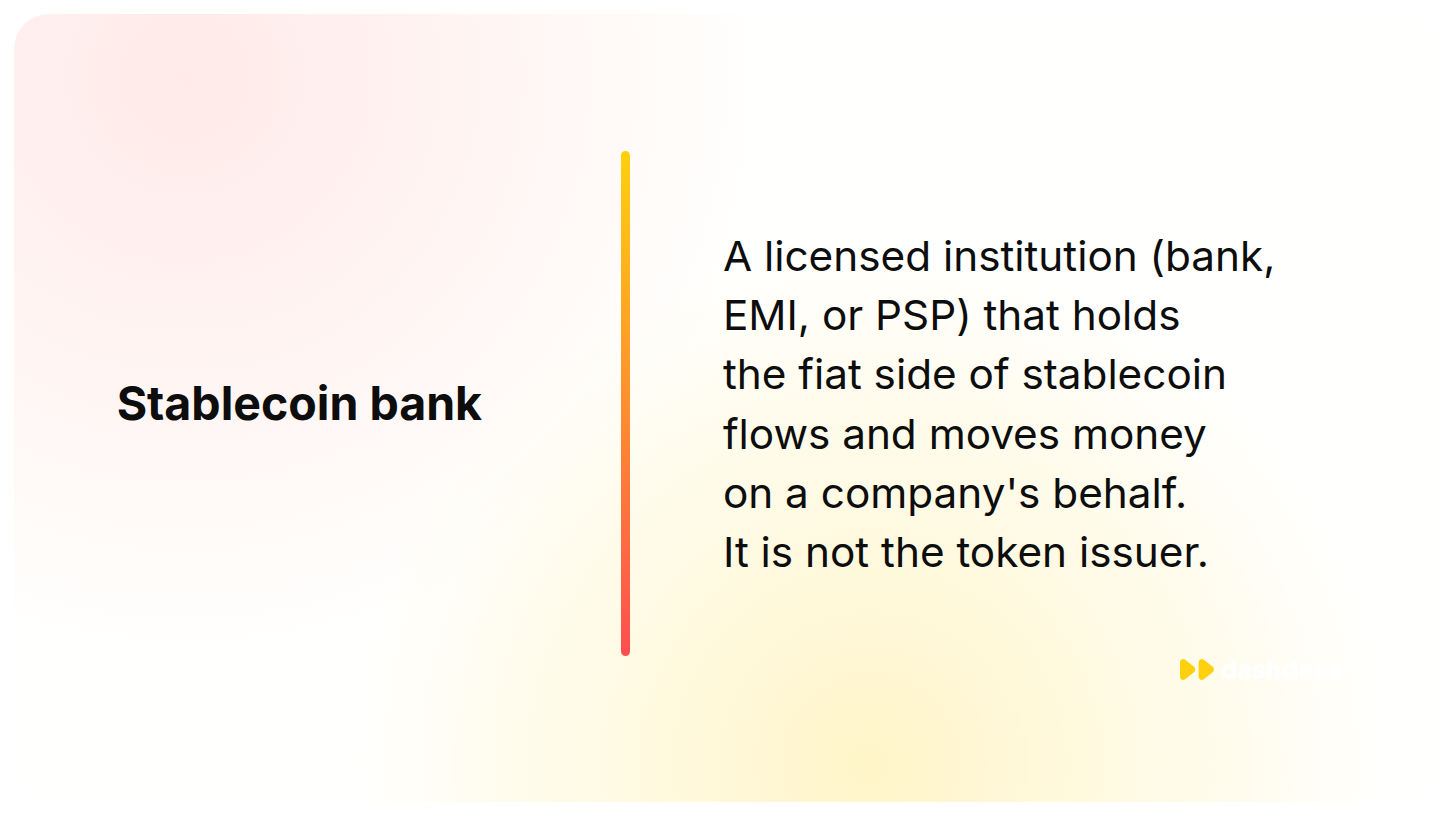
A stablecoin bank does not need to be a stablecoin issuer. Most of the time it is a licensed financial institution—a bank, EMI, or PSP—that holds the fiat side of these flows and moves money on a company’s behalf.
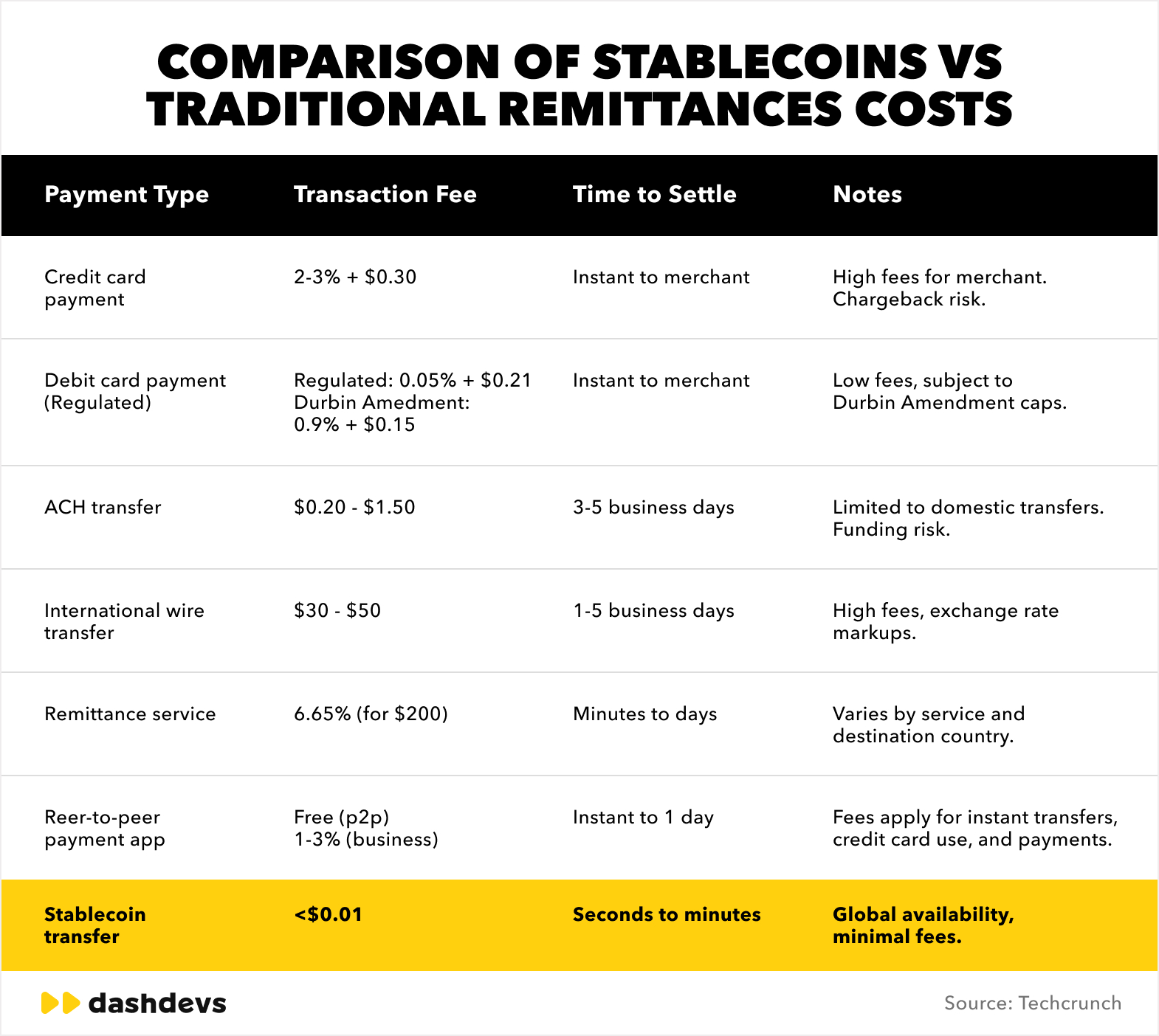
Finding stablecoin banks that will do this at workable stablecoins transaction fees is the selection problem. Stablecoin banking only works when that institution can clear your corridors and reconcile to your ledger—not when the token transfer alone succeeds.
Three underwriting stories get mixed up in the same sales call. Separate them before you apply:
| Who you are to the bank | What the bank actually underwrites |
|---|---|
| Stablecoin issuer / reserve program | Reserve composition, redemption, disclosures, issuer licensing |
| Platform / VASP moving customer funds | Client-money segregation, Travel Rule, transaction monitoring |
| Corporate treasury using tokens for settlement | Purpose of accounts, sanctioned counterparties, off-ramp counterparties |
Apply with the wrong story and you get a silent decline—even if a peer with a clearer narrative was approved last quarter.
Why traditional banking teams hesitate
Direct answer: most declines are risk-committee decisions about evidence, not moral judgments about “crypto.”
Ask founders who have tried to open a corporate account for a stablecoin-adjacent business and you hear the same arc: forms, calls, then a quiet rejection with no usable reason. There usually is a reason. Banks assess stablecoin compliance the way they assess any high-risk vertical—AML exposure, sanctions screening, and reserve transparency.
Recurring red flags:
- Unclear source and composition of reserve assets behind issued stablecoins—or marketing that implies deposit insurance or government backing (claims US issuers are explicitly barred from making under the GENIUS Act framework)
- No clean separation between operating funds and client funds (commingled FBO-style structures without reconciliation you can defend)
- Weak or missing Travel Rule / originator-beneficiary data for cross-border VASP transfers
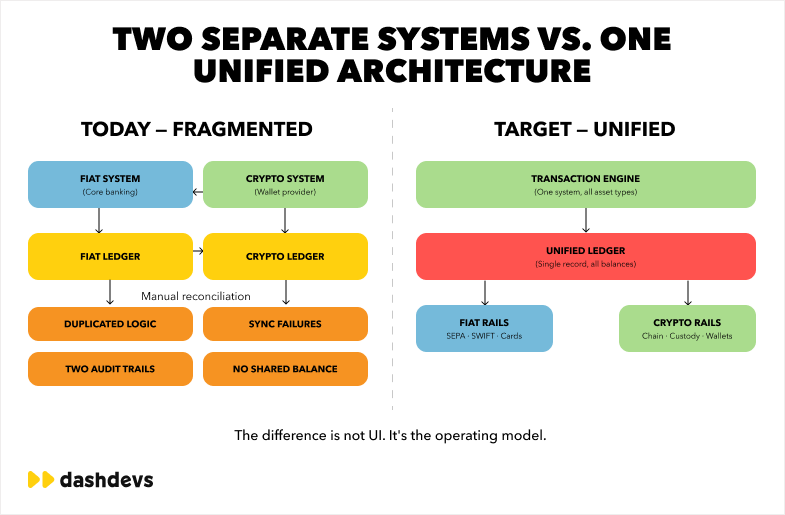
- Dual ledgers that cannot prove, on demand, that on-chain balances match bank cash and customer liabilities
- A business model the compliance team has never underwritten before—and no one-pager that maps money flows end to end
None of this means digital assets are inherently out of bounds. It means a financial institution needs a paper trail it can defend to its own regulator. Design for that constraint and rejection letters become a requirements list.
The regulatory patchwork that decides which banks can say yes
Direct answer: there is no single global rulebook. Corridor choice is a product decision.
- MiCA in the EU: rules for asset-referenced tokens (ARTs) and e-money tokens (EMTs) applied from 30 June 2024; the broader crypto-asset service provider regime applied from 30 December 2024, with national transitional windows running into 2026 in some member states (ESMA MiCA overview). European banks increasingly ask whether the tokens and CASPs in your stack are on the authorized path.
- FINTRAC in Canada: money services businesses and dealers in virtual currency must register, screen customers, and report (FINTRAC). Banking partners will check that registration and your monitoring program—not only your product demo.
- The US GENIUS Act (signed July 2025) creates a federal framework for payment stablecoins—1:1 reserves in cash and short-term Treasuries, monthly reserve disclosures, BSA obligations, and limits on misleading “insured / legal tender” claims. Core obligations phase in toward an effectiveness window anchored around early 2027 as agencies finish implementing rules. Banks will underwrite to that trajectory even before every rule is final.
These regulatory frameworks do not only bind issuers. They constrain which commercial banks and EMIs will open accounts for stablecoin-adjacent businesses, and under what conditions. A setup that clears one corridor can be dead on arrival in another.
What a working architecture looks like
Banking approval is only half the equation. The payment rails underneath have to hold up day after day.
Custody first: self-custody, qualified custodian, or hybrid—and how that choice affects liquid assets management and audit evidence. Most teams eventually face a Fireblocks-versus-build decision; the practical trade-offs are in our digital asset custody guide.
Wallet policy next: hot, cold, or MPC—and how signing policy connects to bank settlement cutoffs. Product teams also need a clear stance on digital wallet types before they promise consumer UX they cannot reconcile.
Then the provider stack: custodians, on/off-ramp partners, and banking rails assembled so a single vendor outage is not an extinction event. Where custody risk must stay off your balance sheet, non-custodial wallet patterns are a design option—not a compliance free pass.
This is where the case for stablecoin payment rails over correspondent chains gets made in cost and availability terms—not slogans. Lower fees and 24/7 settlement only show up if banking and custody are designed together.
Dual-rail products should treat a unified fiat and stablecoin balance system as a core requirement: one customer liability view across rails, with reconciliation that survives an exam.
Operational non-negotiables most pitch decks skip:
- Named reconciliation owner (finance or ops) with a daily break threshold
- Documented client-money flow (who is the account holder; who is the beneficiary)
- Sanctions and Travel Rule RACI between you and every VASP / bank in the path
- An exit drill: how you move customers and balances if a partner exits crypto
Where companies actually get stuck
The pattern across failed account applications is rarely the chain. It is mismatched expectations. Founders assume an existing traditional banking relationship for the fiat business will carry over the moment stablecoins appear. It rarely does. Compliance re-underwrites purpose of account, counterparties, and settlement from scratch. Mature stablecoin banks ask for that evidence early; weaker partners discover the gap after deposits are already live.
Companies that get through tend to share habits:
| Habit | Why banks care |
|---|---|
| Document liquid assets, reserves, and redemption clearly | Examiners need redeemability evidence, not marketing PDFs |
| Build risk management into the product early | Retrofit AML and Travel Rule stacks fail under volume |
| Treat the bank as an ongoing partner | One-time approval without ongoing visibility decays into exit |
If your model is direct fiat-to-crypto conversion, the licensing and banking hurdles look a lot like launching a money exchange business.
Consumer-facing products often pair that path with white-label banking on a modular core so ledger and compliance layers stay replaceable as corridors change.
Every path collapses into corridors
Every serious stablecoin banking conversation becomes a corridor conversation: which countries can send, which can receive, and which institutions in between will touch the transaction. That is true whether you are already running cross-border payments at scale or evaluating tokens for supplier payout for the first time.
For the B2B economics of tokenized dollar rails versus correspondent chains, see our guide to stablecoins for cross-border payments. Corridor math only works if the banking relationship on both ends holds.
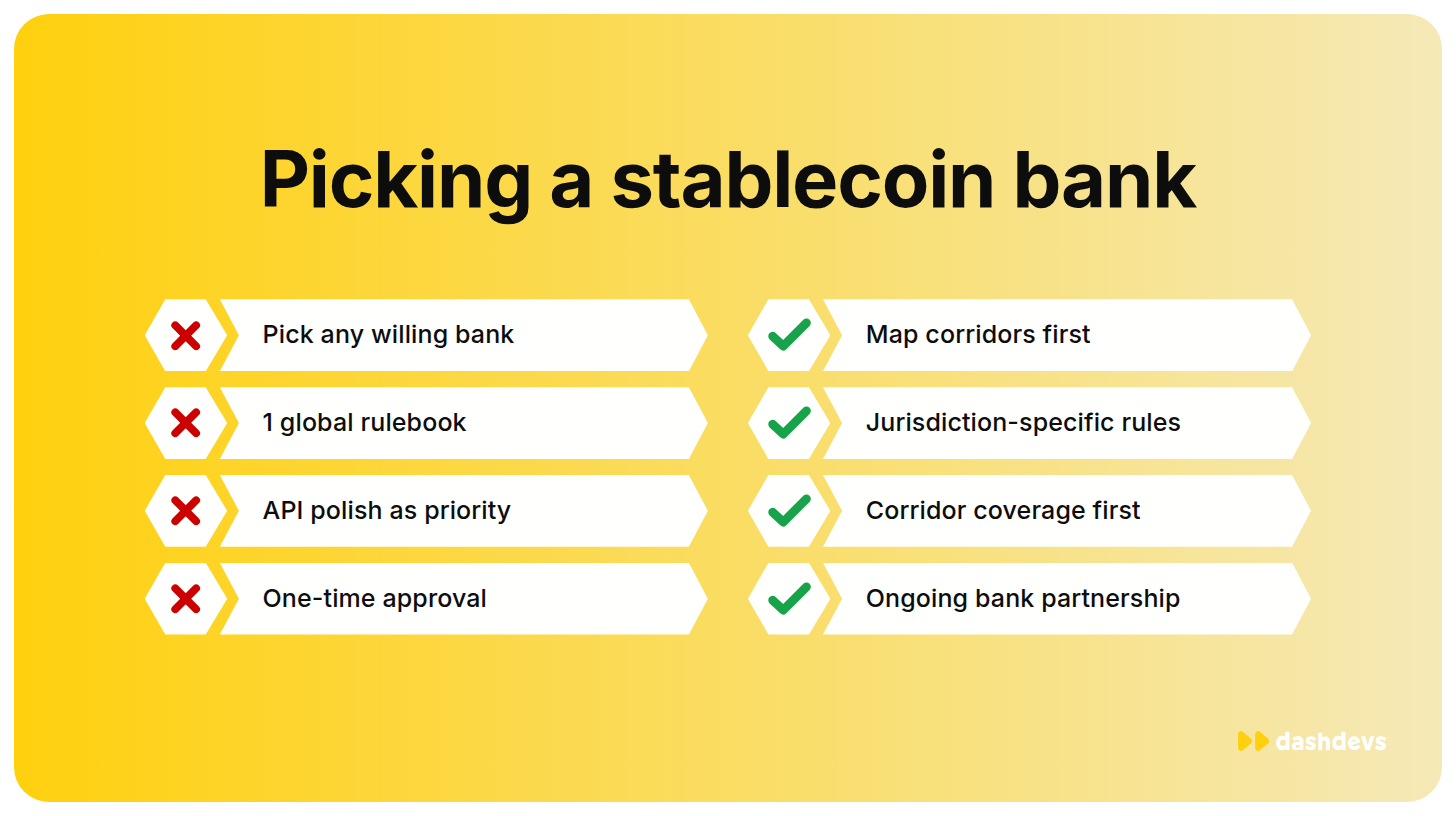
Fee decks that ignore the stablecoins bank relationship on the fiat edge are fiction. When you shortlist stablecoin banks, score them on corridor coverage, settlement cutoffs, and client-fund segregation—not only on API polish. Ask each stablecoins bank the same three questions in writing: supported corridors, client-fund structure, and off-ramp SLA to a named account.
How to choose a stablecoin bank (practical checklist)
Direct answer: pick the institution that can clear your corridors with evidence a regulator will accept—not the one with the flashiest crypto brand.
| Question | Pass signal |
|---|---|
| Can they name supported corridors and currencies? | Written matrix, not a sales promise |
| How are client funds segregated? | Account structure and reconciliation you can audit |
| What is the off-ramp SLA to a named bank account? | Hours/days with failure modes documented |
| Who owns Travel Rule and sanctions screening? | Explicit RACI between you and the partner |
| What happens if the partner exits crypto? | Data portability and dual-rail exit path |
A single stablecoins bank partner can be right pre-product-market-fit. Concentration without an exit path is what turns a partner change into a multi-quarter fire drill. The same discipline applies when comparing how each stablecoins bank prices FX, network, and compliance uplift inside “all-in” stablecoins transaction fees.
If a second stablecoins bank is required for a new corridor, design the orchestration layer—often on Fintech Core or equivalent modular rails—before volume forces a scramble.
Mobile wallet UX that must ship without owning every custody decision can still follow e-wallet app development patterns without pretending the bank edge is optional.
Webinar: Stablecoin On/Off Ramps — get the how, not only the why
Everything above explains the why. The how—account opening, real rejection reasons, and the technical setup that gets applications approved—is a working session, not another glossary.
Stablecoin On/Off Ramps webinar
Thursday, 27 August 2026 — 18:00 CET
Online on YouTube — free, 60 minutes
YouTube live · LinkedIn event · Register via form
Igor Tomych (Founder & CEO, DashDevs) and Dumitru Condrea (Founder & CEO, NOVAFIN) will walk through:
- Corridor economics: where stablecoin rails beat correspondent chains on cost
- Architecture: custody models, wallet setup, provider stack
- Banking reality: which jurisdictions work, which reject, and why
- MiCA, FINTRAC, and the GENIUS Act—what actually matters for your setup
If you have hit a wall banking stablecoin operations, this session is built for that problem. Registration interest shapes final prep—registering now is what locks the session in.
Closing: treat stablecoin banking as an operating system
Stablecoin banking is not a feature you bolt on after the token integration. It is the operating system that makes on-ramps, off-ramps, and settlement usable for a real company. Programs fail when teams optimize the chain and ignore the financial system edges—partner-bank relationships, deposit-insurance assumptions that do not apply to tokens, and commercial banks that will not touch the flow without evidence.
Get the corridor map, the custody model, and the stablecoins bank relationship right first. Then the product story—treasury, B2B payouts, or consumer wallets—has somewhere to land. DashDevs helps teams design that stack so dual-rail products stay bankable as rules tighten and partners change. Done well, stablecoin banking turns digital assets from a demo into money movement a finance team can close the books on.
Share article
