


Stablecoins as a Payment Rail: Architecture Patterns for Fiat-Crypto Interop

October 13, 2026
- Stablecoin payment rails move money between two fiat accounts and use USDC or USDT only as the settlement leg in the middle.
- Real-world stablecoin payments were about $380–390 billion in 2025, roughly 1% of gross transfers.
- Four patterns follow the money: pay-in gateway, payout corridor, held balances, and multi-rail router.
- Record each payment as ledger states. Treat the chain as one more external statement, with a sub-ledger per token and network.
- Compliance sits at every state change. Collect Travel Rule data and screen wallets before broadcast.
Your on-chain transfer clears in seconds. Then your finance team spends two days matching it to a bank statement. If that sounds familiar, the token was never your bottleneck. This guide walks you through the architecture patterns we use to connect fiat accounts and blockchain networks through one ledger, so your stablecoin payment rails hold up under audit.
What are stablecoin payment rails?
Stablecoin payment rails move money between two fiat accounts and use a fiat-backed stablecoin, such as USDC or USDT, as the settlement leg in the middle. Your sender pays in local currency, and your recipient gets local currency. The tokens only exist in between.
A stablecoin is a token on a blockchain network that tracks a fiat currency, usually the US dollar, and can be redeemed with its issuer. US law now has a name for the regulated kind: the GENIUS Act calls them payment stablecoins.
The market is big enough to take seriously. Total supply sat at about $305 billion in mid-September 2026, with USDT holding roughly 60% of it, according to DefiLlama data reported by TechFlow.
Here’s the catch. Most of that money is parked in trading and treasury. McKinsey and Artemis put real-world stablecoin payment volume at about $380 to $390 billion in 2025, roughly 1% of gross transfers, as we unpack in our guide to stablecoin banking.
That 1% is what you’re building for. Simple as that.
How does the stablecoin sandwich work?
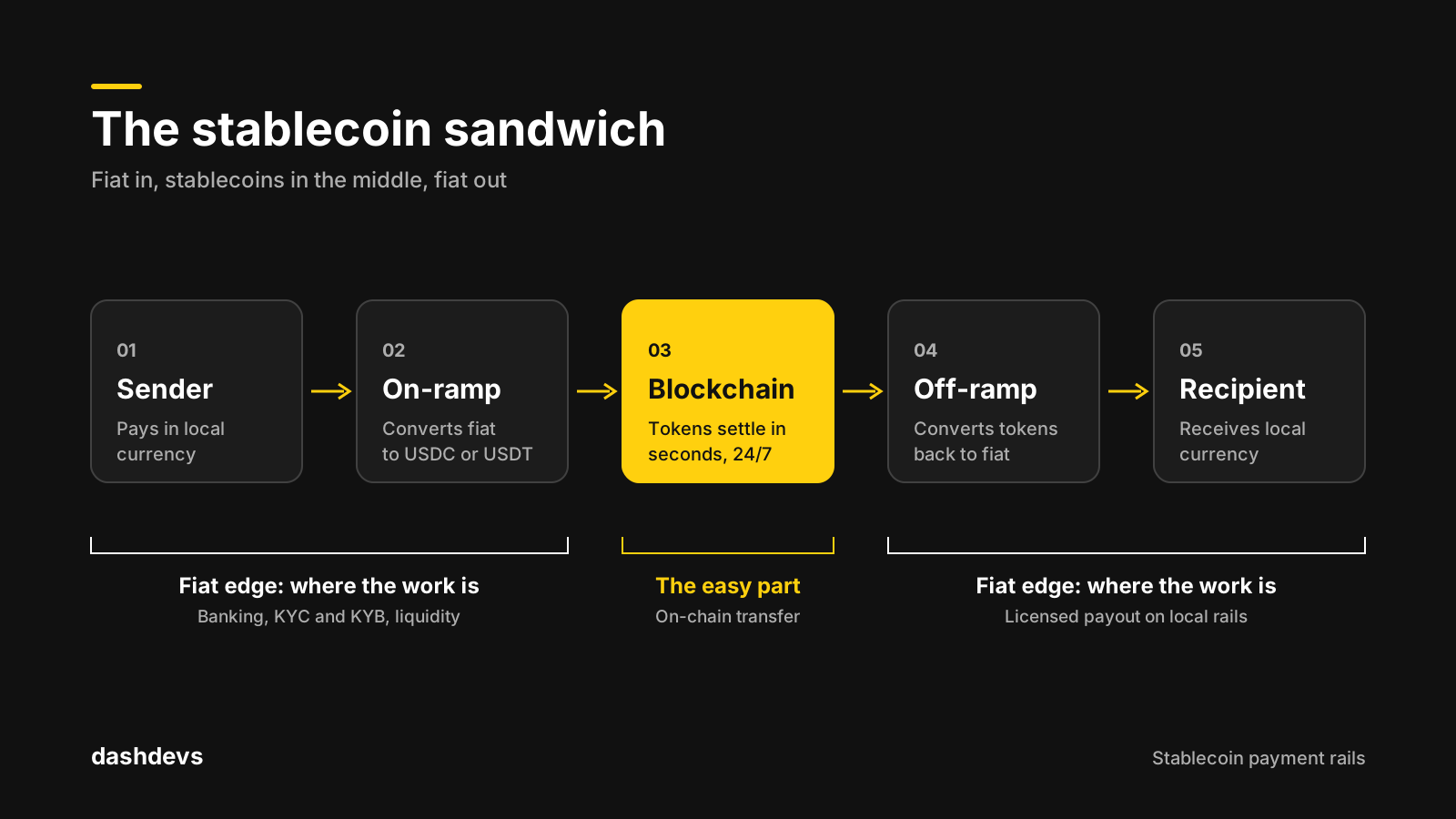
The stablecoin sandwich is the most common flow: fiat in, stablecoins in the middle, fiat out. Kebbie Sebastian, CEO of Merge, broke it down in Fintech Garden episode 140 on the stablecoin sandwich model.
Here’s the payment flow:
- Your sender pays in local currency over a domestic rail such as SEPA or ACH.
- A licensed on-ramp turns the fiat into issued stablecoins.
- The tokens cross blockchain payment rails in seconds, at any hour of any day.
- A licensed off-ramp converts them back and pays out in the recipient’s local currency.
Kebbie’s point stuck with me. The on-chain hop is the simple part. The hard problems sit at the edges, where compliance and liquidity meet local payout rails.
Where do stablecoin rails beat traditional payment rails?
Stablecoins win on corridors where the status quo is slow or expensive. Where traditional payment rails already work well, they often have nothing to add.
A cross border payment over SWIFT can pass through several correspondent banks before it lands. Each hop adds transaction fees and its own cut-off time. Weekends stop everything. A stablecoin transfer settles in real time around the clock, so your money is never stuck on a Friday evening.
Speed alone isn’t a business case, though. Marwan Forzley, CEO and co-founder of Veem, made this point in Fintech Garden episode 166 on why fast rails aren’t the hard part. On a route like US dollar to euro, foreign exchanges are already cheap and liquid, so a stablecoin has little to compete on. Its advantage shows up in messier corridors where the incumbent payment network is slow or costly.
I love how blunt that is. Can you believe how many pitch decks still open with USD to EUR?
Before you add a corridor, check it against these signals:
- The recipient’s local rail is slow, or it closes on weekends and holidays.
- FX spreads and correspondent fees take a visible share of each payment.
- Your clients prefund accounts abroad today, and that cash sits idle.
- A licensed off-ramp can actually pay out in that market.
If a corridor ticks only the first box, a faster domestic payments solution may serve you better than a stablecoin.
On Kleos, the corridor that mattered was euro banking next to USDC on Ethereum, not USD to EUR. We expected the on-chain hop to set the timeline. Personal IBANs through Stanhope, SEPA and SWIFT, and real-time balance sync took the 10-week MVP. The token path was demoable while the fiat edge was still the critical path.
What infrastructure is needed to integrate stablecoin payments?
The infrastructure needed to integrate stablecoin payments splits into two worlds with your platform in between. Fiat lives on one side. Tokens live on the other. Your platform owns the logic that keeps them in sync.
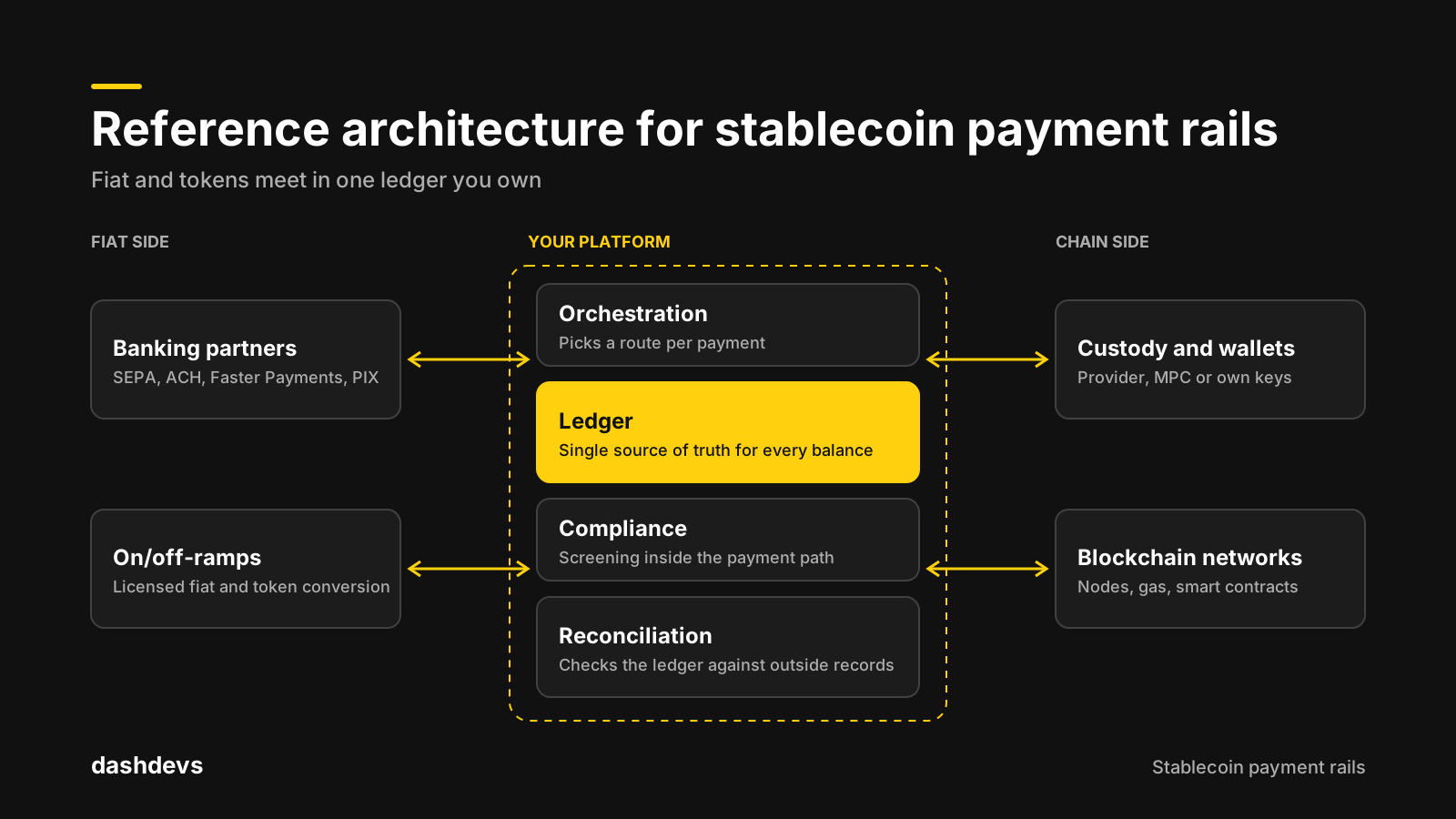
On the fiat side
- Banking partners and local rails. Corporate accounts plus access to SEPA, ACH, Faster Payments or PIX for pay-ins and payouts.
- Licensed on/off-ramps. The partners that convert fiat into tokens and back. Our guide on how to build compliant crypto on/off-ramps covers the licensing side.
On the chain side
- Custody and wallets. Where the keys live. Building custody in-house typically takes 6 to 18 months, as we explain in our breakdown of digital asset custody infrastructure.
- Blockchain networks. Node access and gas management for each network you support. Each token also needs its own smart contract integration.
In your platform
- Orchestration. Picks the route for each payment and handles retries. Our article on payment orchestration explains the routing logic.
- Ledger. The single source of truth for every balance, in fiat currency and in digital assets.
- Compliance services. Customer and wallet screening that runs inside the payment path.
- Reconciliation. Matches every ledger entry against external records, including the blockchain itself.
Most teams budget for the chain side. The platform layer is where stablecoin infrastructure projects run over.
You don’t have to wire every partner yourself. Our fintech integration services team connects your banking and custody partners into one stablecoin payments infrastructure, so your engineers can stay on the product.
Four architecture patterns for fiat-crypto interop
Most stablecoin payment rails we build follow one of four patterns, and the direction of the money decides which one fits. Pick by flow first. Pick vendors second.
Pattern 1: Pay-in gateway
A payer sends tokens, and the merchant gets fiat. This is the pattern for PSPs whose merchants want to accept stablecoin payments without touching crypto themselves.
A stablecoin payment gateway issues a deposit address per invoice and watches the chain. Once the transfer is final, it off-ramps automatically and settles the merchant in local currency. Your design work goes into the edge cases: partial payments and deposits sent on the wrong network.
One wrong-network deposit can cost your support team a full day. Ouch.
Pattern 2: Payout corridor
Fiat goes in on one side, and local currency comes out on the other. This is the stablecoin sandwich built as a product, and it is the workhorse for B2B supplier payments and payroll. Our guide to stablecoins for cross-border payments shows where these corridors usually stall.
The risk here is concentration. If one ramp or one chain carries a corridor, a single outage stops every payout on it. Plan a second route from day one; our list of cross-chain fallback providers is a good starting point.
Pattern 3: Held balances
Customers keep stablecoins next to their fiat accounts and move between the two whenever they want. This turns your product into a stablecoin payment platform with wallets and transfers on one balance sheet.
This is what we built for Kleos, a non-custodial finance platform. The MVP launched on Fintech Core in 10 weeks: personal IBANs through Stanhope, real-time balance sync, SEPA and SWIFT transfers, AML hooks and reconciliation. Six weeks later, v1.1 added Web3Auth wallet login and put fiat and crypto balances on one home screen. Stablecoin support runs on USDC on Ethereum. Fintech Core is DashDevs’ configurable layer for customers, payments, accounts, vendors, controls, and reporting. It is not a bank, a licence, or a BaaS provider; it connects to them.
Read how Kleos unified fiat accounts and USDC on one platform, or go deeper into the balance model in our guide to building a fiat-crypto platform with a unified balance system.
Pattern 4: Multi-rail router
Here the stablecoin payment rail becomes one route among several. An orchestrator picks stablecoins, SEPA Instant, SWIFT or a local rail for each payment, based on cost and timing.
The routing logic doesn’t care whether a rail is fiat or crypto. We learned that building the multi-rail payment orchestration layer for a BNPL provider, Twisto. It handles 10K+ payment requests per second as a design target for campaign load and was migrated with zero disruption. Twisto’s rails are fiat, and the same routing and fallback principles carry straight over to stablecoins. See the Twisto payment orchestration platform.
How do the four patterns compare?
| Pattern | Money flow | You must own | Best for | Main failure mode |
|---|---|---|---|---|
| Pay-in gateway | Tokens in, fiat out | Deposit monitoring, merchant ledger | PSPs and merchant platforms | Wrong-network and partial deposits |
| Payout corridor | Fiat in, local fiat out | Corridor routing, ledger | B2B payout and payroll platforms | Single ramp or chain per corridor |
| Held balances | Fiat and tokens side by side | Unified ledger, custody setup | Neobanks and wallet apps | Balances drifting from the chain |
| Multi-rail router | Any rail per payment | Routing rules, ledger | PSPs with many corridors | Reconciliation across rails |
Partner licenses or your own?
Each pattern can run on licensed partners or on your own licenses. Partners get you live faster. Your own licenses give you control over corridors and margins, at the price of audits and compliance headcount.
We built the second route for a licensed fintech in APAC. The platform keeps fiat and crypto liquidity under one roof and processes stablecoin on/off-ramp flows for cross-account payments. Matching was load-tested above 30K transactions per second while staying aligned with EMI and VASP requirements. See our fiat, stablecoin and crypto platform for a licensed APAC fintech.
How should your ledger record a stablecoin payment?
Record every payment as a sequence of states, and let each state move money between sub-ledger accounts. Treat the blockchain as one more external statement your ledger checks against, the same way you treat a bank statement.
Fiat and tokens behave differently. A SEPA credit can be recalled. An on-chain transfer is final after enough confirmations, yet it can still land on the wrong network. USDC on Ethereum and USDC on Solana look identical to your user and are two separate instruments for your finance team.
Here is how the states map to ledger effects in a payout corridor:
| State | What happened | Ledger effect |
|---|---|---|
| Initiated | Customer approves the payment | Funds move from available balance to a hold |
| Funded | Fiat leaves your bank for the on-ramp | The hold moves to a fiat in-transit account |
| Converted | The ramp delivers tokens to your wallet | In-transit fiat clears; the token sub-ledger shows the new balance |
| Broadcast | Your wallet signs and sends the transfer | Transaction hash recorded; token balance marked as pending debit |
| Final | Enough confirmations on chain | Pending debit posts; the gas fee posts to its own account |
| Paid out | The off-ramp confirms the local payout | Payment closes; ramp fees post |
| Failed or returned | Something broke on the way | Holds release; stuck tokens move to a suspense account |
Four ledger rules make this work:
- A sub-ledger per token and network. Each pair is its own instrument. Our article on ledger architecture for multi-product banks explains the core and sub-ledger split.
- A separate fee account. Gas is paid in the network’s native token, so it needs its own balance and top-up logic.
- One record, every reference. Transaction hash, bank reference, ramp ID and your internal ID live together, with an idempotency key on every write.
- Confirmation depth per network. Decide how many confirmations count as final on each chain, and never post a final state before that.
How do you reconcile on-chain and off-chain records?
Run reconciliation continuously, as events arrive, and match each payment against every external record it touches. A daily batch file is too slow for a rail that never closes.
A single payout corridor payment leaves four traces outside your ledger:
- Bank statement. Confirms the fiat left your account and reached the ramp.
- Ramp report. Confirms the conversion rate and the fee you paid.
- Blockchain. Confirms the transfer reached finality, plus the gas it cost.
- Payout confirmation. Confirms the recipient received local currency.
Each trace arrives on its own clock. The chain confirms in minutes, and a bank file can land the next morning. Your reconciliation engine has to hold a payment as partially matched without raising a false alarm.
The goal is a continuous check that confirms your ledger is already right. We explain the approach in our guide to real-time payment reconciliation.
Pro tip: After 17+ years building licensed payment products, we treat a reconciliation break that survives more than 24 to 48 hours as an incident, with an owner and a deadline. On Kleos, real-time balance sync shipped in the first release so IBAN cash and USDC would not become two overnight truths.
Where does compliance sit in a stablecoin payment flow?
Compliance sits at every state change of the payment, inside the same flow that moves the money. A KYC check at signup can’t cover a payment that crosses borders and chains weeks later.
Two frameworks set the rules in 2026:
- MiCA (EU). The transitional period ended on 1 July 2026. Any firm serving EU clients without CASP authorization is now in breach of EU law. Elliptic counted roughly 213 authorized CASPs across 23 jurisdictions at that point.
- The GENIUS Act (US). The law sets the framework for payment stablecoin issuers. The OCC published proposed implementing rules in February 2026 on reserves and custody, while AML and sanctions rules follow in a separate rulemaking with Treasury, as Sullivan & Cromwell summarizes.
For your stablecoin payment infrastructure, that means four checkpoints in the flow:
- At initiation. KYC or KYB on the sender, plus sanctions screening on both parties.
- Before broadcast. Screen the destination wallet and attach Travel Rule data. Once a transfer is on chain, you can’t call it back.
- At payout. The off-ramp runs beneficiary checks under local rules.
- Across the whole payment. Monitor the fiat legs and the token leg as one transaction, with one case file.
KYB is where the effort hides. Marwan Forzley noted that Veem collects KYB data in more than 100 countries, and some registries return a clean beneficial ownership record while others leave the field blank. Our article on AML compliance for fintechs shows how to keep that evidence available at payment time.
This is architecture guidance. Bring your legal counsel in before you commit to a jurisdiction.
How to roll out stablecoin payment rails in 6 steps
The order of your decisions matters more than any vendor choice. Here is the sequence we follow when we build stablecoin payment infrastructure for licensed fintechs:
- Score your corridors. Use the signals from earlier in this guide and keep only routes where the status quo fails on cost or speed.
- Secure the fiat edges. Sign a banking partner and a licensed ramp for each corridor. Banking approval takes longer than any integration.
- Build the ledger before the first wallet. Set up sub-ledgers and payment states first, so every later integration posts into a model that already works.
- Choose custody by risk appetite. A provider gets you live faster. Your own key management only makes sense with a dedicated security team.
- Pilot one corridor. Run real payments with small amounts end to end, and watch every state change.
- Add fallbacks, then scale. Give every critical corridor a second chain and a second ramp before you open it to all customers.
Pro tip: Sandboxes hide the problems that matter. Bank holds and compliance queries only show up with real money, so budget a few weeks of pilot traffic before launch.
Build rails that pass an audit
The token is the easy part of the whole system. Pick your pattern by the direction of the money. Then put the ledger and the compliance checkpoints in place before the first wallet goes live.
If you’re planning stablecoin payment rails for global businesses, DashDevs can map the architecture with you before growth turns it into a constraint. Explore our crypto-fiat payment infrastructure on Fintech Core, or talk to our team about blockchain development services for your next corridor.
Book a call and bring your corridor list.
Share article
