


Top Sustainable Fintech Companies Leading Green Change in 2026

August 14, 2026
- Sustainable finance applies ESG criteria (environmental, social, and governance) across financial products, while green finance is a narrower environmental subset of it.
- Climate-focused financing has grown from $660 billion in 2015 to over $1 trillion.
- The strongest players in 2026 fall into four practical categories: sustainable banking, green investment, carbon-impact tracking, and sustainable payments.
- Regulatory pressure, talent expectations, and customer demand are pushing fintech companies toward genuine, auditable sustainability claims rather than marketing language.
A challenger bank claims its debit card is “carbon neutral.” A payments API says it funds reforestation with every transaction. Both statements sound similar, but only one may hold up under an ESG audit.
That distinction is why green finance companies matter more than general claims about being “green.” Businesses evaluating a banking partner, an investment platform, or a payment processor need to know which providers back sustainability claims with a specific financial mechanism, not just a marketing page.
This guide is for teams scoping a partnership with a sustainable fintech company or benchmarking their own ESG proposition against the market. DashDevs has helped build sustainability-focused fintech products, including the Downing investment platform, so the criteria below reflect what actually holds up in production. For a broader view of sustainable company examples across the financial industry, the breakdown below covers all four active segments.
Sustainable vs. green finance: the only distinction that matters
Sustainable finance is the integration of Environmental, Social, and Governance (ESG) criteria into financial products and decision-making. It covers lending, investment, banking, and payments—anywhere money moves.
Green finance is a narrower term. It refers specifically to financial activity that funds environmentally positive outcomes: renewable energy, energy efficiency, water management, and pollution control.

Why sustainability has become a competitive requirement
Fintech companies don’t adopt sustainable finance solutions purely out of goodwill. Five pressures across the financial industry make it a business decision:
- Customer expectations are shifting. 67% of banking customers want their bank to be more sustainable, and roughly half say they would switch providers without visible progress. Positive environmental commitment is now a retention lever.
- Regulators are tightening ESG disclosure. European banks must integrate ESG analytics to combat greenwashing, and similar reporting rules are expanding elsewhere. Non-compliance carries direct financial and reputational risk, not just social responsibility pressure.
- Talent decisions follow sustainability records. Almost 70% of Gen Z and millennial candidates research a company’s environmental record before applying. Attracting and retaining talent now depends in part on a credible sustainability posture.
- Capital is following sustainable investment mandates. Climate-focused financing has grown from $660 billion in 2015 to over $1 trillion today, and institutional ESG allocations continue to rise.
- Operational efficiency compounds long-term savings. Energy-efficient infrastructure and reduced carbon emissions from paper-free, branch-free operations lower the cost per transaction and support broader sustainable development goals over time.

Sustainability claims without a specific financial mechanism behind them are marketing.
10 sustainable finance companies driving green change
The sustainable fintech companies below were selected because each has a specific, verifiable sustainability mechanism.
These sustainable finance companies span established banks and newer sustainable finance startups—from green finance companies with fossil fuel exclusions to platforms shipping sustainable finance products such as impact funds, carbon dashboards, and offset-linked cards. Together they show how the financial services sector is using technology to digitize banks, cut environmental impact, and build a more sustainable future while meeting social responsibilities to customers and regulators.
Each entry answers three questions: what the company does, what makes its model sustainable, and which specific product demonstrates it. All ten help the financial industry reduce carbon emissions and meet ESG obligations, but through distinct mechanisms. Companies are grouped by the type of sustainable finance they enable.
Sustainable banking
| Company | What it does | Sustainability mechanism | Key product |
|---|---|---|---|
| Starling Bank | Branchless UK digital bank running on renewable energy | No branches, no paper statements, renewable-powered infrastructure | Debit card made from recycled plastic; joined the Tech Zero taskforce to cut sector-wide carbon emissions |
| Triodos Bank | Finances only businesses in the green economy, from renewable energy to organic agriculture | Radical transparency—publishes every loan it issues | Full depositor visibility into where money goes; no fossil-fuel lending |
| Bunq | Dutch digital bank with an explicit green account tier (Easy Green) that plants a tree for every €100 spent | Digital-only operations; partners with verified reforestation and ocean plastic projects | Easy Green account: customers track trees planted and CO₂ offset directly in the app |
Green investment
| Company | What it does | Sustainability mechanism | Key product |
|---|---|---|---|
| Downing | UK investment manager with £2.6bn AUM in renewable energy, infrastructure, and healthcare | Deploys capital exclusively into renewable energy and sustainable infrastructure; renewable energy arm alone manages ~£900M | Renewable energy funds and infrastructure portfolios. DashDevs rebuilt the platform infrastructure to support scalable, compliance-ready sustainable investment operations |
| Carbon Equity | Platform for retail investors to access private market climate funds | Directs capital exclusively to climate technology, electrification, and energy infrastructure scale-ups | Energy Transition Debt Fund I and climate tech venture portfolios |
| Trine | Swedish platform for funding solar energy projects in underserved regions | Capital returned with interest once solar products are distributed | 2.5M+ people connected to electricity; investor minimum £25 per loan |
You can also review the Downing investment management case study for how production infrastructure supports a sustainable investment platform.
Carbon-impact tracking
| Company | What it does | Sustainability mechanism | Key product |
|---|---|---|---|
| CarbonChain | Tracks emissions across complex supply chains for commodities and heavy industry | Targets the hardest-to-measure emissions sources; auditable data over self-reported estimates | The ESG-data layer other green fintech companies rely on; goal of a carbon-free global supply chain by 2050 |
| Doconomy | Swedish climate fintech partnering with banks to calculate transaction-level carbon footprints in real time | Behavioral science + impact data analytics; €34M Series B co-led by UBS Next, CommerzVentures, and S&P Global | Works with 100+ financial institutions across 35+ markets globally; expanding into North America |
Sustainable payments
| Company | What it does | Sustainability mechanism | Key product |
|---|---|---|---|
| Ekko | Sustainability-focused consumer debit card and B2B embedded checkout provider | Turns everyday transactions and merchant checkouts into micro-donations for verified climate projects | Consumer eco-debit card and the Ecommpay integrated carbon-offsetting checkout API |
| Stripe Climate | Lets any business on Stripe’s payment infrastructure direct a share of revenue toward carbon-removal technologies | Feature layered onto existing payment infrastructure, not a standalone green fintech company | Model other payment processors are starting to copy; no separate account required |
Roadmap for developing a green fintech product
Turning a green fintech concept into a scalable, audit-ready product requires bridging ideation, transparent technology, and strict ESG compliance. Below is an actionable framework for building a sustainable financial product that holds up in production.
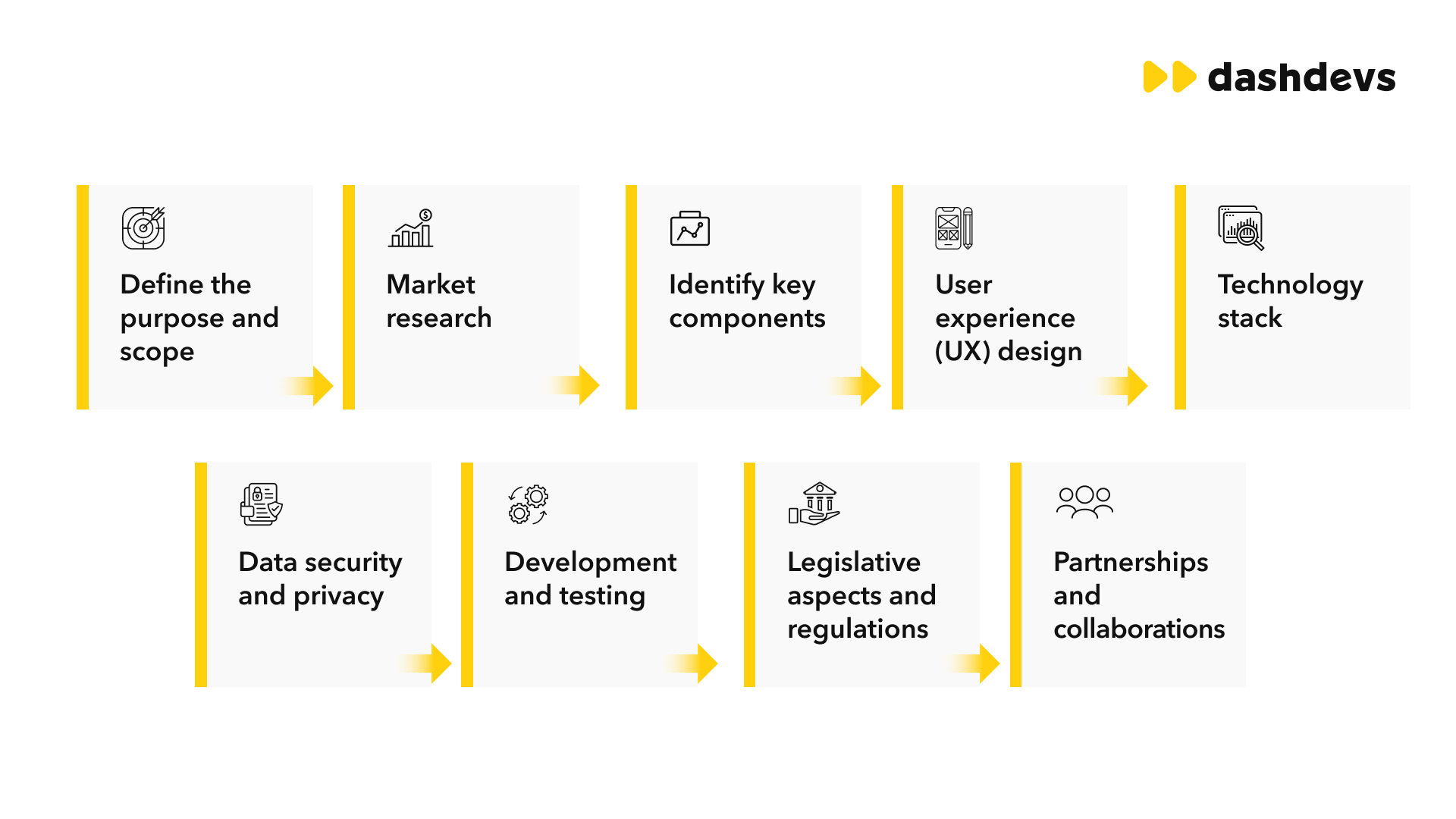
- Define the core impact mechanism — Start with an explicit, auditable environmental mechanism rather than a generic mission statement.
- Benchmark the market and ESG data standards — Analyze current green fintech players (such as CarbonChain) to pinpoint market gaps in carbon accounting, offset verification, or transaction categorization.
- Architect a sustainable revenue model — Establish financial viability early using models such as transaction fee splits allocated to green projects, premium tier subscriptions, or commission structures on impact investments.
- Secure ecosystem and infrastructure partners — Partner with verified carbon registries, accredited environmental non-profits, and specialized technology providers to guarantee data integrity across the entire value chain.
- Develop a high-impact MVP — Build a focused prototype centered on core functionality—transaction-level carbon calculations, round-up savings routed to green funds, or an impact investment portal. Partnering with an experienced fintech software development company keeps this layer scalable and audit-ready from day one.
- Deploy low-carbon infrastructure — Minimize digital Scope 3 emissions by hosting on cloud servers powered by renewable energy and optimizing code efficiency to reduce server compute cycles.
- Ensure regulatory and ESG compliance — Align data architecture with binding reporting mandates, including the EU Corporate Sustainability Reporting Directive (CSRD), updated SFDR rules, and ISSB climate standards. Fintech consulting support can help teams navigate licensing and disclosure nuances faster.
- Execute a data-backed go-to-market — Launch transparent campaigns centered on verifiable data (live impact dashboards or audited third-party reports) to earn trust among ESG-conscious consumers and institutional partners.
- Measure, audit, and iterate — Track traditional platform KPIs alongside real-time environmental metrics (CO₂ offset, habitat restored, or clean energy funded) to continually optimize the product engine.
Following this roadmap, you can create a green and sustainable finance project that genuinely matters and contributes to positive environmental and social change while generating financial returns.
Common mistakes when evaluating green fintech claims
Not every sustainability claim survives scrutiny, and not every green company on a “best of” list survives the market. For example, Tred, a UK green debit card provider once cited across lists of sustainable fintech companies, shut down in 2025 after new fraud-liability rules made its unit economics unworkable.
Before partnering with or citing any sustainable finance provider, look past the marketing layer and watch for these red flags:
- Selective disclosure (the Scope 3 blindspot) — Touting paperless offices while ignoring the footprint of server infrastructure, cloud data centers, and payment rails. If a provider does not track and publish Scope 3 emissions, you are only seeing a slice of their impact.
- Storytelling over hard data — Flashy “trees planted” counters are no substitute for auditable metrics. Credible platforms provide transaction-level KPIs, clear baselines, and transparent timelines.
- Contradictory disclosures — A red flag appears when a company promotes ambitious green targets on its blog but stays silent on ESG commitments in official financial filings and regulatory disclosures.
- Vague terms and missing frameworks — Buzzwords like “eco-friendly” or “clean” do not mean much on their own. Reliable green fintechs align with recognized industry standards and document the methodology behind carbon calculations and offset mechanisms.
The UK’s Competition and Markets Authority began large-scale public enforcement of its Green Claims Code from autumn 2025—meaning greenwashing is no longer just a reputational risk. It is a legal one.
Where green fintech is headed
The next phase of sustainable fintech trends is less about launching new green cards and more about embedding ESG data into existing financial infrastructure. Expect three shifts:
- Carbon data becomes a compliance input, not a marketing add-on, as ESG reporting requirements tighten across the EU, UK, and US.
- AI-assisted emissions tracking scales, letting banks calculate transaction-level carbon impact without manual reporting.
- Sustainable finance solutions consolidate into core banking, rather than staying siloed in standalone green apps—a long-term pattern consistent with broader banking trends.
For teams building a neobank today, ESG reporting is increasingly a licensing and investor-readiness checkpoint, not an afterthought—see how teams approach neobank builds. Even payment products are affected: sustainable product teams evaluating cross-border payments companies now routinely check corridor partners against ESG disclosure standards.
For fintech companies building this into their own roadmap, the technical challenge is less about the ESG dashboard and more about the underlying data pipeline—ledger design, transaction categorization, and reporting accuracy at scale, similar to the groundwork covered in this overview of fintech innovations shaping financial services. Top core banking solutions increasingly expose ESG reporting modules, and the top banking software development companies now treat sustainability tooling as a standard capability, not an add-on.
Final take
Sustainable finance companies are no longer a niche category. They are a benchmark every fintech company gets measured against, whether they intend to compete on ESG or not. The companies above share one trait: a specific, auditable mechanism behind the sustainability claim, not just a green logo.
Building that mechanism—whether it is a carbon-tracking ledger, an ESG-screened investment engine, or a transaction-linked offset system—is an infrastructure problem before it is a marketing one. DashDevs has built regulated financial platforms for clients like Downing across ledger architecture, compliance reporting, and production-grade ESG data handling.
Sustainability features also extend into customer-facing layers: mobile app development now routinely includes carbon-footprint dashboards and eco-reward mechanics, while gamification in fintech is increasingly used to drive sustainable spending behaviors. On the operations side, RPA in finance automates ESG data collection and reporting workflows—reducing manual overhead and improving accuracy across compliance cycles.
If your team is scoping sustainable finance products and needs the infrastructure to back the claim, talk to DashDevs about what production-grade ESG data handling actually requires.
Share article
