


Blockchain Consulting Companies in 2026: How to Choose a Strategy Partner

August 4, 2026
- Blockchain consulting is strategy, operating model, and vendor architecture—not a synonym for smart-contract coding.
- Shortlist top blockchain consulting companies against written criteria: production references, compliance depth, custody stance, and who owns post-pilot delivery.
- Match the partner type to the job: Big Four for multi-country risk programs, SIs for enterprise estates, fintech specialists for crypto–fiat products.
- Demand a decision memo that kills at least two architecture options—not a slide deck that keeps every chain open.
- DashDevs fits when consulting must land in regulated money movement: tokenization, rails, custody, and ledgers that finance can close.
Picking among blockchain consulting companies in 2026 is a board-level architecture decision—not a search for who can run the most enthusiastic “blockchain 101” workshop. Buyers comparing strategy partners need firms that can kill bad pilots early, map compliance before spend, and leave you with an operating model finance and risk will own.
This guide leads with selection criteria, then profiles the top blockchain consulting companies across fintech specialists, Big Four risk practices, global SIs, and crypto-native advisors. Treat rankings as a map. The checklist is the decision tool.

Consulting is not development (do not buy the wrong engagement)
Direct answer: if your RFP still says “build a dApp” when you mean “decide whether tokenization has a business case,” you will hire the wrong partner.
| Engagement type | Primary output | Failure mode |
|---|---|---|
| Blockchain consulting | Strategy, operating model, vendor architecture, go/no-go | Endless workshops with no decision memo |
| Blockchain development | Working product, contracts, integrations | Code without a bankable control model |
| Security / audit | Independent assurance | Treated as a sticker after launch |
Blockchain consulting companies earn their fee when they force a written choice: public vs permissioned vs hybrid, custody model, token legal wrapper, and who owns keys after go-live. Build shops ship what you asked for—even when the ask was premature. For pure engineering shortlists, use our companion guide to top blockchain development companies after the strategy is locked.
Why the 2026 consulting shortlist looks different
Institutional settlement made “blockchain strategy” a procurement category again. J.P. Morgan’s Kinexys unit reports more than $4 trillion in cumulative transaction volume and multi-billion daily averages, with Blockchain Deposit Accounts expanding across major currencies (CoinDesk, June 2026). That is permissioned settlement as infrastructure—not a lab demo.
Market-sizing firms still disagree on exact dollars (definitions swing between software, services, and infrastructure), but 2025–2026 analyses still place the broader blockchain technology market in the tens of billions and rising (Axis Intelligence compilation; MarketsandMarkets blockchain technology overview). For buyers, direction and institutional spend matter more than which analyst wins the spreadsheet war.
RWA and treasury tokenization are the other demand spike. Live trackers such as RWA.xyz show rapid growth in on-chain treasuries, credit, and funds. Tokenization projects fail when legal wrappers, transfer restrictions, and off-chain servicing are treated as “phase two”—exactly the gap enterprise blockchain consulting is supposed to close before code starts.
Europe raises the compliance floor. The EU Markets in Crypto-Assets Regulation (MiCA) sets authorization and disclosure expectations for crypto-asset services. Consulting that cannot speak CASP-grade controls in discovery is selling nostalgia for 2018 pilots.
What good blockchain consulting services include
Direct answer: services include decisions you can fund—not another opportunity scan that keeps every chain open.
Typical blockchain consulting services that matter in production programs:
- Business models and unit economics for a blockchain project (who pays, who settles, who holds risk)
- Blockchain strategy and corridor/product prioritization
- Asset tokenization scoping: legal wrapper, transfer agents, servicing, and redemption
- Operating model: RACI across risk, legal, treasury, and engineering
- Vendor architecture: custody, oracles, payment gateway integration, and identity
- Control design aligned with fintech risk management expectations from regulators and banks
- Build-vs-buy and partner selection for the delivery phase
If your consultant cannot produce a one-page money-flow diagram and a kill-list of rejected options by week three, you are buying theater.
How to choose among blockchain consulting companies
Score vendors before you open any logo deck. The best blockchain consulting companies win on evidence, not slogan density.
| Criterion | What “good” looks like | Red flag |
|---|---|---|
| Production references | Live programs in your vertical (payments, custody, RWA, supply chain) | Only hackathon or “thought leadership” slides |
| Decision quality | Written architecture with options killed | “Multi-chain everything” with no trade-offs |
| Compliance fluency | MiCA, AML, Travel Rule, SOC 2–class controls in scope | Compliance as a final checklist |
| Custody stance | Named HSM/MPC/custodian recommendation | “Founders hold keys for launch” |
| Delivery path | Clear handoff to build / SI / audit | Workshop ends; ownership evaporates |
| Commercial fit | Outcome milestones and exit clauses | Open-ended retainer with no decision gates |
Ask every blockchain consulting firm for: (1) a sample decision memo from a similar engagement, (2) who owns the recommendation after partners leave, and (3) how they score vendor lock-in. Firms that stall on those three are selling workshops.
When buyers search for a top blockchain consulting company, they often mean “who will still be accountable when the pilot becomes a P&L line.” Put that accountability in the SOW.
When you need consulting vs build vs both
| Situation | Hire | Why |
|---|---|---|
| Unclear business case or token legal path | Blockchain consulting firm | Avoid building the wrong product |
| Architecture decided; need delivery | Development partner | Speed to production |
| Bank / multi-country transformation | SI + specialist advisor | Politics and estate integration |
| Regulated crypto–fiat product | Specialist consulting and development | Strategy must land in rails and ledgers |
Many of the best blockchain consulting companies either partner with builders or run a thin delivery bench. That is fine—as long as the contract separates “decide” from “build” so you can switch builders without rebuying strategy.
For product teams that already know they need mobile surfaces after the strategy lands, keep fintech mobile app development services as a later workstream—not the first invoice.
Top blockchain consulting companies in 2026 (shortlist)
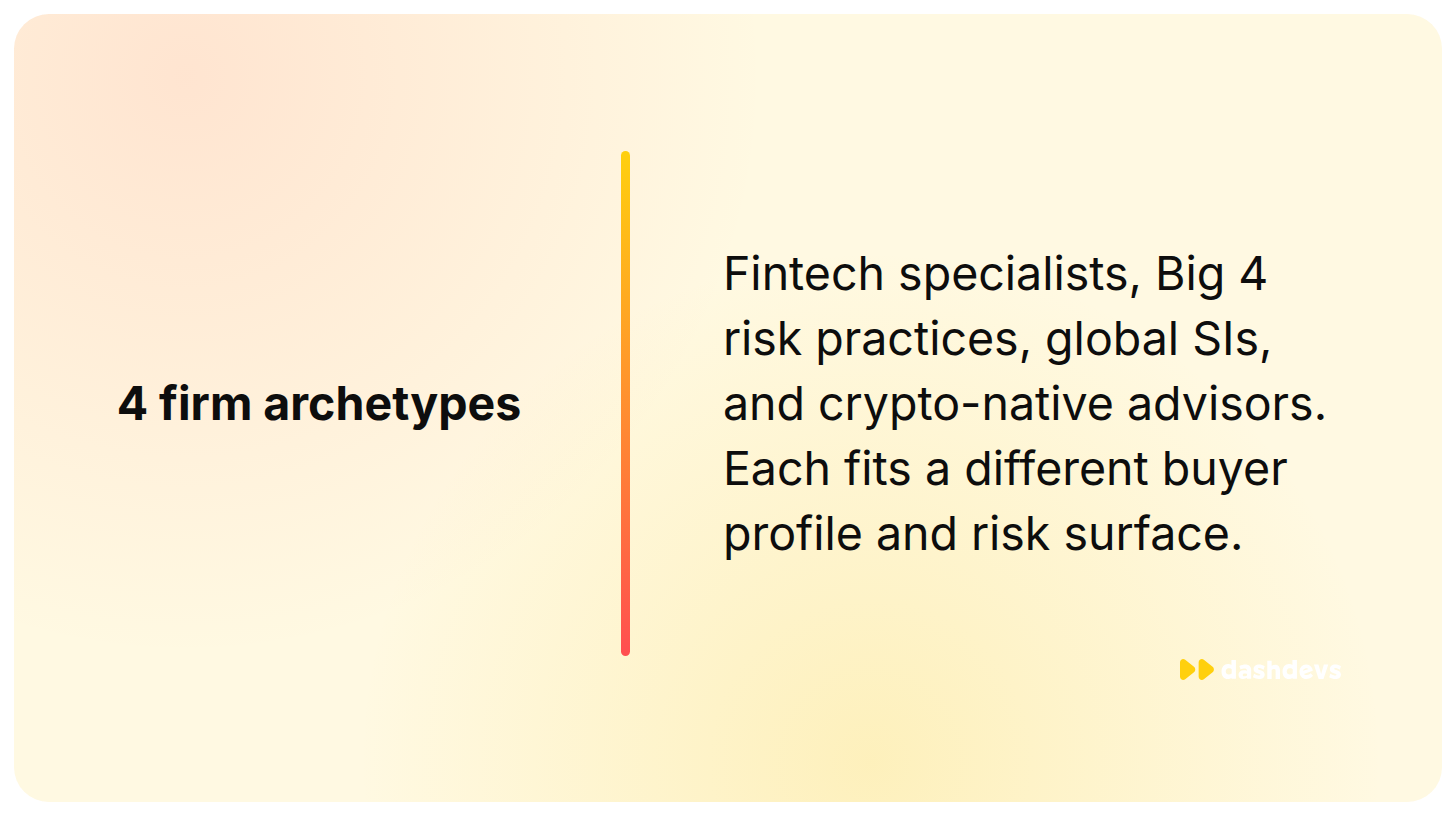
These blockchain consulting companies span a fintech specialist, Big Four digital-asset practices, global SIs, and crypto-native advisors. Order starts with DashDevs for regulated money-movement strategy; re-rank the rest against your checklist. This is not a vanity “top 50”—it is a usable shortlist for enterprise and fintech buyers.
1. DashDevs
Best for teams where blockchain strategy must land in regulated money movement: tokenization adjacent to payments, custody decisions, dual-rail ledgers, and compliance evidence. As DashDevs combines fintech consulting services with production delivery patterns, it leads this shortlist as a top blockchain consulting company for audit-aware programs—not slideware.
Where we fit: corridor and product prioritization, custody architecture choices, multi-account ledger design for dual-rail products, and handoff into build without losing the control model. Pair with a Big Four firm when you need global tax/regulatory program offices; pair with independent auditors when contracts need a second opinion.
2. Deloitte
Best for enterprises that need regulatory, tax, and control design around digital assets at group scale (Deloitte Consulting). Strong when blockchain consulting firms must navigate board risk committees and multi-jurisdiction reporting. Trade-off: slower motion and higher cost than specialists for a narrow fintech MVP—validate the named pod’s shipping history, not only the brand.
3. EY
Best for privacy-aware enterprise blockchain programs and digital-asset operating models (EY blockchain services). Useful when audit, tax, and on-chain analytics sit in the same conversation. Trade-off: confirm whether you are buying strategy, tooling, or both—and who owns implementation after the recommendation.
4. PwC
Best for risk, controls, and assurance-heavy programs inside regulated groups (PwC blockchain). Fits buyers who need blockchain technology consulting that speaks fluently to internal audit. Trade-off: you may still need a specialist builder for crypto–fiat product depth.
5. Accenture
Best for global banks and corporates running multi-year transformation where blockchain is one workstream among many (Accenture blockchain insights). Trade-off: program management muscle is the product; validate on-chain delivery depth of the actual team.
6. IBM Consulting
Best for permissioned and consortium programs that must plug into existing enterprise estates (IBM blockchain). Strong enterprise blockchain consulting lane for identity, change control, and hybrid architectures. Trade-off: heavy for a thin MVP; excellent when the estate is the constraint.
7. Capgemini
Global SI option for industry-shaped blockchain programs that must coexist with legacy systems (Capgemini blockchain solutions). Useful when procurement already mandates a large consultancy. Trade-off: confirm Web3 depth of the named engineers.
8. Consensys
Best for Ethereum-centric strategy, ecosystem access, and public-chain product advisory (Consensys). A frequent blockchain consulting partner when liquidity and composability dominate the thesis. Trade-off: premium positioning—not every permissioned bank pilot needs this tier.
9. Kaleido
Best when the consulting question is “which managed enterprise network and operating model?” rather than “which consumer dApp?” (Kaleido). Strong for consortia and hybrid ledgers. Trade-off: platform fit and exit terms matter as much as advice quality.
10. Halborn
Best as the security-and-assurance consulting layer next to your primary strategy partner (Halborn). Useful when threat modeling, audits, and incident readiness must be designed before launch—not bolted on after TVL. Trade-off: not a substitute for product strategy or fiat–chain operating design.
Quick comparison matrix
Use this matrix after you finish the profiles. Adjust weights for your risk surface.
| Company | Primary consulting strength | Best buyer profile | Watch-out |
|---|---|---|---|
| DashDevs | Regulated crypto–fiat strategy + delivery path | Fintech / EMI / payments | Not a Big Four tax program office |
| Deloitte | Regulatory / tax / controls at scale | Global enterprise | Cost and velocity |
| EY | Privacy + digital-asset ops models | Enterprise / FS | Scope clarity (strategy vs tooling) |
| PwC | Assurance-heavy controls and digital-asset risk | Risk / audit-led buyers | May need specialist builders |
| Accenture | Transformation program leadership | Banks / corporates | Validate chain delivery pod |
| IBM | Permissioned / consortium design | Estate-heavy enterprises | Overkill for thin MVPs |
| Capgemini | Multi-country SI programs | Procurement-mandated SI | Confirm Web3 depth |
| Consensys | Ethereum ecosystem strategy | Public-chain products | Premium for bank pilots |
| Kaleido | Managed enterprise networks | Consortia | Platform lock-in |
| Halborn | Security consulting / assurance | Audit-first programs | Not end-to-end product strategy |
In short: the right mix of blockchain consulting firms is often a strategy partner plus independent security—not a single logo for everything.
Architecture questions consultants must answer in writing
Before you crown a winner among blockchain consulting companies, force answers to these. Weak answers predict weak programs.
Public vs permissioned vs hybrid. Public L1/L2 fit open liquidity; permissioned ledgers fit bank consortia and data residency; hybrids appear when deposits stay on bank rails while settlement events land on-chain. A serious blockchain consulting company should recommend one path and reject two others in writing. If a blockchain consulting company cannot produce that kill-list, treat the engagement as incomplete.
Keys and custody. Decide HSM / MPC / third-party custodian before any tokenization pilot claims “production ready.” Pair advice with explicit custody design—our Fireblocks vs build guide is the diligence lens most boards eventually need.
Fiat and settlement edges. Every regulated product eventually touches rails, reconciliation, and payment tokenization where card or account credentials must not leak into chain design. Strategy that ignores the fiat edge is incomplete.
Cross-border and stablecoin adjacency. If corridors are in scope, demand a view on stablecoins for cross-border payments economics—and who banks the off-ramp—before you fund a chain pilot.
Agentic and automation risk. Buyers now ask how AI agents will initiate payments or monitoring; treat agentic payments as a control problem, not a demo feature.
Integration stack. Consulting that cannot name how financial API integration will connect core, custody, and chain events will strand you at the PowerPoint stage.
RFP checklist for a blockchain consulting partner
Direct answer: buy a decision, a control model, and a delivery path—not hours of workshops.
| Ask in the RFP | Pass signal |
|---|---|
| Sample decision memo from a similar vertical | Real redacted artifact, not a template |
| Named partners who stay after week four | Resumes + time allocation |
| Custody and key-ceremony recommendation | One preferred model + rejected alternatives |
| MiCA / AML / Travel Rule scoping | Explicit workstreams and owners |
| Vendor architecture and exit | Portability clauses, dual-source options |
| Handoff to build | Acceptance criteria and knowledge transfer plan |
| Success metrics | Pilot kill criteria and production KPIs |
Use this list when you shortlist blockchain consulting companies for your budget cycle. The firms that answer crisply are usually the ones that have shipped before.
How DashDevs approaches blockchain consulting
DashDevs sits at the intersection of strategy and regulated delivery. We start with business models and control design, then land recommendations in rails, ledgers, and product architecture that procurement can underwrite. That is why buyers evaluating blockchain consulting companies for payments-adjacent tokenization often shortlist us alongside—not instead of—a Big Four firm for tax/regulatory program offices.
Typical engagement shape: discovery that freezes chain and custody choices, a written go/no-go with killed options, vendor shortlist scoring, and a build-ready backlog. When implementation starts, the same team can stay for delivery or hand off cleanly—without rewriting the control model.
Closing: choose evidence over logo gravity
The market will keep minting listicles of blockchain consulting companies. The differentiator in 2026 is whether your partner leaves you with a bankable operating model—or a pilot that cannot survive the second risk committee. Score the top blockchain consulting companies against the criteria above, demand a kill-list of architecture options, and only then fund build.
Done well, blockchain technology consulting turns tokenization and settlement from a press release into a program finance can close.
Share article
