


Best Neobanks Ranked by Customers, Revenue, and License Structure

August 27, 2026
- The global neobanking market is estimated at $552 billion in 2026, yet over 76% of neobanks remain unprofitable. The profitability gap between leaders and the long tail is structural.
- Nubank, Revolut, and Monzo prove three distinct paths to profitability: credit-led, subscription-led, and community-led.
- Every neobank on this list operates on one of three license models: a full banking license, an EMI license, or a BaaS sponsor-bank arrangement.
- Choosing the right neobank means matching geography, license structure, fee model, and deposit protection to your situation. Brand recognition is not a useful filter.
Picking a neobank to study is not the same as understanding one. Every founder entering digital banking has a version of the same conversation. Which neobanks actually made money? How did they get there? What does that mean for what you are building?
The answer is not in the feature list. It is in the license structure, the revenue model, and the infrastructure choices made years before the product shipped. A BaaS-model neobank carries a fundamentally different economic and risk profile than one with its own banking license. That distinction shapes what you can build, what you can charge, and what happens when a partner bank fails.
This article maps the top neobanks of 2026 for fintech founders, product teams, and BaaS or embedded finance operators. Consumers and SME owners comparing accounts will find their answers in the “How to Choose” section and comparison table below.
We have built regulated financial products for over 15 years, including Dozens, one of the UK’s early challenger banks. That experience is behind this analysis.
What is a neobank, and why the definition matters
A neobank is a branchless, mobile-first financial institution that delivers banking services entirely through apps. No physical branches, no legacy core banking system slowing releases, no branch overhead eating margins.
The word “neobank” covers three structurally different arrangements. Good neobank examples like Monzo, Chime, and N26 each sit in a different category. They are not equivalent in terms of safety or revenue potential:
| Structure | What it means | License holder | Deposit protection |
|---|---|---|---|
| Full banking license | The neobank itself is a regulated bank | The neobank | Direct (FSCS, FDIC, EU DGS) |
| EMI / PI license | Can hold e-money and process payments; cannot lend from deposits | The neobank (limited) | Safeguarding rules, not deposit guarantee |
| BaaS / sponsor bank | A licensed partner bank sits underneath; the neobank is a product layer | The partner bank | Via partner bank (FDIC pass-through in the US) |
This distinction matters after the Synapse collapse in 2024.
Partner bank dependency is not a technicality. It is a risk.
Synapse, a BaaS intermediary used by neobanks including Yotta, Juno, and Copper, went bankrupt in 2024. Approximately $265 million in customer funds were frozen. Reconciliation revealed a discrepancy of $65 to $95 million between Synapse’s records and those of its partner banks. Customers waited over six months for access. Before you open a neobank account or build a product on top of one, that story should inform your decision.
The 2026 neobank market: numbers worth knowing
The global neobanking market sits at $552 billion in 2026, with 350 million users worldwide. According to a 2025 Accenture study cited by Axis Intelligence Research, 76% of neobanks remain unprofitable. Average annual revenue per user is $45, compared to $350 at traditional retail banks. Seven to one. The root cause is simple: most customers keep neobanks as secondary accounts.
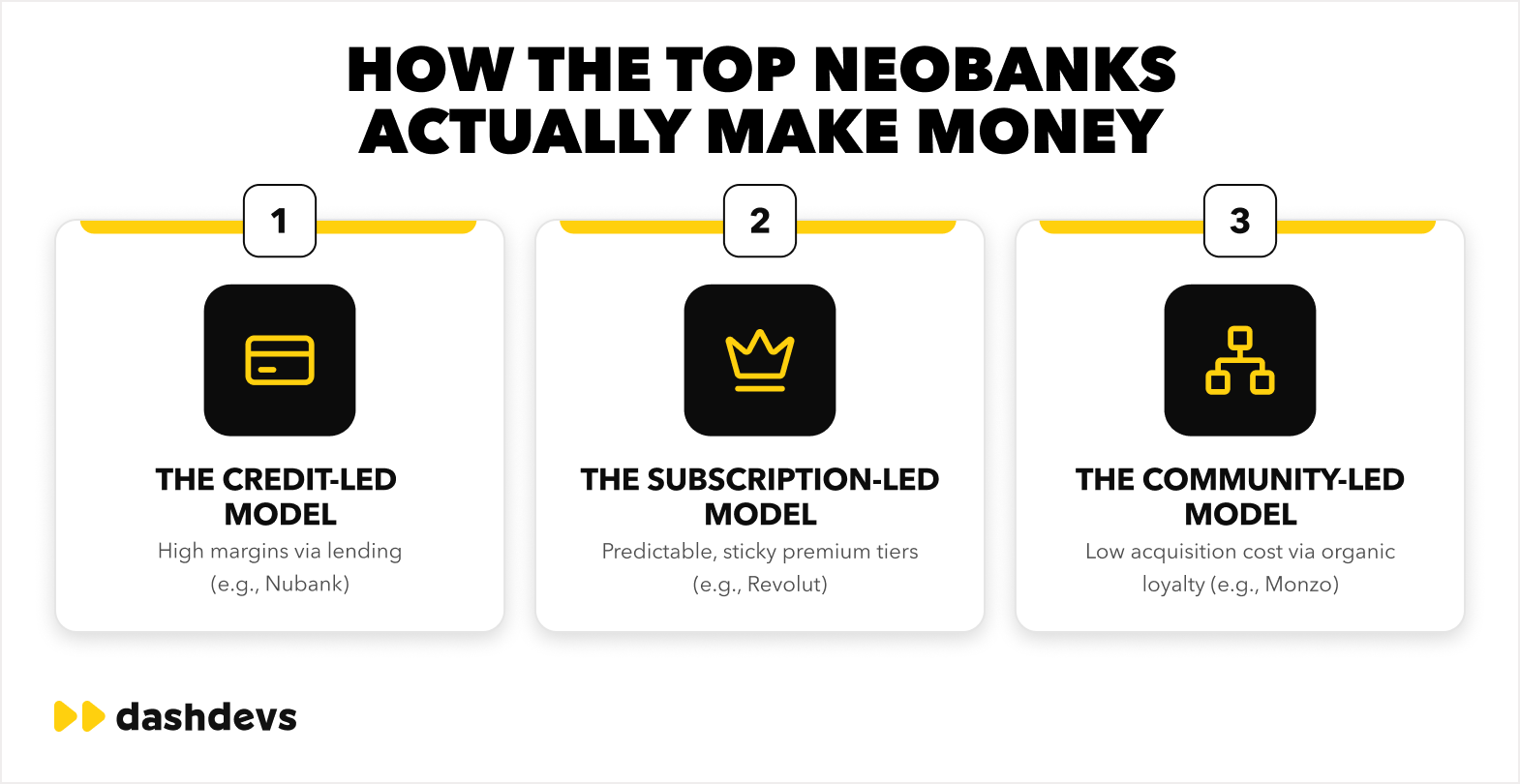
Three structural realities define the landscape. Nubank dominates Latin America. Revolut owns European cross-border banking. Chime leads the US mass market. Only the best neobanks built a second revenue line early enough to close the ARPU gap. The standalone checking account is a customer acquisition vehicle, not a business.
Already running a fintech and thinking about what comes next? Explore digital banking solutions and digital banking trends on the DashDevs blog.
The best neobanks in 2026: ranked and compared
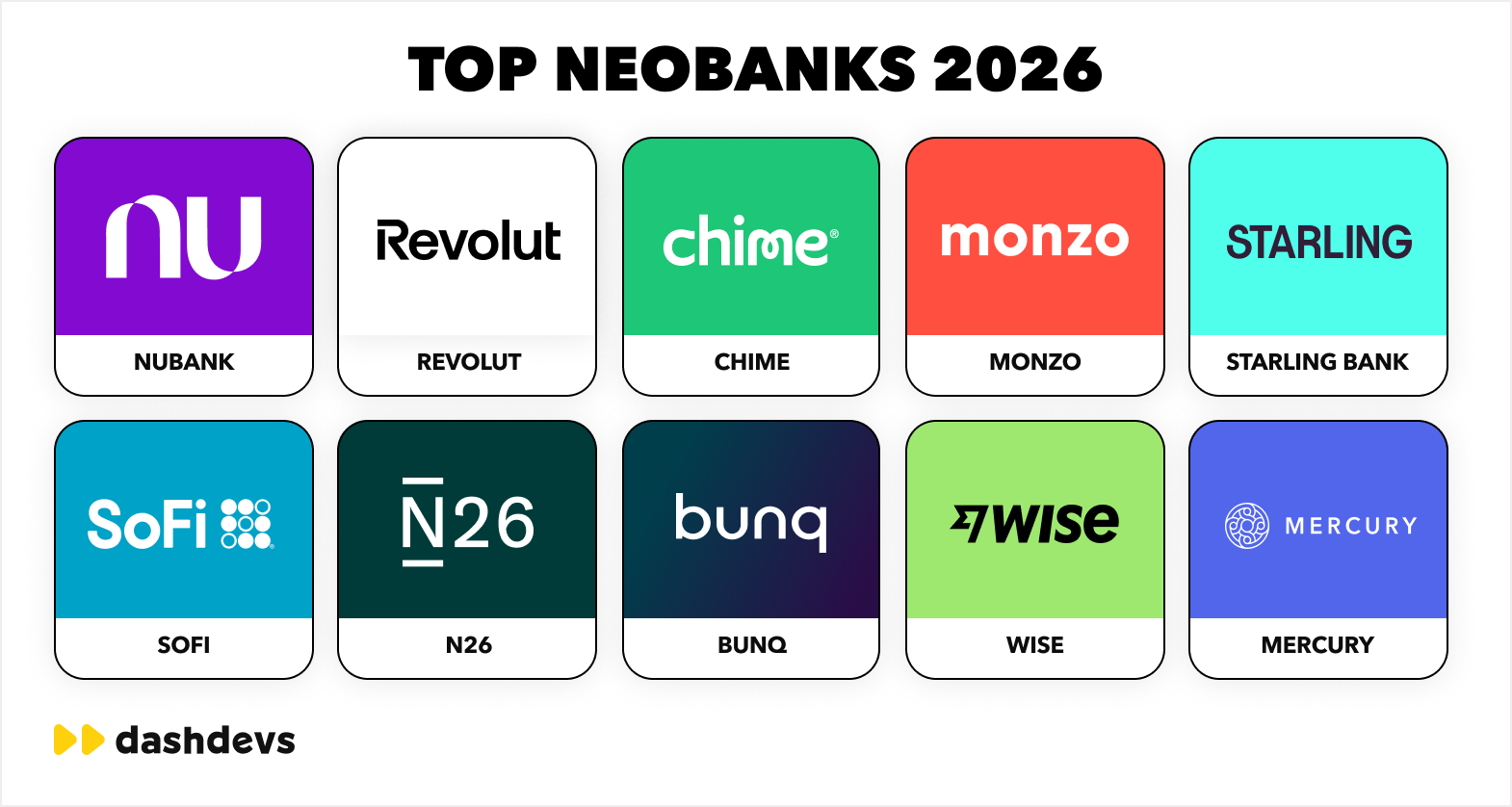
Here is a complete list of neobanks worth knowing, ranked by active customers and assessed by license model and revenue:
| # | Neobank | HQ | Active customers | License | 2025 Revenue |
|---|---|---|---|---|---|
| 1 | Nubank | Brazil | 135M | Full banking (BR, MX, CO) | $5B+ (Q1 2026 alone) |
| 2 | Revolut | UK | 68.3M | EU + UK banking license | £4.5B (~$6B) |
| 3 | Chime | USA | 9.5M active members | BaaS (Bancorp + Stride) | $2.19B |
| 4 | Monzo | UK | 12.2M | Full UK banking license | £1.2B |
| 5 | Starling | UK | ~4M | Full UK banking license | ~£700M |
| 6 | SoFi | USA | 9.5M | Full US national bank charter | Profitable FY2025 |
| 7 | N26 | Germany | 5M active | Full BaFin license | EU-only disclosure |
| 8 | Bunq | Netherlands | 17M | Full Dutch banking license | €85M net profit (2024) |
| 9 | Wise | UK | 16M | EMI (UK/EU), partner banks (US) | Publicly traded, profitable |
| 10 | Mercury | USA | 100K+ startups | BaaS (multiple partners) | Private |
1. Nubank: proof that the credit-led model works
In Brazil, credit card access was a privilege for the formally employed. Nubank removed that barrier, anchored by a purple Mastercard that became a cultural symbol.
Per Nubank’s Q1 2026 earnings, revenues surpassed $5 billion in a single quarter for the first time. Net income reached $871 million, and ARPAC hit $16 per month, up from roughly $3 in 2021. The credit card product funded the infrastructure. Once that worked, Nubank expanded into loans, insurance, and investments with near-zero incremental acquisition cost.
For builders: This model only replicates where banking access is genuinely limited and where you control the credit stack. Cloning it in a well-banked market without a lending license is not a strategy.
2. Revolut: the super-app that got serious about compliance
Revolut started as a travel FX card and added everything: trading, crypto, insurance, eSIMs, business accounts, and BNPL. Critics spent years noting it was not a real bank. It responded by getting licensed.
Per Revolut’s FY2025 Annual Report (March 2026), revenues reached £4.5 billion. Pre-tax profit hit £1.7 billion ($2.3 billion), up 57% year-over-year. Five consecutive profitable years. Eleven separate product lines each exceeding £100 million in annual revenue. The UK banking license was finalized in March 2026, unlocking direct deposit-taking and lending.
The subscription tiers, Premium, Metal, and Ultra, at €5 to €45 per month, deliver predictable, high-margin revenue. Combined with FX income and the expanding lending book, this is what the 38% pre-tax margin reflects.
For builders: Free-tier-plus-premium-upsell is the most durable revenue structure available without a lending license. It only works for tens of millions of customers. Build the wedge first.
3. Chime: America’s mass-market play, and its structural limit
Chime had 8.6 million active members at its S-1 filing in May 2025. That grew to 9.5 million by FY2025 end.
Per Chime’s February 2026 8-K, FY2025 revenue reached $2.19 billion (up 31%), and gross margin held at 88%. The GAAP net loss of $1 billion was driven by $928 million in IPO-related stock compensation. Chime guides to first full-year GAAP profitability in FY2026.
The structural ceiling is real. Chime cannot lend from deposits. Without net interest margin, closing the ARPU gap through interchange alone is not possible at scale.
The BaaS model is a structural choice with long-term revenue implications. It is not a shortcut.
4. Monzo: what community-led growth actually looks like
Per Monzo’s FY2025 Annual Report, revenues surpassed £1.2 billion for the first time (up 48%). Pre-tax profit increased eight times to £113.9 million. Deposits grew 48% to £16.6 billion. Two-thirds of the 12.2 million customers joined via word-of-mouth.
Monzo holds a full UK banking license. Deposits are FSCS-covered up to £85,000 directly. Most neobanks that consumers treat as interchangeable with banks cannot say that.
When two in three customers arrive without paid acquisition, the growth economics are different from any competitor running TV advertising. That is not a marketing story. It is a structural cost advantage.
5. Starling Bank: the quiet one that became profitable first
Starling achieved break-even in October 2020 and has not required additional external funding since. It serves approximately 4 million customers, fewer than Monzo, but with higher revenue per customer.
The reasons: an SME banking focus with higher average balances, a mortgage book generating net interest income, and Engine. Engine is Starling’s proprietary banking platform, now licensed to other banks. It is a rare example of a neobank converting its own infrastructure into a second revenue stream.
For builders: the lesson is customer selection over raw acquisition. Higher-value segments pay more and churn less.
Neobanks 6 to 10: the rest worth knowing
SoFi: Holds a full US national bank charter (obtained in 2022) and serves 9.5 million active members. Its ARPU is $257, more than three times Chime’s. The difference is lending. Net interest margin is what financially separates a fintech from a full bank.
N26: Holds a full BaFin license with local IBANs across approximately 24 EU countries. After BaFin lifted its customer growth cap in mid-2024, N26 accelerated with trading, crypto, and savings products. Its exit from the US and UK looks defensible in retrospect: focus on your strongest regulatory position.
Bunq: It is the best fintech bank for European digital nomads. It is also the best neobank for users who want every plan to include premium features. Multi-IBAN support, high savings rates, and sustainability features. Every plan is paid, with no free tier. That filters out secondary-account users.
Wise: It is technically an EMI. It operates across 40+ currencies with mid-market rates and local account details in approximately 10 currencies. For fintechs building similar multi-currency payment products, hiring a dedicated ewallet app development company helps ensure compliant wallet mechanics and seamless API integrations.
Mercury: Serves over 100,000 US startups with treasury management and clean onboarding for tech companies. Following the Synapse collapse, Mercury terminated its Evolve Bank relationship and diversified its partners. Right call. Any BaaS-dependent neobank should plan for partner bank failure. API downtime is the smaller risk.
How to choose the right neobank
Choosing among the best neobanks means matching your situation to the right license model, geography, and fee structure. Here is how to cut through the noise.
For everyday banking: Monzo or Starling (UK), N26 or Bunq (EU), Chime or SoFi (US).
For international and multi-currency use: Revolut for feature breadth at higher subscription tiers. Wise for FX transparency and mid-market rates on cross-border transfers.
For small businesses: Starling Business (UK), Wise Business (global), Revolut Business (EU and UK), Mercury (US startups).
For deposit safety: Prioritize a neobank with its own full banking license. FSCS covers £85,000 (UK), EU DGS covers €100,000, and FDIC covers $250,000 (US). With BaaS-model neobanks, verify that the partner bank holds the insurance and that reconciliation runs correctly.
Always check which entity actually holds your deposit. The Coral card and the banking license are not the same thing. For a broader look at the space, see our roundup of the best online banking platforms available today.
DashDevs expertise: what we have learned building digital banks
DashDevs built and launched Dozens, one of the UK’s early challenger banks. That project covered sponsor-bank integrations, KYC and AML compliance architecture, card issuing, and the core banking layer. If you’re mapping out your own launch strategy, see our guide on how to start an online bank.
Onboarding is the first compliance test. It is also the first UX moment, but compliance comes first. The neobanks that scaled without regulatory trouble got KYC right early. Following JMLSG guidance in the UK and equivalent frameworks in the EU and US costs more upfront. It costs far less in enforcement exposure later. Global regulatory fines for fintechs surged 417% in 2025, totalling over $1.2 billion. That trend is not reversing.
The ledger choice compounds. One project we worked on rebuilt its ledger at 800,000 users and lost 14 months of product velocity doing it. Evaluating modern core banking systems early ensures your infrastructure handles real-time reconciliation, multi-currency postings, and high-frequency transactions. Teams that chose convenience at launch regret it at scale.
Partner bank contracts deserve as much attention as product roadmaps. Synapse was the predictable outcome of BaaS arrangements without clear protections around fund segregation and reconciliation frequency. Every BaaS-dependent neobank should run independent reconciliation against its partner bank records in real time.
These lessons shaped Fintech Core, our composable banking platform. It covers real-time ledgers, KYC/KYB flows, card issuing, cross-border payment integrations, open banking, and an AML toolkit. It compresses 12 months of typical neobank build time into 3.
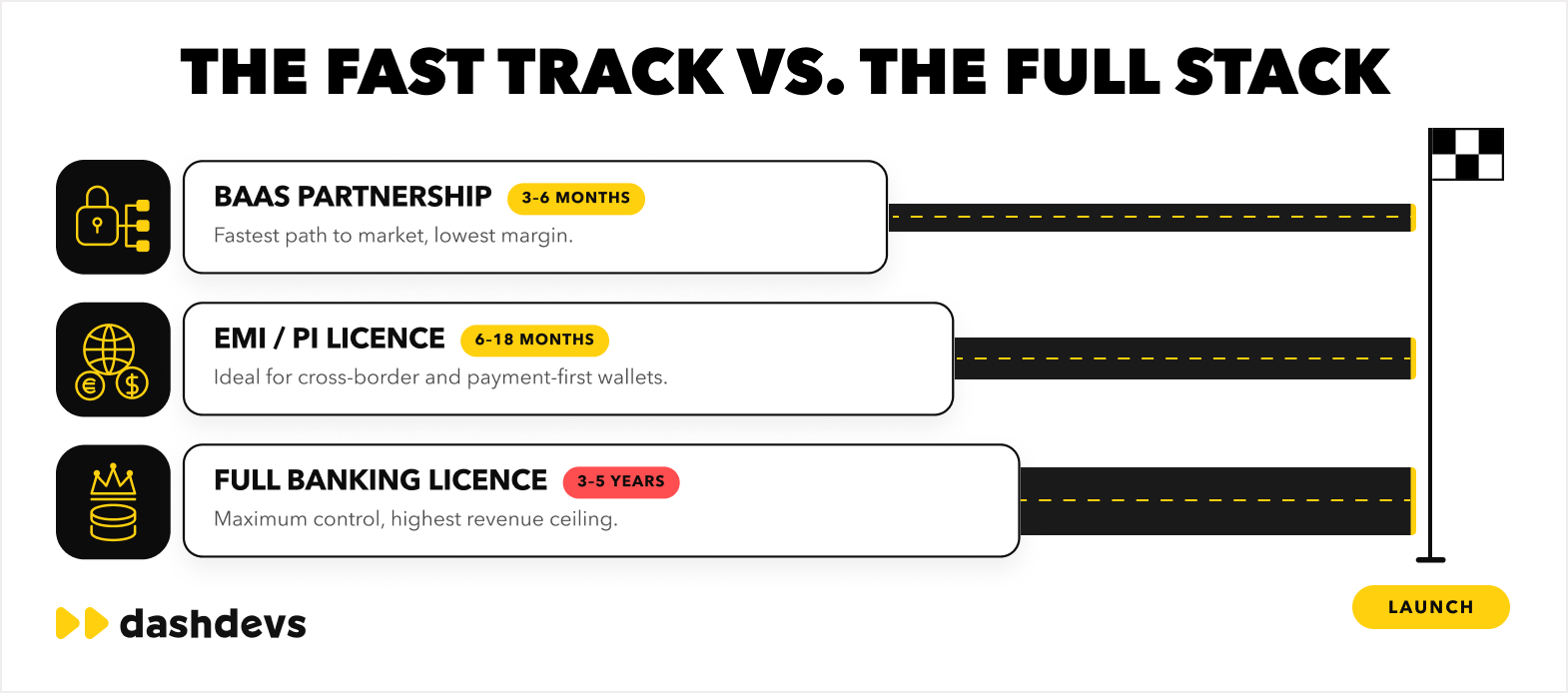
See our guide on how to build neobank products or compare white-label digital banking software options.
The bottom line
The top neobanks of 2026 are not the ones with the most features or the lowest fees. They are the ones that made the right architectural choices early. They built revenue models beyond interchange and treated compliance as infrastructure rather than a checklist.
For consumers: check whether your neobank holds its own banking license before depositing significant funds. For builders: vertical focus, regulatory depth, and infrastructure quality separate survivors from the ones that consolidation will remove.
Our neobank app development services and Fintech Core platform are the right starting point. The mobile app development for fintech team handles the build. Tarabut Gateway and NatWest trusted the same team to build their regulated financial infrastructure.
Once your launch path is set, operational decisions like credit card processing and cybersecurity for banks will dictate your technical build.
Share article
