


Vendor Lock-In in Fintech: What It Really Costs and How to Avoid It

August 28, 2026
- Vendor lock-in in fintech starts in contracts, data formats, and code ownership agreements.
- Switching costs after deep integration routinely exceed $315,000 per migration project. Cloud budgets already exceed plan by 17% on average.
- DORA makes third-party ICT dependencies a supervised regulatory risk for EU-regulated entities.
- 73% of organizations now operate hybrid cloud estates, according to Flexera.
- Fintech teams using a modular platform preserve the ability to swap providers without rebuilding core infrastructure.
Vendor lock-in is a significant business risk that affects various industries. At some point it happens because a payment gateway raised its rates, a BaaS provider changed its terms, or a core banking vendor entered a multiyear maintenance freeze. That’s a moment when your team may not have an exit path, even if you are desperate to migrate to one of the top core banking solutions on the market.
Now, let’s take a look at what vendor lock-in looks like in production: a structural constraint that arrives when you need flexibility the most. For fintech CTOs and founders, it shows up during a compliance audit, a Series B fundraise, or an expansion into a new market.
This guide is for those who are at growth-stage fintechs and licensed FIs. We cover what lock-in actually costs in 2026, where fintech-specific risk differs from generic cloud advice, and which architectural and contractual decisions preserve your ability to change course.
DashDevs has delivered products with 30+ vendor integrations, and the patterns we see repeatedly are the same ones most advice in this space misses.
What is vendor lock-in — and why fintech gets it worse
It means the cost of switching away from a provider exceeds the cost of staying, even when staying is no longer the right decision.
In standard cloud computing, that dependency shows up through proprietary APIs, egress fees, and non-portable data formats. In fintech, those same mechanisms appear, but regulatory obligations add friction that most cloud-migration guides don’t account for.
A fintech company’s vendor relationships span payment rails, KYC/KYB providers, ledger infrastructure, card issuers, and compliance tooling. Each carries its own data residency obligations, audit trail requirements, and switching friction. When a KYC provider holds your verification packs, spot-check evidence, and model-currency mappings, migration needs regulatory sign-off in many jurisdictions. That is a different problem from migrating a database.
Three types of dependency affect fintech teams specifically:
Architectural lock-in: Product logic is written directly into a single vendor’s API schema. Switching requires rewriting application code, and this is the most common pattern in BaaS and payment gateway integrations.
Data lock-in: Transaction history, KYC records, and ledger data sit in proprietary formats or inside a vendor’s managed service. Egress fees and incompatible data models make the move expensive before you have written a single line of migration code.
Contractual lock-in: Multi-year agreements with penalty clauses for early termination. Cloud providers routinely offer enterprise discount programs tied to multi-year minimum spend commitments. The discount itself becomes the trap.
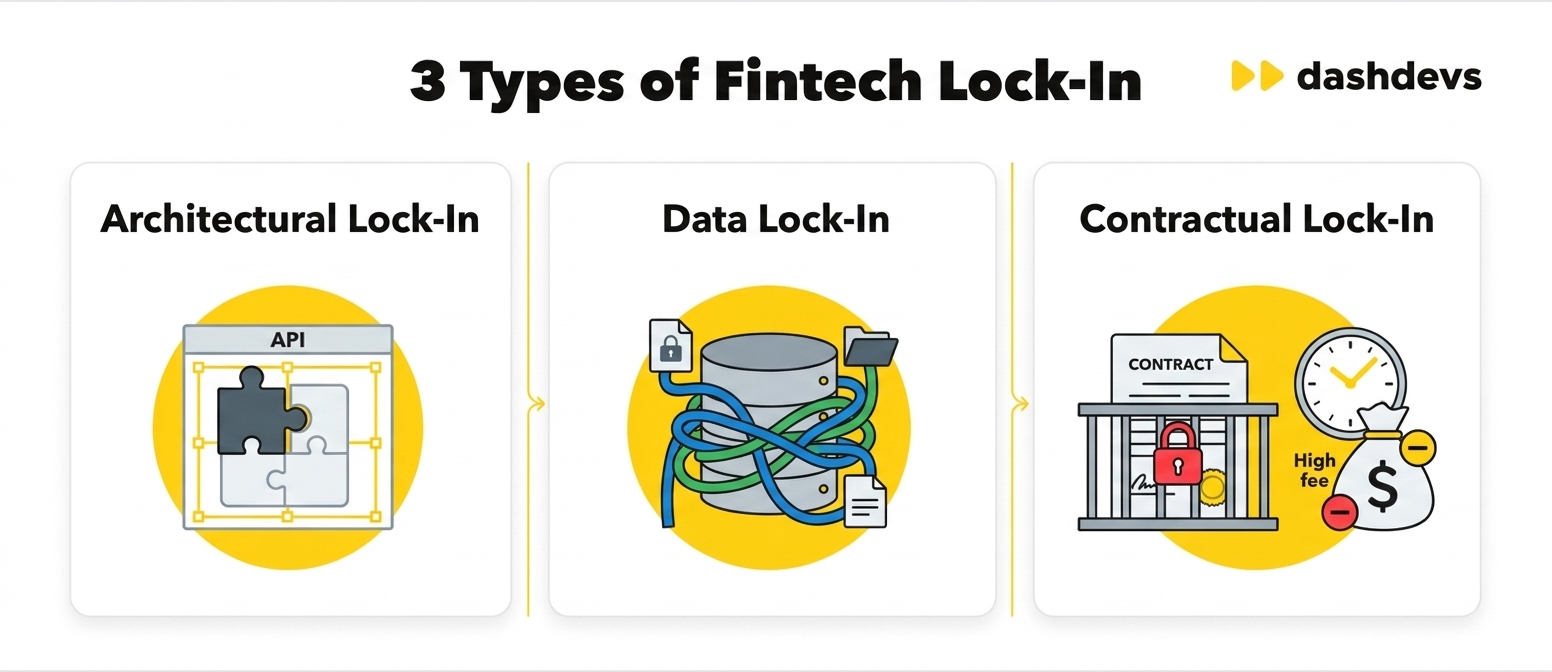
The cost of dependency in financial services is rarely visible at signing. It accumulates in the gap between what you need your infrastructure to do next year and what your current vendor will allow.
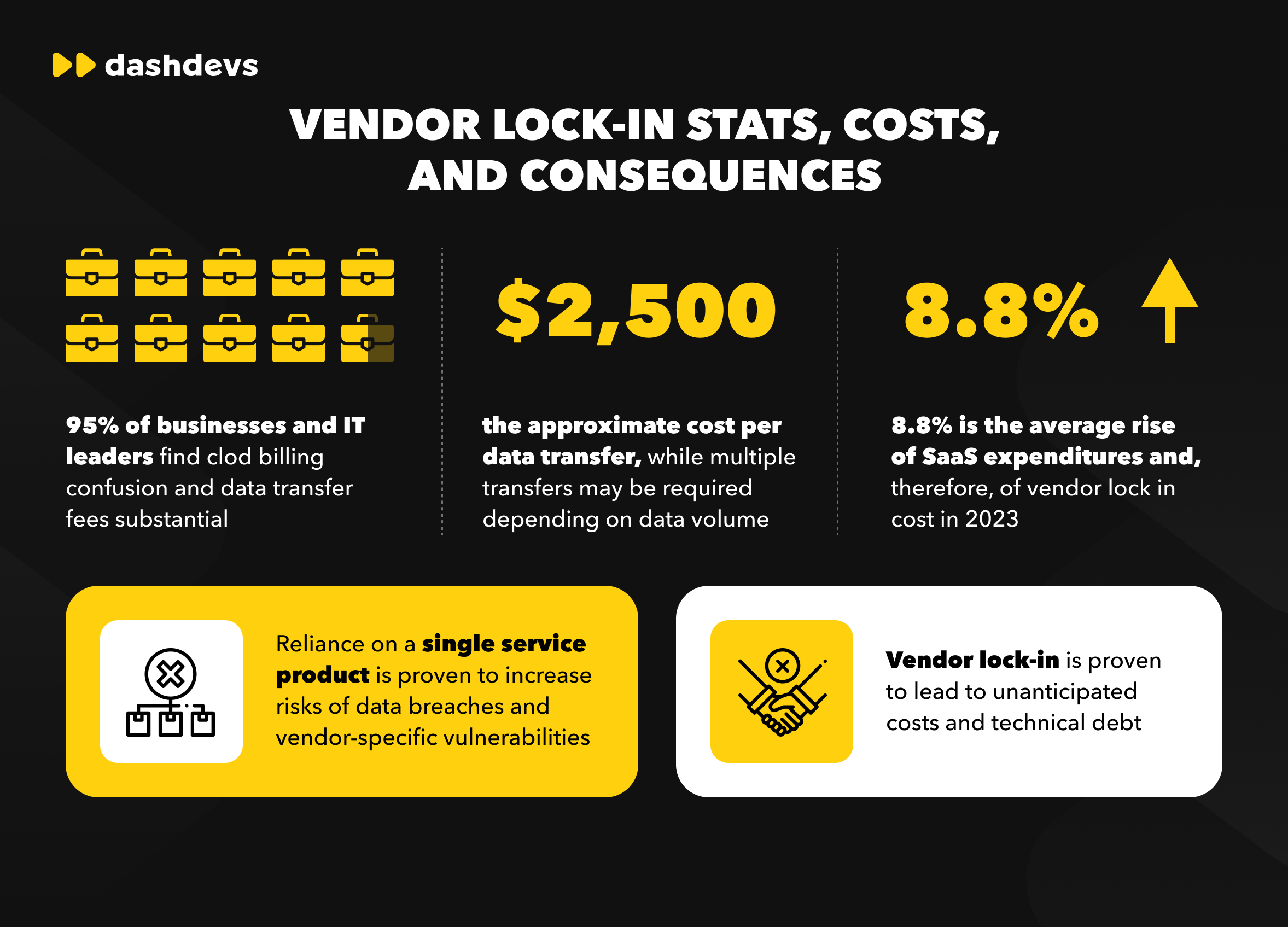
The financial stakes are concrete. The average enterprise migration project costs $315,000. It covers data migration, application refactoring, retraining, and downtime. For a fintech team running dozens of integrations, total exposure can be much higher.
The regulatory dimension: DORA changes the calculation
DORA (the EU Digital Operational Resilience Act) became enforceable in January 2025. For any fintech or financial institution operating in the EU, third-party vendor dependency is a supervised risk with material penalty exposure.
Under DORA, every material ICT vendor arrangement requires documented risk assessment, concentration risk analysis, and evidence of operational control. Supervisors ask who owns the function and how you prove control.
This shifts vendor selection from a procurement decision to a compliance architecture decision. Teams building on proprietary infrastructure from a single cloud or BaaS provider now need to map every material arrangement on two axes: criticality (what fails if this vendor goes down?) and switching cost (how expensive is migration?).
Ledger and BaaS arrangements typically sit high on both axes. KYC and fraud tooling sit high on criticality but can carry lower switching costs when the data model is portable. And payment rails vary based on how deeply scheme connectivity is embedded.
A large share of financial institutions depend on a small number of cloud and ICT service providers. Regulators are examining this concentration actively.
For EU-regulated teams, DORA compliance is also a forcing function. If you can’t answer “how long would migration take?” for your top three vendors with documented evidence, that is a gap regulators will find before you do.
How to avoid vendor lock-in: six practical approaches
Avoiding single-vendor dependency is a set of design choices that compound over time.
1. Build portable architecture from day one
The most effective defense is making portability a design requirement at the architecture stage.
This means containerizing applications with Docker and Kubernetes so they run across providers without rewriting code. It means storing data in open formats (JSON, Parquet, and standard SQL schemas) rather than vendor-proprietary structures and building an abstraction layer between application logic and provider-specific APIs.
The question to ask at design time is “How hard would it be to leave?” You need to think about it beforehand.
2. Demand source code ownership and IP assignment
When you evaluate banking software development companies or platform providers, the default IP assignment in many contracts keeps source code, architecture documentation, and CI/CD configurations with the vendor. If that relationship ends, the client will have a running product they can’t maintain independently.
In any engagement with a dev shop or platform provider, the contract should specify repository access for the client from day one, IP assignment to the client at delivery, and handover documentation that lets a different team take over within 30 to 60 days.
3. Use open source and open standards for core infrastructure
Open source databases and infrastructure tools have a practical advantage: you can run them independently of any commercial vendor.
Platforms built on open standards (PostgreSQL, MySQL, standard SQL interfaces) avoid the proprietary query language and closed storage format problems that make migration expensive. The fintech integration vendor selection process should prioritize open standards at the database and API layer.
Open standards at the data layer are non-negotiable for any fintech product that expects to operate across jurisdictions. The question is whether you’ve built the product so that migration is a decision you make rather than a crisis you manage.
4. Design multi-vendor deployment
Single-vendor architectures are the highest-risk configuration for fintech products. A price change, a service degradation, or a contractual dispute with one provider affects the entire product.
Multi-cloud and multi-vendor deployment keeps options open. According to Flexera’s 2026 State of the Cloud Report, 73% of organizations now operate hybrid cloud estates. In fintech, multi-vendor deployment at the payment rail level means maintaining connectivity to at least two payment providers and two KYC vendors where architecture allows.
5. Negotiate SLAs with explicit exit conditions
Usually teams treat SLA negotiation as a performance discussion. Exit conditions get minimal attention at signing and maximum attention during a painful offboarding.
The contractual elements that reduce dependency are specific. You need written clauses covering data export in open formats with guaranteed timelines, vendor-assisted migration with a cost cap, and data ownership language that assigns records to you. And also, early termination terms that don’t trigger penalties when a vendor materially changes its service.
6. Treat exit planning as a design discipline
Teams often do exit planning reactively just right after a vendor raises prices or misses a critical SLA. The teams that maintain independence treat exit planning as a periodic design exercise.
This means documenting migration playbooks for each material vendor before they are needed, running disaster recovery drills that simulate provider failure, and testing data export procedures quarterly.

Best database choices for avoiding vendor lock-in
One of the most common questions in this topic area is which database software reduces lock-in risk. The answer is grounded in a few concrete properties: open-source license, standard query interfaces (SQL-compatible), portable deployment, and standard export formats.
Here is how common database categories compare:
| Database type | Lock-in risk | Why |
|---|---|---|
| PostgreSQL, MySQL | Low | Open source, standard SQL, runs anywhere, wide tooling ecosystem |
| Kubernetes-deployed open source DBs | Low | Cloud-agnostic by design, configuration is portable |
| MongoDB (self-hosted) | Low–Medium | Open source and portable in self-hosted form; managed cloud version adds some provider dependency |
| Cloud-native managed DBs (Amazon Aurora, Google Spanner) | High | Proprietary extensions, egress fees, API-specific features add migration costs |
| Proprietary SaaS databases | High | Closed formats and vendor-controlled export; migration requires vendor cooperation |
The fintech API integration layer follows the same logic. Standard, self-hostable tools carry significantly less lock-in risk than their fully managed cloud equivalents. This is exactly why platforms like Fintech Core are built on portable infrastructure rather than closed ecosystems.
Vendor risk management: what a real program covers
Vendor risk management in fintech is a structured practice. A working program covers the full lifecycle of each vendor relationship:
- Define requirements and portability expectations before selecting a vendor.
- Build a vendor assessment document that maps criticality, switching cost, and regulatory exposure for each candidate.
- Select vendors and negotiate contracts with concrete exit conditions.
- Document integration ownership — who holds the API keys, who maintains the connection, who can authorize a migration.
- Monitor vendor performance and financial health on a regular cadence.
- Execute planned or unplanned exits against a pre-documented playbook.
For EU-regulated entities, this structure is now a DORA requirement.
What good looks like: Tarabut case
Abstract advice is easier to evaluate against real examples.
At Tarabut, MENA’s first regulated open banking platform, DashDevs built the core open-banking engine and mobile app from scratch in just 9 months. Navigating strict regional legislation, we integrated all 24 commercial banks in Bahrain into the solution and successfully passed the Central Bank of Bahrain’s sandbox testing.
Because we built a custom, modular API architecture, each bank’s integration followed a consistent, portable pattern regardless of their internal legacy systems. This architectural independence helped Tarabut scale rapidly, achieving a £25M product valuation and capturing a massive user base without being trapped by proprietary vendor debt.
Evaluating vendors before you sign
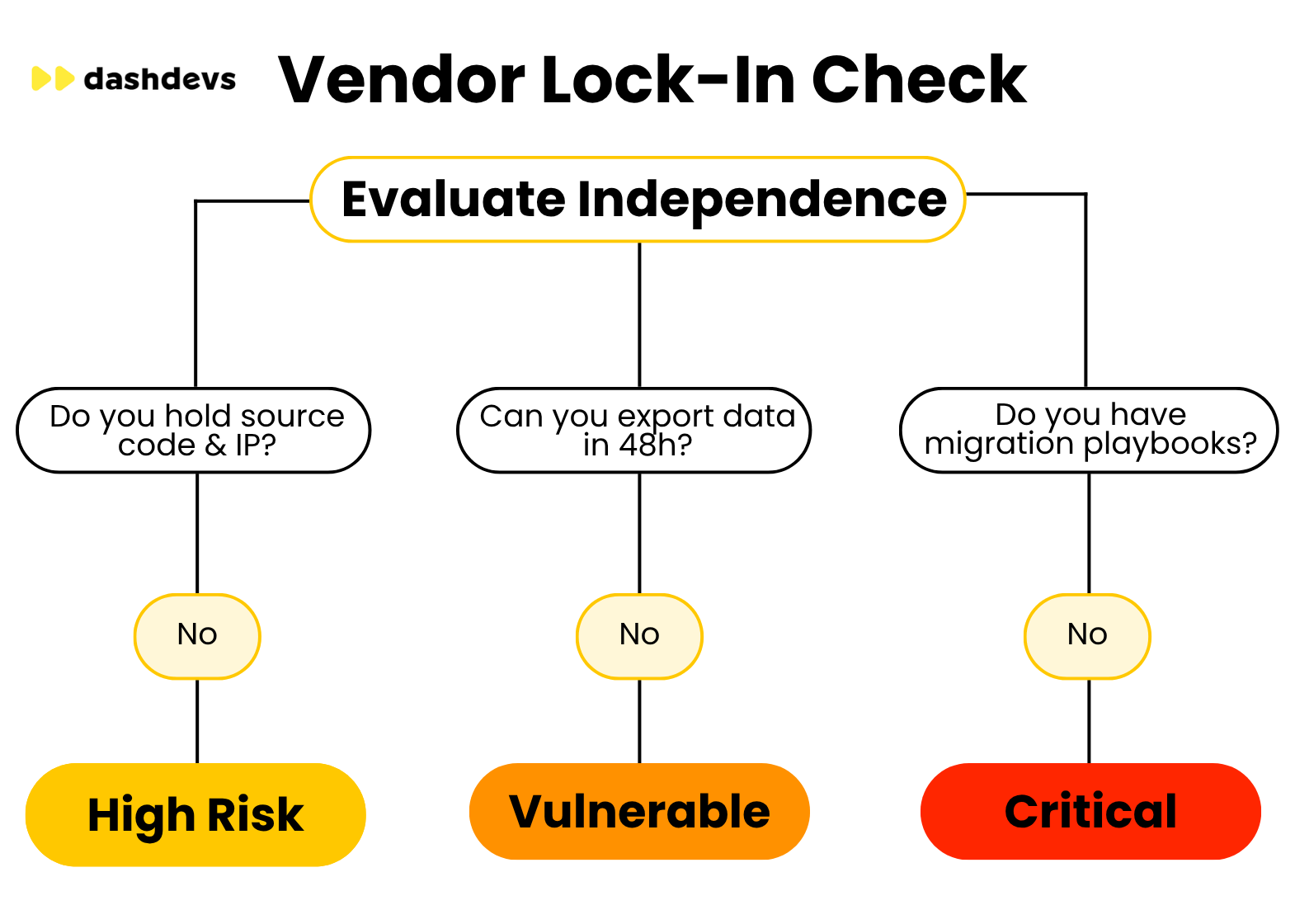
To standardize this process, use a structured RFP template to evaluate these technical and contractual criteria across all potential providers. Ask these questions:
Technical portability: What formats can we export our data in, and how long does that take? Are your APIs based on open standards? Can we self-host?
Contractual portability: Who owns the data we generate? What does the termination clause say about data export? Do you provide migration assistance, and at what cost?
Operational resilience: What happens to our data if your company enters insolvency? How many of your critical functions depend on a third-party vendor we cannot access?
Vendors that give evasive answers to these questions are signaling something.
For fintech teams managing complex stacks, DashDevs’ cloud and devops services include vendor dependency mapping as part of architecture review.
Cloud providers that create lock-in: what to watch
The following ecosystems are commonly cited in dependency discussions because their business models create switching costs as a side effect of integration depth.
AWS: Tight service integration (S3, RDS, Lambda, and Aurora) means each additional service adds switching costs. Egress fees penalize data movement.
Microsoft Azure: Deep Office 365 and Active Directory integration can spread dependency into authentication and identity infrastructure beyond the cloud layer.
Google Cloud: Strong at specific workloads (BigQuery, Kubernetes Engine). Teams heavily using BigQuery often find query optimization is not portable.
Salesforce: Proprietary SOQL query language and deep third-party app integrations create migration complexity.
A hybrid cloud approach keeps proprietary-service dependencies at the edge of the architecture rather than in the core. Teams using risk management in fintech frameworks should treat cloud platform concentration as a category of operational risk.
Fintech Core: a structural answer to the lock-in problem
The conventional choice between a SaaS vendor stack (fast start, high lock-in) and pure custom development (slow start, full control) misses a middle path: a composable platform where the infrastructure layer is reusable but provider relationships are swappable.
Fintech Core is DashDevs’ composable end-to-end fintech platform, built to avoid the dependency patterns that BaaS and white-label providers typically create. Modules for ledger, KYC/KYB, card issuing, payment orchestration, and AML connect through standard interfaces. The integration layer is owned by the team building the product.
Fintech Core clients hold source code access, IP assignment, and deployment infrastructure. This ensures that your foundation is portable by design, giving you the freedom to swap out underlying vendors as your compliance or scaling needs evolve.
If you are launching a digital financial product, you can explore how a white-label bank with a modular system approach allows you to launch quickly while keeping your infrastructure completely portable.
Control your architecture and your future
Lock-in is managed as an ongoing design discipline.
The teams that maintain vendor independence treat portability as a first-class requirement from the architecture stage, negotiate exit conditions at the same time they negotiate onboarding, and maintain tested migration playbooks for every material dependency.
If your current stack has dependencies you could not exit in under 60 days without significant disruption, that is worth addressing before the next fundraise, regulatory review, or contract renewal. Whether you are replatforming an existing product or seeking custom fintech software development for a new venture, building with ownership and open standards is the only way to guarantee your product’s future remains securely in your hands.
Check out our comprehensive guide on how to start a neobank without falling into the trap.
Share article
