

Entering a new, tightly regulated market required certified compliance with the UAE's Open Banking framework — FAPI 2.0 and Nebras — before a single transaction could go live.


From a Provider-Dependent Market Entry to a Certified Open Banking Platform
Madfoat reached the point where entering the UAE required more than a payment integration—it required a certified, regulator-ready Open Banking platform built on a microservices, cloud-agnostic foundation from day one.
01
Business problem
Madfoat, an established payments provider already operating in Jordan, wanted to expand into a certified, regulator-ready Open Banking platform capable of powering merchant payments across the UAE market.
Target operating model
What made this difficult
Payment initiation, consent management, merchant administration, and platform governance needed to operate as one coherent system, coordinated end-to-end with a new banking-scheme vendor.
Supporting both PIS and AIS flows at once — real-time consent capture, KYB-gated merchant onboarding, and audit-ready transaction logging — multiplied the coordination effort behind every product decision.
Committing to a Fixed Cost model on a compressed timeline created pressure to deliver the full platform scope without cost overrun or schedule slippage.
The challenge was not proving that Open Banking payments could work in the UAE. The challenge was proving it inside a fixed budget, a fixed timeline, and a certification path that was still evolving.

02
The cost of delayed certification
If Madfoat delayed or approached UAE entry incrementally, the likely outcomes included:
- Slower market entry into the UAE
- Continued dependency on Jordan-only operations
- Loss of first-mover position relative to competing Open Banking providers
- Extended vendor negotiation and re-certification cycles
- A fragmented merchant experience split across SDKs, consent tools, and dashboards
- Rising cost of coordinating PIS and AIS as separate efforts
- Weakened credibility with UAE regulators and banking partners
- Compounding schedule risk as certification requirements evolved from Nebras v2.0 to v2.1
Over time, the business risk would shift from a delayed launch to a lost market position.
04
What the solution provides
The resulting platform is a microservices-based, cloud-agnostic Open Banking system connecting merchants, customers, and Interact through one certified operating layer.
Unified B2B Open Banking platform
One coordinated system connecting merchant onboarding, payments, consent, and administration under Madfoat.com, integrated end-to-end with Al Tareq and Interact.
Multi-platform merchant SDKs
Native SDKs for iOS, Android, and React let merchants embed Single Instant Payment (PIS) flows directly into their own apps and websites.
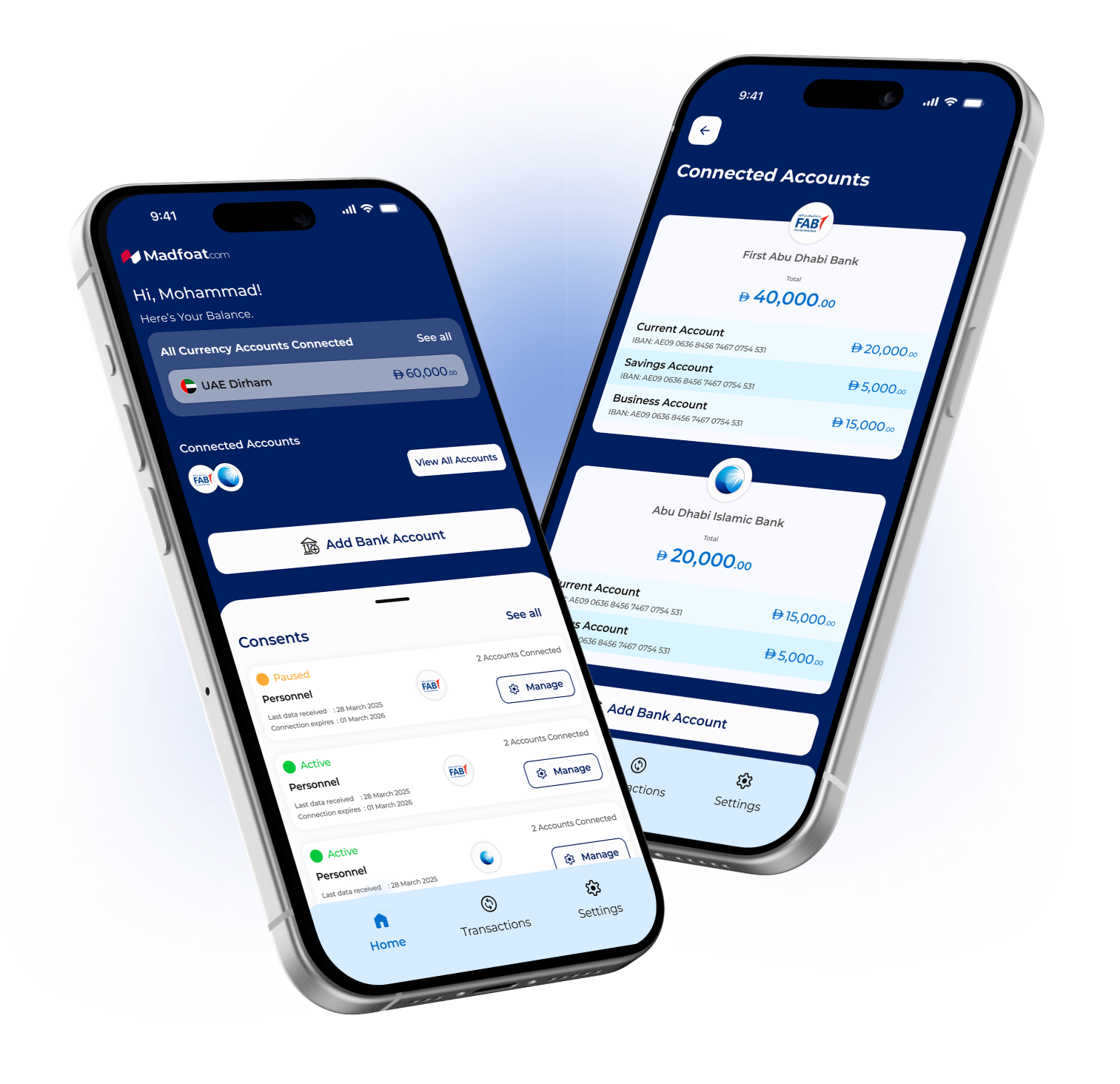
Consent App for real-time and historical account access
Biometric login, push-notification consent prompts, and single-action approve/reject give customers full control over payment and account-information consents, with expired or already-processed requests automatically blocked and every decision relayed to Al Tareq in real time.
Consent history and audit trail
Customers can view a complete history of approved, rejected, revoked, and expired consents with full transaction metadata, and can revoke any prior consent at any time.
Merchant Dashboard
A centralized portal where merchants complete KYB onboarding, manage API keys, and track a real-time transaction ledger filterable by date, status, bank, and consent outcome.
Centralized BackOffice
A governance layer where administrators review KYB submissions, approve or reject merchant onboarding, manage API credentials, and monitor Al Tareq integration health, with every action captured in a non-editable audit trail.
Certified regulatory integration
Certified connection to Al Tareq, the UAE's Consent Authentication and Authorization Provider, including completed FAPI 2.0 and Nebras v2.0 certification, with v2.1 recertification underway.
Microservices architecture
Independently deployable services for authentication, customer, payment, ledger, KYC/KYB, and notification, connected via gRPC, enabling parallel development, fault isolation, and independent scaling.
Cloud-agnostic infrastructure on Kubernetes
A Kubernetes-orchestrated deployment model that keeps the platform portable across AWS, Azure, GCP, or on-premises environments, avoiding vendor lock-in while supporting Dev and Stage environments managed by the delivery team and Production operated by Madfoat.
05
Business outcomes
With this approach, Madfoat gains not only a certified UAE market entry, but a foundation it can extend into every market it enters next.
Enter a regulated market with confidence
A certified route into UAE Open Banking payments, verified through FAPI 2.0 and Nebras certification, replaces an unverified integration.
Support merchants across both payment flows
A single platform serves PIS and AIS use cases without maintaining separate systems.
Extend beyond a single market
Microservices architecture and cloud-agnostic infrastructure built for the UAE support Madfoat's expansion into Morocco and Syria.
Reduce future certification risk
An established certification pathway with Al Tareq positions Madfoat to adapt faster to future Nebras and FAPI revisions.
Preserve merchant and customer trust
Consent-driven account access, KYB-gated onboarding, and full audit logging give merchants and customers clear visibility and control.
Deliver on a fixed, predictable model
Despite a Fixed Cost structure, the completed platform gives Madfoat a foundation it can extend without renegotiating scope.
Map the certification and infrastructure path first.
15+ years building regulated fintech products. 100+ platforms delivered. We know what breaks at launch and what holds up at scale.