


FEBRUARY 4, 2026
by igor tomych
What do correspondent banking, mobile wallets, and blockchain rails have in common? A constant pressure to move value faster, cheaper, and with fewer intermediaries.
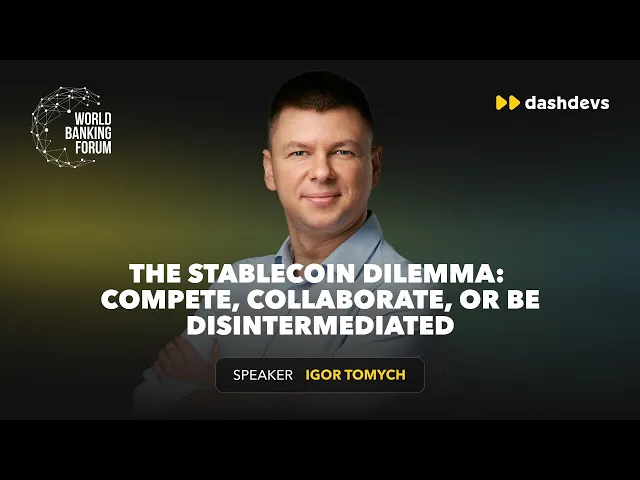
At the World Banking Forum (WBF) event, Igor Tomych took the stage to unpack one of the most polarising topics in modern finance:
“The Stablecoin Dilemma: Compete, Collaborate, or Be Disintermediated.”
In this session, Igor explored why stablecoins are no longer a crypto-side experiment, but an emerging settlement layer that banks and financial institutions must now actively respond to.
Drawing on market data, real adoption patterns, and historical analogies, the talk reframed stablecoins not as a threat to banking — but as a signal that existing infrastructure no longer meets modern expectations.
Topics covered:
- Why stablecoins exist at all — beyond hype and speculation
- How cost of transfer and store of value drive real adoption
- The rise of wallets as a new competitive frontier for banks
- Three institutional paths: issuing, partnering, or being bypassed
- What stablecoins reveal about hidden friction in legacy payment rails
Why does it matter?
Because stablecoins are already here — and customers are already using them.
With the stablecoin market exceeding $300B and transaction volumes rivaling traditional remittance systems, the question is no longer if banks should engage, but how. Ignoring stablecoins doesn’t stop adoption — it simply shifts value, data, and customer relationships elsewhere.
Missed the talk? Catch the full keynote from the World Banking Forum and explore how stablecoins are reshaping settlement, custody, and distribution — and how financial institutions can respond without losing control, trust, or relevance.