


JULY 14, 2026
%22%3E%3Cpath%20d=%22M12%206.18945C12%205.99054%2011.921%205.79978%2011.7803%205.65912%2011.6397%205.51847%2011.4489%205.43945%2011.25%205.43945S10.8603%205.51847%2010.7197%205.65912C10.579%205.79978%2010.5%205.99054%2010.5%206.18945V14.4395C10.5%2014.5717%2010.535%2014.7015%2010.6014%2014.8158S10.7632%2015.0249%2010.878%2015.0905l5.25%203C16.3003%2018.1836%2016.5022%2018.2056%2016.6905%2018.1518%2016.8788%2018.0981%2017.0386%2017.9728%2017.1358%2017.8028%2017.2329%2017.6327%2017.2597%2017.4314%2017.2104%2017.2419%2017.1612%2017.0523%2017.0397%2016.8896%2016.872%2016.7885L12%2014.0045V6.18945z%22%20fill=%22%23111%22/%3E%3Cpath%20d=%22M12%2024.9395c3.1826.0%206.2348-1.2643%208.4853-3.5148C22.7357%2019.1743%2024%2016.1221%2024%2012.9395c0-3.18264-1.2643-6.23489-3.5147-8.48533C18.2348%202.20374%2015.1826.939453%2012%20.939453S5.76516%202.20374%203.51472%204.45417C1.26428%206.70461.0%209.75686.0%2012.9395c0%203.1826%201.26428%206.2348%203.51472%208.4852C5.76516%2023.6752%208.8174%2024.9395%2012%2024.9395zm10.5-12c0%202.7847-1.1062%205.4554-3.0754%207.4246-1.9691%201.9691-4.6398%203.0754-7.4246%203.0754-2.78477.0-5.45549-1.1063-7.42462-3.0754C2.60625%2018.3949%201.5%2015.7242%201.5%2012.9395c0-2.7848%201.10625-5.45554%203.07538-7.42467S9.21523%202.43945%2012%202.43945c2.7848.0%205.4555%201.10625%207.4246%203.07538C21.3938%207.48396%2022.5%2010.1547%2022.5%2012.9395z%22%20fill=%22%23111%22/%3E%3C/g%3E%3Cdefs%3E%3CclipPath%20id=%22clip0_1107_2521%22%3E%3Crect%20width=%2224%22%20height=%2224%22%20fill=%22%23fff%22%20transform=%22translate(0%200.939453)%22/%3E%3C/clipPath%3E%3C/defs%3E%3C/svg%3E)
26 min listen
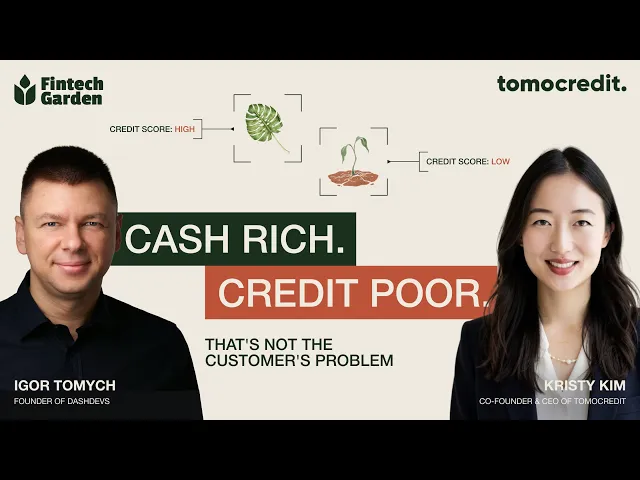



Tune in to the Full Podcast Episode Below
Listen now on


Roughly 30 million Americans have no credit history.
Not because they cannot afford one. Because the credit system does not know how to read a customer whose financial life pattern is saving rather than borrowing.
That is the entire market TomoCredit was built for.
In this episode of the Fintech Garden Podcast, Kristy Kim — CEO and co-founder of TomoCredit — sits down with Igor Tomych for one of the more grounded founder conversations in fintech this year.
The framing is direct. Fintech keeps missing first-generation Americans. Not by accident. By design. And the founders who understand why are building the products that finally serve them.
The Founding Story Is the Product Story
Kristy immigrated from Seoul to the United States alone at age 11.
She studied hard. Went to UC Berkeley. Landed a job in investment banking in San Francisco. Followed the linear version of the American dream she had grown up hearing about.
She checked every box.
Then she was rejected for apartments, repeatedly, and later for a car loan at a Lexus dealership.
She was earning a six-figure salary. She had savings. The credit system did not know how to read her.
That specific gap — between what she had actually built and what the system could see — is the entire product thesis of TomoCredit.
She was not the exception.
She was one of thirty million Americans in exactly the same position.
Somebody had to build the thing that read them correctly.
“Cash Rich, Credit Poor” — Positioning, Not Diagnosis
The product slogan TomoCredit uses — cash rich, credit poor — is deliberately constructed.
It reframes what the credit system treats as a customer failure into a system limitation.
Kristy is direct about why the wording matters.
If you tell an immigrant customer they have a credit problem, you confirm the shame they already feel about being illegible to the system.
If you tell them the system cannot see their actual financial picture, you shift the framing.
TomoCredit’s underwriting analyses cash flow. Money coming in. Money going out. Patterns over time. Ongoing income streams. Savings behaviour.
And it assigns a score that captures what the customer has always been able to see about themselves.
The system needed the technology. Not the customer.
This is one of the sharper positioning statements in fintech today, and it deserves to be studied.
Save-First Cultures Meet a Borrow-First System
The cultural layer under this problem is worth naming clearly.
In many countries — Korea being Kristy’s example, but the pattern extends far beyond it — the financial culture is save-first.
You do not borrow. You build savings. You live within your means. You treat debt as something to avoid.
The US credit system operates on the opposite premise.
You cannot build credit history unless you borrow.
Immigrants who arrive with responsible-at-home financial behaviour end up penalised for it.
This is not just an information gap. It is a fundamental cultural collision.
Fintech products designed correctly do not ask customers to change who they are in order to become legible to a system that then rewards them for the change. They read the customer where they actually are.
That is a harder engineering problem. It is also the only sustainable one.
The Outsider Mindset Was the Advantage
Asked how she navigated the US regulatory environment — federal plus state, consumer protection layered on top of banking regulation — Kristy is clear.
Not knowing the “right” way to do things helped her.
Investment banking and tech, rather than traditional retail banking, meant she was not carrying industry assumptions about what was possible.
She was not jaded. Not too skeptical. Not cynical.
Her mental model:
Regulators and policymakers are people. Rules evolve. Engage constructively. Follow the framework as it exists. Provide the evidence that a better approach helps consumers. Influence how the system evolves over time.
Not every regulator has considered immigrants without credit history when writing the rules.
But they will.
Founders who show up with the data and the customer stories are how that happens.
For any founder building in a regulated space where the current rules don’t quite fit your customer, this is the right playbook.
AI as Coaching, Not Decisioning — Where the Regulatory Line Sits
One of the more useful distinctions in the conversation is where AI can operate freely in financial services and where it cannot.
Making a lending decision or determining a credit score is heavily regulated. Audit trails. Explainability. Human oversight. All required — the same line that shapes fintech ai use cases in practice.
Coaching a customer through what their credit score means, why it moved, and what specific behaviours would improve it is a different category.
Closer to financial wellness. Less heavily regulated. Increasingly where AI produces the most genuine value.
TomoCredit’s strategy is to lean into the coaching layer.
Users upload their financial picture. Get plain-English analysis. Understand what to do next.
The distinction matters operationally. If you build an AI product that can be classified as decisioning, the regulatory burden compounds. If you build it as coaching, you move faster and reach more users.
TomoCredit’s recent product, TomoIQ, is designed explicitly for this layer.
For product teams considering where to place AI in a financial services roadmap, this is the framework worth using.
Three Customer Profiles, Three Different Products
A recurring point Kristy makes is that “immigrant” is not a monolithic segment.
Her team designs for at least three distinct profiles.
Expats and skilled workers. Arrive with established income and savings. Their credit problem is being unable to access meaningful borrowing capacity — a mortgage, an auto loan for a nicer car. Not being unable to access $500.
Immigrants from lower-income backgrounds. Face cash liquidity issues for near-term needs. Without a borrowing history to unlock even small credit lines, an emergency $500 becomes a real problem.
Native-born Americans with thin credit files. Often younger customers who have avoided traditional debt — millennials and Gen Z who rent, don’t buy houses, and never had an auto loan. Different path, same underlying gap.
Two customers with the same credit score can be radically different in cash position, savings behaviour, and product need.
The current system flattens all three into one number.
“You and I could have the same credit score, and 20,000 US banks see us as identical. But you might have 5x more savings. You could be 10x wealthier than me. The score can’t see any of that. That’s bad for consumers, and a missed opportunity for banks.”
The product opportunity is in reading the differences the score cannot see.
Cash Flow Underwriting Is Finally Becoming Mainstream
The strategic reframe here is that Kristy started building on cash flow underwriting when it was still a niche approach.
Institutions treated it with skepticism. Selling it required hard convincing.
Today, largely driven by AI, cash flow underwriting is becoming the mainstream — a real-world application of ai credit scoring for thin-file customers.
BNPL operators use it. Neobanks use it. Alternative lenders use it. A wave of immigrant-focused fintechs has raised serious capital over the last 18 months.
For Kristy, this is not a headwind. It is validation of the thesis.
The size of the US market — more than 20,000 banks, hundreds of millions of consumers — means competition between fintechs matters far less than the shared work of reshaping how the system reads people.
Multiple companies will succeed.
The one that positions itself as an expert on a specific segment will win that segment.
Fragmentation Is Good News for Startups
A counterintuitive point worth pausing on.
US market fragmentation, which most fintech operators complain about, is actually a gift to startups.
Kristy references the alternative: the Korean super-app model, where one dominant player like KakaoBank or Toss handles everything — investing, banking, money transfers, insurance.
Consumer-side, that model is convenient.
Founder-side, it is nearly impossible to break into.
In the US, the fragmented landscape means a startup does not have to be excellent at everything.
It can be excellent at one thing.
That is a much more winnable competitive position.
Founders considering where to build should think about this tradeoff carefully. Convenience for the user is not the same as opportunity for the builder.
The Jamie Dimon Principle
The closing line of the episode has become an internal mantra at TomoCredit and is one of the sharper founder framings in fintech this year.
Kristy does not need to outsmart Jamie Dimon at running a global bank.
She needs to outsmart Jamie Dimon at one specific thing.
Understanding thin-file and no-file customers, and building products designed around their actual financial lives.
On that specific dimension, Kristy argues her team has more expertise than the world’s largest banks.
This is more than founder confidence.
It is a genuine strategic principle.
Incumbents optimise for breadth. Startups win by being unarguably better at a specific segment.
When the segment is 30 million people, that specific-better-than approach becomes a real business.
For any founder building against an incumbent, this framing is worth internalising. You do not need to be better across the board. You need to be undeniably better at the thing that matters most to your specific customer.
What Operators Should Take From This Conversation
The episode does not deliver a checklist. It delivers a framework.
Pulled out into operational implications, four things stand out for anyone building in fintech now.
One. Segmentation matters more than scale. “Immigrant” is three different customers minimum. “Thin file” is not a single problem. Products designed around the actual life pattern of a specific customer segment win the segment.
Two. Cash flow underwriting is table stakes going forward. If your product design assumes credit score is the primary signal, you are optimising for shrinking market share. AI is accelerating the shift, not causing it.
Three. The AI regulatory line is where the strategy sits. Decisioning is heavy. Coaching is light. Product roadmaps that place AI on the coaching side move faster and reach more users. Understand where you are placing it.
Four. Fragmentation is a friend. In the US market, focus beats breadth. Specialist products for specific customer segments have more room than most founders assume.
Kristy’s closing point is straight.
Founders do not need to be better than Jamie Dimon at everything.
They need to be undeniably better at one thing.
The founders who identify the right thing, and stay disciplined about it, are the ones who build the next generation of fintech.
The ones who try to be everything for everyone are competing for someone else’s segment.
Share article
Host


