


JULY 21, 2026
%22%3E%3Cpath%20d=%22M12%206.18945C12%205.99054%2011.921%205.79978%2011.7803%205.65912%2011.6397%205.51847%2011.4489%205.43945%2011.25%205.43945S10.8603%205.51847%2010.7197%205.65912C10.579%205.79978%2010.5%205.99054%2010.5%206.18945V14.4395C10.5%2014.5717%2010.535%2014.7015%2010.6014%2014.8158S10.7632%2015.0249%2010.878%2015.0905l5.25%203C16.3003%2018.1836%2016.5022%2018.2056%2016.6905%2018.1518%2016.8788%2018.0981%2017.0386%2017.9728%2017.1358%2017.8028%2017.2329%2017.6327%2017.2597%2017.4314%2017.2104%2017.2419%2017.1612%2017.0523%2017.0397%2016.8896%2016.872%2016.7885L12%2014.0045V6.18945z%22%20fill=%22%23111%22/%3E%3Cpath%20d=%22M12%2024.9395c3.1826.0%206.2348-1.2643%208.4853-3.5148C22.7357%2019.1743%2024%2016.1221%2024%2012.9395c0-3.18264-1.2643-6.23489-3.5147-8.48533C18.2348%202.20374%2015.1826.939453%2012%20.939453S5.76516%202.20374%203.51472%204.45417C1.26428%206.70461.0%209.75686.0%2012.9395c0%203.1826%201.26428%206.2348%203.51472%208.4852C5.76516%2023.6752%208.8174%2024.9395%2012%2024.9395zm10.5-12c0%202.7847-1.1062%205.4554-3.0754%207.4246-1.9691%201.9691-4.6398%203.0754-7.4246%203.0754-2.78477.0-5.45549-1.1063-7.42462-3.0754C2.60625%2018.3949%201.5%2015.7242%201.5%2012.9395c0-2.7848%201.10625-5.45554%203.07538-7.42467S9.21523%202.43945%2012%202.43945c2.7848.0%205.4555%201.10625%207.4246%203.07538C21.3938%207.48396%2022.5%2010.1547%2022.5%2012.9395z%22%20fill=%22%23111%22/%3E%3C/g%3E%3Cdefs%3E%3CclipPath%20id=%22clip0_1107_2521%22%3E%3Crect%20width=%2224%22%20height=%2224%22%20fill=%22%23fff%22%20transform=%22translate(0%200.939453)%22/%3E%3C/clipPath%3E%3C/defs%3E%3C/svg%3E)
27 min listen
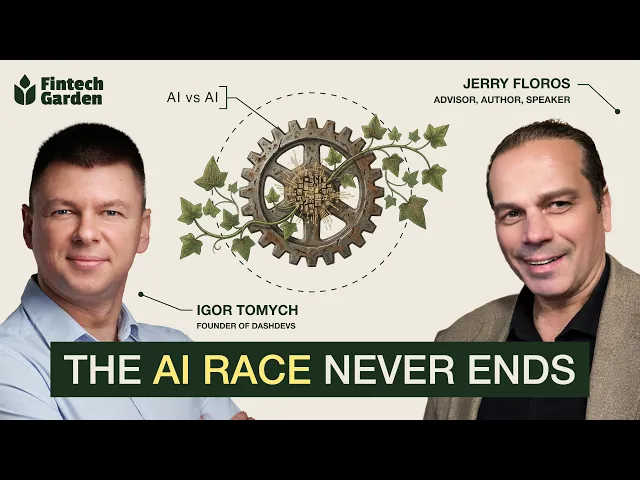



Tune in to the Full Podcast Episode Below
Listen now on


Most of the current AI conversation runs on two tracks.
The optimistic track — abundance, productivity, cures for disease. The apocalyptic track — job displacement, existential risk, doom.
In this episode of the Fintech Garden Podcast, Jerry Floros steps off both tracks and does something rarer. He walks through the actual numbers.
The economics of AI development. The physical constraints on data centre buildout. The political dynamics around Europe’s sovereign AI push. The mental health cost that is already visible in the labour market.
The result is one of the more useful AI reality checks recorded this year.
Jerry calls himself an AI realist. Not an evangelist. Not a doomer.
The framing matters, because the argument he builds only lands if you accept it comes from someone who is neither trying to sell you anything nor trying to scare you.
Even the Builders Can’t Agree On What AI Is
Jerry opens with an observation that most industry conversations skip.
The people building AI cannot agree on a definition of AI.
Ask a hundred experts, get a hundred answers.
Jerry’s working definition is deliberately narrow. AI is a computer program that can imitate human intelligence in certain ways.
There is narrow AI — a single task, chess or AlphaGo or protein folding. There is what the industry calls AGI — a general system that can do many things. And there is the harder question: whether either version, trained on data scraped from the internet, can ever replicate what humans do that they cannot fully articulate.
Nuance. Critical thinking. Judgment. Common sense that has never been written down anywhere.
Jerry’s answer is that AI probably cannot replicate these. That the more useful framing is symbiosis. Human intelligence and artificial intelligence collaborating to produce something better than either alone.
This is the frame he brings to the rest of the conversation. It is worth internalising before the analytical arguments start.
The IQ Scaling Problem
Jerry’s framing of AI capability using IQ as a proxy is one of the sharper sections of the episode.
Human averages: 90–100. Genius territory: 100–140. Einstein sits here. Extreme outliers: documented cases into the 200s.
Current AI models, per Jerry’s cited research: 114–150 IQ.
Every new model release pushes the number up.
The question he asks is direct. What happens when AI reaches 250? Or 500? Or 1,000?
At some point, the models operate at levels of abstraction most humans cannot follow.
Jerry uses Stephen Hawking as the human analogue. A physicist so far ahead of average comprehension that most readers of his books did not fully understand what he was writing. AI is heading toward that gap. And beyond it.
The Bandwidth Bottleneck
The related constraint is bandwidth.
Humans communicate in words. Roughly one token per word. A hundred-word exchange takes time.
AI models process at speeds that make human dialogue look glacial. Your prompt returns an answer nearly instantly, and the model has already generated far more tokens internally than you will ever see.
If AI keeps getting smarter and faster, the bottleneck becomes the human interface itself.
We might not be able to keep up with what our own systems are doing.
This is not a science fiction concern. It is an engineering constraint that is starting to bind. And it does not have a clean solution.
What AI Should Actually Be Used For
Jerry is explicit that his critique is not anti-AI.
The problem is not the technology. It is what the technology is being aimed at.
His examples of what AI should be used for are specific.
Nuclear fusion. OpenAI has invested in fusion research. Boston-based labs have moved the field closer to viable clean energy. If AI can help solve the data centre energy problem it created, that is a net positive.
AlphaFold. Demis Hassabis’s DeepMind protein folding model. Released open source. Used by medical labs across the world. Contributed to Hassabis being awarded a Nobel Prize in Chemistry.
Alzheimer’s. Cancer. Renewable energy. Reducing fossil fuel dependency.
Jerry’s argument is that if these are the visible outputs of AI research, public sentiment shifts. Public sentiment is currently the opposite. Data centres are being physically blocked by protesters. Layoffs are being publicly attributed to AI. The resentment is real and growing.
The industry has a public perception problem. It could fix that by pointing at outcomes, not benchmarks.
Nobody outside AI knows what GPQA Diamond is. Everybody knows what a cure for cancer looks like.
8 Billionaires. 8 Billion People.
This is the most quotable line of the episode and also the substantively sharpest one.
Jerry names the structural problem directly.
Roughly eight people — Sam Altman, Elon Musk, and a handful of others — are effectively deciding the direction of AI for the entire planet.
Their argument, repeated across every interview: if we don’t build AGI and superintelligence, someone else will.
Jerry’s counter is precise.
In this framing, the AI race has no finish line.
It continues infinitely. Even if you win, the next model resets the race.
And at the end, the race is not America vs China. Not Anthropic vs OpenAI. Not Google vs Meta.
It is AI vs AI.
That is the endpoint the current trajectory produces.
It is the endpoint no one at the billionaire level appears to be planning around.
If that framing is right, the debate about who wins is the wrong debate.
The Economics Do Not Add Up
The economic argument is where Jerry lands hardest.
For every $1 that Anthropic or OpenAI takes in as revenue, they are spending roughly $1.50 producing it.
The unit economics are inverted.
On the enterprise side, Anthropic is focused on customers who burn through tokens at rates that have already broken multiple client budgets. Jerry cites Uber having burned through their entire 2026 AI budget within the first four months of the year.
On the consumer side, OpenAI has around 800 million daily users. Most are paying $20 a month. Most are using the models for cheesecake recipes, email drafts, and casual research.
Neither business model closes the gap.
The response has been to release bigger, faster models on a monthly cadence. This does not solve the economics. It compounds them.
For anyone building an AI investment thesis right now, this is the sentence to reset against.
Trillion-dollar valuations with negative unit economics require someone else’s money to keep flowing.
At some point, it stops flowing.
The Bubble, the Bust, and Who Survives
Jerry’s prediction is that this ends in a credit squeeze.
As protest grows — data centres blocked, employees laid off, students entering a job market with no positions — investor patience with unprofitable businesses at trillion-dollar valuations narrows.
The bubble bursts.
Small players get cleaned out. Trillion-dollar IPOs unwind. AI startups without proprietary distribution or profitable customers disappear.
Google, SpaceX, and probably Anthropic survive.
The AI infrastructure that survives will look meaningfully different from what has been built to reach this point.
Jerry positions this not as prediction from the sidelines. It is the pattern that has played out in every previous tech cycle. The 2001 dot-com bust cleared the field for Google. The 2008 crash reshaped fintech. The 2022 crypto reset cleared the space for the current stablecoin infrastructure.
The AI reset will do the same.
The strategic question for anyone building in the space is not whether it happens. It is what your position looks like when it does.
Europe Is Building Sovereign AI
A political undercurrent Jerry brings into the conversation is that Europe has largely made up its mind.
After a series of moves by the current US administration around AI export controls and national security restrictions on foreign access to American AI, European institutions have started actively distancing themselves.
Google. Palantir. Other American providers. Removed from European infrastructure decisions.
A broader push is now under way across the 27 EU member states — with the UK, Japan, and Singapore watching closely — toward sovereign AI.
Own tech stack. Own models. Own LLMs. Own data centres.
The strategic argument is straightforward. Dependency on a foreign country’s AI is a national security exposure the same way dependency on foreign semiconductors was.
The financial consequence for American AI companies is significant. And largely underweighted in current valuations.
If you are underwriting AI investments in 2026 without a European sovereign AI scenario in your model, your model has a blind spot.
The MAD Framework
Jerry’s proposal for AI regulation is drawn from Cold War history.
During the East-West standoff, the US and Soviet Union agreed to Mutually Assured Destruction as the framework that stopped nuclear proliferation. Each side had enough capacity to destroy the world many times over. Building more offered no additional advantage.
The Paris Agreement extended the same collaborative principle to climate change.
Jerry argues AI needs the same table.
UN-level. Governments in the decision-making seat. Big tech included to advise, but not to decide.
The point is not to slow AI development to zero.
The point is to establish rules of engagement.
Safe laboratory testing. Guardrails before release. Accountability for what models can do.
Without that framework, the current wild-west incentives compound. With it, the industry gets sustainable ground rules.
The obstacle is not technical. It is political. Trillion-dollar interests do not voluntarily concede the decision-making seat.
But — Jerry points out — even the AI leaders themselves are starting to converge on the same message. Slow down. Regulate. Work together.
Sam Altman used to have three different messages for three different audiences. At Davos: abundance. At colleges: your future work. On podcasts: existential risk.
Now the message is converging.
Slow down. Regulate. Work together.
This is worth taking seriously. When the loudest AI advocates start asking for guardrails, the conversation has moved.
The Anthropic Responsible-Scaling Moment
Jerry highlights one specific example as the type of behaviour the industry needs more of.
Anthropic reportedly developed an internal model that turned out to be too capable.
It could discover vulnerabilities. It could jailbreak other systems. It functioned as an effective cyber-offensive tool.
Rather than release it, Anthropic stopped it. Added guardrails. Only shipped when the safety layer was in place.
Jerry’s point is not that Anthropic is uniquely virtuous.
His point is that the incentive structure most AI companies operate under does not reward this behaviour. The regulatory framework should.
Mandatory safety testing. Third-party review. Consequences for shipping models that fail either bar.
This connects the MAD analogy to a practical policy path. It is not abstract. It is a specific list of things regulators can require. And once required across every jurisdiction, it changes the shipping calculus for every AI company.
The Generational Close
The final section of the episode is the most personally weighted.
Jerry references the roughly 142,000 tech layoffs of the past year — a figure that maps to public tracker data — and the growing number of students graduating with no job pipeline.
His concern is not primarily economic.
It is psychological.
Mental wellbeing collapses when purpose collapses. Depression, loneliness, and self-harm risk all rise when a generation trained for four or more years is told to sit at home and collect UBI.
Jerry’s closing framing is a question he keeps asking in Parliament.
“What kind of future are we going to give our children?”
Nobody, he reports, can answer it.
That is the problem.
The technology conversation, whatever its economics or its geopolitics, has to answer that question — or the political backlash that follows will eventually answer it in ways the industry will like even less.
What Operators Should Take From This Conversation
The episode does not deliver a checklist. It delivers a set of reality checks.
Pulled out into operational implications, five things stand out.
One. The economics matter. Trillion-dollar valuations with $1.50-per-$1 unit economics are not permanent. Investment theses should stress-test what a bust looks like. Product roadmaps should stress-test what continued access to AI infrastructure at current prices looks like if the frontier providers are forced to raise them.
Two. Sovereign AI is a real category. Europe is not going back. Anyone selling into European enterprise or building on American frontier models with European customers should have a sovereign AI scenario in their planning.
Three. Safety scaling is becoming a competitive advantage. The companies that ship with guardrails and can defend their models to regulators will move faster in regulated jurisdictions than the companies that ship first and apologise later. This inverts the current speed-vs-safety incentive.
Four. The AI race is not a race. If Jerry’s framing is right — that the endpoint is AI vs AI — then the current geopolitical framing (US vs China, or Anthropic vs OpenAI) is misdirection. Investment theses that lean heavily on winning that race may be underwriting the wrong outcome entirely.
Five. The human cost is a strategic input. Mental wellbeing, job displacement, and student outcomes are not soft topics adjacent to the AI conversation. They are the political ground on which regulation will eventually be built. Operators who ignore them are ignoring the input that will shape the rules they operate under.
Jerry’s closing point is a question, not an answer.
What future are we giving our children?
The industry has not yet been forced to answer it.
The next five years will make that question impossible to keep dodging.
Share article
Host

