


JULY 28, 2026
%22%3E%3Cpath%20d=%22M12%206.18945C12%205.99054%2011.921%205.79978%2011.7803%205.65912%2011.6397%205.51847%2011.4489%205.43945%2011.25%205.43945S10.8603%205.51847%2010.7197%205.65912C10.579%205.79978%2010.5%205.99054%2010.5%206.18945V14.4395C10.5%2014.5717%2010.535%2014.7015%2010.6014%2014.8158S10.7632%2015.0249%2010.878%2015.0905l5.25%203C16.3003%2018.1836%2016.5022%2018.2056%2016.6905%2018.1518%2016.8788%2018.0981%2017.0386%2017.9728%2017.1358%2017.8028%2017.2329%2017.6327%2017.2597%2017.4314%2017.2104%2017.2419%2017.1612%2017.0523%2017.0397%2016.8896%2016.872%2016.7885L12%2014.0045V6.18945z%22%20fill=%22%23111%22/%3E%3Cpath%20d=%22M12%2024.9395c3.1826.0%206.2348-1.2643%208.4853-3.5148C22.7357%2019.1743%2024%2016.1221%2024%2012.9395c0-3.18264-1.2643-6.23489-3.5147-8.48533C18.2348%202.20374%2015.1826.939453%2012%20.939453S5.76516%202.20374%203.51472%204.45417C1.26428%206.70461.0%209.75686.0%2012.9395c0%203.1826%201.26428%206.2348%203.51472%208.4852C5.76516%2023.6752%208.8174%2024.9395%2012%2024.9395zm10.5-12c0%202.7847-1.1062%205.4554-3.0754%207.4246-1.9691%201.9691-4.6398%203.0754-7.4246%203.0754-2.78477.0-5.45549-1.1063-7.42462-3.0754C2.60625%2018.3949%201.5%2015.7242%201.5%2012.9395c0-2.7848%201.10625-5.45554%203.07538-7.42467S9.21523%202.43945%2012%202.43945c2.7848.0%205.4555%201.10625%207.4246%203.07538C21.3938%207.48396%2022.5%2010.1547%2022.5%2012.9395z%22%20fill=%22%23111%22/%3E%3C/g%3E%3Cdefs%3E%3CclipPath%20id=%22clip0_1107_2521%22%3E%3Crect%20width=%2224%22%20height=%2224%22%20fill=%22%23fff%22%20transform=%22translate(0%200.939453)%22/%3E%3C/clipPath%3E%3C/defs%3E%3C/svg%3E)
34 min listen



Tune in to the Full Podcast Episode Below
Listen now on


For three and a half years, fintech hiring has run in one direction: down. Redundancies outpaced growth roles, and the people who kept their jobs often ended up doing two or three of them.
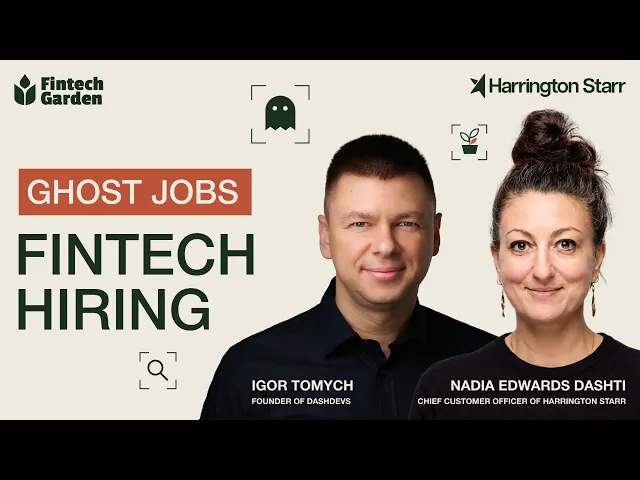
This episode of the Fintech Garden Podcast turns to Nadia Edwards-Dashti, Chief Customer Officer at Harrington Starr, whose agency runs close to 1,000 interviews every quarter across fintech, payments, and financial services. In conversation with Igor Tomych, she explains why 2026 finally looks different, and what companies got wrong along the way.
A slow decline, not a single shock
2008 hit everyone at once. Banks failed, budgets froze, and the industry knew exactly where the bottom was. This downturn has worked differently: a pandemic hiring boom, inflated salaries, a correction in fintech valuations, AI anxiety, and a run of geopolitical shocks, arriving one after another rather than all at once. Nadia calls it a slow punch. There is no single moment to point to, and no clear signal that the worst has passed, which makes it harder for candidates and companies alike to plan.
Who takes the blame when AI writes the code
Igor raises a comparison to Linus Torvalds: nobody blamed compilers for the code they produced. The same logic applies to AI-assisted development. A language model can generate code, but it can’t take responsibility for whether it works, and it can’t run a business end to end. Someone still has to define the requirements, review the output, and own the result. That accountability gap, not the tooling itself, is what companies need to plan hiring around.
Ghost jobs are a brand problem, not a hiring trick
Nadia draws a distinction between two things people lump together as ghost jobs. Some are silent searches: a company restructuring quietly and working with a recruiter rather than posting publicly. The more damaging version is a company that posts a real vacancy, gets flooded with applications, and never responds to any of them. Nadia has written about this for Forbes, and her argument is simple: candidates remember how they were treated, and silence at scale quietly wrecks employer reputations built up over years.
Succession planning is the fix nobody is budgeting for
Nadia’s clearest warning looks two to three years ahead. Companies comfortable leaning on AI instead of hiring juniors now are setting up the same gap the industry hit around 2012, when nobody could find engineers with three years of experience because nobody had hired them at zero. If AI closes off some entry-level work today, someone still needs to be trained for the roles that come after it. Nadia’s answer starts with identifying potential in people who don’t look like a copy of whoever is doing the hiring, and building the habit of promoting from within before the market forces a scramble.
The conversation closes on Nadia’s challenge to the industry: not just spotting talent, but doing it fairly, consistently, and before the next hiring wave arrives.
Share article
Host


