


SEPTEMBER 8, 2026
%22%3E%3Cpath%20d=%22M12%206.18945C12%205.99054%2011.921%205.79978%2011.7803%205.65912%2011.6397%205.51847%2011.4489%205.43945%2011.25%205.43945S10.8603%205.51847%2010.7197%205.65912C10.579%205.79978%2010.5%205.99054%2010.5%206.18945V14.4395C10.5%2014.5717%2010.535%2014.7015%2010.6014%2014.8158S10.7632%2015.0249%2010.878%2015.0905l5.25%203C16.3003%2018.1836%2016.5022%2018.2056%2016.6905%2018.1518%2016.8788%2018.0981%2017.0386%2017.9728%2017.1358%2017.8028%2017.2329%2017.6327%2017.2597%2017.4314%2017.2104%2017.2419%2017.1612%2017.0523%2017.0397%2016.8896%2016.872%2016.7885L12%2014.0045V6.18945z%22%20fill=%22%23111%22/%3E%3Cpath%20d=%22M12%2024.9395c3.1826.0%206.2348-1.2643%208.4853-3.5148C22.7357%2019.1743%2024%2016.1221%2024%2012.9395c0-3.18264-1.2643-6.23489-3.5147-8.48533C18.2348%202.20374%2015.1826.939453%2012%20.939453S5.76516%202.20374%203.51472%204.45417C1.26428%206.70461.0%209.75686.0%2012.9395c0%203.1826%201.26428%206.2348%203.51472%208.4852C5.76516%2023.6752%208.8174%2024.9395%2012%2024.9395zm10.5-12c0%202.7847-1.1062%205.4554-3.0754%207.4246-1.9691%201.9691-4.6398%203.0754-7.4246%203.0754-2.78477.0-5.45549-1.1063-7.42462-3.0754C2.60625%2018.3949%201.5%2015.7242%201.5%2012.9395c0-2.7848%201.10625-5.45554%203.07538-7.42467S9.21523%202.43945%2012%202.43945c2.7848.0%205.4555%201.10625%207.4246%203.07538C21.3938%207.48396%2022.5%2010.1547%2022.5%2012.9395z%22%20fill=%22%23111%22/%3E%3C/g%3E%3Cdefs%3E%3CclipPath%20id=%22clip0_1107_2521%22%3E%3Crect%20width=%2224%22%20height=%2224%22%20fill=%22%23fff%22%20transform=%22translate(0%200.939453)%22/%3E%3C/clipPath%3E%3C/defs%3E%3C/svg%3E)
29 min listen
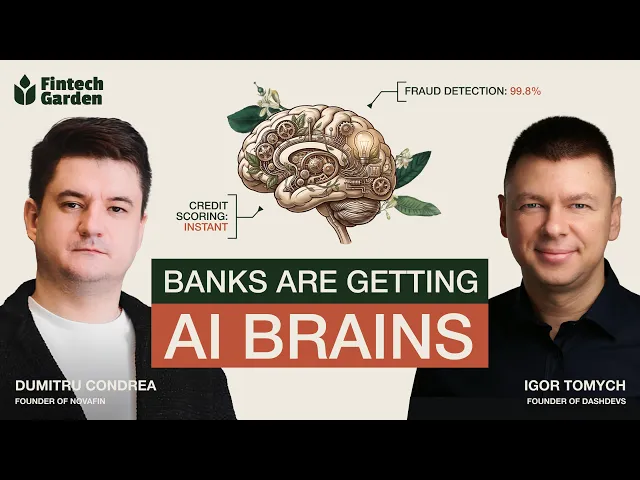



Tune in to the Full Podcast Episode Below
Listen now on


From showing your balance to predicting your future: Igor Tomych and Dumitru Condrea open this episode with what they call the central leap happening in digital banking right now: institutions moving past simply displaying transactions and balances toward actively budgeting, forecasting, and advising on a user’s money. Dumitru points to his own past work on a UK savings-focused product as an early example of this shift, one built entirely around the idea that a thriving customer is a customer with money left over to spend on premium features. That product lens is familiar from Chip’s saving and investment app, where the product succeeds when the customer actually keeps money.
You can’t build an AI brain on bad accounting
Igor is direct about the prerequisite nobody wants to talk about: an AI layer is only as good as the P&L and cash flow data underneath it. He walks through a concrete example, a $120 annual subscription that should be accounted as a $10 monthly cost, not a one-time $120 hit, to show how easily cash flow and P&L get confused. His analogy: building AI on messy financial data is like building a tall building on a swamp instead of concrete. That is why financial data aggregation has to be solved before the forecasting layer is even interesting.
An AI assistant isn’t a chatbot, it’s the plumbing
Dumitru pushes back on the common assumption that “AI transformation” means bolting a chatbot onto an app. In his framing, the real AI brain works in the background: structuring a bank’s existing data into clear policies and flows, then using that structure to generate specific, personalized advice, like flagging that cutting two recurring expenses would free up $200 a month to invest. Teams that want that kind of AI in banking usually start with fintech consulting to map data quality, product policy, and the advice layer as one system, not a widget.
Why this feels like the dot-com boom all over again
Dumitru draws a direct parallel between today’s AI agents and the door-to-door computer salesmen of the early 1990s: constant pitches, and a market response of “why do I need this, I already have Excel.” His prediction: a coming wave of AI-native finance apps, a market correction once the hype outruns the value, and only then a clearer picture of which players, from super apps like Revolut to potentially ChatGPT itself, end up owning the AI layer on top of people’s money.
Share article

